I’ve been struggling to find time for more casual, personal writing lately, and I now find myself with a bunch of recent books I intended to share but never got around to. Today’s quick reviews are for:
- South of Superior, a novel by family friend Ellen Airgood (very enjoyable)
- The Action of the Holy Spirit by Frank Sheed (clear, concise, and informative)
- The Shallows: What the Internet is Doing to Our Brains by Nicholas Carr (disturbingly prescient and motivating)
Better brief (and late) than never…here goes!
South of Superior by Ellen Airgood

First, a quick note about the author: Ellen Airgood is the daughter of some old friends of my parents. She runs a cottage bakery called Ugly Fish Baking Company out of a tiny camper-trailer in the Upper Peninsula of Michigan, near Lake Superior. We dropped by to visit a few years back and enjoyed wonderful baked goods and stories about life up north. I have only vague memories of Ellen myself, but I learned that I was the first baby she ever held, and I purchased her debut novel.
The book is delightful—though not a typical read for me. It tells the story of a young woman, Madeline, who is running from a pending marriage and the life that is happening to her in Chicago toward friends and family she barely knows in a tiny Upper Peninsula town. Life is hard there; the tightknit locals are set in their ways, and outsiders never quite fit in. As she comes to term with her own story and family history, she is pushed outside her comfort zone, living with two elderly family friends, caring for a boy whose mother is on the verge of catastrophe, and trying to build a relationship with man who has his own troubled past he can’t seem to escape.
To me, the story unfolds like the best of the romantic comedy movie genre, in which the leads and supporting characters are real people with complexities and suffering in their lives. The misunderstandings that drive the plot aren’t simple or silly, and we can relate to the conversations not had, the things left unsaid, and the consequences of it all. The conflicts aren’t insurmountable, but they also aren’t easy, and we recognize that things don’t always end happily ever after, even when we want them to. That tension makes us want the happy ending all the more. I recommend it, especially to the women in my life and anyone with a love of the UP, Lake Superior, and small-town living.
The Action of the Holy Spirit by Frank Sheed

Almost exactly 10 years ago, I read and reviewed Your Life in the Holy Spirit by Alan Schreck. At the time, I admitted my struggles relating to the Holy Spirit as a person:
[I]t’s much easier to be devoted to a divine father-figure; a humble king; a suffering servant; even a virgin mother; because we know what these things are and what they do in the world around us — then devoting oneself to the various roles of the Holy Spirit. Friend, confidante, advocate — but also gift, revelator, unifier, and promise. The Holy Spirit is all these things — a tremendous blessing to be sure, but a person? The more I imagined a person that could do all these things, the less individually distinctive the Holy Spirit seemed, and the more He seemed like…God.
Since we live in the age of the Holy Spirit, however, I continue to try to understand Him. And, since I found Society and Sanity by Frank Sheed both edifying and enjoyable, it made sense to take a run at Sheed’s overview of the Holy Spirit, with a foreword by Schreck.
This book takes a deep dive into scripture—both the Old and the New Testaments—to explore who the Spirit is and what He does. It is clear, concise, and thorough, and (I think) a bit more straightforward that Schreck’s book, which took a longer look at the Acts of the Apostles and more of an advocacy position with regard to the charismatic gifts in the Church, as I recall. I enjoyed it, but I admit I struggle now to recall anything specific or new that I took from it. It is a good, clear account of the third person of the Holy Trinity.
The Shallows: What the Internet is Doing to Our Brains by Nicholas Carr
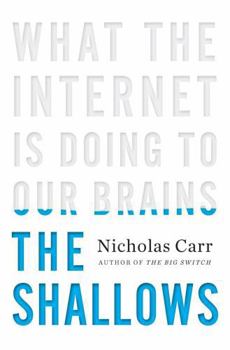
This book was another unexpected gift from our son Brendan’s friend Nick, who is currently a seminarian for the Diocese of Milwaukee. He also gave us Technopoly, a book in a similar vein that I read a few years back, on our human tendency to adopt new tools will little thought except to their convenience and expedience. The Shallows makes a similar case, but with a darker edge: As far back as 2011, when the book was originally published, we already had ample evidence that the Internet, in particular, is reprogramming our brains. You know that sinking feeling that your memory, focus, ability to read or think deeply, etc., isn’t as good as it once was? It’s true—and it’s not just because we’re getting old.
This book is as fascinating as it is disturbing. Carr starts by talking about other transformative technologies that fundamentally changed the way we interact with the world around us. Think about this:
- Before mapmaking became an art and a science, we didn’t “view” or imagine the world from above. We were spatially oriented only by what we could see, with no broader context for our position or what was around the bend or beyond the horizon. Mapmaking changed how we view our place in space.
- Before the Middle Ages and the invention of the mechanical clock and bells to call monks to prayer, time wasn’t neatly divided into hours, minutes, and seconds. The fundamentals of how we regard and measure time didn’t exist for most people until the past several centuries. Clockmaking changed how we view our place in time.
- Before the written word and, later, the printing press, we didn’t have easy access to other’s thoughts or the ability to sit with their ideas, think deeply, and form our own conclusions. When scholars of the written word began reading silently to themselves, it was a revelation, because in the early days of the book, we read aloud even when alone. We learned to think deeply in part because of books. Bookmaking changed how we view our place in humanity.
Carr then makes the case that the Internet is another of these transformative technologies, but even more impactful because it interacts with our brain’s amazing plasticity in a self-reinforcing way. Like many things we teach ourselves to do, the more we use the internet, the stronger those neural pathways become. But the internet also affects our brain in subconscious ways, short-circuiting the processes that enable us to make connection, form memories, and more. We think and communicate less linearly; we feel more informed and less certain, more productive and less accomplished. Using brain science and more, Carr makes a compelling case that, by putting the world’s knowledge at our fingertips, we are not “freeing up space” in our brain for more important things (a computer-based metaphor, mind you) but instead training our brain not to think.
Those of us who grew up without computers may notice the differences in our brains already. Those who grow up with smartphones and touchscreens from infancy may never know what they’ve missed.
This book is nearly 15 years old. Reading it now, in the age of AI (artificial intelligence), underscores how clearly Carr saw the writing on the wall. I highly recommend this book.
 Archangel Stomp
Pingback: Book Break: Two Volumes by Matthew B. Crawford | Archangel Stomp