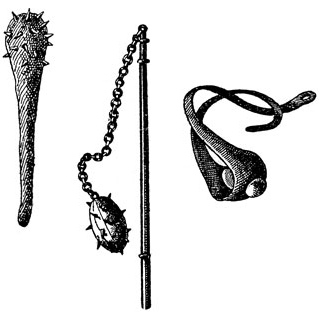
MELEE! The Necessity of Close-Combat Evangelization to Secure the Kingdom

Indeed, the word of God is living and effective, sharper than any two-edged sword, penetrating even between soul and spirit, joints and marrow, and able to discern reflections and thoughts of the heart. No creature is concealed from him, but everything is naked and exposed to the eyes of him to whom we must render an account. – Hebrews 4:12-13
 

As much as I was impressed with the high-tech precision of the Navy SEALS portrayed in Act of Valor—and moved by their sacrifice for our country—I am generally more deeply affected by portrayals of the blunt savagery of older wars. I can marvel at the mathematical elegance of a sniper kill from a mile or more distant, until I recall James Michener’s account of a Polish peasant walking to meet armored and mounted invaders, carrying a length of ash wood he had induced to grow snugly around a few pieces of jagged flint, forming a homemade mace. The time required to grow your own weapon might be long enough to steel yourself to bludgeon an armored man to death, and another, and another. It seems to me that a man who would kill in this way must have the courage of his convictions. There is no hope of distance or anonymity; he must be willing to look his enemy in the eye and get his hands dirty.

* * * * *

Three recent experiences inspired this essay. [Blogger’s Note: This essay was written in 2012, to be read and critiqued in a men’s group.] The first was the continuation of a friendly debate regarding the best way to engage and challenge non-believers (here and here), in which a friend of mine indicated that the older he gets, the more he feels that polite arguments and sustained discussions are not worth his time. The second was an unexpectedly difficult Lenten struggle to hold my tongue, and the third was a men’s group’s opposition to the Health and Human Services (HHS) mandate. All three of these experiences have in common the issue of when and how we should engage those who think, feel, or believe differently than we do.

Continue reading

Byline: J. Thorp

I was doing some work for an old friend and former employer today and found myself reflecting on the wide variety of writing I’ve undertaken for pay in the past 30 years. Beginning as an undergraduate working in the Yale School of Music Concert Office, I’ve been creating marketing materials and writing profiles, features, articles, and speeches on everything from interior design to kung fu to the public impact of higher education.

So, just for kicks, here are a few recent bylines I’ve rediscovered. For those that are available online, I’ve included links.

Continue reading

Grandpa Vibes

Blogger’s Note: Now that I’m writing for a living again, I am trying to find my way back to writing for the heck of it (i.e., for the sheer enjoyment). Wish me luck!

A curious thing happened at the St. Michael Catholic Church Fall Festival last month. The celebration was just getting underway on the church grounds; I was setting up a St. Vincent de Paul display in the gathering space of the church (which also serves as our cry room), and Saturday evening Mass was about to culminate in the reception of Holy Eucharist.

Just then, a young father approached me with his infant daughter in his arms. I am familiar with this young man: We are close friends with his wife’s family and attended his wedding, though I’m not sure I ever spoke to him directly before this moment.

He leaned close and whispered, so as not to disturb the other parents praying nearby: “Would you mind bringing our baby down to her mom? She’s working in the food tent outside. It’s almost time for Communion, and baby needs mom-time!”

I was not expecting this, but the prospect of snuggling this baby, even for a few minutes, was irresistible. “Sure!” I said, extending my arms to receive the precious bundle, “Happy to do it!”

“I knew if I found someone like you or John*, I’d be all set,” the young man said. “Thank you.” Then he knelt and returned to prayer.

As I carefully descended the stairs, I nuzzled the fuzzy head near my chin and a wave of infant sweetness swept over me. Her eyes were open wide, but she seemed content. I stopped at the bottom, closed my eyes, smiled, and sighed, briefly contemplating if it would be a violation of trust to find a quiet corner to enjoy this blessing while she was peaceful and quiet. I shook off the desire and headed out to the festival grounds.

Continue reading

Book Break: Second Nature

I received a somewhat uneven education at Yale University, primarily because I was a 17-year-old kid when I arrived, and given a smorgasbord of courses and little guidance. Yale’s approach was to require a certain number of courses from each of four groupings, plus the prerequisites for your degree. With that as my framework and anthropology as my major, I had plenty of room in my schedule to take whatever caught my eye, from Herpetology to Polish to The History of Jazz.

The history course catalog, in particular, lured me down a rabbit hole: I took two History of the American West courses back to back, essentially two semesters following the colonial frontier westward over the history of Europeans on this continent, then a course called North American Environmental History, which traced our peculiarly American views and impacts on land, nature, and the environment over that same period.

That’s a long preamble to a book review.

Continue reading

Seeing Jesus in the Poor

Religion that is pure and undefiled before God and the Father is this: to care for orphans and widows in their affliction and to keep oneself unstained by the world.

James 1:27

A year or two ago, I took my dad to visit an old friend. I heard many stories from their younger days, from middle school through their time in the Army.

I knew my father grew up with a little bit of nothing: He was the youngest of his siblings; his mom died when he was little, and his dad and stepmom had new babies to provide for and little means to do it. That morning I learned that Dad and his friend lived out of Dad’s car for awhile when they were in high school, scraping together what money they could for food or a cheap hotel room by doing odd jobs for their teachers and neighbors.

I learned something else as well: As tough as Dad’s life was at that point, his friend’s was tougher. From his outside perspective, Dad had a wonderful family—a place to get a half loaf of bread if things got really bad. Dad was his friend’s safety net.

Continue reading