Brewing Sustenance: Beer and Sourdough

“Bread is the staff of life, but beer is life itself.” – Anonymous

I’m in the process of starting two new hobbies, and as a result, a new periodic series of posts for this blog. Some years ago, after falling in love with a world’s worth of good beers, I tried my hand at home-brewing. It was an ill-fated attempt that never produced so much as a bubble. Later, my dad tried his hand it; as I recall, his wort never quit bubbling, until finally he bottled a brew that tasted a bit like cider vinegar (the good bottles) or worse (the bad ones).

At that point, thanks to a growing variety of craft and micro brews and the increasing ease of purchasing good beer at any reasonably well supplied liquor store, I lost most of my interest in DIY beer. In the intervening years, however, I’ve had the good fortune to encounter a couple really skilled and experienced home-brewers whose beers kept the dream alive, until at last a friend here in Minnesota, named Mike, caught wind of my interest and dusted off his brewing equipment to produce (with my help, in his kitchen and basement) a summertime wheat brew. Unfortunately, we couldn’t connect on bottling, so the task fell to him, in a rush, so the flavor varied from quite good to somewhat pungent and yeasty from one bottle to the next. Still, it was an enormous step forward.

Since then, another friend, Butch, who has at least two avid homebrewers as neighbors, has taken up brewing. I had the pleasure of helping with his first batch over Father’s Day weekend, an early Autumn Amber we brewed in his garage over a propane burner for a turkey fryer, as seems to be the standard approach now.

Last night, his bride handed me a plain brown bottle from the fridge. I poured a beautiful pint, roughly the reddish-brown color of Bass Ale, with a finger’s worth of tight, pale foam at the top. The flavor was refreshing and clean, like a somewhat lighter and fruitier Newcastle. I loved it. Thoroughly.

Butch has two more batches as various stages, and this weekend, we will move them along and start the next one. I’ve nearly acquired all the equipment I need to brew my own (delayed somewhat by the purchase of a beautiful little Browning Buck Mark .22), and this fall, I will join the fray. I plan to chronicle those adventures here, as well as…SOURDOUGH!

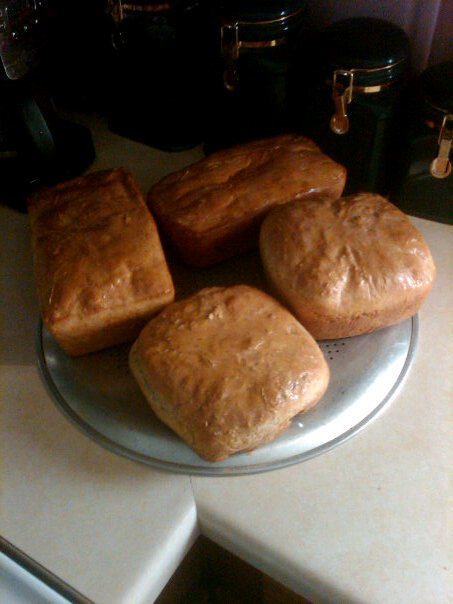
I love sourdough bread, and actually enjoy cooking and baking when I have time. So when my dad decided he wanted someone in the family to master sourdough, not only did he sense my natural weakness in this regard, but A) he gave me two books, one with countless wonderful stories and recipes for breads, flapjacks, waffles, and doughnuts, and the other, an account of a man’s quest to travel the globe looking for ancient oven residues that would reveal sourdough recipes of the ancients; and b) he drew the neat parallel in my mind between brewing beer and “brewing” bread. (He also through making cheese into the mix, saying, “It’s all fermentation” – but I’m not quite ready to make that leap yet. Plus we can’t keep a cow or goat in town.)

He played his cards well:
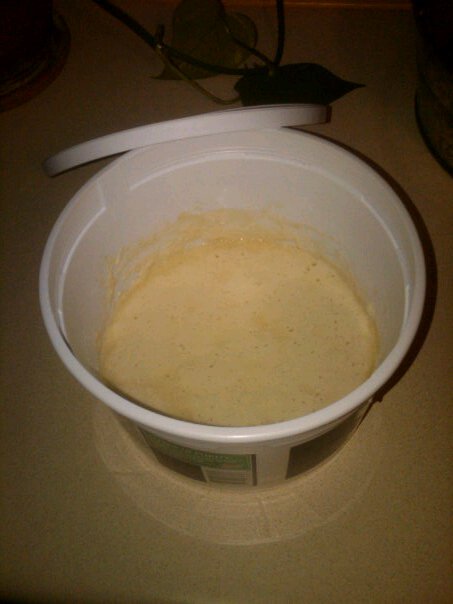
My first batch of starter, created from scratch, looked wetter and slimier than pictured above, and smelled like B.O. This one (my second batch) looked like pancake batter, bubbled almost imperceptibly slowly, and smells slightly yeasty and sour. It worked to create the deliciously sweet and hearty bread above (made with wheat germ, butter, and honey, among other things), but just barely. I’m hoping to coax this started into a higher gear, or I’ll have to start again and try to muster a more vigorous starter. But the entire family agrees: the result of my first sourdough experiment was a resounding success. With a little luck and persistence, hopefully I’ll be posting regular notes on the strange alchemy of brewing sustenance.
The Adjustment Bureau

A young, popular New York City politician suffers an unexpected electoral defeat. Suddenly he finds himself face-to-face with the girl of his dreams – a strange woman he’s never met before – in an unlikely place. Their time is short, the attraction is palpable enough for a sudden, passionate kiss, interrupted by campaign staff. She exits quickly. He has only her first name and these few moments. He delivers the speech of a lifetime, and from the jaws of defeat, snatches superstardom and frontrunner status for the next open Senate seat in New York state.

In a city as vast as this, he could never find this beautiful stranger using only her first name – but chance throws them together on a city bus, and it’s clear this is something special. Too special, in fact. He was not supposed to see her again. A group of grim, dark-suited G-men snatch him from his workplace to inform him: they are with the Adjustment Bureau, and this love affair not in The Plan. Whose plan? The Chairman’s – but you know him by many names.

What follows is a fast-paced, but coherent sci-fi romance that turned out to be the perfect mix for my bride and I – with Matt Damon doing a low-key Bourne, trying to outsmart and outpace adversaries who are nearly (but not quite!) omnipotent and omnipresent, and who are bent on keeping him from what he feels sure is true love. More than once he is ripped abruptly from Emily Blunt’s life, re-finds her, and works to regain her trust, unable to tell her what’s really going on.

It’s a solid, entertaining movie, with some language and sexuality (including two instances of a word neither Jodi or I thought was permitted in PG-13 films). And it’s thought-provoking after the fact: at one point, Damon’s character asks a more sympathetic “adjuster” if they are angels. This is not an idle observation, since the underlying problem in the movie is the problem of free will versus predestination. The film proposes a world in which beings who are less limited and more powerful than humans direct the world according to a grand scheme they themselves do not entirely comprehend. From what little I’ve read, this is in close keeping with Catholic traditions and teachings about angels – except that in the film, the adjusters suggest that they function to override human free will, which, unfettered, produced the Dark Ages and the World Wars, but with their guidance (i.e., free will only with regard to small, day-to-day choices), yields peace, happiness, and productivity. (Hmm…that sounds familiar.)

I don’t believe angels, according to Catholic teachings and belief, have the option of taking free will from us. They operate more subtly and keep the world operating according to plan…but we still choose. We make our beds, and we lie in them.

In the film, the very aggressiveness and implacability of the adjusters seem to increase our hero’s resolve and drive him to his climactic decision and the film’s resolution. It’s almost as if the adjusters themselves are off-plan…and as if that, in fact, is part of the plan.

(Pro) Life, Without Religion, Part 1: It’s My Body!

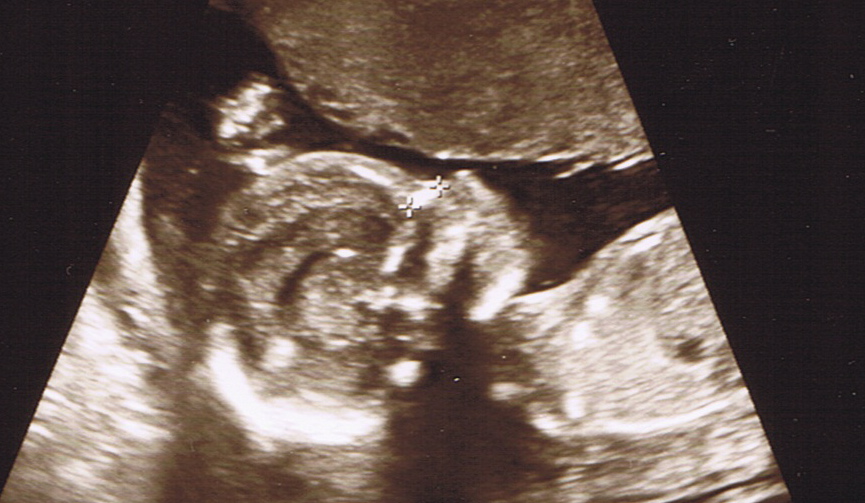
This morning Jodi and I saw the face of an angel — our angel, a tiny new Thorplet, just 11 ounces now at 18 weeks of development. Our baby pulled away from the attempts to examine his or her feet, just like all of our children, but otherwise kept uncooperatively still, making it difficult to get a good look at the tiny, chugging heart. When the sonographer was finally finished her thorough examination, she took the photo above: a tired wee child, hand above head, resting peacefully.

I’ve always loved ultrasounds. In part, it’s the geeky wannabe scientist in me, but mostly, it’s the wonder and sweet jealousy of seeing our tiny baby alive and safe inside the love of my life, and knowing that yeah, I can pee standing up, but I’ll never feel life moving within me. This was a level-2 ultrasound: given my bride’s so-called “advanced maternal age” (I wouldn’t begrudge her a right cross next time someone says that…not this time, but next time…) they offer it as a way of taking a closer look at how both the baby and the mother are progressing. We turned down all the other tests and genetic screening, but taking a closer look at our little one and Jodi, especially given the size of our babies, seemed like a good idea.

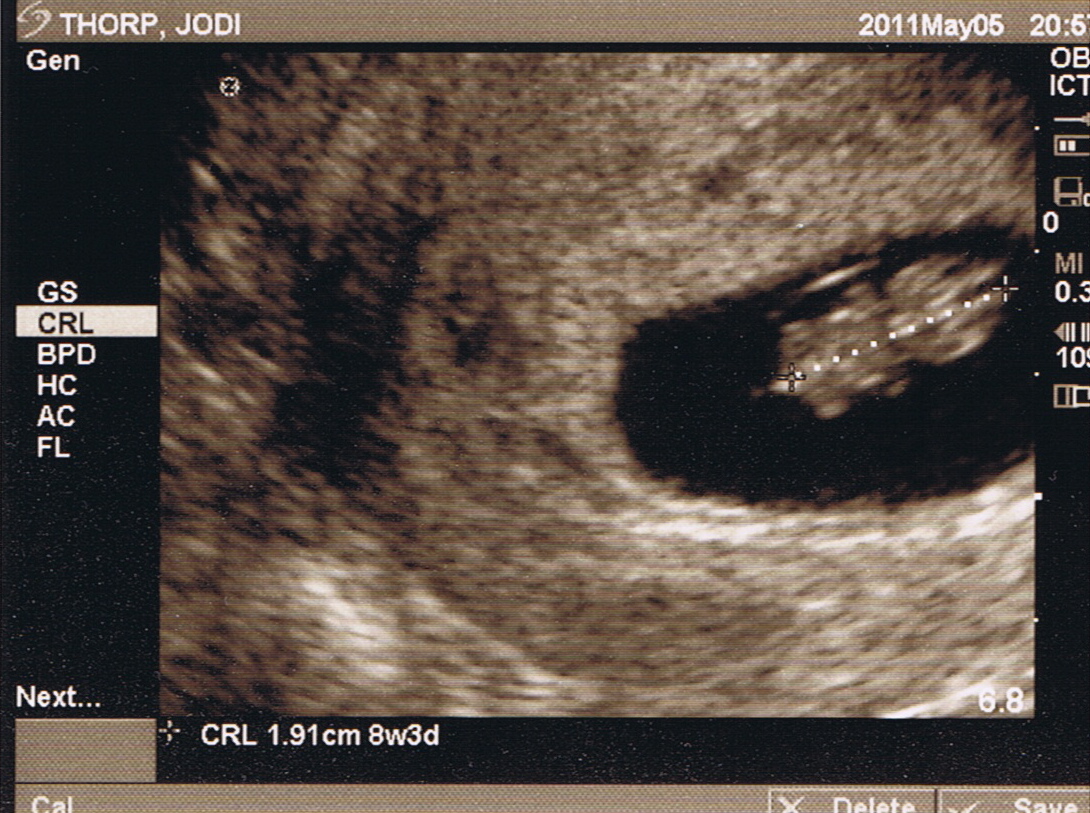
The photo above was the highlight of the hour or more we spent in a dimly lit room with the sonographer. It was worth the wait, but to be honest, I was more excited about these two images:

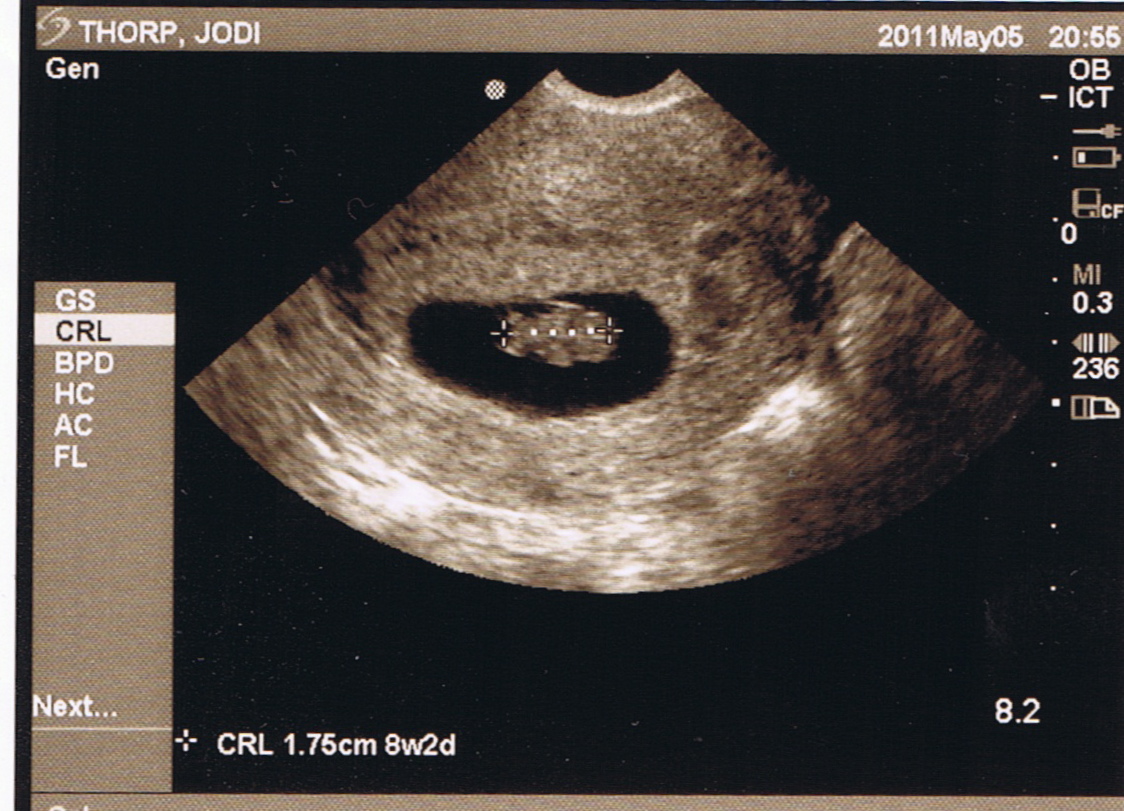
These show our baby at just eight weeks of development. We’re looking down on him or her from above, with an absolutely Thorpian head to the right, and a torso with four tiny limbs extending to the left and down in the lower image. This was a thrill, not only because we lost a little one last fall and were hoping for an “all systems go!” from our doctor, but because there on the screen was a tiny person, less than two centimeters long, with a beating heart and legs and arms that moved independently of any thought or command from Jodi or me. A child the size of my fingertip who, just before Christmas, we will be blessed to welcome and trusted to raise.

Some people say miracles are impossible; others believe they happen, but only rarely. I believe miracles happen daily, all across the world. I’ve got photographic proof.

As we drove home from the earlier ultrasound, I was reminded of an extended argument I had once, on a political blog in South Dakota, with a staunch and pseudonymed liberal who dismissed me and two of my friends as Bible-thumpers for being against abortion. I explained to him that, on the contrary, I studied physical anthropology and human evolution in college and was anti-abortion well before I became a practicing Catholic. I articulated to him a set of arguments against abortion, completely independent of religious belief or church doctrine, and asked, then begged, then dared and taunted, him to engage me on them. He would not.

What came back to me as we drove home was the first argument I offered to him. As I recall, he insisted, on behalf of women everywhere, that “It’s their body; it should be their choice.”

“Which part of their body is it?” I asked.

An abortion removes something from a woman’s body, without a doubt. If what is removed is her, or some part of her, then it should share both her gender and her genes, and she should be somehow physically diminished, something less than the whole and functional woman she was before the procedure. If she had her gallbladder removed, for instance, or a toe, a mortician or coroner might note such a thing upon her death.

A woman who has a “successful” abortion, however, emerges physically intact, but no longer pregnant. What is removed, though taken from within her, and attached to and dependent on her, is not her — not genetically, and not logically. (In my online arguments, I moved from what a fetus isn’t, step by step, to what it is, over several exchanges. In time, I think I’ll do the same here.)

This was made clear again to me when I saw our tiny infant, wriggling in amniotic bliss, at eight weeks of development. Jodi had no say in the flailing of those tiny arms and legs, and that tiny heart beat in part because of, but not for, her. No choice on her part, short of violence, could have stopped it.

And of course, it was made clear yet again today when we saw that beautiful profile at the top of this post. There’s a reason that the Knights of Columbus and other Catholic and pro-life organizations are investing in ultrasound machines for clinics and teaming with expecting mothers to show live ultrasounds of their babies to middle- and high-school students. There’s no better way to recognize the humanity of others than to see them face to face.

The Second Third, Week 36: Cultivating Patience


Well, you’re in your little room
and you’re working on something good,
but if it’s really good,
you’re gonna need a bigger room.
And when you’re in the bigger room,
you might not know what to do —
you might have to think of
how you got started
sitting in your little room.

— The White Stripes, “Little Room”

I tend to obsess a bit once I get an idea in my head. It’s frustrating at times to both Jodi and me, because I find it difficult to concentrate on other things, and the more I dwell on the object of my obsession, the less inclined I am to wait for a pay-off.

I’ve been this way forever, I think, but first recognized it clearly around 2002, when the band The White Stripes released their recording White Blod Cells. I caught them accidentally on Saturday Night Live, liked what I saw, and went to a local CD store to pick up the disk. I had heard they had release a limited edition disk with a bonus CD-DVD that included a couple extra tracks and music videos, so I figured I’d pick that version up. I guessed it would be about $15, maybe $20 with the DVD.

I got to the store over lunch, I think, after stewing all day on the prospect of new music. I didn’t have a lot of time, and the store didn’t have the limited edition with the bonus disk. Furthermore, they were asking $20 plus tax for just the regular CD. I knew I could get it cheaper at another place, but didn’t have time to run there. I wanted that disk. I needed that disk.

I bought that disk.

I loved the music, but now began to obsess over the missing bonus CD-DVD. A day or so later I passed a display in a different store: The White Stripes Limited Edition White Blood Cells CD plus bonus CD-DVD, only $17 (or something like that). My heart sank. I couldn’t justify spending money on the package just to get the bonus disk. I should’ve waited.

Some weeks (months?) later, I found the bonus disk for sale, by itself, on eBay. I bought it; with shipping it probably cost $10. $30-plus for something I could’ve had for $17 plus tax. And the bonus disk wasn’t that great.

There is a point: Now, as I’m working from home on longer writing projects and trying to finish a novel, I’m again obsessing over ideas and wanting to rush headlong toward the finish. On the University side, I’m wading through reams of detailed background material right now, and I’m not writing, even though I very much want to. I keep thinking, “I know this material!” and wanting to shove it aside and type away, but I’m forcing myself not to. The reason? I tend to write my first drafts in close to final form, so that I have a cohesive, easy-to-read whole at the end. That’s wonderful, but it makes it more difficult to revise and add material later, because it leaves few openings (and often I’m wedded to the words already on the page).

Similarly, the novel I’ve been working on for 15 years now has stagnated because when I started it, I rushed headlong forward, improvising on a very general idea of where I wanted the story to go. Now what I have are several tightly drafted sections that hint at a great story, but they need fleshing out and more direction. So at this late date, I’m finally taking a big step back and patiently sketching (with words) whose story this is, who the characters are, what they care about, what they want to achieve. I want to ditch this step and just write, because for the first time in a long time, I’m getting excited again…but I know I need to plot it out a bit more carefully if I want to make sustained progress toward a completed book. And you know what? I’m getting to know things about my characters that I hadn’t guessed before!

Fruits that are allowed to ripen are sweetest and juiciest just before they spoil. Patience and careful attention to what I’ve set out to do, I think, will be more important than ever in my Second Third if I hope to enjoy the full flavor of the things I love.

Emma Contemplates Death By Brain Overload

We were driving back from town last night — me, Emma, and Trevor — when out of the blue, Emma says, “I’m glad we don’t have to tell our bodies to do everything. Like telling ourselves to breathe, telling our blood to move around our bodies? Because then if you were reading a book and you got really into it, you might forget to tell yourself to breathe and then elkgh!” — and in the rearview I see her pretty head jerk sideways, eyes closed, tongue out, stone dead save a suppressed smile at the corners of her mouth.

It is a good thing we don’t have to worry about telling our hearts to beat and our lungs to breathe, so we don’t accidentally drop dead. However, if everyone looked as happily cute in death as Rose, perhaps we would worry less about it!