Dostoevsky, or Three Things to Love About The Brothers Karamazov

Blogger’s Note: Three long summers (and three even longer winters) ago, I agreed to my friend Jacqui’s challenge to read 15 Classics in 15 Weeks. I have since read 10 of 15, this being my tenth from the list. The last one, Homer’s The Odyssey took 11 months, not because it was overly long or monotonous, but because it required a level of mental engagement I couldn’t always give it. The same is true for this one, which has taken me more than a year…

I literally just finished The Brothers Karamazov and logged into this blog with a tear in my eye. It has not managed to displace Steinbeck’s East of Eden as perhaps my favorite book ever (thus far) — but I imagine it will prove to be a 936-page seed that will germinate, slowly grow, and bear fruit years from now. It will stick with me, I have no doubt. Without further ado, Three Things to Love about The Brothers Karamazov:

  • Absurd As Us. Many, and perhaps most, of the characters seem absurd, even over-the-top. Chances are you’ve never been in a town such as this, with people such as these. You know no one like the Karamazov clan or their diverse friends and lovers — and yet, each rings true, and we recognize ourselves, our friends, and our families in the peculiarities we find here.
  • Fatherhood and Brotherhood. What does it mean to be a father? A brother? A friend? What would you endure for fools who share your surname, whom you can abuse but no one else can touch — what loyalties do we bear to our fathers, sons, and brothers? Though you might guess that this is a theme from the title, these ideas emerge slowly and subtly from the plot, since the Karamazov men’s family ties are, uh, looser than most…
  • Religion and Culture. Dostoevsky does not shy away from religion and philosophy, permitting his characters to speak at length (and in character, so not always clearly) about the existence of God, morality, humanity, science, psychology, justice, the state, and more. I was struck by how a book written circa 1880 could have so much to say about our world in 2011.

You might ask, would I recommend it? I might reply: in general, or to you, specifically? I don’t know how to answer, so for now, I will say that I enjoyed it very much, and that it rewards persistence. It is a great book.

I have another, contemporary novel to knock out before I proceed, but it should be a quicker read. Next on this long-running (and long-overdue) challenge will be a book not on my original list of 15, but one recommended by my good friend Fr. Tyler at Prairie Father: Brideshead Revisited. Fr. Tyler, incidentally, recently wrote this wonderful review of Dostoevsky’s Crime and Punishment.


The Second Third, Week 17: Ashes

There is a paragraph from this year’s Holiday Letter that has returned to me again and again in the past few months:

“Ever wonder how God can know everything that will happen, even though we have free will and make our own decisions? St. Augustine talks about God as existing outside of time: He existed before time in any meaningful sense, so He can see all of time—past, present, and future—in an instant. But I think of life as a high sledding hill with God at the top, giving us a push. It’s left to us to steer, but like any good father, He knows our tendencies to close our eyes or overcorrect better than we do, and so He can see every curve we’ll negotiate, every bump that will bounce us airborne, every tree we’ll hit. He sees the trajectories of other sledders and knows their tendencies, as well—knows whose paths we’ll cross, for good or for ill, and when we’ll be blindsided by love. He alone has the long view, the Big Picture. We must persist with less—a glimpse of heaven through the treetops as we slip away, faster, faster…”

This seems particularly appropriate this Ash Wednesday, when we dwell a moment or two on the ephemeral nature of this life and this world: We are dust, and unto dust we shall return. In these Second Third posts, I’ve already written about being grateful for what we have and finding the sense to know when enough is enough. But today, the focus is on something a little different: In my Second Third, I hope to detach even from the “stuff” we choose to keep. I hope to turn my eyes toward heaven instead of where I am now, staring at the ground, watching my step. I hope to quit worrying about who’s in control of the sled, and enjoy the sting of snow on my cheeks, the gleam of stars passing overhead, the laughter of those I love weaving through the trees beside me, the white moon and the lonely miles. I hope to live, not hastily or extravagantly, but thoroughly — so that when I reach my third Third I have nothing left but joy to spend on anyone. Including you.

A man can dream, can’t he?

The Second Third, Week 16 (Belated): In One Ear…

First, let me say that, obviously, the idea of posting these Second Third entries on Wednesdays has fallen by the wayside. This is primarily because this winter has been crazy busy, especially since three Wednesdays a month, I teach Confirmation classes. So I’m settling for weekly, roughly. If I end on or about November 10th with The Second Third, Week 52, I shall declare victory.

So…

I had an Alien Abduction moment last week. I woke at about 5:20 a.m., rolled over, and in the pre-dawn gloom, discovered my wife was not beside me. This struck me as curious enough that I mustered the wind to croak, “Jodi…” and listen, half-asleep, for a response.

Nothing.

My eyes opened a bit wider. “Jodi?”

Nothing. I sat up and rubbed my eyes. No noise from the bathroom. No lights visible anywhere. Probably on the couch with a sick kid, I thought. But I usually hear sick kids.

I rose, stepped carefully past the snoring Schnauzer in the darkness, walked down the short hallway and into the living room.

“Jodi!”

Nothing.

I turned my head from the side to side, dumbly, in the darkness. No signs of a struggle. (Yes, I actually thought that.) Where could she be?

Perhaps I only stood there for a few seconds, perhaps longer. Eventually I occurred to me that she had told me something before bed, something relevant. What was it?

She had told me she was getting up and going walking at the indoor track at our high school early in the morning. I had heard her say it, and no doubt it registered subconsciously, because I had slept soundly through her rising and leaving. But it took awhile to recall it consciously.

I have a knack for hearing but not listening. This is not selective hearing, per se, which all people cultivate to a certain extent. This is a problem in which I hear everything you are saying, and mere seconds later, it’s gone.

It’s not a matter of simple distraction, although if I’m engrossed in something, it’s almost a given that I’m hearing you but not computing. (On the other hand, I can doodle my way through a meeting and catch all of it.)

No, distractions and “multi-tasking” (in which we do several things poorly at the same time) are different evils altogether. What I’m describing is “in-one-ear-and-out-the-other” in it’s worst form. Jodi can do everything right: she can get my attention, get me to put down the book I’m reading or shut off the TV and look at her, tell me what she’s going to tell me, tell me, then tell me she told me…and I can blink and lose all of it. Sometimes I realize immediately that my memories been wiped clean, and will ask, sheepishly, for her to repeat herself. I’m sure that, more often, I have no idea it’s happened. One can’t remember what one has forgotten.

And it’s not just Jodi, though she has so many more opportunities per day to be the victim (or perpetrator?) that she is the person most frequently connected to it. Lucky gal.

In my Second Third, I need to figure out this little glitch in my software. Unfortunately, they say the memory is the first thing to go.

The Second Third, Week 15 (Belated): Boot Love

Blogger’s Note: The whole idea behind these “Second Third” posts can be found here.

Most regular readers (like, two out of the three) know that I met my bride while selling western boots one summer at Wall Drug. You might not know that I actually worked three summers at Wall Drug in an effort to be near my bride, and that each summer, I bought a new pair of boots.

Up until a few moments ago I was convinced that I had written at length on this site about my once-and-future obsession with boots. Apparently not. I know I wrote about it in a newspaper column at one time; I’ll try to round that up and post it shortly. In the meantime, suffice it to say there was a time when I knew more than was healthy for a boy my age about boots and boot makers, leathers and stitching, fit and finish. I could convey that knowledge to cowboys, bikers, and foreign tourists, using only my hands if I had to, and I lived in boots, at least in the summer months.

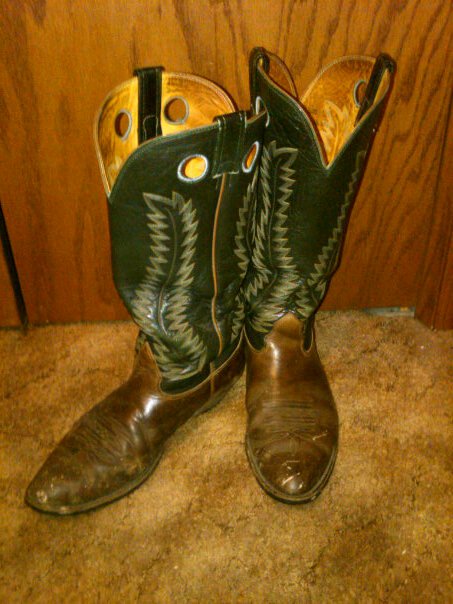
My three pairs of boots are pictured below. In my Second Third, I intend to wear the soles off them again and again. Why? Pfft. Just look at them!

My first pair (also pictured at the top of this post). Summer 1994. Nocona size 12 1/2D (the perfect fit from day one). Chocolate oiled bull shoulder with black tops. Soft as moccasins; tough as nails. I’m on my third set of soles and heels.

My second pair. Summer 1995. Blucher Boot Company, custom-made for someone else, but didn’t fit them; fit me like a second skin. Black French calf tops and bottoms. Soft and smooth and takes a nice polish. Great for dancin’ if they didn’t look so wicked. And if I danced. Still on the first set of soles and heels.

My third pair. Summer 1996. Nocona size 12 1/2D. I special-ordered these for rougher use: oiled cowhide foot; high green goatskin tops, and a bit higher and more underslung heel, just for kicks. I also put a black rubber half-sole on them for extra durability in the wet or on pavement. Scratched, gouged, salted, and paint-spattered. Second set of soles and heels.