Love Is Necessary

It’s still dark outside, early Monday morning, and I’ve just read today’s gospel. Jesus once again performs a healing miracle on the sabbath, for a woman who has been crippled and unable to straighten her back for 18 years. Once again, the synagogue leader is outraged that the Lord is “working” on the Sabbath, and once again, He sets him straight:

Hypocrites! Does not each one of you on the sabbath untie his ox or his ass from the manger and lead it out for watering?  This daughter of Abraham, whom Satan has bound for eighteen years now, ought she not to have been set free on the sabbath day from this bondage?

Luke 13:15-16

I close my eyes to reflect: He’s telling them they take time to certain things, even on the Sabbath. They do what they need to do so their animals don’t die. They do what is necessary—but they won’t help this woman. They won’t love this woman, so He calls them hypocrites.

What is He telling them? What is He telling me?

Love IS necessary.

In our current culture, we are less inclined to strictly observe the Lord’s Day by resting from work. But might we abstain from love?

Continue reading
Don’t Let Your Limp Become Your Crutch

A few weeks back, I had a conversation with my sister Jill. Among other things, we talked about my distance from our folks in Michigan. I must have confessed my insecurity around being a good son and a good brother, and Jill called me on it. She told me she had heard me say that before and shared that while it may be true, I should be careful about repeating it too often, because we can’t progress if we stay tied to past problems, behaviors, sins, or weaknesses.

My mind has returned to the conversation numerous times since, and I believe she is right. My limp was becoming my crutch.

Let me say that again: My limp (insecurity, a problem I have that I struggle with) was becoming my crutch (something I lean on to help me excuse bad habits and get through the day).

Several years ago, when my spiritual director said I was insecure, I bristled immediately—a pretty sure sign. He warned me at the time that it would continue to surface, and that the important thing would be to acknowledge it and move on.

Somewhere along the way I forgot to move on. Instead, I lean into the limp: Instead of struggling against the insecurity, I resign myself to being insecure.

Continue reading

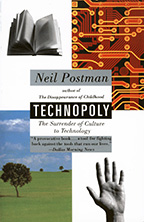
Book Break: Technopoly

Now for something completely different: I haven’t been writing nearly enough and am way behind on books I’ve read and would like to share. Most of the books I share are fiction, spiritual, or both. Technopoly by Neil Postman is neither.

This book came to me as an unexpected Christmas gift from our son Brendan’s friend Nick, who was his roommate at University of Mary and is now a seminarian for the Diocese of Milwaukee. Brendan has always been a curmudgeon and skeptic regarding technology; Nick, not so much, until he started reading more deeply on the subject. Then, he started spreading the word, including by giving our family a lightly used paperback copy of Technopoly.

One of the concepts that intrigued me as a young anthropology major was the idea that, at a certain point, our ancestors began to compete technologically rather than biologically, meaning that, at a certain point, our ancestors crossed a threshhold and were no longer strictly beholden to their biology to survive—the fittest was not necessarily the fastest or strongest hominid, but may be the cleverest one, with the best tools.

I’m certain that, soon afterward, our ancestors saw another defining characteristic of our species: Our solutions to problems often cause other, unforeseen problems. Indeed we can see this in the anthropological record, with evidence of hominids using “tools” to club each other to death beginning nearly half a million years ago.

Continue reading

Made To Be Broken

I will give you a new heart, and a new spirit I will put within you. I will remove the heart of stone from your flesh and give you a heart of flesh.

Ezekiel 36:26

Life in this world seems to dispense blessing with one hand and heartache with the other. In the past few weeks, we’ve enjoyed weddings and worship, family, and friends, brewing and canning in abundance—and learned of the passing of friends, the decline of others, lost children, and struggling families.

Have you ever wished you couldn’t feel each loss so keenly? The joys of life are wonderful, but at times, the temptation to not feel at all becomes so strong that you harden your heart even against the good to avoid the pain of the bad.

Hardness is not a virtue. As a physical trait, it has the peculiar tendency of making a thing seem solid and strong, while rendering the thing more brittle and fragile. (Diamonds are a rare exception, and the conditions required to create one in nature are extraordinary.) Scripture warns specifically against hardness of heart, and many people know from experience that the thicker the shell we build around our hearts, the more painful the blow and crack that finally breaks it open.

Continue reading

What Discernment Looks Like—for Us

Many of you reading know that Jodi and I have been discerning the possibility of me becoming a deacon. A deacon in the Catholic Church is an ordained member of the clergy, meaning that like priests and bishops, they receive the sacrament of Holy Orders. An ordained deacon is a deacon for life. If unmarried, he remains unmarried; if married, he does not remarry after the death of his wife. They generally serve the Church and assist priests at the altar during Mass, with certain pastoral and sacramental duties, and with teaching and preaching. Generally, they maintain their careers outside the Church, which uniquely positions them as clergy out in the world on a regular basis.

The Church recognizes two types of deacons. Transitional deacons are ordained deacons on their way to becoming ordained priests. Permanent deacons are ordained deacons who do not intend to become priests but have answered God’s call to serve the Church in this deeper way.

 In the Catholic Church, deacon is not a volunteer position or a job, but a vocational call—and for a married couple that has a vocational call as husband and wife, it ought to be a big decision. As the Institute for Diaconate Formation (IDF) here in the Archdiocese of Saint Paul and Minneapolis often puts it, Wives need to be comfortable with their husbands marrying another woman, the Church.

Continue reading