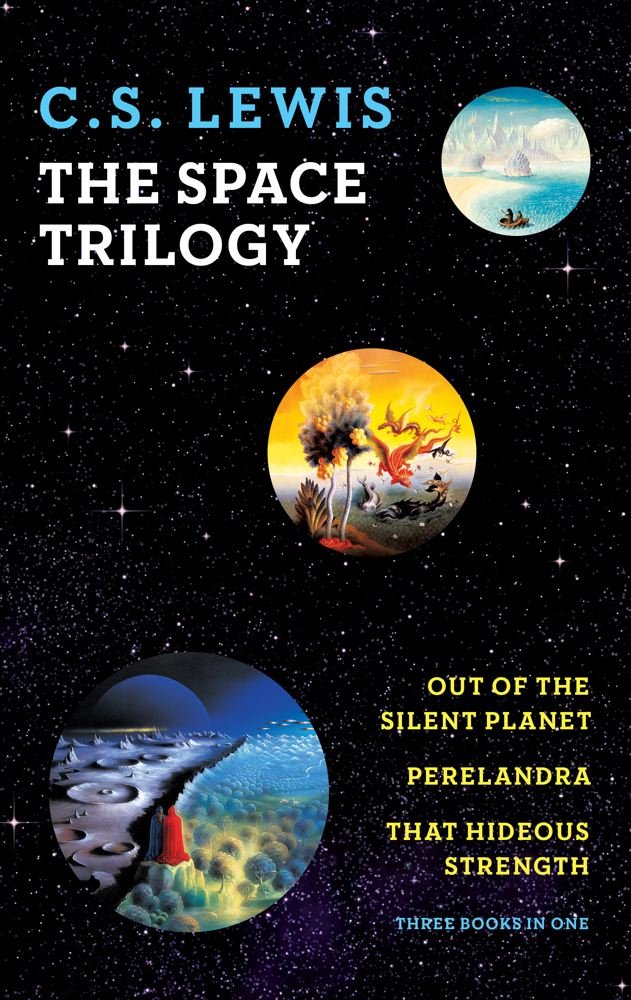
Extended Book Break: The Space Trilogy by C.S. Lewis

I was blessed, on my trip to Michigan and back in the past few weeks, to listen to The Space Trilogy by C.S. Lewis in its entirety. The version available on Audible, narrated by Geoffrey Howard, is approximately 24 hours of continuous listening, and worth every minute. The three books of The Space Trilogy were certainly inspired by classic science fiction of the last century, but combine these influences with fantasy, mythology, horror and Christian theology.

  • The first book, Out of the Silent Planet, is the most sci-fi of the three, delving into interplanetary space flight and exploration, extraterrestrial life-forms and more. A British linguist named Ransom is shanghaied onto a spaceship bound for a nearby planet known by its native inhabitants as Malacandra. He escapes his captors to discover multiple rational animals with very different appearances, skills and abilities, and cultures, who nevertheless live together in good-humored and mutually beneficial peace. Slowly Ransom abandons his earthly notions of power, control, and desire and strives to help the natives against the other Earthlings who seek to exploit them.
  • The second book, Perelandra, is a science-fantasy tale also involving interplanetary travel and extraterrestrial life to frame a retelling of the temptation of Eve in the Garden of Eden. Ransom agrees to travel to the planet Perelandra on an urgent mission, but with no idea what that mission is. He encounters a lone humanoid woman who lives in harmony with the world and creatures around her and is searching for her man. An old adversary arrives from Earth to tempt the woman into disobeying the higher powers she knows on Perelandra, and Ransom must again fight against his fellow man as well as demonic activity to save a pristine world from importing Earth’s sin.
  • The final book, That Hideous Strength, is as long as the first two books combined and takes place entirely on Earth, specifically, in England. It continues Ransom’s tale in a story combining dystopian fiction, Arthurian legend and horror to critique materialism, modernism, politics, education and contemporary ideas of gender and marriage. It follows a young sociologist striving to get ahead in his career by joining a new and increasingly powerful national scientific insitute, while his wife, who is struggling with bad dreams that appear to predict the future, falls in with a small band of local resistance led by an eccentric old linguist who is rumored to be contact with powerful extraterrestrials who are pure spirit and are preparing for a final battle over the fate of the Earth.
Continue reading

A Promise, Not a Threat

This post appeared in the Sunday, May 9, edition of the St. Michael Catholic Church bulletin.

I spent the past week with my folks in Michigan, in the log house we built together when I was in high school. It’s surrounded by trees and green pastures, flowers and birds, with deer wandering through nightly and a plump woodchuck burrowed in beneath an old truck-box-turned-storage shed.

We built this place from scratch, from tall, straight pines some of which we felled ourselves. We drove the well ourselves. At the time, there wasn’t a thing my dad couldn’t do with his mind and body—and I, who had a very different mind than his, was amazed by what he could see and accomplish.

Over the past few years, time has taken a toll on my father. His strength is diminished; his hands, unsteady; that creative inner vision, not as clear as it used to be. His machine shop is largely idle these days, but he stays busy keeping the lawn and pasture mowed, the birds and wildlife fed, and my mother loved and entertained.

Continue reading

Take the Wheel

The post was published as a column in the St. Michael Catholic Church bulletin for Sunday, April 25.

I have a bone to pick with Fr. Mike Schmitz.

Before you send a message up to Duluth to tell him I’m calling him out, let me explain: Several years ago, I shared a wonderful video of his with the parents in our LIFT classes, entitled “Heaven: You’re Not Good Enough (and Why That’s Okay).”

It’s a great video—Google it!—but in the final minute, he says something that has haunted me ever since: “I’m not good enough to go to the Olympics, and I’m not good enough to go to heaven, but any one of us can surrender.”

Any one of us can surrender. He says it, just like that.

Have you ever tried? I have. I can say the words and think the thoughts, but when it comes to actually letting go and letting God, I can’t unclench my fists.

Any one of can surrender, he says. Sure…but how?

Continue reading

Mercy Made Easy

This post ran as a column in the Sunday, April 11, bulletin for St. Michael Catholic Church.

A friend frequently reminds me to “keep my armor polished.” By this he means if I stumble into a significant sin—or even if it’s just been a while, and the daily imperfections have smudged and tarnished the sheen on my soul—don’t wait; get to Confession.

I was pressed for time in the run-up to Holy Week. I wasn’t struggling with anything grave or intentional, and with my schedule packed and my energy ebbing, something had to give. So I postponed Confession.

Then, as usual, the fog descended.

I don’t know about you, but even the accumulation of venial sins obscures my spiritual sight. I think less clearly, feel more anxious, see challenges in a worse light, and feel temptations more keenly. On Monday of Holy Week, I sat down to examine my conscience and six weeks of debris tumbled from my heart and onto the paper. Suddenly the weight was apparent, so that even the long lines at the penance service could not deter me unburdening myself.

When my turn came at last, I stepped past the screen to look Father in the eye. I was surprised not to recognize the priest: a stocky man with a fringe of clipped hair around a bald dome, and calm but serious eyes. He began without greeting: “In the name of the Father, and of the Son, and of the Holy Spirit…”

Continue reading

Your Cross Was Made for You

This post ran as a column in the Sunday, March 28, bulletin for St. Michael Catholic Church.

Last weekend Fr. Park’s homily drew our attention to a simple turn of phrase in the gospel account of Jesus raising Lazarus from the dead: “Now Jesus loved Martha and her sister and Lazarus. So when he heard that he was ill, he remained for two days in the place where he was” (John 11:5-6).

Jesus loved them. So he waited. He lets Lazarus die and Martha and Mary suffer. Why? For the glory of God, so that some greater good might result. Even at our worst, our heavenly Father knows best. As Fr. Park said, quoting St. John Henry Newman: “He may make me feel desolate, make my spirits sink, hide my future from me. Still, He knows what He is about.”

This sort of friendship is not easy to endure.

Continue reading