Able-Bodied

good-friday-2264164_1920Now you are Christ’s body, and individually parts of it. – 1 Corinthians 12:27

Over the past three years I’ve been blessed to serve as faith formation director for our parish and to write a monthly column in our church bulletin. I’ve tried in that time to urge us all to discipleship: to cultivate a personal relationship with Jesus every day, listening and responding to what He asks of us, seeking the lost and leading them to heaven.

It’s a big job, to be sure, but we are not alone. We are one body, with Christ as our head. Through the Apostles, the bishops, our priests, and our baptism, His mission of saving souls has been given to each of us. Individually we are ill-suited to the task of redeeming the world, but together?

Together we are unstoppable. Continue reading

Nothing Safe

This past weekend was Albertville Friendly City Days, our little town’s version of an annual summer festival, featuring  a softball tournament, a pedal-power tractor pull, the Miss Albertville competition, live music, carnival rides and games, fireworks, clowns, and more. The highlight for our family each year is the parade — one of the biggest and best in Wright County, with more than 100 entries including several marching bands. The past few years we’ve enjoyed the spectacle from a beautiful old home on Main Street, right next to the announcer and judges booth, so everyone is looking and performing their best, and candy is tossed by the handful. This year we enjoyed the additional treat of Trevor’s debut as a percussionist in the STMA Middle School Marching Band, playing quads (technically quints, I suppose, since his drum harness has a tiny fifth tom, not just four).

19095554_10211398666936902_6245668699463826280_o

Trevor and bandmates marching

Earlier we had been discussing what we love and don’t love about Friendly City Days. Lily was strongly urging that we walk down to the carnival and at least check out the rides; Jodi and I weren’t anxious to do so. A friend agreed with us: Traveling carnival rides especially made her nervous, she said — so much so that she has been known to pay her children not to go, still spending less for peace of mind than she would have for ride tickets. She even shared a story about a girl who was scalped when her hair got caught during a ride on a classic old Tilt-a-Whirl.

13413740_10208066541475848_7740465260764804086_n

Jodi and Lily sliding

Although we rode the Ferris wheel, the carousel, and the giant Fun Slide last year, by and large, we agree. Anything that’s moves and spins and is not bolted down is just asking for someone to get hurt. Or throw up. Or both.

On the other hand…

What is it about a Tilt-a-Whirl, anyway? I used to love that ride: the unsteady motion of the platform, the off-kilter slide into your friends as your car tilted and spun sideways, first one way, then the other. Yeah, sometimes people puked (I never did), but that was part of the excitement — the sense that anything could happen, at any moment. You felt alive.

Dead people don’t barf.

I think I’ve discovered that ride was so appealing — and why I don’t care to do it anymore. Think about it: what else do we experience that is tilted, spinning, unstable, and potentially dangerous; that sends us careening into the people closest to us; that makes us laugh, cry,  and hurl?

We don’t need some old carnival clunker. We spend all day, every day, on a massive, unhinged Tilt-a-World. As a kid, the simulating is stimulating. As adults, it’s too real, like when you’re watching The Office and can’t laugh because you actually lived through that particular episode.

And it’s not safe. This world is broken, grimy and off-balance, hurtling through the cosmos, and run by grubbing scoundrels, leering ne’er-do-wells and lazing doofuses. We’ll never make it out alive — and yet, here we are: leaning, laughing, spinning…

So let go. Whatever you’re clinging to can’t keep you safe anyway. Let’s throw our hands up and enjoy this ride — together!

Featured photo at the top of the post: Abandoned Tilt-A-Whirl By Derrick Mealiffe from Toronto, Canada (Wet n Wild) [CC BY-SA 2.0], via Wikimedia Commons


Book Break: Christianity and the Crisis of Cultures

CatCoCI don’t remember exactly when I picked up Christianity and the Crisis of Cultures — or why — but it was on my nightstand, unread, for many months until Brendan came home from UMary and mentioned it was one of the good books he read in his Catholic Studies classes this year. Essentially a lecture delivered by Cardinal Joseph Ratzinger (now Pope Emeritus Benedict XVI) circa 2005, the book highlights the ways in which Europe’s widespread Christianity served as a foundation for many of the great advances of the Renaissance and Enlightenment, which have paradoxically led to a severing of the Christian roots that made them possible and a grave imbalance between technology and morality, between what we can do and what we should.  Yet even as we stand on the brink of cultural collapse, Cardinal Ratzinger proposes an approach that could restore the moral foundations of Western societies and lead people back to God.

It is a short (115 pages of well-spaced text), but heady, read — unflinching yet hopeful in its outlook, recalling that all things are possible through Christ. Two major ideas touched on in the book stand out to me this morning, each of which I will paraphrase and tackle in somewhat of my own way so as not to spoil the lecture itself.

The first is that we live each day by faith, which is never blind but always rooted in authority of those who have firsthand knowledge of the subject at hand. An example a friend of mine shared some months ago: how many of us know our birth mother? How do we know? None of us can possibly recall the moment of our birth, and few if any of us have incontrovertible photographic evidence of that moment, with faces in focus and the umbilical tether uncut. We could have been adopted or inadvertently switched. But we have faith based on authority: the signed documents, the witness of family members and friends, and in most cases the presence and loving care of our mothers themselves.

Most of us aren’t engineers, yet we trust another’s deep understanding of engineering to get us to and from work safely each day and to perform our work functions. Most of us no longer raise the majority of our food, yet we trust that it is safe to eat. In the same way, while many of us do not claim to have firsthand knowledge of God in person, our faith is based on the authority of those who did (or do): signed documents, the witness of family members and friends, and the loving care of the Creator Himself.

Indeed, without this foundation of so-called irrational faith — this fundamental belief and trust in things outside our own personal experience — everything else, including the science and technology we cling to as “rational,” breaks down.

The second idea worth highlighting is that, as Cardinal Ratzinger puts it, “It is an obvious fact that the rational character of the universe cannot be explained rationally on the basis of something irrational!” If the origins of the universe, the world, and humanity are random, how then can we rely on them to unfold in a rational way and be understandable? If our brains are merely chemicals and electrical impulses particularly suited to our survival, what are reason and choice, and why do they matter?

Cardinal Ratzinger puts forth a compelling picture of the modern culture and offers advice for believers and non-believers alike to rebuild the crumbling foundations of Europe and the West. Brendan found this little book worthwhile, and so did I.

The Great Improviser, or One Blesséd Thing After Another…

I remember watching an improv comedy group with friends in college. Each member of the troupe was a whirlwind of wit and creativity, responding instantly to audience suggestions, random props, and fellow comics’ off-the-cuff reactions.

After more than an hour of nonstop hilarity and laughter, the group took its bows, then the members spoke briefly to the audience about how they do what they do: How they keep the laughs coming at such a breakneck pace when even they aren’t sure what will happen next?

The basic answer was so simple: Say yes, and

Whatever the situation, the idea, the inane detail added by the last castmate as he passes the scene to you, say yes, and build on it. Anything else — a no, a but, a hesitation, a rejection — derails everything. The joy of improv (for both performers and audience, I’ll wager) is in the way that it embraces the unknown and absurd and builds on them, laugh upon laugh, until the entire humorous edifice is revealed and the leader says, “Aaaaand scene!”

Say yes, and build on it. Embrace the situation and move forward. Such a simple trick — but it requires practice. (If you don’t believe me, get two friends and try Three-Headed Broadway Singer.)

It strikes me today that this is good advice for life, as well. This world is tilted, spinning, ridiculous in so many ways, and at times life appears to be, as an old saying goes, “one damned thing after another.” But it’s not. The sequence of events is not damned, but blessed.

We know that all things work for good for those who love God, who are called according to his purpose. — Romans 8:28

God, in fact, must be the Great Improviser, to work out  His plan among so many free-willing, fallen creatures who are constantly doing the dead-wrong thing. God’s providence, it seems to me, must be a resounding, eternal, “Yes, and…”

Fr. Mike Schmitz shares great perspective on discerning God’s will for us, in which he reminds us that, even in scripture, when God appears to be taking His people by the hands and leading them, still less is known than unknown. In particular, he reminds us that, after being told by the angel Gabriel that she will bear the Son of God, Mary says “Be it done unto me according to your word,” and the very next line in scripture is, “Then the angel departed from her” (Luke 1:28).

Mary is left to improvise: to build upon that yes and each yes after, until the entire astounding edifice is revealed and the Master calls out, “Scene!”

Like Mary, we don’t know what’s coming: what incredible, impossible, unwieldy, absurd situation we may encounter, this moment or the next. But our response matters. In fact — since the universe is beyond our control — our response is all that counts.

It’s so simple, though it takes practice: Step with joy into the unknown. Say yes, and build upon it.

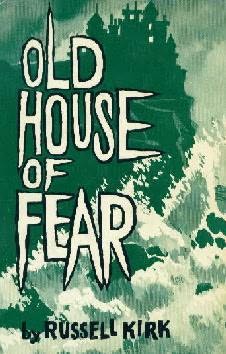
Book Break: Old House of Fear

While back home in Michigan over Divine Mercy weekend, I had the pleasure of browsing the Mecosta Book Gallery and coming home with my first Gothic fiction work of local literary hero and celebrated thinker and writer Russell Kirk, an unjacketed, former library edition of Old House of Fear.

Too few people, perhaps, know of Russell Kirk today. Even growing up a few miles from the tall brick house where he dwelt and wrote, and with his four daughters not far from me in age, all I knew growing up was that a eccentric writer supposedly lived in that big house. Such knowledge was wasted on my teenage self; had I known he was one of the foremost conservative political thinkers of the last century and a novelist to boot, I may have postponed Yale for a year and ultimately saved myself the trouble and the expense.

But I didn’t — and now I’m playing catchup.

I would describe Old House of Fear as a Gothic men’s adventure story: equal parts ghostly yarn, murder mystery, and manful romance. Our protagonist is sent by his employer, a Scottish-American industrialist intent on buying his family’s ancestral home on the remote Scottish island of Carnglass. The requisite castle has an ominous name — the House of Fear — though in its ancestral Gaelic it would be spelled fir or fhir and means “man.” What begins as a challenging business transaction with a strange old widow becomes a treacherous tale of intimidation, terrorism, and murder, involving Communists and occultists, as well as more run-of-the-mill ruffians, a beautiful red-headed niece who may also be a witch, and the ever-present shadow of a legend: a grostesque, three-eyed goat-man said to haunt the island from time immemorial.

It is a quick and satisfactory read, if a bit tidier than I expected at the end. I enjoyed it thoroughly and recommend it wholeheartedly…if you can find it! If not, I may be convinced to loan it to you!