Just the Four of Us

For the first time in more than 20 years—near as we can figure—my mom, dad, sister, and I are alone together in my parents’ house.* The last time this happened, according to Jill’s recollection, was just before I left for South Dakota to marry Jodi. Jill was pregnant with my niece and goddaughter Kayla (hence the asterisk above) and couldn’t travel; she recalls sitting together in the loft overlooking the great round beams of my folks’ house, talking with me and giving me a old penny from her coin collection that had belonged to Grandpa Thorp. I don’t recall the exact moment as clearly as she, but I have the penny still, and the timing seems right.

And now here we are again, just the four of us, talking and laughing together. Births, holidays, weddings, funerals. Decades pass like minutes. We are entirely different people than the last time, and just the same.

I’m not sure I have a point tonight, other than to commemorate this day and note the speed with which time’s arrow flies, the swift fluidity of life, and the beautiful permanence of family.

The Temple In Decline

I am reclined this morning on one end of a well-worn brown leather sofa, black coffee near at hand, my laptop atop my lap. Conveniently, it is held in place by that protruding portion of my abdomen that overlaps my waistline and also serves as a convenient snack tray. I try to see this is as a blessing, but most blessings I enjoy are well-wrought and gleaming. This one is pasty, soft, expansive, and lumpy.

We are told our bodies are temples. To what heathen god, then, has this been erected? I am 230* pounds of flesh and bone (flesh mostly), underworked and overfed, misshapen and hairy and graying. I am weary from too much rest—so comfortable it hurts. The portal is expansive, the veil is stretched; my altar, I fear, is all table and no sacrifice.

There is a time and place for opulence, but it is not my midsection at 42. Time to tear down this sprawling pagan jumble and put up a tent, a table, a candle, and a cross.

Three days may not be enough.

* * * * *

* More or less…


Who Is This Mary?

When Brendan came home from college for Easter, one of the first things I noticed was a coarse metal chain around his wrist. It is a sign and reminder of Marian consecration, a total gift of self to God through Mary—a symbol of slavery, but of a good and holy kind—which says he is devoted to doing God’s will in the most perfect way he can, and that he is following his Blessed Mother’s lead in this.

Our local church has undertaken a parish-wide push for Marian consecration this month, using a 33-day self-guided mini-retreat published by Fr. Michael Gaitley as the book 33 Days to Morning Glory. Jodi, Gabe, Emma, Trevor, and I have undertaken this journey together, in hopes that we, too, will be chained to our Lady in mid-May.

The daily readings in this book are short, but thought-provoking, helping us to better understand why Catholics so venerate and so often turn to the Virgin Mary. What struck me this morning is this question: If Mary was sinless, married to a saintly carpenter, and raising a sinless Son, how is it that she was not known better in her day? I know how drawn I am to certain families in our community—families that strive for holiness even as they struggle with all the typical family dysfunction. How is it that Mary and the Holy Family didn’t have a constant throng of people at the door?

Several answers come to mind. First of all, perhaps people did flock to the house in Nazareth, but in the same way we do today. Perhaps they were exactly the sort of family that neighbors were drawn to: mothers confiding with Mary during play dates and nap time, men seeking Joseph’s advice as he worked in his wood shop, parents nudging their children to get to know Jesus because He seemed like a nice boy. Perhaps people realized they were an exceptional family, just not the Holy Family.

But how could they not have seen it?

Well, Mary’s perfect humility comes to mind. I tend to want recognition when I do good work or suffer in some way. Mary, I imagine, would have drawn no attention to herself, and even moreso than our other saints (who were, in fact, sinners), she would have downplayed any recognition she received as due to God and not herself.

And finally, we sinners have a tendency to project our weaknesses onto those around us. No doubt there were those around the Holy Family and Mary who thought they couldn’t possibly be as good as they appeared. The movie The Nativity Story does a great job of illustrating the effect of Mary’s unplanned pregnancy on people’s perception of her, culminating in people scowling from their doorways as Mary and Joseph begin their journey to Bethlehem. (They can feel the eyes upon them, and Joseph jokes to Mary: “They’re going to miss us!”)

Then it occurred to me that these three thoughts might characterize our response to Mary today, as well. We may turn to her as a friend and confidant, or even as a mother, without truly considering her virtue, her proximity to God, her influence as Queen of heaven and earth—without regard for her role as the model and mold of discipleship and humanity. We might not recognize her as powerful, the new Eve and the saint closest to her Son in all respects, because all of this results from a simple, humble yes: complete obedience and submission to God. And we may simply not think she’s “all that”—however good she may be, she’s not God, so why should we let her stand in between us and the Source of life, holiness, and joy?

My answer to this last question is simple: I know how often I’ve lost God, sought Him alone, and failed to find or reach Him. I know I need help. Who better to turn to than the creature like me who loved God best and followed Him perfectly?


Lenten Hits: Firelight Fridays

One of the most fruitful family sacrifices we undertook this Lent was to fast from electric lights after sunset on Fridays. We had already decided to abstain from television, movies, and video games for all of Lent, when I ran across an article by well-known atheist-to-Catholic convert Jennifer Fulwiler on the National Catholic Register website: “8 Reasons to Turn Out the Lights During Lent.” I proposed to the family that we undertake this fast at least once a week, and we decided on “firelight Fridays”once the sun went down on Friday evening, we would use nothing but candles in our house.

My hope was that, as Fulwiler suggests, this would spark a massive downshift in activity and draw us closer together as a family, around the flickering flames. It did exactly that.

The fact that we had already committed to shutting off the televisions for forty days laid a good foundation for Firelight Fridays, since that caused our older kids to break out board and card games and begin playing together and with Lily in ways we hadn’t seen in years. Soon they were inviting Jodi and me to play. Parcheesi, Sorry, Cribbage, Garbage, and head-to-head Solitaire were the favorites, and as darkness gathered late Friday, we would clear the coffee table in the living room, light several candles on a tray, and sit in a tight circle to talk, laugh, and play together. I discovered that Jazz 88 plays the blues all night on Fridays, which offered a suitable soundtrack to our “penitential” family time.

Usually we played together until some of us grew sleepy, then we talked, sprawled across the furniture and floors, until we could no longer keep our eyes open. Often we went to bed earlier that usual for a Friday, and still felt as though we’d had a very full evening, because our time together had started at sundown and was concentrated on the here and now, with the people we love. In retrospect, it strikes as similar to a silent retreat: when we reduce the distractions that keep our eyes and brains flitting about from one thing to the next, time stretches out and we expand to fill it.

By the end of Lent, I was ready to go full Amish and invest in candles for every day of the week. Lily—who each week would begin a countdown to candles on Tuesday or Wednesday—was close behind in her enthusiasm for continuing the practice.

Jodi and the older kids missed family movies and other typical Friday practices, so we compromised: We agreed that, beginning this spring we will commit to at least one Firelight Friday a month: indoors with candles in bad weather; outdoors at the fire pit in good.

Each Lent I worry that we’ll fall back into old patterns as Easter rolls ’round, and we will lose what we’ve gained from fasting. Yesterday afternoon, I picked up Lily from daycare. We hadn’t left Jennie’s driveway when she asked if she could have a snack and watch a show when she got home.

“You can have a snack,” I said, “but we’ll have to wait and see about a show.”

When we got home, she got herself a snack while I put aside my work and started thinking about supper. Next thing I knew, Lily was setting up Clue Jr. to practice playing it by herself. She made no mention of watching a show for the rest of the evening.

If unplugging and lighting candles can work such a change in our biggest little screen junkie, that, to me, is a sacrifice worth sustaining.

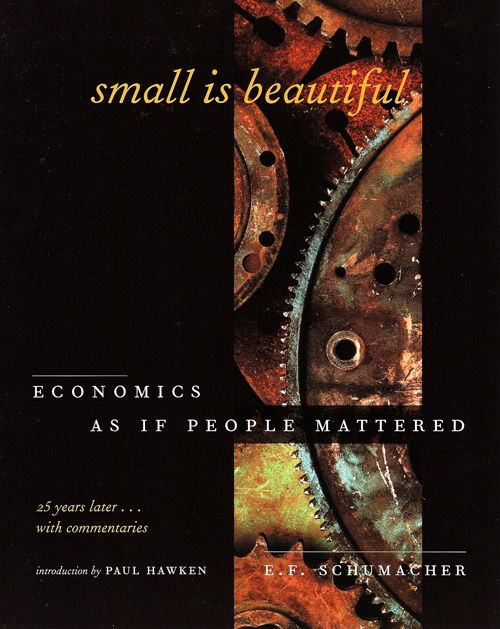
Book Break: Small Is Beautiful: Economic As If People Mattered

One of my regrets from my college days is not taking any courses in economics. I received a relatively unstructured liberal arts education: aside from a few specific prerequisite courses for my undergraduate degree, all class were divided into four groups, and we had to take a certain number from each group. Math and physical sciences were grouped together, so the classes and labs I took in chemistry meant I didn’t have to take math. I heard only complaints from my friends in economics classes, and since I had so many other interesting classes in the social sciences to choose from, I skipped it.

This teenage shortsightedness bothers me still today, since our news and politics revolve around the economy. E. F. Schumacher’s Small Is Beautiful: Economics As If People Mattered recognized this utter domination of economics over all, warned against it, and proposed specific antidotes. Written in 1973—a year before I was born—and recommended to me by a former boss, it strikes me as a book that was likely read, loved, and then neglected by many in the last 40 years as they were swept along by currents too strong to swim against.

With no economic background of my own with which to offer a proper review or critique, I will instead offer a couple of objections and a few ideas I loved from the book.

The most obvious grounds for dismissal of Schumacher’s book for many will be that the alarms he sounded in 1973 were, in retrospect, too shrill—the gloom and doom he predicted, especially in terms of natural resource shortfalls and environmental crises, have not yet come to pass. For some readers, this alone will “prove” that the author obviously didn’t know what he was talking about. Schumacher himself, a Rhodes Scholar and economic advisor with the British Control Commission and the British National Coal Board, warned against trying to predict the future. Common sense told him that finite resources can’t last forever, and exploratory calculations suggested that, at the rates of consumption and growth he was seeing in the 1970s, we were living on borrowed time. He acknowledged it was possible that we would find new sources of fossil fuels and other rapidly consumed resources—his point was, to what end? Unless we change our habits, eventually we will suffer.

The second objection was, for me, the more difficult: at this point in his career, Schumacher had strong opinions about what was wrong in the world and what needed to be done about it, and his blunt negative assessments of markets, economists, and motivations in his day leave little room for compromise or evangelization. I found myself nodding in agreement with three-quarters of his writing, only to run against passages about which I thought, surely not everyone in capitalist society is solely motivated by relentless profit-taking?

On the other hand, Schumacher does an excellent job of drawing our attention to the underlying problems with an economic approach to everything. Early in the book  he quotes his fellow British economist (and an early benefactor of sorts) John Maynard Keynes from 1930: “For at least another hundred years we must pretend to ourselves and to every one that fair is foul and foul is fair; for foul is useful and fair is not. Avarice and usury and precaution must be our gods for a little longer still. For only they can lead us out of the tunnel of economic necessity into daylight.”

Is this not contrary to the Christian ideal and common sense? Can fallen man use sin to achieve virtue? Of course not—but he can use his fellow man to achieve personal prosperity.

Schumacher goes on to write, “This was written forty years ago and since then, of course, things have speeded up considerably. Maybe we do not even have to wait for another sixty years until universal plenty will be attained. In any case, the Keynesian message is clear enough: Beware! Ethical considerations are not merely irrelevant, they are an actual hindrance, ‘for foul is useful and fair is not.’ The time for fairness is not yet. The road to heaven is paved with bad intentions.”

Lest you think of Schumacher as a naïve idealist imagining utopia, consider that two simple, practical ideas he advocated in his writings were the continuation of coal development and reducing energy consumption. He recognized that mankind is notorious for developing new problem-solving technologies that create new problems; that turning one’s back on an entire energy source on the belief that we could replace it entirely with oil or nuclear energy and meet rapidly growing worldwide demand, was foolish, even if it turned out to be true; and that wasting resources we cannot, ourselves, replace never makes sense.

This, to me, is (at least in part) what conservatism ought to be: maintaining the tried and true even as we explore new possibilities and conserving, even when a crisis is not looming, because it’s the sensible and moral thing to do.

Am I good at it? Not very—but getting better.

His biggest idea, however, was the concept of intermediate technologies for developing countries. Schumacher traveled the world and saw that most economic development supported by wealthy nations not only replicated the patterns of economic dysfunction he was in the developed world, but deepened the economic problems in the developing country for all but a fortunate few.

One example he uses (which I will paraphrase and expand on) is that of a large earthwork project that needs to be done in a developing country. You have a range of options you may employ for accomplishing this work, from people using their hands to scrabble and scrape away at the earth to the most modern and powerful earth-moving machinery. The former approach would cost almost nothing and “employ” a lot of people for a long time at menial and nearly impossible work; the latter would employ relatively few people for a relatively short time, unless the expensive equipment broke down and needed repairs—in which case there would be no parts or expertise locally to fix it. In the middle, however, are a range of intermediate technologies, however, that could put people to work, providing income for their families, value for their time, and dignity for themselves. For example, equipping a hundred men with well-built shovels and wheelbarrows would put those men to work—plus many more making and repairing shovels and wheelbarrows using local materials. The money earned by all those people (instead of just a few heavy-equipment operators) could be used to support other local industries—because what good is producing food or consumer goods if no one has any money to buy them?

There is much to love in this book, including Schumacher’s very Catholic views on the dignity of work and the human person. He speaks against an all-pervasive economic approach to efficiency, which quantifies and assigns value to the incalculable and invaluable. When everything is assigned a value, the sacred (such as human life) is diminished and no longer sacred. He speaks against an approach to labor and productivity that reduces work to individually pointless tasks without freedom or creativity and fails to employ large segments of society that, because they see no value in their time and effort, quickly devalue themselves. And he speaks against the underlying assumption that one who works less and consumes more is better off than one who works more and consumes less.
It is a thought-provoking read, and I highly recommend it.