Fool for Christ: An Easter Reflection

Such fools, these followers of Jesus. Witless tradesmen, traitors, cowards, and louts, smelling of dust and sweat and fish—with a carpenter to lead them! The honest one, Nathanael, spoke well when he asked, Can anything good come from Nazareth? Yet even he was smitten—by a wandering woodworker!

And then what? This Jesus rides into Jerusalem like God’s gift to humanity, picks a fight with the scribes and scholars, and blasphemes before the high priest. Who could stand for it? They had him flogged and humiliated, beaten within an inch of his life—they gave him every opportunity—and still he would not repent. So they had him crucified.

Great wickedness demands great atonement.

Such disciples! Most of them fled when God’s arm was revealed. Only the young one, John, stuck it out to the end. His mother was there, too, I hear. Poor woman. She raised him right, by all accounts, and this is her thanks: a criminal in an early grave. She must be proud.

They’ve been in hiding since. What would you do, if you left your home and livelihood to follow your heart’s desire, only to see it crushed completely and come to nothing? They say he worked wonders: fed the masses, healed the sick, even raised the dead! But how could that be, unless he came from God Himself? And why would God would allow his servant to be profaned so publicly, so completely—on the Passover, no less! Why could he not save himself?

Unless…

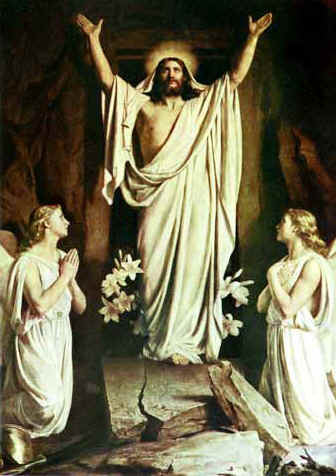
But no. Nothing short of bodily resurrection could make up for so great a loss. For the man Jesus to redeem Himself and his followers, He would have to burst from that tomb of his own accord, bathed in light and breathing God’s own spirit, baptizing in fire as the beheaded Baptist foretold, with angels as His heralds and judgment on His lips. He would have to show Himself victorious over not only worldly powers, but over sin and death itself.

Some say he will. Just imagine: the stone rolled back, an empty tomb, the astonished guards. Imagine the embarrassment of the Romans, the recriminations among the Jewish leaders, the joy and wonder among His followers.

Mercy! Who could stand before so great a Redeemer as that?

On that day, may every knee bend at His holy name. May He find a people worthy to be called His disciples.

And may I be one of them.

Book Break: The Spiritual Combat

Dom Lorenzo Scupoli’s The Spiritual Combat was recommended to me by a friend many years ago, when I was first looking into my patron saint Francis de Sales’s spiritual classic An Introduction to the Devout Life. First published in 1589, Fr. Scupoli’s book was required reading for those whom St. Francis de Sales advised, and he reportedly carried in his pocket a copy given to him by Fr. Scupoli himself.

Over the past several months, I’ve been reading and reflecting on The Spiritual Combatduring adoration. I will warn you up front: It is not an easy read. The language and structure are archaic and complex at times, and Fr. Scupoli takes sin, Satan, and the possibility of Hell uncomfortably seriously (as we should, too). Take your time; read a section and reflect on it. Re-read if necessary. This is a book the rewards patience and prayer.

I believe it will reward repeated reading, as well. Each “chapter” reads like a short reflection building upon the previous. I have read all of these reflections now, but find that, in my own spiritual life, I’m still focused on the first few reflections. Early in the book, Fr. Scupoli insists that in the battle for souls, we must fight or die—but victory can only come from recognizing our own spiritual weakness and putting no trust in ourselves and our own abilities. We must recognize our overwhelming tendency to fall and put all our confidence in a loving and merciful God, without whom we can do no good, but with whom we cannot fail.

I don’t live like that. Most days I still try to get by on my own steam and get frustrated when I stumble or fail. So in terms of spiritual combat, most days I’m still reminding myself of my weakness and striving to distrust me and trust Him instead. When this becomes habitual, it may be time to read this book again!

My edition ends with a shorter work also attributed to Fr. Scupoli, A Treatise on Peace in the Soul. This is another old fashioned, hard-hitting, and practical work, much shorter than The Spiritual Combat, and for me, much easier to apply as a whole to my day-to-day life. The overarching theme is the importance of maintaining peace in the soul and responding immediately to worries, anxieties, and fears that disturb us, recognizing that these are tools the Enemy uses to separate us from God. I read this part in about two sittings and found myself much refreshed and with much to think about and apply, even as a raw recruit to the spiritual combat.

* * * * *

Blogger’s Note: The cover on my edition is the one pictured. As a former wrestler and father of wrestlers, this image of Jacob wrestling the angel alone is worth the price of the book! Also: toward the end of the post at the following link is my brief reflection on Introduction to the Devout Life, another great spiritual book.

Poured Out In Love

 Each year during Lent, the Church focuses more intentionally on the Passion and Death of Jesus. How strange it seems that, during the very season we are trying to examine our lives and conform ourselves to Christ, we are also focused on Jesus at His lowest: beaten, humiliated, tortured. Jesus tells us in no uncertain terms that, to be His disciples, we must deny ourselves, pick up our cross, and follow Him—but surely we can stop short of whips and spears, thorns and nails, can’t we?

We are each a unique image of God, and each called to follow Christ in a unique way: to pour ourselves out in love for those around us. Most of us won’t be called to martyrdom in the bold and bloody sense—though some of us may. Most of us won’t be called to leave behind family and friends for foreign missions or cloistered religion life— but, God willing, some of us will.

Instead, most of us will be called to holiness in the context of ordinary, everyday lives: working, raising a family, pitching in where we can. This may seem easier than facing blades or beasts in the Coliseum, but I’m convinced it’s not. St. Josemaria Escriva warns us, “Many who would willingly let themselves be nailed to a Cross before the astonished gaze of a thousand onlookers cannot bear with a Christian spirit the pinpricks of each day! Think, then, which is the more heroic.”

To make a once-for-all choice for Christ, in the heat of the moment, facing certain death and eternal glory, seems downright doable compared to 70, 80, 90 years of making a million moment-by-moment choices to love the person in front of us, in every circumstance. Daily discipleship is difficult—and it’s made more difficult when we attempt to carry crosses we were never meant to bear.

Think about it: Each of us is called to be a disciple, and each disciple is called to pick up his or her cross and follow Christ. But since many people choose not to be disciples, we have a lot of crosses lying around, waiting for someone to drag them away. All these crosses can make it difficult to discern which is ours. They can cause us to stumble and fall. They can cause us to neglect our own cross in a misguided effort to clear the path.  But if we take the time to identify our own cross—the one God made precisely for our particular strengths and weaknesses—and if we shoulder it and keep our eyes fixed on Jesus, who walks the path ahead of us, He will show us the way.

This, at last, is discipleship: Not to drive ourselves into the ground trying to do everything for everyone, but to ask God what He wants from us, to listen for the answer, and to resolve to do exactly that—to embrace the cross the Carpenter has crafted with each of us in mind, and leave the others.

Imagine a parish of such disciples, all doing exactly what God has asked of them—no more, no less—and all moving the same direction, pouring themselves out in love on a world that desperately needs it.

Such a parish would change the world, because unlike time and energy, love never runs out.

It’s the Little Things

I often worry about what my wife and children, family and friends, and even those of you I don’t know, think of me. Am I doing good work? Setting a good example? Who sees me at the grocery store—and what do they see? Who walks down my street and hears me thundering away at my poor children? Am I letting them down? Am I letting you down?

You know the old song: You’re so vain/you probably think this song is about you/you’re so vain. Yeah. I tend to think the song is about me. Like all of you don’t have better things to do than watch for me to stumble. I used to think, At least I’m not prideful—I’m worried I’m going to let people down!But now I see what twisted pride convinces a guy that everyone is looking at, paying attention to, and judging him.

I bring this up because Lent is on the horizon. In Fr. Mike Schmitz’s video reflection, Preparing for Lent, he cites three common mistakes people make in their approach to Lenten sacrifice:

  • Take on a very easy sacrifice that will have no spiritual impact whatsoever
  • Take on a very hard sacrifice just to see if they can do it
  • Take on a two-fer–use Lent as a reason to fix a broken resolution or to do something you should have been doing all along

I have done made all three of these mistakes over the years: trying to break old habits during Lent, but for myself, not for God, or piling on the sacrifices and prayer practices until I couldn’t help failing, then cutting back and simplifying to the point that I became an unprofitable servant, only giving to God the minimum due. And all the while, I’ve wondered: Who’s watching? Who’s judging

Who cares? The point of prayer, fasting, and almsgiving Lent is to draw nearer to God and to detach from things that keep us bound to our earthly lives. We should ask, What in this world is keeping me from Christ? What can I do to more closely follow Him? —and listen to the answer.

Jodi and I used to tell our youth group in Michigan that if they thought of a sacrifice and had a sinking feeling in their hearts because they didn’t want to give that up, it might be the right thing. It doesn’t have to be earth-shattering. In fact, once I started thinking in terms of the little things, I realized that this is where the real work is. I’m no longer a slave to those big, serious, mortal sins that used to weigh me down, but I have countless little attachments and anxieties that crowd God out of my life.

Do you, too? Pick one, and let it go this Lent. Replace it with a simply prayer practice (maybe genuflecting more slowly and reverently before the tabernacle or monstrance, as though the King of the Universe is present—because He is!) and self-giving (how about a loving compliment to each person we interact with?).

Uh, oh. I’ve got that sinking feeling…

Note: Lent begins on Wednesday, March 1, with Ash Wednesday. Watch Fr. Mike Schmitz “Preparing for Lentand collect bonus points for watching “4 Reasons for Fasting“…

Addendum: The Science Behind Man-Cold

Blogger’s Note: In a recent post, I explored the symptoms, origins, and treatment of the the very real, though often ridiculed, affliction known as man-cold. In retrospect, I realize that I did not do justice to the prevailing scientific theories underlying this misunderstood illness. This post seeks to rectify that oversight.

As providence would have it, on the heels of my earlier post on man-colds, I was stricken by the dreaded disease myself. This first-hand experience, coupled with a striking observation by my son, Gabe, has shed new light on why man-colds happen in the first place.

First, the story: Almost at the same time I was posting the earlier writing, the symptoms began: sore throat, cough and congestion, alternating sweats and chills. At first these appeared to be little more than common cold symptoms, but at a certain point, they quickly escalated, leaving me a shell of the man I hoped to be the next morning. I was feverish, sleepless — near death in all things save fact — and did not know when (if ever) I might expect to be upright and functional again.

The following day, thankfully, my symptoms were reduced, and I was my typical jovial, carefree self — ready to take on the world despite a constant and singularly non-productive cough that plagues me even now, and the periodic sensation that I am about to drown in my own fluids.

During a coughing jag while I was out and about with my family, I shook my head and muttered, “Man-cold…” Gabe looked at me with a sympathetic smile, but gently corrected me: “Clearly not, or you wouldn’t be here.”

He’s right. What I was experiencing was no longer a man-cold, but the common-cold symptoms left behind by the more virulent strain. The question then became, how? How is it that that what manifests itself as a common cold in women and children — and even in men both before and after the man-cold — is so devastating to grown men at its symptomatic peak?

The prevailing theory is so simple it is often overlooked: the man-cold virus is a strain of common cold that feeds particularly on testosterone. When the virus infects a grown man, the testosterone available for consumption causes this strain to outperform all others. The manlier the man, the worse the man-cold, as the bug turns from a mild-mannered sniffle-inducer to a rampaging, rage-infused berserker virus, pillaging and burning everything in sight.

Now consider the effect of this rapid consumption of testosterone after the initial infection:

  • First, the man appears to have the same cold as the woman and/or children his life, with little impact on how he interacts with the world.
  • Next, the man-cold strain begins to feed on testosterone, outperforming the others strains in much the same way the healthy man would outperform lesser men, and quickly spreading through the man’s body, enhancing symptoms and overwhelming defenses. Instinctively the man lays low, knowing that, in nature, the weak and sick are killed and eaten.
  • As the man-cold virus multiplies rapidly, it consumes exponentially more testosterone, emasculating the patient and causing him to revert to a more childlike state of dependency. 
  • Furthermore, in particularly manly patients who are, by their profuse masculinity, prone to frequent man-colds, the immune system may itself reduce the supply of testosterone to starve the virus. The patient’s weak and pathetic appearance is, in fact, proportional to his typical strength and manliness and a testament to the quality of the man under attack by the virus.
  • Once the testosterone in the man’s system is sufficiently reduced, the man-cold strain quickly dies off, restoring the patient to common-cold status and relatively normal, manly functionality.
Of course, this theory need further investigation, but it’s elegant simplicity makes it the front-runner for explaining the truth of man-colds. Please share this information to continue to spread awareness and understanding!