Book Break: The Screwtape Letters by C.S. Lewis

The genius of C.S. Lewis continues to astound me. I read the Narnia series as a child and liked-but-not-loved them (although The Lord of the Rings has taken on new dimensions now that I am a practicing Christian, so perhaps I should revisit the world in the wardrobe, as well). But as an adult, Lewis’s nonfiction — Mere Christianity, The Abolition of Man, and The Weight of Glory — has consistently delivered new spiritual insights and deepened my conversion, and his fictional meditation on the afterlife, The Great Divorce, is one of my favorite books of all time.

Which brings me to The Screwtape Letters. This little book has been on my shelf for quite some time, and my oldest son, Brendan, read it a year or more ago and loved it. The book, ostensibly, is a collection of found letters from the demon Screwtape, an experienced administrator in the bureaucracy of Hell, to his nephew Wormwood, a young tempter striving to lure a budding Christian away from salvation. The letters show the subtlety and patience of the diabolical, the insidious ways in which we are knocked off the straight and narrow path, and the relentlessness with which we are pursued by the “roaring lion looking for someone to devour” (1 Peter 5:8).

I saw myself in nearly every letter, as Screwtape outlines the fledgling Christian’s typical stages of conversion and the best ways in which to turn his progress into regress. The book is darkly funny, which makes the medicine easier to swallow. For example, Screwtape admonishes Wormwood for being naively enthusiastic about the outbreak of war in Europe, saying that while human death and destruction are always to be praised and enjoyed, it is not, in itself, necessarily helpful in the damnation of souls, because A) it affords opportunities for men to exercise saving virtue as well as condemning vice, and B) it can end lives in an instant — snatching souls for the Devil just as easily as from God, and undoing years of patient temptation. He also advises his nephew that tempting humans to great and glorious wickedness can backfire into stunning conversions, and that small temptations that lead them slowly, slowly away from God — all unaware of the danger — is just as good for their Father Below, and besides that, more enjoyable for the skill required.

We never hear directly from Wormwood, but we can hear Screwtape’s displeasure with his dear nephew’s failures and mistakes and begin to sense his affection for the young tempter is only marginally different from his ravenous hunger for condemned souls. My volume (pictured above) included an extra essay, “Screwtape Proposes a Toast,” in which the demon lifts his glass to toast the Tempters Training College and uses the opportunity to explain to the new graduates how Hell is leveraging the public education system on Earth to promote the one thing democracy and virtue cannot survive: forced equality. It is biting and brilliant — and contains one of my favorite passages, about why small, subtle temptations and sins can be better for Hell that bold, passionate wickedness (remember, in this passage from the demon’s perspective, everything is inverted, hence “the Enemy” is God):

I have said that to secure the damnation of these little souls, these creatures that have almost ceased to be individual, is a laborious and tricky work. But if proper pains and skill are expended, you can be fairly confident of the result. The great sinners seem easier to catch. But then they are incalculable. After you have played them for seventy years, the Enemy may snatch them from your claws in the seventy-first. They are capable, you see, of real repentance. They are conscious of real guilt. They are, if things take the wrong turn, as ready to defy the social pressures around them for the Enemy’s sake as they were to defy them for ours. It is in some ways more troublesome to track and swat an evasive wasp than to shoot, at close range, a wild elephant. But the elephant is more troublesome if you miss. — C.S. Lewis, “Screwtape Proposes a Toast”

This is definitely spiritual reading, which you can apply to yourself if you try. A brief example might suffice to illustrate this point: in one letter, Screwtape advises Wormwood on what a huge difference a seemingly small tweak in the language of his “patient” can have on the fate of his soul. He urges his nephew to encourage the man to think of his duty to practice charity as unselfishness. Unselfishness has the advantage, Screwtape says, of turning a positive attribute (charity) into a negative (UN-selfishness), and an external, active habit into something more akin to navel-gazing: inwardly focused, inactive, and a potential source of pride.

He then goes into great detail as to how this commitment to unselfishness can be used to increase resentment and secret pride in marriages and families, as men and women forego the pleasures of this life not out of genuine love and desire of the good for another, but out of a selfish desire to appear unselfish:

“Let’s do what you want to do.”

“No, no, I insist, let’s do what you prefer.”

“Well, I don’t want to anymore.”

“Fine, we’ll do neither.”

She doesn’t even appreciate how unselfish I am!

I don’t need his pity — two can play at this game! 

Like The Great Divorce, The Screwtape Letters led me to think more deeply about the little things that draw me daily away from God, and underscored for me that getting to Heaven is something akin to long-range marksmanship: a tiny deviation at this end can, over the distance of years, result in missing the mark entirely. Yet it never ceases to be hopeful: the demons admit they are at a disadvantage and cannot challenge God directly — and they have no understanding at all of charity, and dismiss it as a lie God has told in service of a secondary goal they have yet to discover. They cannot fathom why He loves us so.

Season’s Greetings from the Thorp Gang, 2016 Edition!

Clockwise from bottom: Bren (19), Gabe (16), Emma (14), Trev (12), and Lily (5) 
Our annual Christmas letter is online now for your enjoyment! A Christmas card is on its way for friends and family, but to save ink and paper, our letter will appear here. Please feel free to print and pass it on. 

Past letters, Christmas poems, elf letters, and more are available here. Merry Christmas to all!

The Stray: A Christmas Poem


The Stray
Well-groomed for a shepherd, fragrant for a sheep, the sleepless lad lurches, shuffle-stomp, shuffle-stomp, out of town toward the hills. Dawn spills like too much wine, red above the ridges where flock and friends, abandoned, spent the night. Alright, he mutters thickly, steadying himself as for a blow. The sun is up, and now they know.
But what a night!
Ahead a man and donkey walk a slow, steady pace. Full of grace, his wife and infant rock and sway. Clop. Clop. Both stop—and pick their path with care. They see him there. The man measures with a carpenter’s eye. Radiant and shy, the woman offers him a smile as they pass. An ass, an old goat, and a kid—he returns a toothy grin—
But what a woman!
Head pounding, heart pounding, hung-over still. Narrow path, tumbled rock, all uphill. Grumbling and stumbling, the stray finds his way to the herd. Not a word. They are like pilgrims resting at a journey’s end, world-weary and at peace. Eyes bleary, still he sees they also spent the night in light and song. Something’s amiss, he says to one.
What did I miss?

J. Thorp
12/15/16

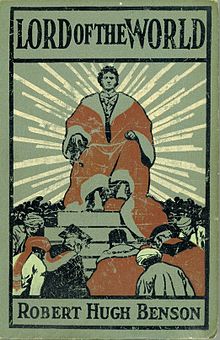
Book Break: Lord of the World

This past spring I ran across an Aleteia blog post relaying that both our current pontiff, Pope Francis, and our Pope Emeritus, Benedict XVI, have recommended the same novel to the Catholic reading public. The book–Robert Hugh Benson’s Lord of the World–is a dystopian novel about the coming of the Antichrist and the end of the world. So I bought a cheap copy for Kindle and have since devoured it. I could not put it down.

Monsignor Benson was the son of the Anglican Archbishop of Canterbury who converted to Catholicism and was ordained a priest. Though he and his work are not as well known today, he was praised in his time by great Catholic writers like Hilaire Belloc, and today by the likes of Joseph Pearce. Pearce has this to say about Lord of the World:

The world depicted in Lord of the World is one where creeping secularism and Godless humanism have triumphed over religion and traditional morality. It is a world where philosophical relativism has triumphed over objectivity; a world where, in the name of tolerance, religious doctrine is not tolerated. It is a world where euthanasia is practiced widely and religion hardly practiced at all. The lord of this nightmare world is a benign-looking politician intent on power in the name of “peace,” and intent on the destruction of religion in the name of “truth.” In such a world, only a small and shrinking Church stands resolutely against the demonic “Lord of the World.”

The novel was written in 1907, but from the world it creates, I would have guessed it had been published after one or both of the World Wars. It does feel prophetic, though I’ve ceased to be surprised by this, given the number of literary classics I’ve read in recent years that seem as though they fit our times. But Benson’s book is short, gripping, dark, terrifying at times–and beautifully represents the challenges of living a Catholic faith in a world with little use for it.

That said, it is a very Catholic book and may not be enjoyed as much by non-Catholics (unless, God willing, they have a heart very much open to learning about the faith). The cheap download for Kindle have numerous typos, but Ave Maria Press has a new edition out for those who prefer print anyway. I recommend it wholeheartedly.

We Are a Pilgrim People

“I’ll be home for Christmas, if only in my dreams.”
 
We are on the home stretch: a week out from the blessed Feast of the Nativity, Christmas, when we celebrate the birth of our Savior, Jesus Christ. Many of us, however, feel as though Christmas has been upon us for weeks now, an immense burden of gifts, lights, music, and cheer under which we labor to breathe—like a lone elf struggling to load the loot of the world into a glossy red sleigh.
 
The first Christmas was uncomfortable for a different set of reasons. In the days prior, a newly-married couple traveled from Nazareth to Bethlehem with a few essentials and a donkey. They traveled not by choice, but by order of the emperor in Rome. They arrived not to familiar faces, food, and comfort, but to a town crowded with distant kin and strangers, and the crudest of accommodations: a dugout-stable-turned-makeshift-nursery where the woman would give birth to a son.

It turned into celebration of sorts, I suppose, as angels summoned shepherds from the hills to the town to greet the newborn as they were, dirt-poor and smelling of sheep. A star, too, beckoned Magi from the East, strange and majestic, in rich robes and bearing gifts too generous for the circumstances. (I wonder if Joseph might have gripped his staff a little tighter, wondering how he, his wife, and son would make it back across the dangerous country alive while carrying gold, frankincense, and myrrh.)
 
Imagine a Christmas celebration in which only your third and fourth cousins showed up, along with the local indigent population and three fabulously wealthy foreigners—and then you had a baby the basement. Perhaps the stresses of this Christmas are more manageable from this perspective.

Mary and Joseph were displaced—from Nazareth to Bethlehem for the census; from Bethlehem to Jerusalem for the presentation of Jesus at the Temple; and in exile to Egypt, to protect their son from the murderous intent of Herod. Even as a baby, “the Son of Man has nowhere to rest his head” (Matthew 8:20).
 
In LIFT this month, we are completing our study of the Mass. As an introduction to the adult and teen lesson, we are watching a short video from elementsofthecatholicmass.com on the role of parishioners in the Mass. As the video explains, the word parishioner comes from the Greek work paraoikos, meaning pilgrim—it’s the same Greek word that gives us the English word pariah, which means outcast.
 
We don’t belong here. We, like the Holy Family, are a pilgrim people, en route to our true home with God in heaven. The Church is the ship that carries us: the ark which preserves God’s people from the storms and waves that batter and drown the rest of the world.* Let us take refuge here from the maelstrom—the dizzying spin the world has put on Christmas—and draw near, instead, to Mary, Joseph, and the newborn king of kings.
 
* * * * *
*In fact, the area of the church worship space where we sit, which we commonly call the sanctuary, is technically called the nave—which comes from the Latin word for ship.