The Feast Before the Feast

Alarm at 6. Hands inside a semi-frozen turkey at 6:05, breaking free the neck and extras. Stuffed and in the oven by 6:20. Sun’s not even up yet. Maybe I should head back to bed — it’s a holiday, after all.

Nah. Coffee and a quick post about the Feast before the feast.

Each year, the church offers a special Thanksgiving Mass on Thanksgiving morning — the perfect start to a day dedicated not so much to fats and football, but to that most precious of human expressions: gratitude. We are blessed people. Blessed to be breathing. Blessed to have a God in heaven who cared enough to create us, to give us an ordered world in which to live, and the freedom to strive, fall, and strive again.

In The Lamb’s Supper: The Mass as Heaven on Earth, Scott Hahn reminds us that the sacrifice of the Mass, the Holy Eucharist, takes its name from the Greek word for thanksgiving: “Man’s primal need to worship God has always expressed itself in sacrifice: worship that is simultaneously an act of praise, self-giving, atonement, and thanksgiving (in Greek, eucharista) (p. 26).”

In the early Church, the Eucharist would have been the most distinctive and outlandish characteristic of “the Way,” and the Church today reaffirms the sacrament as the source and summit of our faith. Our greatest expression of thanksgiving is a re-presentation of the greatest sacrifice ever known: God’s own humiliation and death on a cross.

Thank God it didn’t all end there.

Hahn goes on to write:

Perhaps the most striking liturgical “ancestor” of the Mass is the todah of ancient Israel. The Hebrew word todah, like the Greek Eucharist, means “thank offering” or “thanksgiving.” The word denotes a sacrificial meal shared with friends in order to celebrate one’s gratitude to God. A todah begins by recalling some mortal threat and then celebrates man’s divine deliverance from that threat. It is a powerful expression of confidence in God’s sovereignty and mercy (p. 32).

Our own family feasts of gratitude, then, should also involve a sacrifice, signifying that what we have is not ours by right, but a gift from above. We should give something back. And lest we think we’ve faced no mortal threat from which God has delivered us in this past year, we should remember Christ’s victory over death and Hell — the fundamental threat of our mortality, which none can escape except through God’s grace.

So instead of scarfing the last of the potatoes on our plate to beat our siblings to the last piece of pie, or skipping cleanup to ensure we get the sunniest couch cushion on which to nap, we should give and serve. We should make a point of saying Grace and sharing our blessings. And we should avail ourselves of the Feast before the feast: the precious Body and Blood of Jesus, at our communal table, the altar.

Time now for a shower. If I don’t see you this morning, may you have a blessed Thanksgiving!
Wear Your Faith Lightly

“Seriousness is not a virtue. …[S]olemnity flows out of men naturally; but laughter is a leap. It is easy to be heavy: hard to be light. Satan fell by the force of gravity. 

– G.K. Chesterton, Orthodoxy

About the time I graduated high school, I remember a conversation with my dad about a friend of mine. You know the guy—great fun to be around, but always on the edge of trouble, and one could never be sure he’d stick around if things went south. “But someday,” said Dad, “he’s going to grow up, raise a family, and be an upstanding citizen. And he’s going to look back on his high-school days and think, ‘Man, I had fun.’”

He looked at me and said, “Sometimes I wonder if you’ll be able to say the same.”

I have always been a serious soul—earnestly wanting to do the right thing, to avoid the mistakes I could and learn from the ones I couldn’t. I was the kind of kid who felt so badly for things I did wrong that I ratted on myself. Even today, I am an emotional sort who avoids the news to keep from raging or sorrowing over the terrible things that happen to people I don’t know.

This serious streak has also manifested itself in my faith life. I am so abundantly blessed, both at home and at work, but you wouldn’t always know it. The weight of my faults and earthly concerns drag my gaze downward until all I see is dust and grime. At times I dwell on past sins that have already been forgiven, and against my own advice to others, I worry about things that have not, and may never, come to pass.

This is not what God desires for us. In the parable of the talents from last weekend’s gospel, the master bids his two worthy servants, “Come, share your master’s joy.” Earlier in Matthew’s gospel, Jesus reassures his disciples, “Come to me, all you who labor and are burdened, and I will give you rest. … For my yoke is easy, and my burden light.” Though Jesus tells us we should expect to suffer for our faith, these are not the words of a Lord who wishes for us to suffer needlessly. God wants us to be happy.

A friend recently gave me a collection of C.S. Lewis speeches entitled The Weight of Glory. Lewis opens with a reflection on the idea that Unselfishness has replaced Love as the highest virtue in modern society, and insists that this shift is a mistake, because it put the emphasis on denying ourselves and not on helping others. The focus has shifted inward, but in a stoic, joyless sort of way that fails to acknowledge the extravagant promises to us who live a holy life. Lewis writes, “We are half-hearted creatures, fooling about with drink and sex and ambition when infinite joy is offered us.”

Imagine: infinite joy! Should that not put a spring in our step and a laugh in our throat, and raise our gaze toward heaven? And won’t that light-hearted faith be far more attractive and illuminating to those lost souls circling like moths in the darkness, trying to find their way?

Blogger’s Note: This article appears in the Sunday, Nov. 23, church bulletin .

LIFT Links: In Defense of Large Families and a Great Reflection for Parents

Blogger’s Note: In an effort to help friends find great Catholic content that supports them in the practice of their faith, periodically I’ll be sharing articles, websites, books, and other resources that may be of interest.

  • In Defense of Large Families. If you’ve had more than one or two children, you’ve probably already encountered someone asking incredulously, “Are all of them yours?” This article, “Your Mother Is Destroying the Earth,” authored by an Ivy League grad and sister of four, rebuts the idea that it’s any of their business at all — and links to some solid material about the dangers of declining birth rates. Worth a read, if only to laugh at the audacity of people who, on other issues, would demand the government stay out of private bedrooms and away from personal bodies.
  • They’re the King’s Kids. A fellow faith formation director from our previous parish, St. Michael in Remus, Michigan, shared this article from Fr. Barron’s Word on Fire blog: “Kreeft, Kids, and Cattle.” The post, by theology professor Tom Neal, is a great reminder that our job as parents is to “love the Hell out” of our kids and get them to Heaven. It’s easy to lose track of that in our day-to-day, hectic lives. Grades, sports, and college choices are important, but they don’t necessarily have eternal implications. “They’re the King’s kids. You’re His foster parents.”

Farewell to Puck

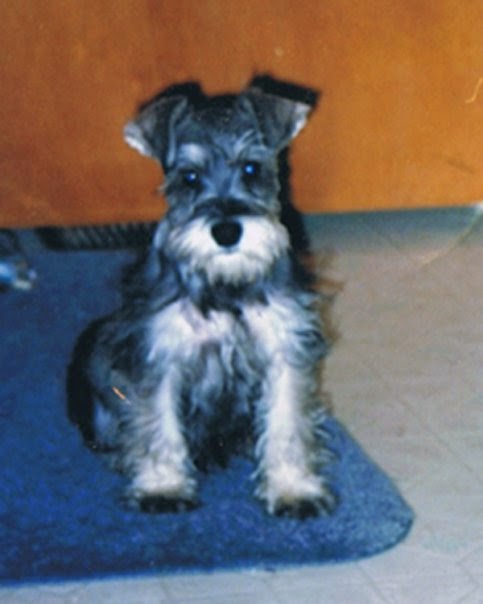
Our new pup, circa 2002

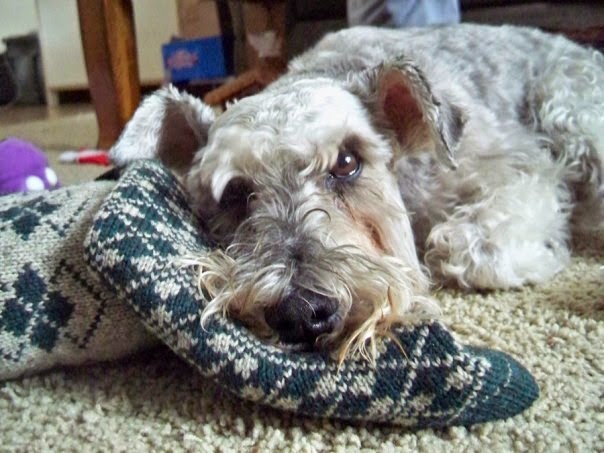
We lost Puck today. At 13 years old, he was certainly not a young for a dog, but definitely not old for a Schnauzer. He had begun, in recent years, to sleep longer and run less, and earlier this fall, he had some teeth removed. At that time, the vet said his blood work was clean and extolled how healthy he seemed for his age, but warned that at this stage in a dog’s life, anything can happen.

And it did. Over a matter of weeks, Puck went from old to frail. He never complained, but slept more, ate less, and stayed closer to the house and us. He was slower on the stairs and slower to respond to our calls and whistles. Then a few days ago, he lost his balance and struggled to stand. Our other dog, Boomer, had done this several times in his old age — he would usually sleep for the better part of a couple of days, then be up and around again. Only Puck didn’t recover.

He was 13, and our kids are age 16 to 2, so he’s been a part of the family for as long as they can remember. We miss him.

Puck, all Christmased out.

We got Puck from a Schnauzer breeder on an old farmstead in rural Michigan. I wanted another dog — a smaller, indoor pet, since Boomer was big, woolly, and hated being inside. Jodi is not a dog person, but gave in to my persistence and the boys’ pestering. (Or was it vice versa?) He was an adorable pup (my Dziadzi — Polish for grandpa — was not overfond of our Airdales, but looked at our Schnauzer and said, “Now that’s a dog!”), and full of curiosity and mischief. I was struggling to come up with a name that reflected both his Germanic roots and his personality, and my choices were getting more and more outlandish. At one point, the name Wolfgang came to mind. I had Mozart on the brain, but was freely associating, and thought of the chef, Wolfgang Puck, then of the Shakespeare character from A Midsummer Night’s Dream.

I looked at our impish pup, and the name fit. (Of course, only later did I discover how a grown man shouting, “Puck!” out the back door sounded to the neighbors, or how many Minnesotans would instantly assume I was a hockey fan.)

Steamy summer roadtrip…

He’s always been an easy keeper and a good traveler. In fact, the only trouble he’s ever been came from a tendency in his younger days to know exactly when we were preoccupied by something else and high-tail it around the neighborhood. During the day, he would turn up in someone’s garage, or walk in through their front door with their kids, and they’d look at his collar and call. At night, he’d run yard to yard, and I’d drive with my head out the window, listening for jingling dog-tags or a neighbor dog in an uproar, trying to catch up to him.

After Boomer passed, Puck no longer wanted us to travel anyplace without him. If he sensed even a hint that we were preparing for something longer than a day trip, he would look for an opening, jump into the van, climb as far back in as he could, and refuse to come out unless I removed him. He would lay in whatever open space he could find in our overstuffed minivan, never bothered the kids when they were eating, and was content to sleep in the vehicle, in garages, in tents, wherever, as long as he could come with us. On cold winter nights, he would curl up under my old Carhartt jacket, head and all, and be there in the morning, ready to greet the frosty dawn.

He loved dog biscuits and pop corn and being scratched above the collar bone, beneath the collar. He used to love chasing tennis balls, but only in the house. He never liked to be picked up or manhandled — I could do what I wanted (he would even roughhouse a bit with me), but he only tolerated Jodi or Brendan lifting him, and nobody else. In recent years, he tended to get out of traffic when little kids were around. He tolerated other known dogs, but strays drove him berserk. Cats made him quiver with nervous energy; he was never quite sure whether he was supposed to chase them or not, and they seemed to relish his uncertainty and rub it in his face.

The old man, a couple weeks ago.

When we told the kids last night that it might be his last, we recalled three other special memories. Jodi remembered how our little ones, especially Lily, bonded with Puck by dropping food from their highchairs, and when they realized he was eating it, making a game of it. I remember him shifting from front foot to front foot and softly ruffing at us when he thought we were paying too much attention to baby Lily and not enough to him.

I also remember how perceptive he could be. He had a habit of sidling up to whomever he thought was most likely to pet or snuggle him — he would sit on your toes, even, or thrust his soft gray head up under your hand. But when we lost little Jude, I remember him insisting that I pet him as I lay on the couch or the bed, quiet and sorrowful. He nudged, prodded, cajoled, as if to say, C’mon…better days are ahead!

And he was right.

Goodbye, old man. Good dog.

Inspiration and Aspiration: Our Blessed Mother and the Apostles

inspiration – n. – the action or power of moving the intellect or emotions
aspiration – n. – a strong desire to achieve something high or great

Last month, our adult faith formation groups talked about Our Blessed Mother. The discussions were good, and the Q&A with our priests each night centered primarily around the Immaculate Conception and the fact that Mary remained sinless throughout her life.

I find Mary to be a tremendous inspiration. By saying yes to God plan and saying no to sin, she received her heavenly reward, body and soul, immediately upon leaving this world. And that simple, resolute yes changed the history of the world! Would that all of us could do the same: resolve to do God’s will, whatever the cost, and refuse to yield to temptation, however strong.

Of course, we are not immaculately conceived and full of grace — so while it can be inspiring to meditate on Mary, the crown of creation, it can be difficult (and perhaps moreso for a man) to imagine putting ourselves in her shoes and following in her footsteps.

This month, the adult groups will be talking about Saints Peter and Paul. I recently had the chance to show an Orthodox priest and iconographer the great Eastern-style icons in our sanctuary, and I asked why Paul was portrayed in the dome with the other 11 original apostles. He replied that in the Eastern tradition, Peter and Paul always go together: the weak one who denied Christ and became the Rock, and the proud one who persecuted the church and became the great evangelist to the Gentiles. Both men prove that it doesn’t matter who or where we are, what we do, or how much we stray — when at last we are ready to turn to God, He is right there beside us.

The apostles are great examples of the wondrous creations God can make with broken pieces like you and me. With all their imperfections, St. Peter and St. Paul call us to holiness and to persevere in faith — and because they stumbled along the way, they make the path to heaven seem navigable.