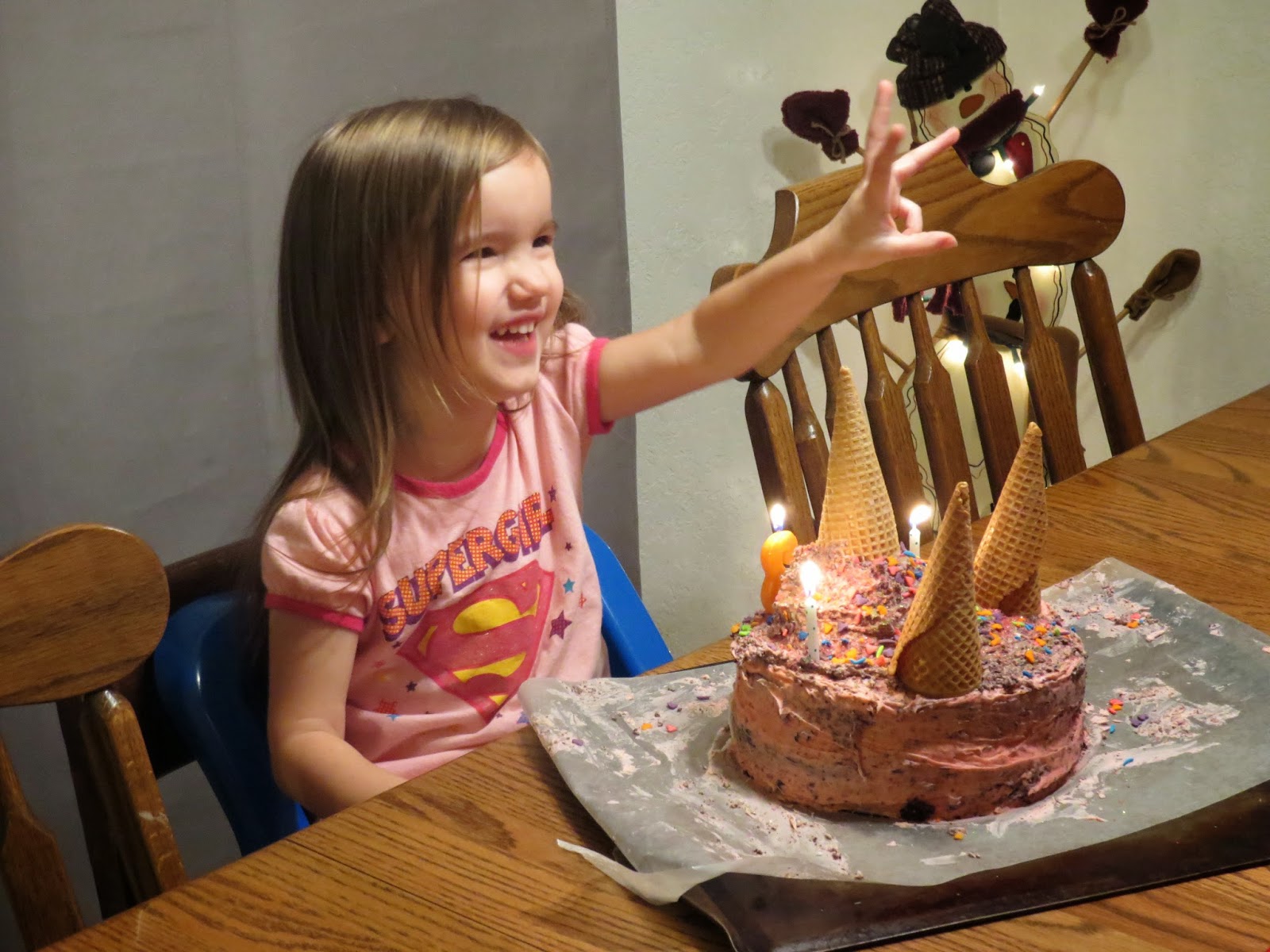
How the Baby of the Family Celebrates

“I’m three now!”

 On Monday, our monsterpiece turned three. Strangely, the fact that, for one special day, the world revolved around her seemed very much like any other day, except that she also got to choose what we had for dinner. Baked mac-and-cheese and meatloaf was the order. (Actually, Double Beetloaf, a tongue-in-cheek name for a family favorite recipe from Jodi’s soon-to-be sister-in-law, Tally.) And a castle cake, with pink frosting and multicolor sprinkles.
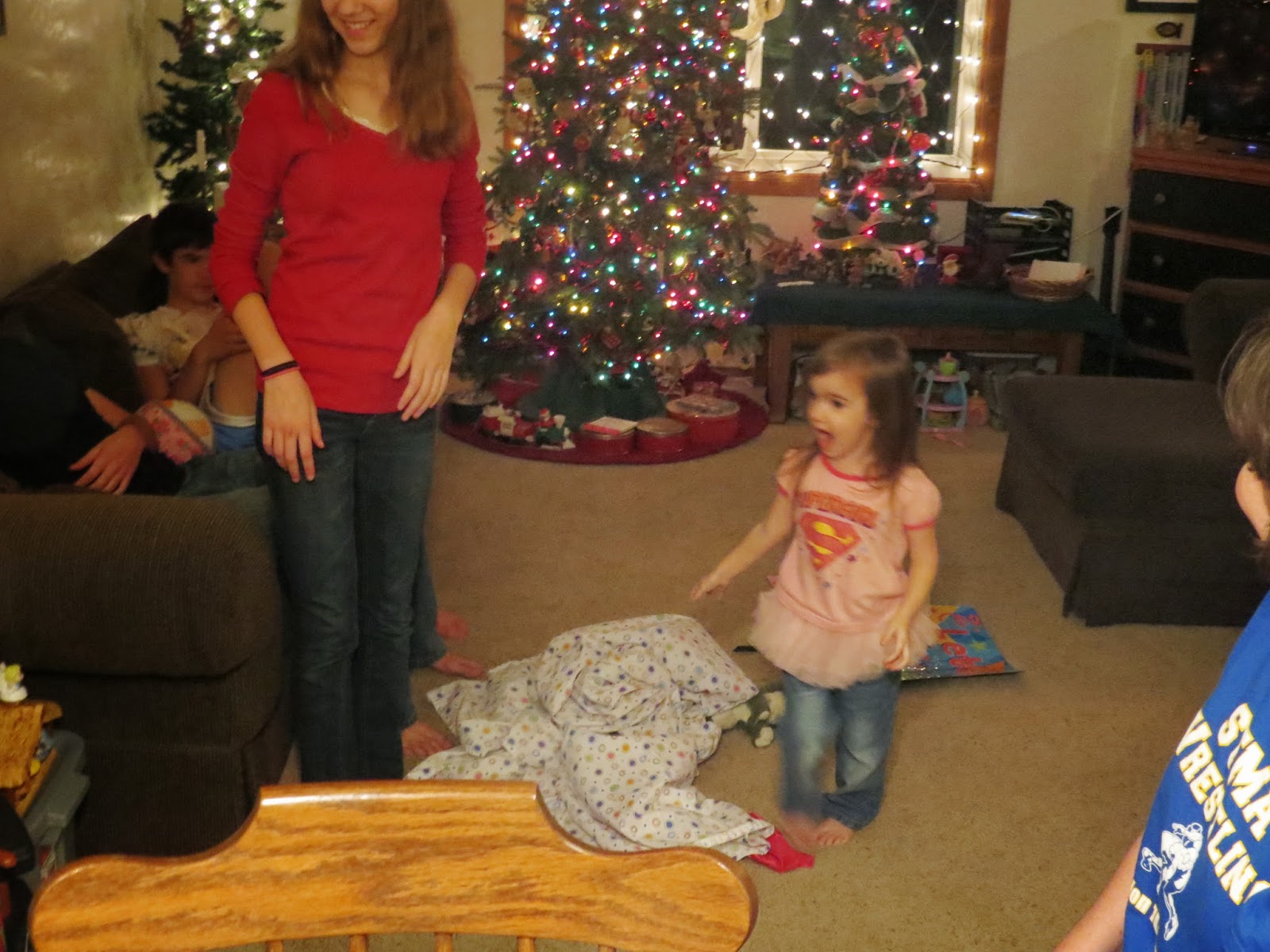
She just uncovered her new gift.

Her gift has been hiding in our shed since late last summer: a toy kitchen, complete with cookware and play food, picked up at a garage sale down the street. She’s been cooking vegetable-donut soup, making coffee with baked beans and green beans, and making giant cups of tea topped in strawberry ice cream ever since.
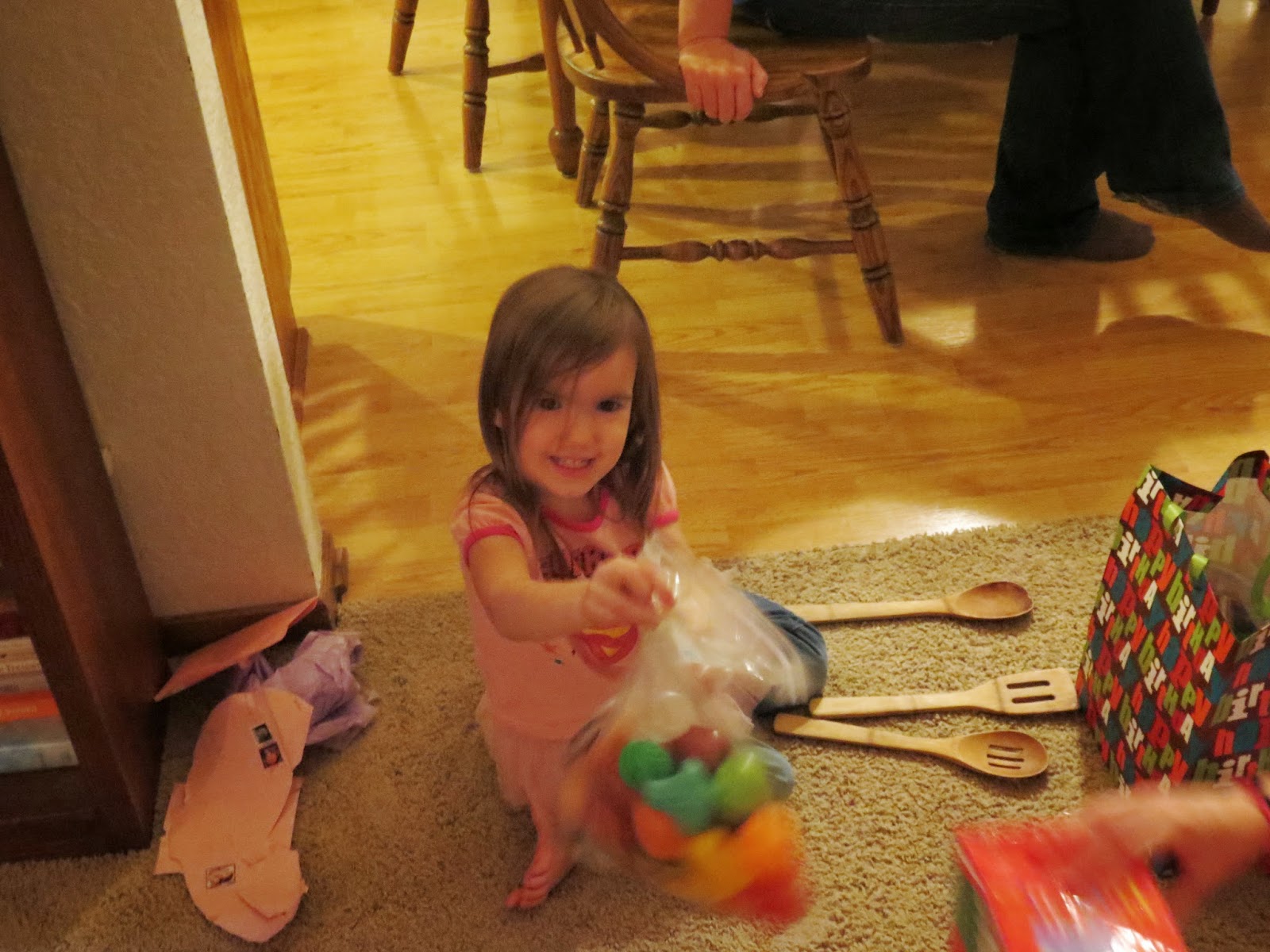
No real veggies could ever compare!

Based on these recipes, she will not be catering her birthday party this weekend, which she somehow convinced everyone she was having by talking about it for the past month as if it were a reality. She has invited two girls roughly her age from daycare, one preschool-age neighbor girl, plus Emma’s middle-school friends Ella, Emma, Paige, and Olivia; and Brendan’s and Gabe’s high-school friends Olivia, Joe, Jeff, Justin, and Joey.
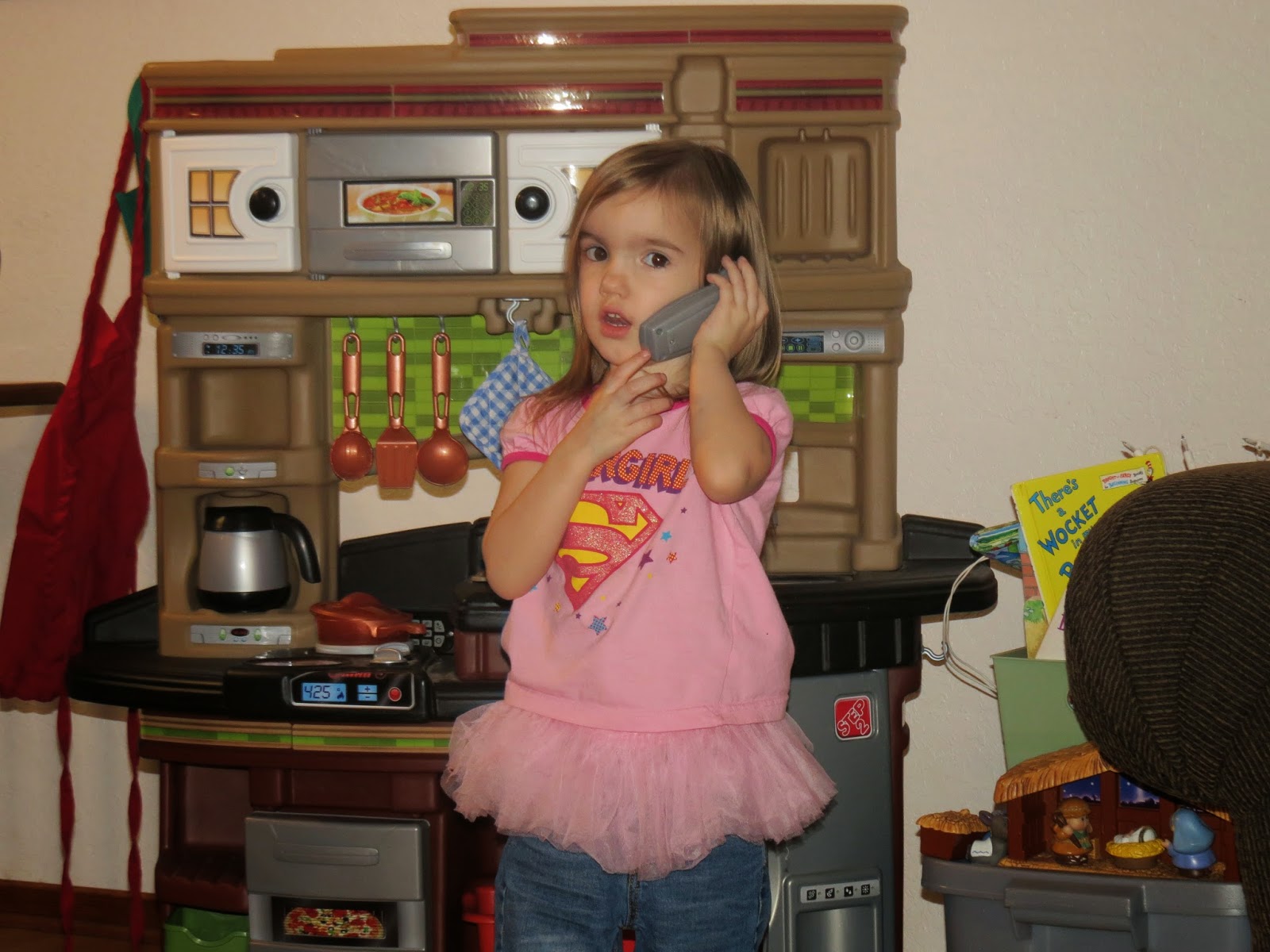
“Excuse me…I need to take this.”

See, they’re her friends, too. She knows them. She talks to them. She claims them. And I think most of them are coming, because when Lily beckons, it’s what you do.

“She so cute!” Jeff’s and Joe’s parents gushed at Brendan’s wrestling meet tonight.

Oh, no, I thought. She’s got you, too.
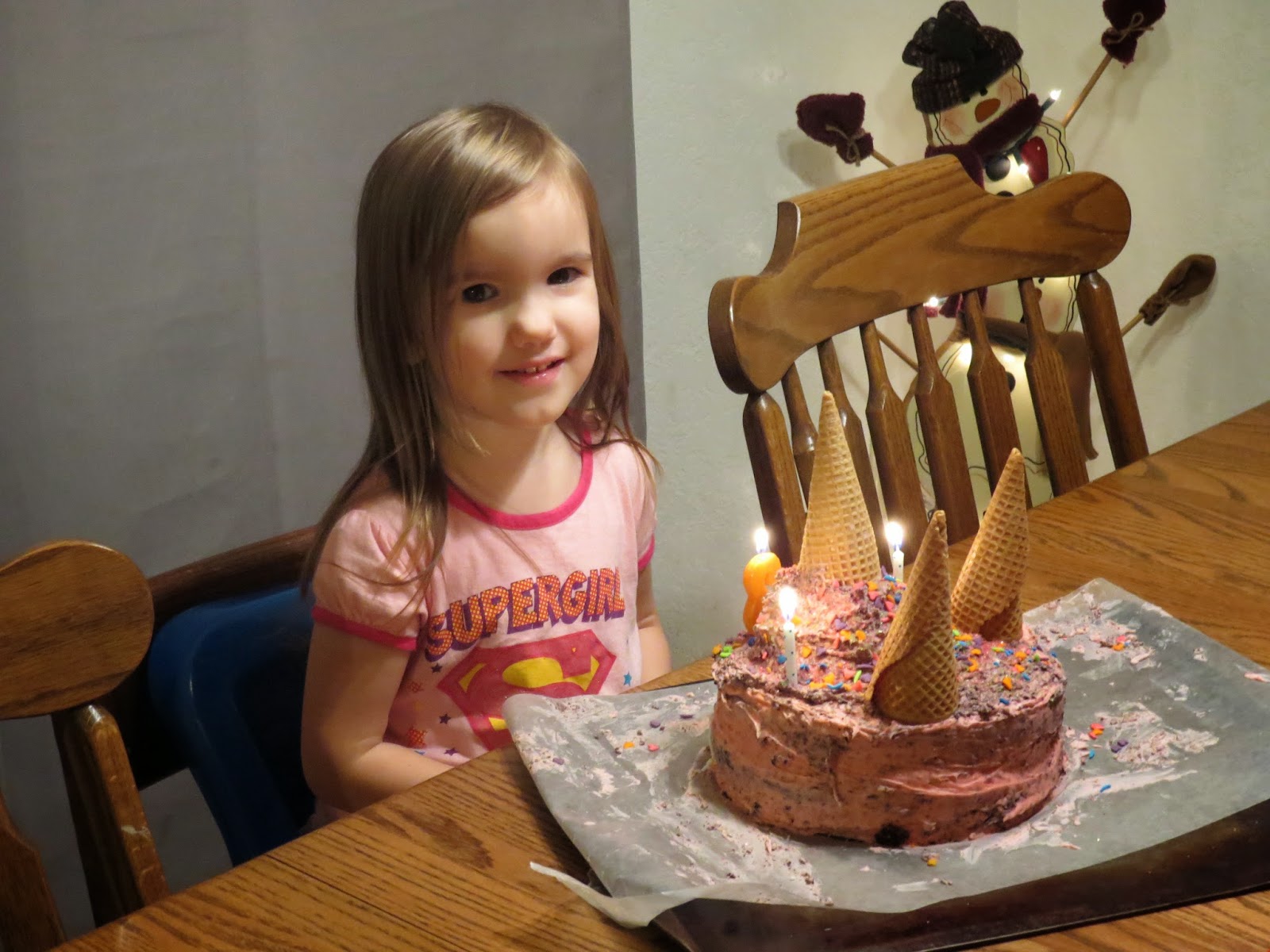
Happy birthday, dearest monster!

Called to the Light Through Confession

Not long after Jodi and I were married, I found myself sitting beside her at Mass with more questions than answers about why I was coming every week, but refusing to resume receiving the sacraments. I had been baptized Catholic as an infant, and had made my First Reconciliation and First Communion as a tween, but had not grown up in the faith. I had a few doubts, a dozen objections, and a hundred excuses — but fatherhood changes a guy, and I was struggling with the fact that what I loved about my wife (her strong and solid faith) I was as yet unwilling to commit to myself.

Our priest at St. Michael Catholic Church in Remus, Michigan, changed all that. I asked Fr. Bill if I could meet with him one evening, and we talked for a couple of hours or more. I dumped my doubts, issues, concerns, and questions in the middle of the floor of the rectory living room, and he helped me pick through them awhile.

Finally he said, “Jim, you’ve got a good head on your shoulders. God gave you that brain, and he wants you to use it. But you aren’t going to find the answers to all your questions if you hold your faith away from you and examine it at a distance. You need to embrace it and look at it up close. You should consider going to confession and resume receiving the Eucharist.”

It sounded reasonable, so I thought I would consider it. “Okay,” I said, “Thank you, Father.”

He smiled. “If you like, I can hear your confession right now.”

“I dunno,” I said. “It’s been a long time…I don’t even remember how.”

“Don’t worry,” Fr. Bill said. “I can help you through it.”

After another half-hour or more, I floated home to my bride, a goofy smile on my face. I have not lived my faith perfectly in the days since that second “First” Confession, but I am always amazed at how wonderful it feels to receive God’s mercy through the sacrament of Reconciliation.

A couple weeks ago, a dear friend in Michigan sent me a copy of Faith magazine from the Diocese of Grand Rapids. On the cover was Fr. Bill, older and balding, but with the same kindly smile. The title of the article? “God is Madly in Love with You: Fr. Bill Zink and the Sacrament of Confession.” It’s a great reminder to practicing and fallen-away Catholics that God loves us — and a reassuring pledge that there is nothing to fear from this blessed sacrament.

Read it and share it, if you feel called — and thank you, Father, for calling me back into the Light!

LIFT Links: On Christmas, Mentoring, and Chastity

Blogger’s Note: In an effort to help friends find great Catholic content that supports them in the practice of their faith, periodically I’ll be sharing articles, websites, books, and other resources that may be of interest.

  • This Christmas, Strive to Look Good on Wood. It’s a bit poetic, but this reflection on the scandal of God coming down to be born in a feed trough and die on a cross is worth a slow read in a comfortable chair. Oh, how He loves us!
  • Sticks and Stones? Those Catholic Men reflect on how important it is for mentors (from fathers to teachers, coaches to catechists) to be thoughtful in their words. I know I’ve been one to snarl, “Man up!” from time to time myself…but how beautiful the words of God: This is my beloved son, in whom I am well pleased!
  • Chastity Is For Lovers. A columnist for the National Catholic Register reviews a book with an important message, not just for young adults, but for old married couples as well. I can speak to this from my own conversion after 11 years of marriage (most of them as a practicing Catholic): marriage does not do away with the need for chastity. Indeed it is essential to happiness in married life!

    The Feast Before the Feast

    Alarm at 6. Hands inside a semi-frozen turkey at 6:05, breaking free the neck and extras. Stuffed and in the oven by 6:20. Sun’s not even up yet. Maybe I should head back to bed — it’s a holiday, after all.

    Nah. Coffee and a quick post about the Feast before the feast.

    Each year, the church offers a special Thanksgiving Mass on Thanksgiving morning — the perfect start to a day dedicated not so much to fats and football, but to that most precious of human expressions: gratitude. We are blessed people. Blessed to be breathing. Blessed to have a God in heaven who cared enough to create us, to give us an ordered world in which to live, and the freedom to strive, fall, and strive again.

    In The Lamb’s Supper: The Mass as Heaven on Earth, Scott Hahn reminds us that the sacrifice of the Mass, the Holy Eucharist, takes its name from the Greek word for thanksgiving: “Man’s primal need to worship God has always expressed itself in sacrifice: worship that is simultaneously an act of praise, self-giving, atonement, and thanksgiving (in Greek, eucharista) (p. 26).”

    In the early Church, the Eucharist would have been the most distinctive and outlandish characteristic of “the Way,” and the Church today reaffirms the sacrament as the source and summit of our faith. Our greatest expression of thanksgiving is a re-presentation of the greatest sacrifice ever known: God’s own humiliation and death on a cross.

    Thank God it didn’t all end there.

    Hahn goes on to write:

    Perhaps the most striking liturgical “ancestor” of the Mass is the todah of ancient Israel. The Hebrew word todah, like the Greek Eucharist, means “thank offering” or “thanksgiving.” The word denotes a sacrificial meal shared with friends in order to celebrate one’s gratitude to God. A todah begins by recalling some mortal threat and then celebrates man’s divine deliverance from that threat. It is a powerful expression of confidence in God’s sovereignty and mercy (p. 32).

    Our own family feasts of gratitude, then, should also involve a sacrifice, signifying that what we have is not ours by right, but a gift from above. We should give something back. And lest we think we’ve faced no mortal threat from which God has delivered us in this past year, we should remember Christ’s victory over death and Hell — the fundamental threat of our mortality, which none can escape except through God’s grace.

    So instead of scarfing the last of the potatoes on our plate to beat our siblings to the last piece of pie, or skipping cleanup to ensure we get the sunniest couch cushion on which to nap, we should give and serve. We should make a point of saying Grace and sharing our blessings. And we should avail ourselves of the Feast before the feast: the precious Body and Blood of Jesus, at our communal table, the altar.

    Time now for a shower. If I don’t see you this morning, may you have a blessed Thanksgiving!

    Wear Your Faith Lightly

    “Seriousness is not a virtue. …[S]olemnity flows out of men naturally; but laughter is a leap. It is easy to be heavy: hard to be light. Satan fell by the force of gravity. 

    – G.K. Chesterton, Orthodoxy

    About the time I graduated high school, I remember a conversation with my dad about a friend of mine. You know the guy—great fun to be around, but always on the edge of trouble, and one could never be sure he’d stick around if things went south. “But someday,” said Dad, “he’s going to grow up, raise a family, and be an upstanding citizen. And he’s going to look back on his high-school days and think, ‘Man, I had fun.’”

    He looked at me and said, “Sometimes I wonder if you’ll be able to say the same.”

    I have always been a serious soul—earnestly wanting to do the right thing, to avoid the mistakes I could and learn from the ones I couldn’t. I was the kind of kid who felt so badly for things I did wrong that I ratted on myself. Even today, I am an emotional sort who avoids the news to keep from raging or sorrowing over the terrible things that happen to people I don’t know.

    This serious streak has also manifested itself in my faith life. I am so abundantly blessed, both at home and at work, but you wouldn’t always know it. The weight of my faults and earthly concerns drag my gaze downward until all I see is dust and grime. At times I dwell on past sins that have already been forgiven, and against my own advice to others, I worry about things that have not, and may never, come to pass.

    This is not what God desires for us. In the parable of the talents from last weekend’s gospel, the master bids his two worthy servants, “Come, share your master’s joy.” Earlier in Matthew’s gospel, Jesus reassures his disciples, “Come to me, all you who labor and are burdened, and I will give you rest. … For my yoke is easy, and my burden light.” Though Jesus tells us we should expect to suffer for our faith, these are not the words of a Lord who wishes for us to suffer needlessly. God wants us to be happy.

    A friend recently gave me a collection of C.S. Lewis speeches entitled The Weight of Glory. Lewis opens with a reflection on the idea that Unselfishness has replaced Love as the highest virtue in modern society, and insists that this shift is a mistake, because it put the emphasis on denying ourselves and not on helping others. The focus has shifted inward, but in a stoic, joyless sort of way that fails to acknowledge the extravagant promises to us who live a holy life. Lewis writes, “We are half-hearted creatures, fooling about with drink and sex and ambition when infinite joy is offered us.”

    Imagine: infinite joy! Should that not put a spring in our step and a laugh in our throat, and raise our gaze toward heaven? And won’t that light-hearted faith be far more attractive and illuminating to those lost souls circling like moths in the darkness, trying to find their way?

    Blogger’s Note: This article appears in the Sunday, Nov. 23, church bulletin .