Homebrew II: Irish Stout

My second batch of homebrew was an Irish Stout kit from Midwest Supplies, fermented with the recommended Wyeast packet in the same glass carboys and set-up used for my first batch. Brewing came off without a hitch, except that I forgot to take an initial hydrometer reading and then broke my hydrometer before taking a reading the afternoon I transferred to the secondary fermenter. (All this means is that I have no real idea regarding alcohol content, though from the feeling in my cheeks and ears, I’d say around 4.5 to 5 percent.)

The kit contained a small packet of gypsum, which (as I understand it) can be used to tweak the pH of your water, but in this context, is used to accentuate the bitterness of the brew and give you a drier stout. The wort tasted stoutish, and the samples at racking and bottling both tasted like flat stout…all good signs in my book.
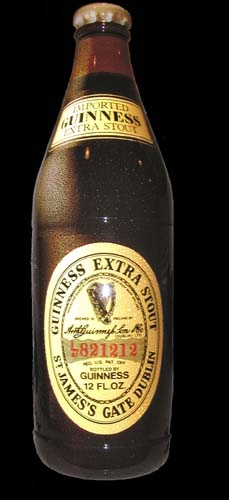
The final result? This is good beer, like the non-draught bottled Guinness I used to buy, only (dare I say?) better. Like strong French roast coffee, hearty bread dark-toasted, with a pleasant prickliness that grabs your tongue on the way down. [Blogger’s Note: I may be biased, since it’s mine, my own, my…prrrrecious!] I’ve had one bottle chilled and several at basement temperature (around 65 degrees F), and all have been delicious, though the warmer ones are decidedly better in my book.

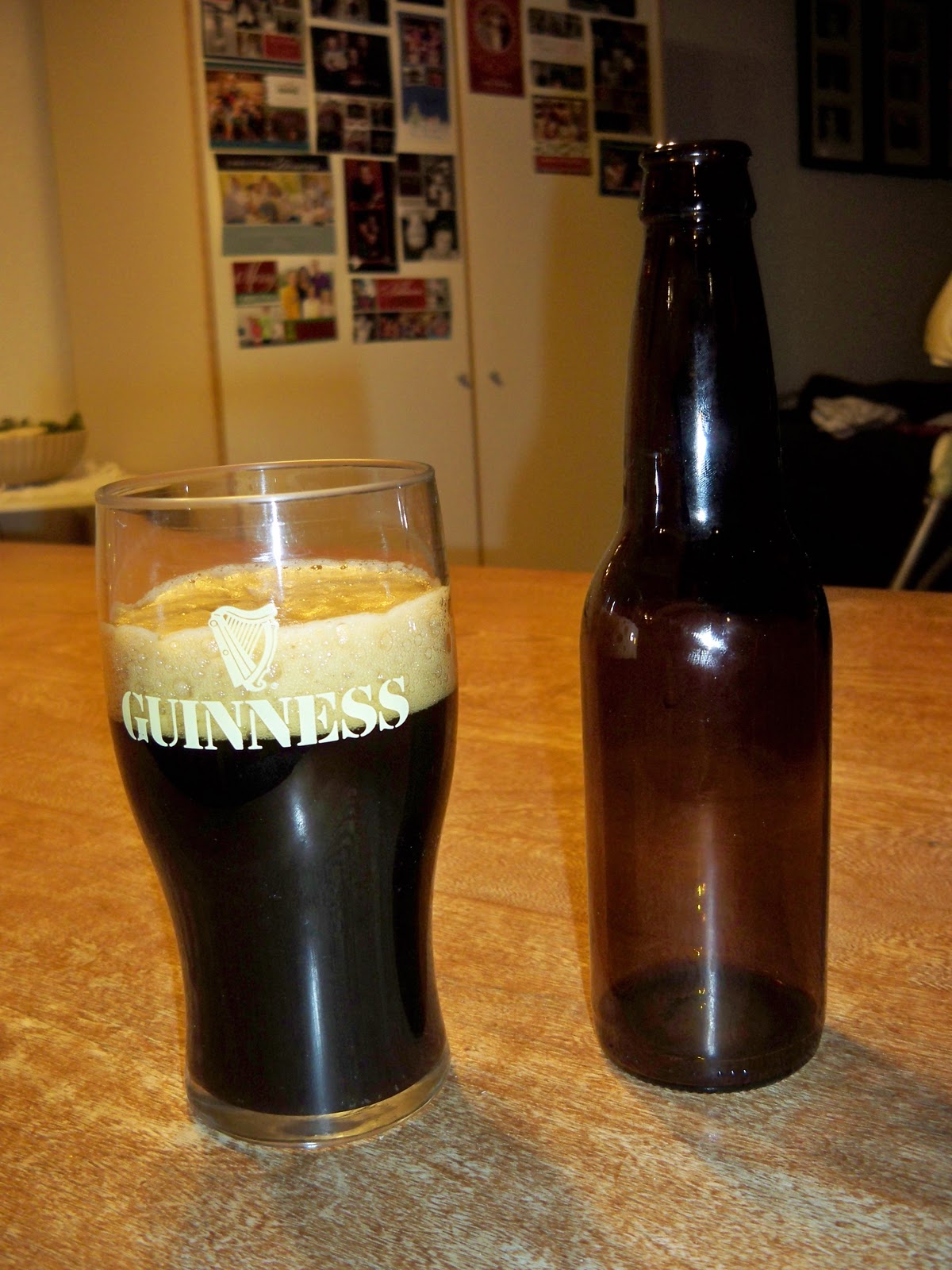
Complaints? I definitely get a better head with these (see the top photo), but it still lingers only a few minutes. Also, I had hoped to make an all-homebrew black and tan with one my few remaining English pale ales, but despite my Dad’s insistence that he has successfully pour a black and tan with non-draught stout, I failed on multiple attempts. The resulting mistakes were consumed, of course, and fortunately tasted like good dark beer.

My next brew awaits bottling. It’s a bit of an experiment using an old stout kit from a decade ago. More on that when the time comes. In the meantime, as Dad and I would say, “Na zdrowie!”*

—–

*Na zdrowie (nah ZDRO-vee-ah) is a Polish toast meaning “to your health.”
Book Break: A History of Corruption

As I mentioned last summer, I’ve been reading a number of diverse books as research for a novel that I hope to complete in 2012. These have included three books on the Irish mob in the U.S. which, together, paint a sobering picture of corruption extending back to the earliest days of our republic.

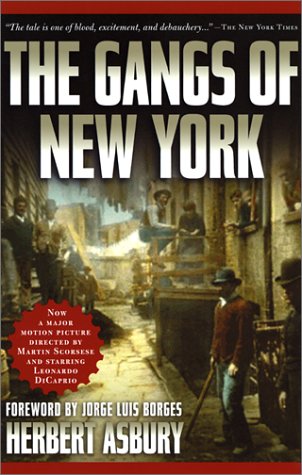
The Gangs of New York: An Informal History of the Underworld

Written by journalist Herbert Asbury and published in 1927, this book provided much of the fodder for the Scorcese film Gangs of New York, if not the actual storyline. It paints a picture of unimaginable squalor, poverty, violence, racism, and political corruption beginning in post-colonial New York City and continuing through Prohibition. Filled with colorful characters and a mix of historical facts and gangster lore and legend, it is a darkly engaging read that makes the reader question how close our animal instincts may lurk beneath our human surface. The propensity for grotesque violence among those with no hope and nothing to lose stands in sharp contrast to our usual views of American ideals and opportunity at the time of our nation’s founding. I will see the film soon, but I don’t expect to enjoy it much…

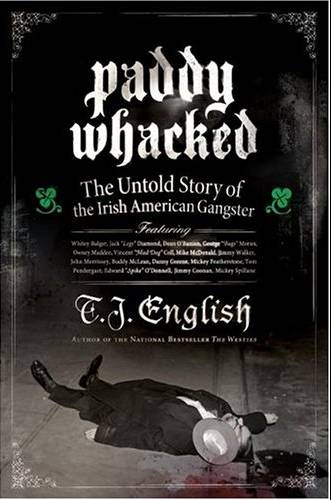
Paddy Whacked: The Untold Story of the Irish American Gangster
This 2006 volume by T.J. English draws on the Asbury book as a source, but digs deeper, extending beyond New York City to Chicago, New Orleans, Kansas City, and Boston, and including the mid- and late-20th century. The book is more explicit about the relationships between Irish mobsters and hoods and the Italian Mafia, organized labor, corporate strikebreakers, and politicians on both sides of the aisle. (It also paints a less romantic picture of the Kennedy family and suggests multiple strong motives for the assassination of President Kennedy.) It appears to be well researched and is also an engaging, if disturbing, read. Whereas The Gangs of New York made me question human nature, Paddy Whacked made me question the nature of our democracy.

Black Mass: The Irish Mob, the FBI, and a Devil’s Deal
This 2001 book by Boston Globe journalists Dick Lehr and Gerald O’Neill tells the story of the legendary South Boston crime boss Whitey Bulger: his rise to power and secret status as a federal informant whose corrupt FBI handlers protected him and his men from prosecution for years. The recent Scorcese film The Departed may have been a remake of the Hong Kong crime thriller Infernal Affairs (in some cases shot-for-shot), but the South Boston setting and the Jack Nicholson character are inspired by this true tale, and Bulger’s capture this past summer after 16 years on the lam does little to fend off the disquieting feeling that we cannot know who the bad guys are or how far their reach extends. A parallel history of Bulger’s brother, formerly a prominent state senator and president of the University of Massachuesetts, adds to that feeling…

Taken together, these books provide a sobering look at the seamy underbelly of “truth, justice, and the American way.” Strong language and violence abound, and these books won’t leave you feeling warm and fuzzy about the world, but they are good, solid reads.

Greeting From the North Pole, Part IX

Blogger’s Note: Over Christmas 2003, we became annual pen-pals with an elf named Siberius Quill, and he has again delivered this year! Transcriptions of past letters from Quill can be seen here.

Christmas 2011
My dearest children!
Bless my soul, but you’ve thrown a wrinkle in my writing! Again, the four of you have been on Your Very Best Behavior (all in all), so I’ve had my attention elsewhere—joining the Watcher Corps to observe and encourage those Children-on-the-Cusp, who drift from Naughty to Nice and back again throughout the year and may need a Pre-Christmas Nudge to keep them aright. Our Director of Circumstance, Miss Incognita Trueheart, and her team of Elfin Infiltrators secretly arrange opportunities for these children to do what is Right and Good, free from distraction or wicked influence, and most “Cuspers” thereby prove their True Loving Natures and merit the Nice List.
But back to the point: Such is time to an elf already centuries old, and so engaged was I in the trials of my other Young Charges, that I overlooked the Blesséd Arrival of little Lillian Clara, your delightful Baby Sister! I had thus already penned my letter to Masters Brendan, Gabriel, and Trevor, and the lovely (and still special, regardless of what your Father says in jest), Miss Emma, when the Goodchild Twins burst into my room with bright grins, all a-flutter. Now, the Goodchilds (or Goodchildren, as they prefer to be known), are the daughters of Old Abacus, the Master Counter, who for long centuries stretching to millennia, has aided my forefathers on the Quill side with assembling The List for the Old Man, ensuring no one is left off! Plethora Goodchild is herself a Nursery Watcher, whose sole responsibility is to monitor the hospitals, huts, ambulances, and baby-rooms of the world—anywhere a New Someone might appear, and add the Infant’s name to our records. Oftentimes she knows Who and Where to watch, for her sister, Firtilitee, is an elfin Midwife, who aids in the Arrivals of our Own Kind and has an eye for spying Baby Bumps, even on humans. Indeed, it was Plethora and Firtilitee Goodchild who first told me of the Expectation and Loss of little Jude last autumn, and they have watched your Dear Mother with much joyful anticipation these several months! Welcome, Lily! A very Merry Christmas indeed! Santa is most pleased to have Another Reason to stop over, and I am grateful for another Wee One to bring along in the Ways of Christmas!
You Older Ones have asked no questions of me this year, though I suspect you hold some close to your Hearts. It is no Crime to doubt Father Christmas and his Ways, for he is not only Bold and Jolly, but also Cunning and Elusive as the Artic Fox which pilfers ptarmigans from our coops! When you seek him hardest he slips your grasp, only do not lose your Sense of Wonder—for it is there, in your sleeping and waking Dreams—that you will find the Saintly Old Sprite, warming his hands o’er the Fire of your Own Heart. You’ll know he is Real when you do the Hard Work he does—the work that Christ Himself assigned to each of us: loving Each Other, our Neighbors, and our Enemies. Christmas is not about Any of Us, after all—it is always about Someone Else entirely (and the Child in the Manger, of course).
Ah, but I ramble so, and have run out of paper! A Very Happy Christmas to you all!

Siberius Quill

Trevor Remembers Jude

Several years ago, we purchased a cheap, pre-lit, artificial Christmas tree from Fleet Farm. It had been clearanced after the holiday, and we figured we could use it on those Christmases when we were travelling for much of the Christmas season and didn’t want a pricier real tree browning in our living room while we were gone.

The first time we set it up, the kids were excited. The box showed a mother and child decorating a beautiful, full, authentic-looking evergreen and brimming with holiday cheer. The box contained a green steel pole and stand, wrapped in what appeared to be the green shag version of outdoor carpet, and an array of giant green pipe-cleaners.

We put it together, bent the branches as best we could to block the view of the pole, and stepped back to admire our creation. Gabe looked from the bedraggled “tree” to the box and back again. “Can they do that?” he asked.

We sometimes still use the tree, just for a little extra greenery and lights, in some out-of-the-way corner of our home. This year we put it behind the Big Chair in our living room, and when we lucked into some extra Christmas decorations on Freecycle, we found ourselves with extra green, red, and gold balls, so we agreed to hang them on the fake tree.

The result is pictured above. It’s still a poor fake tree, but it doesn’t look half bad.

Last Christmas, on the heels of a miscarriage, Santa brought us a bird-feeder and seed for the backyard and a dove ornament bearing a message of Peace, in little Jude’s memory. As we were decorating our real tree, a nice blue spruce, someone in the family spied the little dove and suggested we put it on the fake tree — then, assuming Santa brings us another ornament for Jude this year, he can hang it on that tree, too.

So we did exactly that. Perhaps you can spy the dove on the tree above, as well.

A day or two later, Jodi and Trevor were talking as I came upstairs. Jodi saw me and said, “Trevor, you should tell Dad what you think we should call the fake tree.”

“What’s that?” I asked.

Trevor smiled his slightly embarrassed smile — a sure sign he is very excited about something but not sure how you’ll react. “I think we should do this every year, and put Jude’s ornaments on it,” he explained. “Then we could call it the Lost and Loved Tree…” (Here I choked back instant tears, and he went on to explain what needed none — that we lost a baby last year, and we miss and love our lost little one.)

Our previously pathetic, fake-Charlie-Brown tree has since taken on new beauty and significance, and my bride and I agree we can’t even consider not doing this again next year. Every year, we discuss new traditions we could start for our family. This year a new one was born independent of us, from a fake little tree and real big heart. Thanks, Trevor.