Book Break: The Santa of Oz?

A quick review today: as part of my ongoing reading in support of my writing, just before Christmas I checked out L. Frank Baum’s The Life and Adventures of Santa Claus and began to read it to the family. It’s a delightful book with an essentially pagan take on The Old Man’s origins and his status as a saint. It tracks his rescue from a hungry lioness by the nymph Necile when he was an abandoned infant in the Forest of Burzee (the lioness is later made to nurse the child and becomes his friend); it explains the origins of his unusual powers; the “why” behind the reindeer and little people who help him; and what motivated his mission on behalf of children in the first place.

As you might expect from the creative mind behind the Wizard of Oz, Baum’s story is delightful, quirky, and dark at times, but never too dark for children. His writing “voice” is distinctive, and I found it lent itself quite well to reading aloud. This book is a completely unique take (to my knowledge) on the Santa Claus legend, which is why I wanted to read it…but while it is kid-safe, parents may wish to read it first to see how it jives with the experience of Santa Claus in their own homes. It could also be a fun read for older kids who are beginning to question their beliefs; again, however, parents should peruse it first. The edition I read (a Signet Classics paperback, pictured) included an introduction and an afterword (the latter by a Jewish man who, as a boy, was against the very notion of Santa Claus) that make for interesting reading for adults, but might cause greater confusion for youngsters. All in all, our kids enjoyed it well enough, but afterward, Trevor said, “I think it was just a story he made up.”


John Barleycorn

Photo by Trevor

One of the cooler things I received for Christmas, as an aspiring brewer and literary type (also aspiring), was this t-shirt from The Brewing Network, which features Scottish poet Robert Burns’s version of the old folk song, “John Barleycorn” (or “John Barleycorn Must Die”) in the shape of a brewing carboy. The poem tells barley’s story from planting to brewing as a ballad and a tale of heroic sacrifice. The words are below, but to hear a proper reading, check out the YouTube clip at the bottom.

John Barleycorn
by Robert Burns

There was three kings into the east,
Three kings both great and high,
And they hae sworn a solemn oath
John Barleycorn should die.
They took a plough and plough’d him down,
Put clods upon his head,
And they hae sworn a solemn oath
John Barleycorn was dead.
But the cheerful Spring came kindly on,
And show’rs began to fall;
John Barleycorn got up again,
And sore surpris’d them all.
The sultry suns of Summer came,
And he grew thick and strong;
His head weel arm’d wi’ pointed spears,
That no one should him wrong.
The sober Autumn enter’d mild,
When he grew wan and pale;
His bending joints and drooping head
Show’d he began to fail.
His colour sicken’d more and more,
He faded into age;
And then his enemies began
To show their deadly rage.
They’ve taen a weapon, long and sharp,
And cut him by the knee;
Then tied him fast upon a cart,
Like a rogue for forgerie.
They laid him down upon his back,
And cudgell’d him full sore;
They hung him up before the storm,
And turn’d him o’er and o’er.
They filled up a darksome pit
With water to the brim;
They heaved in John Barleycorn,
There let him sink or swim.

They laid him out upon the floor,
To work him further woe;
And still, as signs of life appear’d,
They toss’d him to and fro.
They wasted, o’er a scorching flame,
The marrow of his bones;
But a miller us’d him worst of all,
For he crush’d him between two stones.
And they hae taen his very heart’s blood,
And drank it round and round;
And still the more and more they drank,
Their joy did more abound.
John Barleycorn was a hero bold,
Of noble enterprise;
For if you do but taste his blood,
‘Twill make your courage rise.
‘Twill make a man forget his woe;
‘Twill heighten all his joy;
‘Twill make the widow’s heart to sing,
Tho’ the tear were in her eye.
Then let us toast John Barleycorn,
Each man a glass in hand;
And may his great posterity
Ne’er fail in old Scotland!

I love The Brewing Network’s other shirts and its “hop grenade” logo. I haven’t checked out any of the radio shows or podcasts yet. It must be a small outfit, since the emails Jodi exchanged when ordering this shirt were signed “Linda, Justin’s Mom.”

Anyway, check out the reading below, then check out The Brewing Network.

Book Break: Shogun

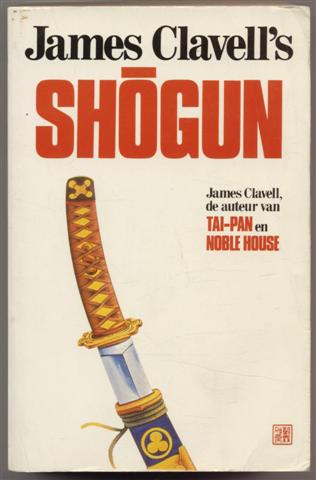
Cross another book off the Fiction Writing Reading List that I posted last summer: James Clavell’s Shogun. I have a vague recollection of Richard Chamberlain in a TV miniseries adaptation in the 1980s, but I’m certain it’s from the advertisements and not actually watching it. (Maybe Mom watched it? Maybe I’m thinking of The Thorn Birds?)


This book is sprawling, convoluted, vulgar, and violent  and engaging for most of it’s 1,000-plus pages. What made it most interesting to me is its point of view (or ultimate lack thereof) with regard to the cultures clashing throughout the story. Set in feudal Japan in the 1600s, the novel gives us an arrogant, foul-mouthed, and cunning English Protestant protagonist; surrounds him with a narrow-minded and ever fouler-mouthed Dutch Protestant crew; and strands them in a strict (and mostly Shinto/anti-Christian) samurai culture that is deeply enmeshed in trade with the Catholic Portuguese and rushing headlong toward civil war. Initially, it is a very anti-Catholic read; although the Protestant characters are not particularly virtuous or sympathetic characters, the initial perspective is theirs, and their biases shine through.


The British pilot is removed from the group because various samurai see value in his knowledge and his ability to antagonize the Catholics by his very existence in Japan. Gradually he gains favor, and ultimately influence, among the samurai, and becomes conflicted as he begins to see value in their way of life (and of course, falls in love with a well-known samurai woman who has converted to Catholicism).


That’s the gist…but lest you think this is Last Samurai or “Dances With Blue-Man Group” rehash, understand that A) Shogun came first, and B) no one group emerges as the noble savage. All are savage, and ultimately, the only group shown without nobility is the Dutch Protestant crew. (Clavell shows does a tremendous job writing in multiple languages and using “dialects” (written in English) and curses or other interjections to distinguish between Portuguese, Latin, “gutter Dutch,” and Japanese.) The hero never goes completely samurai, never loses his English-Protestant bias against priests and the papacy, and is always “in it for the money”—but he comes to love at least one Catholic convert, respects at least one priest, and has his life saved by another priest. He is a married father of two in England, and as such, is an adulterer; he equally enjoys Japanese views on sexuality and is horrified by them because so much is permitted in the name of pleasure. He enjoys the order, the cleanliness, the beauty of Japanese living, but not the brutality and bigotry that enforce it. Love and life here are regarded as meaningless, replaced by duty and death — as he is immersed in this culture, he begins to use it to his advantage, but it also begins to re-shape him.


Beneath this story is a violent political thriller that uncoils slowly only, to be completely understood at the very end — and perhaps not even then. According to Clavell, in a small crowded country with paper walls, politeness is paramount; everything is planned (and counter-planned, and counter-counter-planned); everyone hears and everyone knows, but no one speaks until it is to their devastating advantage. The result is a fascinating book that seems overlong at times, but not monotonous. He wrote six novels in what came to be known as his Asian Saga; Shogun was the third written, but is set the earliest in history. Rumor has it he had other Asian novels planned at the time of his death, and I have no doubt there’s a great book to be written exactly where this one leaves off.

Homebrew II: Irish Stout

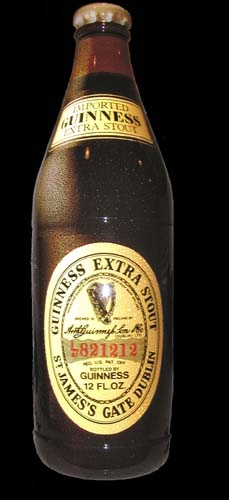
My second batch of homebrew was an Irish Stout kit from Midwest Supplies, fermented with the recommended Wyeast packet in the same glass carboys and set-up used for my first batch. Brewing came off without a hitch, except that I forgot to take an initial hydrometer reading and then broke my hydrometer before taking a reading the afternoon I transferred to the secondary fermenter. (All this means is that I have no real idea regarding alcohol content, though from the feeling in my cheeks and ears, I’d say around 4.5 to 5 percent.)

The kit contained a small packet of gypsum, which (as I understand it) can be used to tweak the pH of your water, but in this context, is used to accentuate the bitterness of the brew and give you a drier stout. The wort tasted stoutish, and the samples at racking and bottling both tasted like flat stout…all good signs in my book.

The final result? This is good beer, like the non-draught bottled Guinness I used to buy, only (dare I say?) better. Like strong French roast coffee, hearty bread dark-toasted, with a pleasant prickliness that grabs your tongue on the way down. [Blogger’s Note: I may be biased, since it’s mine, my own, my…prrrrecious!] I’ve had one bottle chilled and several at basement temperature (around 65 degrees F), and all have been delicious, though the warmer ones are decidedly better in my book.

Complaints? I definitely get a better head with these (see the top photo), but it still lingers only a few minutes. Also, I had hoped to make an all-homebrew black and tan with one my few remaining English pale ales, but despite my Dad’s insistence that he has successfully pour a black and tan with non-draught stout, I failed on multiple attempts. The resulting mistakes were consumed, of course, and fortunately tasted like good dark beer.

My next brew awaits bottling. It’s a bit of an experiment using an old stout kit from a decade ago. More on that when the time comes. In the meantime, as Dad and I would say, “Na zdrowie!”*

—–

*Na zdrowie (nah ZDRO-vee-ah) is a Polish toast meaning “to your health.”

Book Break: A History of Corruption

As I mentioned last summer, I’ve been reading a number of diverse books as research for a novel that I hope to complete in 2012. These have included three books on the Irish mob in the U.S. which, together, paint a sobering picture of corruption extending back to the earliest days of our republic.

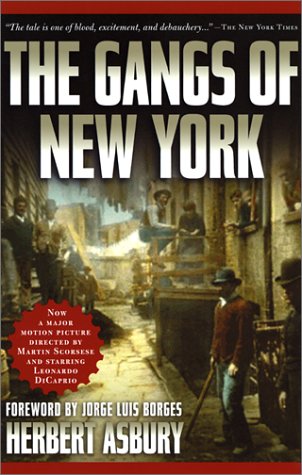
The Gangs of New York: An Informal History of the Underworld

Written by journalist Herbert Asbury and published in 1927, this book provided much of the fodder for the Scorcese film Gangs of New York, if not the actual storyline. It paints a picture of unimaginable squalor, poverty, violence, racism, and political corruption beginning in post-colonial New York City and continuing through Prohibition. Filled with colorful characters and a mix of historical facts and gangster lore and legend, it is a darkly engaging read that makes the reader question how close our animal instincts may lurk beneath our human surface. The propensity for grotesque violence among those with no hope and nothing to lose stands in sharp contrast to our usual views of American ideals and opportunity at the time of our nation’s founding. I will see the film soon, but I don’t expect to enjoy it much…

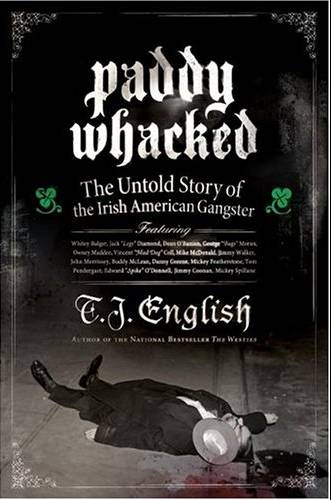
Paddy Whacked: The Untold Story of the Irish American Gangster
This 2006 volume by T.J. English draws on the Asbury book as a source, but digs deeper, extending beyond New York City to Chicago, New Orleans, Kansas City, and Boston, and including the mid- and late-20th century. The book is more explicit about the relationships between Irish mobsters and hoods and the Italian Mafia, organized labor, corporate strikebreakers, and politicians on both sides of the aisle. (It also paints a less romantic picture of the Kennedy family and suggests multiple strong motives for the assassination of President Kennedy.) It appears to be well researched and is also an engaging, if disturbing, read. Whereas The Gangs of New York made me question human nature, Paddy Whacked made me question the nature of our democracy.

Black Mass: The Irish Mob, the FBI, and a Devil’s Deal
This 2001 book by Boston Globe journalists Dick Lehr and Gerald O’Neill tells the story of the legendary South Boston crime boss Whitey Bulger: his rise to power and secret status as a federal informant whose corrupt FBI handlers protected him and his men from prosecution for years. The recent Scorcese film The Departed may have been a remake of the Hong Kong crime thriller Infernal Affairs (in some cases shot-for-shot), but the South Boston setting and the Jack Nicholson character are inspired by this true tale, and Bulger’s capture this past summer after 16 years on the lam does little to fend off the disquieting feeling that we cannot know who the bad guys are or how far their reach extends. A parallel history of Bulger’s brother, formerly a prominent state senator and president of the University of Massachuesetts, adds to that feeling…

Taken together, these books provide a sobering look at the seamy underbelly of “truth, justice, and the American way.” Strong language and violence abound, and these books won’t leave you feeling warm and fuzzy about the world, but they are good, solid reads.