Pinched, or the Descent into Meaninglessness

I have, in the past several months, read more deeply and broadly than I have since college, and perhaps ever. A few weeks back, in my mini-review of Brideshead Revisted, I mentioned that I was reading a new book for work, Pinched: How the Great Recession Has Narrowed Our Futures and What We Can Do About It. I finished it today, and it is a sobering comparison between our current recession, and previous deep downturns at end of the 19th century, in the 1930s, and in the 1970s. The book takes a close look at both the similarities and the differences in order to get a clearer picture of where we are in terms of a recovery (short answer: not very far along) and what we might work to address the short-term, and especially the long-term, effects.

The important issues raised by this book are too numerous to detail, and while I don’t agree with the author on everything, a few insights struck me as particularly compelling, especially on the heels of reading Brideshead and C.S. Lewis’s The Abolition of Man.

First, I have never been one to begrudge the wealthy the fruits of their honest effort; however, Pinched shines a bright and terrible light on the fact that not only are America’s most wealthy and privileged few becoming more so, they are also becoming increasingly detached from the problems and concerns of the rest. Many would rather help the poor on the other side of the world than the struggling here at home, because the visibility and ROI (return on investment) is better.

Second, the book shows clearly that in America, as in the Middle East, men with time on their hands are a major problem. Men are feeling the strain of the recession more keenly than women, and this leads to a wide range of economic, social, and psychological problems that are difficult to remedy. Interestingly, the book even touches on traditional gender roles, indicating that, even in instances in which unemployed men take on more responsibility for household chores and childrearing while their wives work — and indeed, even when their wives say they are satisfied with the level of support their husbands are providing on the home front — nevertheless, satisfaction in the relationship and perception of the male’s worth deteriorates, as I understood it, for both parties.

John W. Gardner once said, “America’s greatness has been the greatness of a free people who shared certain moral commitments. Freedom without moral commitment is aimless and promptly self-destructive.” Don Peck, the journalist who compiled and wrote this book, includes among his recommendations for addressing the fallout of the current recession, a section called “One Culture,” in which he insists that our social fabric is fraying and that cultural solutions are needed, as well as economic ones. He writes:

“The information age — individualistic, experimental, boundary-breaking — has eroded other once-common virtues, ones that we not associate as strongly with a distinctly American character, but that are nonetheless essential to a cohesive, successful society: from family commitment rooted in marriage, to civic responsibility. The Great Recession has merely cast light on the extent of that erosion. The past is not a hallowed place, and we would not want to return to it even if we could. But we do need to sow those virtues again as we move forward — through education and through our own private actions and expectations.”

The book — and this quote in particular — sparked in me an idea for a non-fiction book of my own, exploring the idea that as we debunk age-old beliefs and fail to replace them with new values of equal weight, we devolve into meaninglessness. Relativism, globalism, scientism, the collapse of religion and ritual that help us understand our place in the world (a la Joseph Conrad’s The Power of Myth), and the redefinition of “value” more and more exclusively in economic terms, have actually made the world less understandable — because it no longer jives with what see with our eyes and know with our hearts.
Book Break: Two Very Different Books

As part of my ongoing research into the novel I hope to write this year, I’m looking at a wide range of books and movies — including two very different books I recently finished.

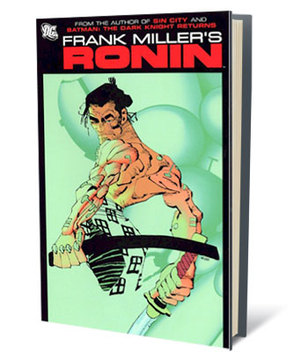
The first is a graphic novel by Frank Miller (of Sin City and 300 fame) called Ronin, about a masterless samurai reincarnated and finding his purpose in a grim, post-apocalyptic future. Because I have a fascination with ancient codes colliding with the modern world, and because I am specifically interested in samurai-themed comics and artwork with regard to my fiction writing, I checked it out from the local library on a hunch.

I’m never been a comics reader, and found it to be a very engaging story, once you get the feel for “reading it” — especially learning to pick up visual cues that convey the order of panels and images, which isn’t always left to right. These visual cues enable Miller to occasionally use visually arresting images that are full-page, full-spread, or shaped or cropped in unusual ways to convey more clearly (or more chaotically) what is happening.

It is not a book for younger readers; though not as bad as I expected from the cinema adaptations of Sin City and 300, it contains some nudity, sexuality (though not explicit), strong and racist language, and lots of violence.

On the contrary…

Yesterday I started and finished The Invention of Hugo Cabret — a wonderful, award-winning novel for young readers that was unlike any book I’ve ever seen. I’d asked a high-school friend who now teaches English and is particularly interested in graphic novels if he knew of any really well-done novels written in a combination of styles, with drawings conveying scenes or sections, interspersed with pages of prose, and he recommended this one as the only such book he knows. It is intimidatingly thick, but reads very quickly, and the story–about a secretive orphan who lives in the walls and crawlspaces of the Paris train station in the 1930s and keeps the clocks repaired, was utterly unique to me and completely unexpected. Even a second-grader with a decent vocabulary could probably handle it, but I suspect it would be a wonderful to read aloud as a family in the evenings, provided everyone could see the pictures. It was a delight, and I’m excited to learn that the author, Brian Selznick, has another novel out as well!

Also on my novel research stack: non-fiction books The Gangs of New York (from which the movie takes its title), Paddy Whacked: The Untold Story of the Irish American Gangster (which has the best title ever), and Black Mass: The Irish Mob, the FBI, and a Devil’s Deal (which tells the true story upon which the movie The Departed was based, nevermind that was also a remake (in some instances, shot-for-shot) of a Hong Kong crime drama with the cheezy English title Infernal Affairs. I’ve seen both, and liked both for different reasons.). Finally, we just watched Angels With Dirty Faces starring James Cagney the other night. Check it out if you can.

Book Break: The Abolition of Man

I have said more than once that too often we seek to explain the hell out of everything and explain the heaven out of it in the process. This observation seems tightly intertwined with the arguments set forth in C.S. Lewis’s thin little book, The Abolition of Man. Do not judge this book by its size — the content is dense and provocative, demanding close attention. I’m sure I’ll need to read it again (and again).

The book starts innocently enough, with a critique of an English textbook of the day (the late 1930s) — then expands into a defense of objective reality and value, and the increasingly maligned notion of true right and true wrong. Lewis doesn’t suggest that we won’t continue to debate the finer points of how to live according to this universal Way (he uses The Tao as his term in the book, though he makes it clear that this is for convenience; that the Way transcends world views, creeds, and cultures); his goal is not peacemaking, but to lend credence to the idea that some things are simply worth fighting for and to illustrate the dangers of “debunking” objective values in favor of a more scientific approach to the world — an approach which, ultimately, (he said way back in 1939) would force us to sacrifice our humanity.

This relates to an idea I began to form last week, thinking about the story of the Fall in the book of Genesis: When we seek to become like gods, we become something less. Why? Because the only thing of value we have to trade for godhood is the thing that already makes us as close to God as we can ever be — our humanity. Lewis’s book, to me, was sobering and prescient.

Unfortunately, my head is still spinning, and I know I’m not doing the book justice by a mile. Perhaps a few favorite passages, then…

“As the king governs by his executive, so Reason in man must rule the mere appetites by means of the ‘spirited element’. The head rules the belly through the chest … It may even be said that it is by this middle element that man is man: for by his intellect he is mere spirit and by his appetite mere animal. … The operation of The Green Book and its kind is to produce what may be called Men without Chests. It is an outrage that they should be commonly spoken of as Intellectuals. This gives them the chance to say that he who attacks them attacks Intelligence. It is not so. They are not distinguished from other men by any unusual skill in finding truth nor any virginal ardour to pursue her. … It is not excess of thought but defect of fertile and generous emotion that marks them out. Their heads are no bigger than the ordinary: it is the atrophy of the chest beneath that makes them seem so.”

“The final stage is come when Man by eugenics, by pre-natal conditioning, and by an education and propaganda based on a perfect applied psychology, has obtained full control over himself. Human nature will be the last part of Nature to surrender to Man. … Man’s conquest of Nature turns out, in the moment of its consummation, to be Nature’s conquest of Man. Every victory we seemed to win has led us, step by step, to this conclusion. All Nature’s apparent reverses have been but tactical withdrawals. We thought we were beating her back when she was luring us on. What looked to us like hands held up in surrender was really the opening of arms to enfold us for ever. If the fully planned and conditioned world (with its Tao a mere product of the planning) comes into existence, Nature will be troubled no more by the restive species that rose in revolt against her so many millions of years ago, will be vexed no longer by its chatter of truth and mercy and beauty and happiness. Ferum victorem cepit: and if the eugenics are efficient enough there will be no second revolt, but all snug beneath the Conditioners, and the Conditioners beneath her, till the moon falls or the sun grows cold.”*

“[Y]ou cannot go on ‘explaining away’ for ever: you will find that you have explained explanation itself away. You cannot go on ‘seeing through’ things for ever. The whole point of seeing through something is to see something through it. It is good that the window should be transparent, because the street or garden beyond it is opaque. How if you saw through the garden too? It is no use trying to ‘see through’ first principles. If you see through everything, then everything is transparent. But a wholly transparent world is an invisible world. To ‘see through’ all things is the same as not to see.”

I wholeheartedly recommend this book, although it is essentially philosophy and so will vex some readers. I read the Chronicles of Narnia as a boy, enjoying them somewhat less than the Lord of the Rings trilogy, which appealed to my love of history and myth and language in a different way entirely. But I renewed my love of Lewis as my own children began to read (and watch) Narnia, and even moreso when I finally acquainted myself with Mere Christianity. Abolition came on the recommendation of a good friend and deep thinker, and it is again clear to me that I must read more by C.S. Lewis.

*Ferum victorem cepit essentially means “the conqueror is conquered,” I think.

Waugh, or Three Things to Love About Brideshead Revisited

Blogger’s Note: Four summers ago, I agreed to my friend Jacqui’s challenge to read 15 Classics in 15 Weeks. I continue to press forward, this being number 11 of 15, and at this point 15 Classics in 15 Years seems quite doable…

Evelyn Waugh’s Brideshead Revisited was the wildcard in my list of 15 classics, replacing Cormac McCarthy’s Blood Meridian on the original list. I was trying to buy all 15 books used, and couldn’t find McCarthy; one previous spring I picked up Walt Whitman’s Leaves of Grass and thought, “What the heck; I’ll read that instead.” — then my friend Fr. Tyler recommended Brideshead. He has proven to be a reliable recommender of books (especially East of Eden), so I added it to the mix.

This is not a book I would’ve chosen without recommendation. An impenetrable title by an author with whom I was not familiar (a man, as it turns out), which, as I flipped through it, skimming pages, seemed another novel about shallow, wealthy people indulging in food, wine, and art and mocking the less sophisticated and the pious. If not for Father Tyler, I might have set it aside, guessing it similar to The Picture of Dorian Gray — which it is not so much. And so…Three Things to Love About Brideshead Revisited:

  • People Change: As in Dorian Gray and The Brothers Karamazov, most of the characters in Brideshead begin as superficial, hedonistic, and not particularly likable, however, through chance and tragedy, as these characters collide and intermingle again and again, they grow deeper and more complex. This is not a story in which the weakness of characters lead them to an inescapable end. These people struggle. They learn from their mistakes (however slowly). They change over time, and emerge different people at the end.
  • The Whole is Greater Than the Sum of Its Parts: One recurring theme in the book is that of a tiny part of a man, pretending to be whole. These upper-crust Brits lead lives of leisure — they have time on their hands and passions and vices they indulge, ignoring transcendental truths, scoffing at faith and virtue and love, and pretending to live. They become artists, politicians, alcoholics, trophy wives, adulterers and mistresses, but can’t figure out to be whole or happy. How many people have we seen like that?
  • All Roads Lead Home: The deeper theme of the book, it seems to me, is that all roads lead to Truth and God — you are never so far away that you cannot get back, and although we may choose to resist, when we do not, He draws us inexorably to Him, with grace and mercy we do not merit. It is, in the end, a very hopeful book.
A side note: I have said numerous time in this journey through 15 classics that it is remarkable how timeless these books are — how the characters are relatable and the themes common to our time. I finished this book yesterday, even as I started a new book for work called Pinched: How the Great Recession Has Narrowed Out Futures & What We Can Do About It. (Sounds like a page-turner, doesn’t it?) 

Brideshead was published in 1944 and is set between the World Wars; Pinched opens with a 1914 quote from writer and journalist Walter Lippmann: “We are unsettled to the very roots of our being. There isn’t a human relation, whether of parent and child, husband and wife, worker and employer, that doesn’t move in a strange situation….There are no precedents to guide us, no wisdom that wasn’t made for a simpler age. We have changes our environment more quickly that we know how to change ourselves.”
Sound familiar? It is ironic to me that a book published just this year should open with a quote from 1914, claiming there are no precedents to guide us. We’ve been down the path of “unprecedented change” repeatedly* — apparently in 1914, for example. Waugh’s great novel, to me, insists that the wisdom “made for a simpler age” is unchanging, still relevant, and even necessary. We are simply slow to learn.

—–

*If change wasn’t unprecedented, it wouldn’t really be change, would it?

Book Break: Orbiting the Giant Hairball

Today I finished another of my boss’s books, recommended to me by our research assistant, Ben, who was responsible for sorting the boss’s library as we moved from Morrill Hall to the Humphrey. I’d seen the book before, and it looked like a gimmicky, gifty book someone would use to decorate a shelf or display as light bathroom reading. It featured multiple styles of fonts, “handwriting,” and illustration, and bore the oddball title, Orbiting the Giant Hairball: A Corporate Fool’s Guide to Surviving with Grace.

“I think you should take a look at this,” Ben said, when I raised a skeptical eyebrow upon seeing it again, in his hand. “It’s actually pretty good.”

I took it, exhaled, skimmed the opening poem by Rumi, glanced at the whimsically illustrated table of contents and a two-page spread that looked like a grade-school painting, and started to read. And read, and read, and read.

The author, Gordon MacKenzie, worked 30 years at Hallmark, and this book is his attempt to show adults how to recollect their creative genius; to flush (or even remove) their PC, company-line filters and begin to really innovate and invent again…like when they were kids. For 30 years, he worked for a great “hairball” of a corporation, and for much of that time, he managed to orbit the hairball, close enough for mutual benefit, far enough to never be sucked into the mess and stifled. The book is, at times, a little New Age-y, but it’s inspiring, nonetheless. Here’s a guy who tends to say the things we wish we said, who pushes the envelope of acceptable behavior, gives the wrong answers, writes his own rules…and time and again, shows that it pays, both in terms of profit and personal fulfillment.

I’ve been that guy only once that I recall — when I applied for my former job at a Minneapolis marketing firm. The job posting was quirky and creative (somewhat moreso than the job, as it turned out); I wrote a solid but straightforward cover letter to accompany my resume. I was trying to stretch my experience a bit to cover the position described, and a friend read my cover letter and said, “This isn’t going to do it.” She told me that, since I didn’t have the qualifications they were looking for, I should show that I could market myself in the same way they were selling themselves in their ad. I went home and thought, “What do I know about branding?” Immediately I thought about my rancher friend Jinglebob, and wrote a completely different letter, excerpted here:

You aren’t looking for me. The anthropology degree is all wrong—I studied people, not business. My work history skews journalistic, with infrequent forays into student recruitment and fundraising. Where I come from, branding involves a flame, a red-hot iron and singed hair. It’s difficult work, and it scars.

That said, it’s not so different from what [COMPANY] does. Your clients want what every rancher seeks—a brand that leaves an indelible mark that the world will recognize and associate with its owner. It’s hard work, sure, so you do what any good foreman would: hire the best hands and stoke the fire.

My friend read the new letter and grinned. “This. Is. It.” she said. “They may love it; they may hate it, but they will definitely remember it.”

I had abandoned the way you apply for a job and had done something new. It paid off — both the HR manager and the hiring manager called me, stumbling over each other to set up a flight and an interview. I had successfully re-written the rules, and “The Hairball” had given me the benefit of the doubt, and a shot. That never happened, before or since.

I’ve tried the revise that letter in applying for other jobs, but it doesn’t work. I’ve tried to build writing routines and exercises to spark consistent writing that moves me as much as, for example, last year’s Holiday Letter, but everything sounds forced and derivative. It’s frustrating…and then, as I neared the end of MacKenzie’s book, one of his main points struck me like a ball-peen to the forehead — rang my head like the ginormous bell that it is: Once creativity is routine, it is not creativity. You cannot do something completely different, over and over again.

The cover letter accomplished its intended purpose; I can ask no more of it. Should I need another, I must again give birth. Which is hard work. But worth it.

Blogger’s Note to His Bride: You’ve noticed I’ve been goofier lately. It’s the fumes from the rocket fuel, keeping me just clear of the Hairball.