
Pre-Election Rant-A-Day 1: Of Course I’m Right! Aren’t You?

Blogger’s Note: I’ve been absent a long time, partly because I’ve been crazy busy this fall, and partly because I’ve had a terribly long and curmudgeonly blog post brewing in my head for months, and no time to write it. So I’ve settled on the “Rant-A-Day” format. My intention is to post a portion of the aforementioned terribly long and curmudgeonly blog post, in rant form, each day until the election, at which point (hopefully) they amount to something.

At Mass on Sunday, Deacon Steele shared the observation that, while saints in heaven are wonderful, saints here on earth can be tough to stomach. You know the type: always polishing their halos and making a point to love the smiles right off their neighbors’ faces.

To a certain extent, in college that was me. Not growing up in the Church, I didn’t consider myself a saint, per se — but my upbringing was quite different from that of most of my college friends and, I thought, clearly superior. Some of this was defensive: I was surrounded by very different expectations and standards of behavior than I was used to, and I watched the beliefs of like-minded classmates crumble around them at the hands of the better-informed and the sharper-tongued. So I bolstered my arguments to support my beliefs — and in the process, polished my halo.

I remember the moment a close friend finally called me on it. We were talking about the death penalty and prison and to what extent a convicted criminal’s environment and upbringing should be taken into account when sentencing. Apparently, I was arguing not very dang much because my friend said, “You think you’re better than them, don’t you?”

I paused for a moment, taken aback by the question (because, let’s be honest, when you hear that question, you’re almost programmed to respond with an indignant, “NO!”). Then I said, “Yeah. Yes, I guess I do. Don’t you?”

“No,” he said. “I think we’re the same. I got lucky to be born into the family I did, and to go to the school I did, and to come here, or I might be in the same situation as they are.”

I didn’t back down at the time, but he gave me food for thought. How much pride could I take in my parents, whom I did not choose, and the solid home and upbringing they provided? How much of me was me, and how much them? I began to listen to myself speak, and I could hear the squeak of the rag on the halo. And I didn’t like it.

Shortly thereafter, I embraced agnosticism — and not just religiously. I started to build a world view on the notion that there was very little we could know for sure about anything, and it’s best to just get along.

Thank God I met Jodi.

See, self-righteousness is ugly. Smugly counting your blessings and crediting yourself for them all won’t win you friends or favor, and clinging blindly to beliefs that keep you safe and comfortable won’t get you to Heaven (or even across the street).

But pretending that nothing is certain — or that you don’t believe in anything for sure — so as not to offend or be caught in error, is as cowardly as it is false. And yet recently — within my 35 years, it seems to me — it has become arrogant to express confidence in or adherence to your personal convictions in public, unless your underlying worldview is neutral. This approach can be summarized by three insidious words: It’s All Good.

“It’s all good.” This is how we summarize freedom and love of neighbor. It’s how we avoid conflict; how we justify ourselves and avoid condemning others; how we let everyone know we’re on their side without taking sides. It is without meaning — and when we live accordingly, so are we.

We cannot and do not live our lives in unbelief. We might keep our beliefs secret, and even act in opposition to them on occasion — but we all have convictions, and we should have the courage of them. We should act, speak, and vote accordingly. We should absolutely vote for like-minded candidates who support our way of life and our values and morals. That’s the only way in which “government of the people, by the people, for the people” can function. If we do anything less — if we decide by our actions, our words, or our ballots that any one candidate, position, or decision is as good as another — we cede our authority to the government, and all priorities and decisions become the state’s.

In this week prior to the elections, the first thing I want to say — the thing I want to shout from the rooftops, really — is this: It is NOT all good. Decidedly not. For God’s sake, and our own, believe in something and make a stand. If it’s all good, as they say, why get out of bed a week from Tuesday? How will you choose, anyway?

It’s all good will be are downfall.

We should come to the polls believing that we’re right — each and every one of us — and if we don’t believe we’re right, we should spend a little time contemplating a new direction before November 2nd. I have a set of beliefs, some of which stem from my upbringing, some of which stem from my experience, and many of which stem from my faith. Not only is it decidedly not arrogant to bring these (faith included, even in America) with me the ballot box, but it is required in order to have a functioning democracy. Our ideas and our ideals must do battle.

So next week, I will vote and do my level best to impose my own belief system on our local, state, and national governments. Why? Because I believe I’m right. Of course I believe I’m right. Don’t you?
Book Break: Walking on Water

Just finished reading Madeleine L’Engle’s book Walking on Water, on being a Christian and an artist. (She doesn’t talk so much about “Christian artists,” because the phrase suggests something about both the art and the artist that may not be true; some overtly Christian works are poor art, and some great “Christian” works have been produced by nominal Christians or non-Christians.)

This book was recommended by a former colleague and friend of mine, Cerdo — he of Squad 19 and Harley-Davidson fame, and true to his word, it’s solid. L’Engle’s not afraid to believe and proclaim the hard parts of more “orthodox” or traditional Christianity — the Annunciation, the Incarnation, Transfiguration, Resurrection … sin and the devil … angels and redemption. She sees the artists role (whether writer, composer, sculptor, painter, or actor) as “incarnational” — much like Mary. Whatever the medium, we are called to be co-creators with God; the artist who is true to his or her vocation says yes to work — the gift — God has given to make Him present in the world. Sometimes the work is hard, and it’s easy to be led astray; to choose not to serve, and use the gift to destructive ends. (The book is 30 years old now, but she speaks frequently and well about the problem of pornography, as though she saw this online epidemic coming.)

L’Engle’s use of the “title story,” of Peter stepping off the boat to walk toward Christ on top of the waves, beautifully to illustrate how a deep and almost childlike faith lies at the root of creative work, of following inspiration where it leads. She describes Peter’s (and our) situation more like we’ve forgotten how. It’s not that Peter was doing the impossible and sank when he lost faith, but instead, that he was doing what we are all meant (and able) to do — walking with God — and sank when he “remembered” that he didn’t know how to walk with God.

Deep down, we all know. I’m realizing that these cement shoes are my own handiwork.

Movies That Bug Me: Avatar

Blogger’s Note: This may become an infrequent recurring topic, like Book Breaks. Please note that this post is not about a bad movie, per se. Some bad movies I like, and I’m far more likely to be annoyed by a decent movie that should’ve been great. And passable but over-hyped/over-praised movies. Grrr.

Blogger’s Addendum: P.S. There might be spoilers.

After reading Starship Troopers and blogging about Heinlein’s great, grown-up sci-fi, I finally decided to get this off my chest.

Awhile back, well after all the hype died down, we borrowed and watched Avatar. I was underwhelmed. Here is a movie that could have been tremendous. It was called as much by so many gushing fans and critics that perhaps I expected too much.

No, come to think of it, I didn’t.

See, I read a lot of Roger Ebert. He and I don’t see eye-to-eye much of the time, but I can usually tell from what he says whether I’ll like a movie or not. Here’s his take on Avatar:

Watching “Avatar,” I felt sort of the same as when I saw “Star Wars” in 1977. That was another movie I walked into with uncertain expectations. …”Avatar” is not simply a sensational entertainment, although it is that. It’s a technical breakthrough. It has a flat-out Green and anti-war message. It is predestined to launch a cult. It contains such visual detailing that it would reward repeating viewings. It invents a new language, Na’vi, as “Lord of the Rings” did, although mercifully I doubt this one can be spoken by humans, even teenage humans. It creates new movie stars. It is an Event, one of those films you feel you must see to keep up with the conversation.

High praise. I could tell from the outset I wasn’t going to like it as much as he did. I watched it start-to-finish, and was struck by many things…but must of all, by its unrealized potential. Here’s what bugs me…

The Plot. I had hope I could come up with an original witticism to summarize how many times we’ve heard this story. “Dances With Smurfs” and “Dances With Blue Man Group” were taken. But the point is, we’ve seen this, in Dances with Wolves and The Last Samurai, and to a different/lesser extent, Kingdom of Heaven and Pathfinder (another movie that bugs me). This just in: Hardened warrior has more in common with his enemy, undergoes spiritual conversion. Don’t get me wrong; I liked those movies. But it’s just one of many things about this movie that have been done before, like…

The Love Story. Holy Pocahontas! (Or maybe Aladdin?) This one’s right from the Disney Channel: a disandvantaged but tough outsider falls for a fiesty princess, who likes him despite their very different backgrounds. The captain of the football team (er, the tribe’s best warrior) is jealous…can their romance survive the tragic misunderstanding that costs her family everything? Can he win the respect of his rival and the hand of the girl he loves?

The Sci-Fi Hook. Sure, our hero’s a paraplegic Marine, which provides a different emotional twist, but while the idea of lying dormant while piloting another more capable body through a threatening world is super-cool, it’s not new by any means…enter The Matrix, among other films.

The Noble Savage. When George Lucas started cranking out the Star Wars prequels, people criticized him for using racial stereotypes to distinguish the looks and patterns of speech of various non-human aliens (go ahead; google it). Avatar does the same thing, with its bow- and spear-wielding, scantily clad, earth-loving, whooping and kaiyai-ing warriors. You can google this, too, and find criticism. A whole other planet so unlike our own, and this is the best we can do? Evil cavalry versus noble natives? Speaking of which…

The Evil Cavalry. Ebert said the movie is anti-war. At first, I didn’t see it so much anti-war as anti-corporate, for one, because the blue-skinned aliens are warriors to the core. But then I watched as the movie’s Marines increasingly devolved into greedy thugs and meathead killers, until finally only two soldiers were left with white hats. In which case, why not make them mercenaries instead of Marines? Why does the U.S. military have to be evil? (And yes, this bugged me about both “Dances With Samurai” movies, too.) Maybe not anti-war, but clearly anti-military…Starship Troopers (the book) was like a breath of fresh air.

The Special Effects. Wow, did people gush about the visuals! I will admit, the floating islands and waterfalls and such were cool. The aliens’ home city, however, was reminscent of Lothlorien in the Lord of the Rings movies. (Come to think of it, the Na’vi weren’t altogether dissimilar from the wood-elves in the old animated version of The Hobbit…except they drank less.) And those strange forest illuminations reminded me of glow sticks and those funky fiber-optic Christmas trees, set in Mario Cart’s Mushroom Gorge. The little floating fairy seed things? Sorry, they made me think of this clip from Finding Nemo. From the hype, I expected better. They could’ve been better, just like…

The Fauna. Avatar is a pro-science movie. So why, on a planet in which evolution has yielded multiple species with the strange ability to “jack” their neural network (or some such thing) into other creatures to form some sort of communication link or tail-to-tail bond, a planet with anti-gravity islands and air unbreathable to humans, why on Pandora does everything look like a big, blue version of something from Earth? Take the princess: easily the most attractive blue monkey woman I’ve ever seen, and though the Na’vi are less sexually dimorphic than humans, still you can tell she’s a she; the curves are in the right places, more or less. (A side note: I keep wanting to call the Na’vi “the Skinnies” after an alien race in Starship Troopers: “humanoid, eight or nine feet tall, much skinnier than we are and with a higher body temperature; they don’t wear any clothes…”) Similarly, the prehistoric rhino creatures, the hairless blue dogs, the Pandoran antelope…they look like critters here, which is good for our hero, because when he’s attacked, he knows what to do: avoid the teeth and claws; snap the neck, cut the throat, or shoot/spear behind the front shoulder, and they die. Ebert will occasionally make fun of the outlandishness of creatures in movies. (See paragraphs six and seven of this review for example; go on, read them, they’re great!) But why must extraterrestrials function the way creatures do on Earth? Shouldn’t they be different? And wasn’t that what was terrifying about The Blob? How do you stop ravenous, living ketchup? Even the dragons on Pandora look familiar (and somewhat less menacing than in Harry Potter).

And finally:

The Network. At the end of the flick, here’s where it fell flattest for me: the whole John Muir everything-is-connected idea that they began to discuss as though it were scientific turned into spiritual gobbledy-gook. Think about what they could’ve done with the idea that the strange tail/neural-organ-thing can be used to connect with or communicate with or subdue other living creatures (as our hero learns to do with the dragon). Oh man! The bad guys should’ve tried to use those connections to manipulate the Na’vi or other creatures to their own ends. The Na’vi totally should have jacked into the forest and the spirits of those who had gone before and caused a massive forest uprising to send the mercenaries packing! The whole connectivity thing should have been the movie! That was something I’d never seen before!

Instead we wind up with that weird waving-dance-seance thing, which looked like a religious ritual of some sort, except that…were they praying? To a god(dess)? To their ancestors or Mother Pandora? Why? Only the human hero seems to think he can actually make difference, through action and maybe through prayer…but even he is told their diety won’t listen. If their diety doesn’t take sides, why pray? If their diety only works to keep the balance, why fight? How can they be so connected and so clueless?

Ebert is right about one thing, however. I’m sure Avatar is predestined to spawn a cult.

Book Break: Starship Troopers

Years ago, I read Robert Heinlein’s Stranger in a Strange Land. I remember only a handful of details about the book — the concept of grokking, the story in broad strokes, the religious aspects — and I remember realizing, at the end, that I had read my first mature science fiction book. Not mature in the Rated M sense (which actually is quite immature, when you think about it) — although the book has its moments and is not for kids — but mature in the sense that it wasn’t a space adventure with rocket-ships, robots, and ray-guns.

Now, some of you know that my middle-school son aspires to the Naval Academy, followed by the Marine Corps. Awhile back I ran across a supposed “required reading” list for our military academies, and nestled among The U.S. Constitution and The Art of War was a surprise title I knew only from a movie preview: Starship Troopers. Thinking it might be a sci-fi book to interest Brendan, I googled it; seeing it was written by Heinlein, I thought I’d better check it out first. We borrowed it from the local library, I skimmed it thoroughly for adult content, then let Brendan have a go.

He devoured it, though he struggled with the rapid fire dialogue and military jargon. I finished it last night, and again discovered that I read a mature science fiction novel.

Heinlein supposedly caught a lot of flack for an overtly pro-military (and some say fascist and species-ist) book. I found it a very compelling read, especially considering it was written in 1959. It’s set in the future, and tells the story about a teenager who volunteers to join the military against his parents’ wishes, mostly because his buddy (and a pretty girl they both know) is doing it. The world has changed since the 20th Century — Earth is part of an interplanetary federation, and ruled as a democracy of sorts…except that only those who have served a full term in the military can vote. Apparently in the late 20th century, things on Earth went downhill: parents ceased disciplining children and were no longer considered responsible for the actions of their children; children, as a result, looked to their peers for security and guidance, joining gangs and engaging in selfish (and ultimately criminal) activities. The criminal justice system ceased holding criminals reasonable beyond a fairly comfortable period of isolation with other criminals, followed by early release and frequent re-incarceration. And citizens young and old became so self-involved that they voted only in their narrow self-interests, for policies that padded their pocketbooks, kept them comfortable, or made them feel good about themselves. Vision, long-term impact, and responsibility to others fell by the wayside…

I’m elaborating a bit. Can you tell the book struck a nerve?

The seductive thing about Starship Troopers is that Heinlein seems to have glimpsed the future, and he paints a picture of the aftermath that is un-American in so many ways and yet makes me shake my graying head in agreement that yes, that’s exactly the problem. Only veterans can be entrusted with vote because only they have shown by their actions — by their service and sacrifice — that they will put the long-term interests of the nation and the public good ahead of their own interests, or even their own lives…un-American, but almost makes sense…parents of juvenile offenders are held partly responsible for the crimes of their progeny and share in the flogging…un-American and brutal, but who hasn’t read a news story and said, “They oughta lock up the parents, instead!”

I recommend the book as a good, quick, and thought-provoking read. I can’t recommend the movie, one, because I haven’t seen it, and two, Denise Richards. (Seriously? She’s the wrong kind of of “cute girl” and Carmen was mostly an emotional presence in the book, not a physical one.) Gonna have to read more Heinlein (and maybe re-read Stranger in a Strange Land). Maybe you should, too.

The Creation of Thunder

As originally reported on my Facebook page, I watched Ben-Hur this weekend with Brendan and Gabe. I think Brendan now wants me to go back to The Albertville Creamery antiques shop to pick up the late 19th century edition of the book they have for sale. He knows I am susceptible to such suggestions…

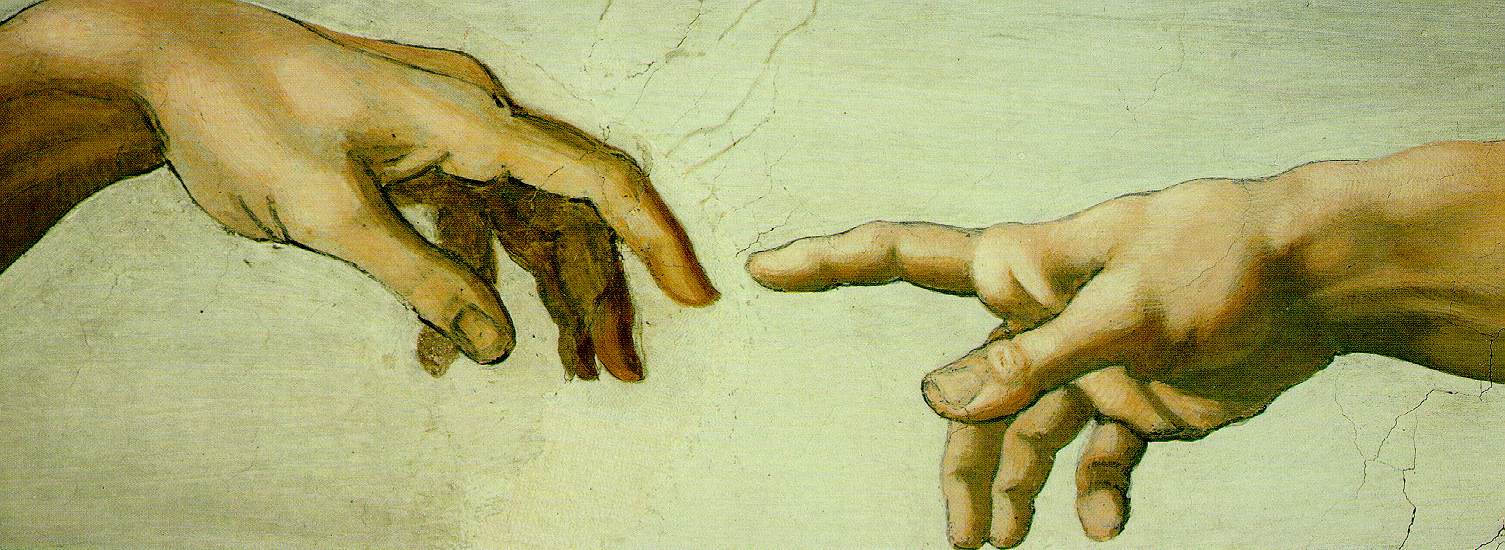
At the outset of the movie, as the Overture played, the DVD displays Michelangelo’s painting, The Creation of Adam, and since I was watching with two tween boys, I referenced the irreverent “pull my finger” caption you sometimes see associated with that painting. It was storming at the time, and Gabe (our aspiring priest) said, “GOD said, ‘Pull my finger,’ and the first thunder was created!”

We laughed and laughed. And it was good.