Road Rations: Cars, caffeine and the culture of convenience

It’s the car-culture call to arms, as American as Mt. Rushmore and as loud as Las Vegas, the siren song for legions of cooped-up auto owners. It signals a change of scenery and the chance for adventure — not to mention bloodshot eyes, backaches and piss-poor public toilets.

Road trip!

Two days and 1,200 miles? No problem. Amtrak? Greyhound? Who needs ’em. The car’s got a CD player, a sunroof and cruise control. Not to mention a console between the seats. That’s key. Because the appeal of the road trip extends beyond getting from point A to point B, beyond our love affair with open road, our need for speed, all of it. Road trips represent the freedom to go where we want and do as we please. Wanna give a passing trucker the old airhorn fist pump? Go for it. Chinese fire drill at the next stop light? Absolutely.

A supersize cola and chili cheese fries? Now you’re talking.

Food is integral to our love affair with automobiles. Consider the ’50s drive-in burger joint: Sharp fins, rolling fenders and gleaming chrome; pompadours and poodleskirts; window trays and rollerskates — an American icon built around the idea that eating in your car is cool.

In the decades since, the cool has turned practical. Today, automakers tout the number of cupholders in their vehicles, and minivans are equipped with tailgating tables and in-floor coolers. And practicality has turned cool, as well, as evidenced by the meteoric rise in the late ’90s of the PT Cruiser — a compact station wagon with a surfin’-safari makeover. Soccer moms now have flames on the fenders of their grocery-getters.

* * * *

The appeal of the road trip — and its close connection to food and freedom — starts before we ever get behind the wheel of a car. Kevin Seymour, my best friend since the first day of kindergarten, lived a half mile down the blacktop from a tiny red-and-white convenience store with no gas pumps. Van’s Grocery stood on a sandy lot next door to nothing and across the road from less. Even so, we rode our bikes down to Van’s every chance we got for a couple root beers, a bag of Fritos and some Big League Chew, shredded bubble gum in a foil pouch that featured a caricature of some scruffy slugger with a lump in his cheek.

I loved Big League Chew, in part for the connotation, and more so because my parents would never get it for me. When I rolled into Van’s on my bike, though, the folks weren’t with me. I could flip through MAD magazine if I wanted, gawk at the well-endowed bikini model on the cover of the hot-rod magazine, and steal a sidelong glance at the adult magazines, wrapped in their black plastic sarongs you could almost see through. Nobody said boo.

* * * *

Another shift has occurred since the 1950s. The drive-in has changed to the drive-thru. No longer a destination themselves, the biggest burger joints serve your food in to-go bags, nearly as fast as you can order it. Now the cars come to the server, who scarcely has to move. Even the cups fill themselves.

Why the shift? Because we expect to go farther faster, and with so much ground to cover, there’s little time to eat. Although food is necessary for life, on the road, sustenance is almost an afterthought. Eating serves as a stimulant and a distraction. It’s idle amusement — we tickle our taste buds to stay awake.

Check the numbers: Driving burns roughly 110 calories per hour, depending on your weight. (Somewhat more, perhaps, if you’re driving a stick; more still if you’re in heavy traffic). 110 calories an hour. That’s a single serving of Mt. Dew — the high octane stuff, not diet. According to the label, a 20-ounce bottle of Dew contains two and a half servings, totaling 275 calories.

In theory, that single bottle of non-diet soda should fuel you for 150 miles behind the wheel.

On the road, Mt. Dew is liquid defibrillator — it keeps your eyes wide and your heart pumping, but it doesn’t stick to your ribs. The calorie count says you don’t need anything else, but that growl in your stomach suggests otherwise. So you eat. Maybe a Snickers from the rest-area vending machine. A bag of chips from the Shell station. (Not the little bag, either; 99 cents for six freakin’ bites, when the big bag’s only a couple of bucks!)

It ain’t sustenance if you don’t need the calories. It’s just eating — but it tastes good and passes the time. A burger and fries from Hot’n’Now? Supersize it; what the hell. Chicken-fried steak and eggs at a truck stop? Why not? Road trip!

* * * *

The earliest road trips as a child are formative, setting your expectations for adult excursions. To this day, I rarely drink root beer or chew bubble gum unless I’m driving, and I still can’t resist Big League Chew …

From third grade until I started football in high school, Dad would take me out of school each October to hunt and fish the Tahquamenon River and the swamps near Paradise in Michigan’s Upper Peninsula. In the early days, the highlight of every trip was our traditional late-night breakfast at Big Boy just before we crossed the Mackinac Bridge going north.

I’d often be sleeping when we rolled in — I’d rub my eyes and look up through the amber glow of the parking lot lights to see Big Boy himself, cheerfully chubby in red checked overalls, smiling down at me like an old family friend, a giant burger held aloft on a platter above his head.

I wasn’t up for the burgers, though. For me, Big Boy was, and is, all about french toast. Thick slices of fluffy golden sweetness, dusted with powdered sugar and served with whipped butter and a warm maple syrup. It was better than my mom’s (which I loved all the same), better than Big Boy’s signature burger, better than dessert, even!

Big Boy, Happy Chef, Perkin’s or Country Kitchen — on the road day or night, I still check the breakfast menu first. Two eggs over easy, hashbrowns and toast? Biscuits and sausage gravy? Pick your poison, or better yet, pick ’em all. Breakfast isn’t just for breakfast anymore.

* * * *

Further evidence that eating on the road isn’t based on need: You eat things while driving that you wouldn’t think to any other time: Slim Jims, Corn Nuts, prepackaged sub sandwiches, pork rinds, you name it. Fruit by the Foot? Twinkies? Some road rations scarcely qualify as food; others may be food, but are barely edible. Doesn’t matter. On the road, people will eat anything.

Case in point: As a kid, I saw my dad buy a package of hotdogs from a gas station “meat case” in Michigan’s Upper Peninsula. He put them on the dash of our old van as we drove south, and by Mackinac City, they were warm through. Roll ’em in a slice of bread, and voila! Lunch on the road, no stopping necessary.

I’ve told that story a time or two, and the general response falls somewhere between revulsion and concern: Aw, man! Did anyone get food poisoning? Nope, I say, and those dashboard dogs looked a lot better than the day-old brown one rolling slowly under the gas-station heat lamps.

Has anyone ever eaten that last, shriveled dog? Count on it. Some dark night, some saddle-sore road warrior pulls into the Kwik Mart just as the night manager turns off the big sign. He fills up, pours the last of the coffee — the thick stuff — into a foam cup, sees that last weiner and hesitates.

“Go ahead,” the night man says. “You can have it.”

He takes it, of course, because hey, free hotdog. It’s dry and a bit chewy, I’ll bet — like the ancient teriyaki beef sticks I picked up with my fishing license at the sporting goods store in Gunnison, Colorado, last summer. Brendan and Gabe, age 7 and 5 respectively, were scoping out the candy selection, which hung in little plastic sacks on long rods next to the bait cooler.

Bren was eyeing the candied peanuts; Gabe had his heart set on sour gummy worms. The beef sticks seemed healthier somehow.

In the parking lot outside the store, several Hispanic women were selling fresh peaches and chili-pepper ristras under a makeshift awning made from old two-by-fours and a blue plastic tarp.

“Those peaches look good!” said Bren.

“Yup,” I said, and smiled at the women as we walked by.

“Why are they selling peppers out here?” Gabe asked.

“Just trying to make a little money,” I said, handing him a beef stick.

His face fell. “I wanted candy,” he said.

“Hey,” I said. “Some people don’t ever get beef sticks.”

He took a bite, and his face read lucky them.

The truth is, when my dad bought those hotdogs and warmed them on the dash, he was making do. We had bread with us, left over from our fishing trip, so a package of hotdogs made a meal on the cheap.

Convenient? Yes, but more important, cheaper and less wasteful than buying snack food.

* * * *

Patterns become habits over time, and our road-trip routines become less and less rational. My college buddy Damon was a sucker for a Denny’s late at night: always the same order, their version of ham and eggs, dubbed “Moons Over My Hammy.” His love for ham and eggs ran deep and true, but he could never bring himself to call the dish by name. His ears red, his eyes fierce, he would simply point to the picture when the time came to order and dare us all to laugh.

My wife and I have our own routines now. Case in point: Each time we cross her home state, we stop at the world-famous Wall Drug, the tourist mecca where we met. In addition to offering free ice water, cheap coffee, western art and souvenirs, Wall Drug makes the best homemade, frosted donuts in South Dakota. The Husteads give ’em away to honeymooners and veterans, and, as it turns out, former employees like Jodi and me.

So every time we’re headed west, we find ourselves watching the horizon for the 30-foot green brontosaurus that marks the Wall exit; find ourselves scoping the license plates of the cars, pickups, RVs and Harleys that line the main drag in front of the drug store (which now occupies an entire city block); find ourselves herding four kids past the Western wear counter where we met and through the boot department where I passed three summers daydreaming about marrying her.

Invariably one of the managers recognizes us and puts an order in for a dozen donuts on the house. We leave with an assortment — creamy chocolate, sweet maple and sugary white icing — and I don’t make it to the freeway again before I’ve swiped the first maple.

We don’t need donuts. We’re an hour from Grandma’s house, and Lord knows she’s planning to feed us. But westbound on I-90, what else can you do? It’s Wall Drug — dig it?

* * * *

Dad still travels pretty lean — a bag of pretzels, a couple apples and coffee. Occasionally he’ll splurge for jerky, but a $5 bag will last days.

Me? I eat 16 ounces of Cheezits in two hours flat and chase it with a quart of chocolate milk. That should be enough to fuel 24 hours of hard driving, easy.

“Well,” I belch. “That should hold me for a few minutes.”

I’ve never had to “make do.” My cupboards are full, and my fridge is stocked. I have my own kids, and we travel with coolers of food, most of which is ignored as we move from town to town and treat to treat. We don’t waste the food we’ve brought per se — it gets eaten, as an afterthought, when we reach our destination.

We say grace before meals, even in the car, but it’s generally said with salty lips over greasy fingers. We eat on demand and drink on a whim. It’s straight-up consumption, not sustenance. We’re living to eat, not the other way around.

* * * *

You know you’re a road warrior when the routine slips into the subconscious. Confined to a car on day seven of a 10-day tour to the Rockies and back, I absently open a bag of Doritos. It’s half gone before my head registers the growing brick in my belly. Enough junk food, I think. I need to eat better.

I remember the women selling peaches in Colorado, and I can almost feel the juice sticky on my chin.

“Oof,” I grunt. “We really need to buy more fresh fruit.”

“We can stop and pick some up,” says Jodi, “if you’re hungry.”

* * * *

Blogger’s Note: Yeah, it’s another re-run. This genius creative type I used to work with (the guy behind Cerdo in the “Friends and Good People” menu to the right) and his Squad 19 buddies got the idea of doing a series of prints and selling them to raise money for America’s Second Harvest.

The prints were all representative of convenience-store and road-trip food, the idea being that while we’re eating to pass the time, some people don’t have enough to live on. The project was called Fuel, and the boxed set of prints was accompanied by a book that, among other things, contained this essay.

Thanks, Steve, for letting me be a part.

Tales of the Inexplicably Frightening II

Seen on the way to work this morning: A young man in a black watch cap standing near a ladder to a second-story window with a manure fork in hand.

Initial reaction: Boyfriends use ladders, but devils use pitchforks!

Current thinking: He’s there to remove shingles, but his ladder is too short …

Bottom line: Trick? Or treat?

—–

Blogger’s Note: This morning’s sighting was within a block or two of the original “Tales of the Inexplicably Frightening” post.

The Sticky Revenge of One-Eyed Jack, Part IV


The is the final installment, part four of four. To read them in order, start with part one in the Blog Archive at the right.

* * * * *

The sound of footsteps reached them from the open front door. No time, said the apparition, gliding toward the house.

Just then Sam’s mother stepped to the porch in her long coat and slippers, latching the door behind her. She entered the garage and flipped on the light. The ghost hissed his dismay—he had no desire to haunt a garage.

Listen, said Jack. Sam won’t scare easily—he’s an imaginative one; I’m sure he’s daydreamed worse than you.

The ghost hissed again, swooping close to Jack’s one eye. Jack stared, unflinching.

You saw who did this, he continued. That one deserves a good haunting, don’t you think? Do you know which house is his?

The ghost grinned hideously.

Gather my remains and take me there, and I will get you into his very bedroom, Jack said.

Swear it! said the ghost.

By my Mother Vine and the black earth, you’ll be his waking nightmare before dawn, swore Jack. Here’s the plan …

* * * * *

Moments later the ghost swooped low over Jack’s shattered remains, this time spreading like a deep shadow on the driveway until nothing could be seen. When it flew skyward, no trace of Jack remained. Sam’s mother emerged from the garage with a wide push-broom and battered snow shovel and stared at the driveway.

She was so surprised to find the pumpkin and glass shards gone that she barely registered the chill as the ghost passed quickly through her and into the garage. When at last she re-entered the garage, shaking her head, she didn’t notice the missing stapler.

* * * * *

Four houses down, soft snoring emanated from a tangle of blankets, candy wrappers, and dirty tube socks. A pale and skinny boy lay sprawled and sleeping, his blue eyes half hidden under half-closed lids. The clock on the nightstand flashed 11:53. Just then, there came a tap at the window.

The boy groaned, sat halfway up, then collapsed back on the bed.

Tap. Tap. Tap.

The boy rubbed his eyes and sat up. Who’s there?

Tap-tap.

He looked to see a dark, ill-defined shape in the window, and the lights of town shining beyond. In fact, the lights seemed to shine through the object, through a three-sided hole that was strangely familiar.

Tap, tap, tap, tap.

He untangled himself from his bedding and walked to the window, still half-asleep. What’s tapping on the window? he thought. A cat? A rat? A bird?

It was none of those things. He opened the window to see what it was.

* * * * *

The boy’s mother woke to a cold draft in the morning and assumed her son had been sneaking out of the house—on a school night, no less. “Anthony?” she called as she walked down the hall. “Are you there?” She knocked on his door. No answer. She gave an exasperated sigh and slowly opened the door. Then she screamed

The bed was empty; the window was open; and her son was gone. The bed sheets, the floor, and the window sill were smeared in sticky orange goo. Trembling uncontrollably, she stuck her head out the window and saw a trail of pumpkin remains, broken glass, and melted candle wax leading from the back to the front of the house. She rushed to the front door and threw it open. “Anthony!” she shrieked.

* * * * *

Sam’s mom broke the news about Jack to him as soon as he woke the next morning. He took it better than expected. He asked if she saw who did it, though he felt sure he knew.

Sam left for the bus stop to see blue and red lights flashing further up the street. Bryce came at a run from the same direction.

“Did you hear about Anthony?” he asked Sam breathlessly.

Sam shook his head and thought of Jack.

“They found him this morning,” said Bryce, “in his front yard.”

“Found him?” asked Sam. “What, dead?!”

Bryce shook his head. “Way better than that!” he said. “Someone stapled his pajamas to a tree with him still in them!”

Sam stopped cold. “His mom found him and screamed,” said Bryce. “There must’ve been a thousand staples! He frostbit his feet—couldn’t call for help because they stuffed a stump of candle in his mouth. He was shivering and crying and going on and on about a giant eye peering in his window. Can you imagine?”

Sam could imagine. Jack! he thought, and smiled.

* * * * *

For Bren, Gabe, Rose and Trevvy, who bring out the best (and worst!) in me.

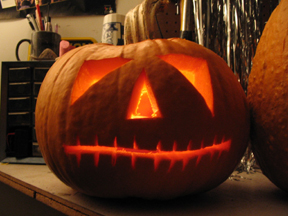
Photo: Another of the old man’s jack-o-lanterns, 2007

The Sticky Revenge of One-Eyed Jack, Part III


This is part three of four. Read part one here, and part two here.

* * * * *

Jack spent that night on a small table in Sam’s bedroom, next to the clock radio. With his one good eye, he watched the trees outside toss their leaves into the gusting winds. The streetlight shining through the waving branches flung manic shadows across the room. Jack watched the street in silence, Sam’s words running circles in his thoughts: He has a scar over this eye so he can’t open it … he’ll be the scariest jack-o-lantern in the neighborhood … call him One-Eyed Jack … he can’t open it.

Jack thought the scraping had been the worst part of being Chosen, but this anticipation was as bad. Tomorrow night was Halloween, and he was to guard Sam and his mother against whatever evil or undead spirits might haunt the neighborhood. But his eyes—or rather, his eye—had only just been opened. Would one eye be good enough? Would he recognize a ghost if he saw one? A demon?

Jack didn’t know—but he was all but certain that two eyes would be better than one.

And yet, before Sam’s mom had turned off the hall light, Jack had seen his own reflection in the window. Sam had carved a narrow gash below the natural crease, then had stapled across the cut in several places—“like stitches,” he said. The effect did make Jack look uncommonly fierce for a pumpkin—like one who had weathered the winter and emerged hardened, not soft. And the crease was a birthmark of sorts to Jack; he took strength from this sign of his Mother Vine.

Something moved in the street. Jack’s wide triangle eye strained into the darkness. A tall, thin figure in black was coming up the street. It moved not unlike Sam, so Jack reasoned it was human—but still he felt uneasy. His steady gaze never left it as it drew nearer.

When the figure crossed under the streetlight, Jack saw it was a boy—older than Sam, with spiky yellow hair like a dandelion atop his head. His hands were jammed deep in his pockets as he sauntered past. He glanced once toward the house, and fierce eyes glittered blue above a narrow nose and thin lips.

* * * * *

Sam woke before the alarm in the morning and turned Jack to face the room while he dressed for school. “It’s gonna be a great night, Jack,” he said as he pulled on his socks. “I’m dressing as a pirate, and you already look like one!”

After Sam left, his mother moved Jack to the front step and placed a small, vanilla-scented candle in a glass holder inside him. Jack beamed at the thought of the fire to be lit in his belly at dusk, and spent the day watching the street for Sam to come home.

When the bus rumbled to a stop at the end of the street, Sam wasn’t the first to emerge. Instead, Jack saw a stocky, crew-cut boy in jeans and a black t-shirt, and a familiar, lean figure with spiked blond hair and pale eyes that seemed to lock on Jack immediately, then turn away.

Behind him, a little man with a beard, moustache, and feathered hat was walking with another wearing and eye-patch and a colorful scarf tied around his head. The one with eye-patch said, “Wait ‘til you see Jack—he’s the best yet! He’s got one eye, just like me!”

Sam! Already in costume!

Sam and his friend Bryce ran to the porch in their pirate garb, and stopped to admire Jack.

“I’ve never seen a jack-o-lantern with just one eye,” said Bryce. “That scar looks terrific!”

“Thanks,” Sam said. “If they’re supposed to keep evil spirits away, they should look creepy!”

“Right,” said Bryce, and they went inside for an early supper.

* * * * *

That evening was exactly as Jack had imagined. Sam’s mom lit his candle, and he glowed orange in the failing daylight. His grin radiated Halloween cheer to scores of trick-or-treaters—princesses and goblins; ghosts and wizards; vampires, mummies, knights, and superheroes—but his eye was ever watchful, and his gleaming yellow scar earned many wide-eyed looks of admiration.

As the evening deepened from violet to purple to black, Jack began to notice other forms among the false ghouls and monsters prowling the neighborhood for candy. These forms moved differently from the children—at times effortlessly; other times, disjointed—and appeared silvery-grey, casting no shadows in the streetlight. The spirits grew bolder as the night drew on, approaching homes behind the children, hoping to pass the threshold when the doors were opened. Jack was vigilant, glaring balefully at any spirit that ventured too close to Sam’s house.

Slowly the constant flow of trick-or-treaters diminished, and Sam returned home with a false pumpkin filled with candy. As he approached the house he held out the plastic pumpkin for Jack to see.

“Happy Halloween, Jack!” he said. “I told you it would be great!”

Sam’s mom let Jack’s candle continue to burn even after Sam turned in. All the lights were off in the house, and she sat in the family room, watching TV. The apparitions hovered high above the houses now, looking for doors left ajar and homes left unprotected. Jack kept his one good eye on these spectral creatures, but his mind wandered. He thought back to the summer, his green and growing days, his ripening, and his worries just two days earlier that he may never be Chosen. Now Halloween was drawing to a close, and his purpose was nearing fulfillment. In the frosty dawn, he would appear shrunken and old; his teeth would fold inward, his facial features soften and wither. He might not last the weekend, but no matter. He need only last the night.

A gust of wind sent a swirl of dry leaves across the porch, and Jack’s candle flickered and went out. Vanilla-scented smoke rose slowly from his eye and his scar. Jack heard whispering. He looked up the street to see two boys approaching—one thin, one thick, both dressed head to toe in black.

“It’s just a stupid pumpkin,” rasped the thin one. “What are you worried about? People do it all the time—I bet your dad used to!”

“I dunno, man,” said the thicker one. “What if we get caught? Don’t you think he’ll suspect it was us? Besides, this one’s pretty sweet.”

“Yeah, one eye—real cool,” said the thin one. He glared at his reluctant partner: “I want that little freak to know exactly who it was. He won’t tell a soul if he knows what’s good for him.”

Jack’s darkened eyes watched as the thin one started across the lawn toward him. His partner stayed behind. “C’mon, man—let’s go. His mom’s still up!”

The thin one’s eyes and teeth gleamed as he smiled. He grabbed Jack in both hands, walked to the paved driveway, raised the pumpkin high above his head, and brought him crashing down.

There was a sickening crunch as Jack’s shell gave way, followed by the sharper sound of the glass candleholder smashing on the concrete. “Man, let’s go!” shouted the stocky one, and the two boys raced down the street.

Sam’s mom opened the front door in her bathrobe. “Who’s there?” she called. Then she saw the smashed pumpkin on the driveway. “Anthony,” she said, clicking her tongue in disgust. “Sam will be so upset if he sees this …”

She stepped back in the house to dress, leaving the front door ajar. Jack was scattered in pieces across the driveway. The Destroyer, he thought. No one to protect them, and hours before dawn. His triangular eye lay flat on the cement, staring up into the void.

A silvery figure floated into his field of view, hollow eyes expressionless, but a ghastly toothless grin across its ancient face. A small, thin voice, like the hiss of a cockroach, spoke directly to his mind: Most unfortunate for you, Jack. And the woman left the door open—an open door; an open invite tonight! Tell me: Does young Samuel seem soft to you? Will he scream? Wet himself? Oh, this should be fun!

NO! shouted Jack, though he had neither a mouth nor a voice.

Stop me, then, Jack, if you can. You’re a broken shell; you have no power over me now.

Jack’s mind raced. If he could stall this ghost long enough for Sam’s mom to return, she would close the door tight behind her—but it would follow her close when she went back in …

Well, I should be going, the ghost hissed. Go rot, Jack. Enjoy death.

Wait, said Jack. I have a proposition …

* * * * *

To be continued …

Photo: One of the old man’s jack-o-lanterns, 2007.

The Sticky Revenge of One-Eyed Jack, Part II


(Editor’s Note: Continued from yesterday’s post, which, of course, you should read first!)

* * * * *

Jack hoped to be one of the Chosen that fall. Of course he was called Jack—even the smallest pie pumpkins, or the foulest rotters in the field, are Jacks in name and in spirit. This Jack was a plump, round pumpkin, bigger than a basketball, somewhat wider than he was tall, with a thick stem that corkscrewed slightly from his crown.

He was perfect, except for a four-inch crease across his face where his Mother Vine pressed against him as he was growing. Jack had always believed he was destined for carving, but seedward, he wondered if that one flaw might change his Fate. One by one, the pumpkins around him were claimed by excitable children with their parents in tow. Three times he had been picked up and turned round and round, and three times, found lacking. The tall, skinny Jack from the next vine was gone, as was Yellow Jack, who had never fully ripened, and Lazy Jack, who couldn’t even stand up! He was beginning to fear he would be left to rot after all—and with such late start, he might linger in the field well into spring.

Then one grey and windy evening, a dark-eyed, dark-haired boy in a green raincoat approached. Jack felt his footsteps in the soft wet earth. The boy looked at Jack with a curious intensity. He didn’t pick Jack up, but Jack could feel the boy circling him, first to the right, then to the left. He crouched next to Jack and peered at the crease, then traced it with his thumb. He smiled.

A woman approached. “Did you find one, Sam? It’s beginning to rain,” she said.

“This one,” said Sam.

“Are you sure?” she asked. “It’s got a dent in it, see?”

“It’s a scar, Mom,” he said matter-of-factly. “This is the one—I know just what to do!”

* * * * *

Sam sat in the back seat of his mother’s car with Jack on his lap, tracing that crease with his fingers over and over. Jack thrilled at the touch. This Sam knows pumpkins— I can see that with my eyes closed, thought Jack. And soon—maybe as soon we stop—my eyes will be opened!

When they arrived at home, Sam carried him to the kitchen. His mother spread newspaper on the table and placed a large silver bowl next to Jack. She then left for moment and returned with a long, gleaming knife. Her eyes went suddenly wide and twitchy, and Jack heard her speak to the boy in a loud and raspy voice: “Shall we … begin … Master?”

Sam laughed and said yes. Jack braced himself for the blade and the piercing pain that must surely follow.

The tip of the blade sank about a quarter-inch into Jack’s rind with little more feeling than a sharp pinch. Sam’s mother then pushed the blade through, which sent a strange tingle to Jack’s very core. As she slid the blade up and down, up and down, in a circle around his stem, the tingling sensation was replaced by sudden warmth as the air of the kitchen seeped in to fill him.

Sam’s mother grabbed Jack’s stem and twisted his crown free, dragging with it long, slimy tendrils of orange goo and pale white seeds. Jack felt as if the table had dropped from under him, and he was spinning down, down. He heard a voice say, “Now it’s time to get your hands dirty,” and it sounded half a world away.

Sam plunged both bare hands through the hole in Jack’s top, tearing loose fistfuls of goo and seeds. He called to his mother, held up his hands, and squeezed until pulp squirted from between his fingers. Then Sam used the edge of a steel spoon to scrape Jack’s insides clean. From inside his shell, the noise was deafening, and the falling sensation was replaced by a pulsing ache and waves of nausea.

When Sam finished scraping, he turned Jack upside down, and the pumpkin’s pale orange insides spilled into the garbage can. Instantly Jack felt better, and when Sam set him upright and replaced his crown, he was empty of seeds, pulp, and fear. The worst was surely over, and no other Fate would have him now. He was to be a jack-o-lantern—his eyes would now be opened.

Sam’s mom brought a short-bladed paring knife to the table. “Remember,” said Sam, “you said I could do it this year. You said I could use the knife if I’m careful.”

Jack heard a motherly sigh: “Alright, Sam—but be very careful!”

Sam slowly, painstakingly, carved Jack’s face into his orange shell. Jack could feel it taking shape, exactly as he’d imagined when he was green: first a wide, toothy grin with no less than a dozen sharp teeth; next, a nose like an upside-down kite …

Jack knew his eyes were next. Already the air flowed freely through him—he could smell the odors of the kitchen and his own insides in the garbage nearby; he could taste the metallic tang of the blade and bitterness of the wet oak outside. He couldn’t wait to see everything!

Sam pushed the blade home, and carefully slid it back and forth, back and forth, on a diagonal toward Jack’s nose. The tiny ribbon of daylight Jack saw was irresistible, and he felt he wanted to be filled with light, to shine like the harvest moon. Sam cut another diagonal, starting from the same point, this time moving away from Jack’s new nose.

A triangle! thought Jack. I knew it—wide triangle eyes!

Sam cut across the bottom of the triangle, and the piece fell inside. Light flooded Jack from everywhere—too bright, blinding, like waking to a camera flash. He felt his crown removed and felt Sam fish out the triangular piece and toss it into the garbage. He felt Sam’s finger retrace his scar, then begin cutting just below it.

By the time Sam had completed the cut below the scar, Jack had regained his senses, and was looking with wonder at the world around him. The cherry wood of the kitchen was bathed from above in a clean white glow. He saw Sam’s mother, and could imagine the vine that linked the two of them, from her dark hair and eyes to his. He could see Sam, carefully beginning a second cut below the scar, just the tip of his tongue sticking out, brow furrowed in concentration. From the inside, the boy seemed to have made a mistake: The second cut was nearly parallel to the first, and not at all like the cuts he had used to open Jack’s first eye.

“What on earth are you doing?” asked Sam’s mother.

“He has a scar over this eye so he can’t open it—see?” said Sam. “I call him One-Eyed Jack.”

Just one eye? thought Jack. All because of my scar? Barely any light seeped through the narrow slit where his second eye should be.

“Are you sure, honey?” said Sam’s mother.

“Sure, I’m sure,” the boy said. “He’ll be the scariest jack-o-lantern in the neighborhood.”

“You may be right!” said his mother. “Tell you what: let’s not set him out tonight, so nothing happens to him. We’ll put him in the garage, where it’s cool, overnight—then we’ll move him to the porch tomorrow for Halloween.”

* * * * *

To be continued …

Photo: Gabe’s and Dad’s jack-o-lantern, 2007