Book Break: Sword of Honor

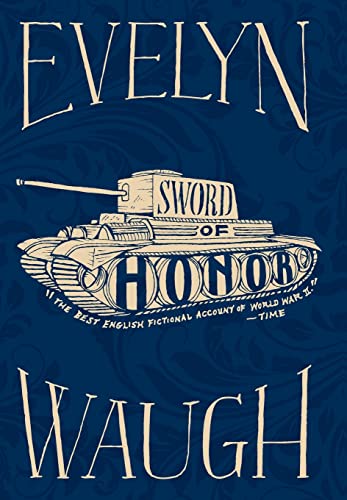
Last month, I drove to Michigan and back on consecutive weekends. Roadtripping comes easily for me, especially with a good audiobook. During the winter, I saw an article on the Imaginative Conservative website about Evelyn Waugh’s Sword of Honor trilogy, and since I haven’t read anything by Waugh since Brideshead Revisited in 2011, it seemed like a solid choice.

In case you don’t know (I didn’t): Arthur Evelyn St. John Waugh is a British man; an author, journalist, and book reviewer; a World War II veteran; and a twice-married convert to Catholicism. Sword of Honor comprises three separate novels published in chronological order: Men at Arms (1952), Officers and Gentlemen (1955), and Unconditional Surrender (1961).

The books trace the wartime story of Guy Crouchback, the only surviving son of a once well-to-do Catholic family in England, who is floundering after his beautiful but promiscuous wife leaves him for another man (and another, and another) in the early days of World War II. Despite being older than most recruits, he joins the Army to escape his loneliness and reassert himself as a man—God willing, to do something meaningful with his life.

Continue reading

Wednesday Witness (on Thursday): I Can’t Hear You…You’re Yelling

Your opponent the devil is prowling around like a roaring lion looking for [someone] to devour. – 1 Peter 5:8

Woke this morning on the wrong side of the bed. Shuffled to the living room to pray with my bride. Opened the missal to the Tenth Thursday in Ordinary Time (Year II) and began to proclaim the first reading, only for Jodi to say that her copy of “Living With Christ” had a different reading.

Of course. It’s the memorial of St. Barnabas, apostle.

I turned to the back of the missal and found June 11. Sure enough, the first reading was about St. Barnabas, from the Acts of the Apostles. I read the responsorial psalm, then began the gospel.

“Um,” said Jodi, “I have a different gospel.”

I sighed and shrugged. “Well,” I said, exasperated, “I don’t know what it is…what do you have?” Continue reading

George Floyd: What Can I Do?

Blogger’s Note: This is a long post. I hope to do some shorter ones, rooted in specific Catholic teachings and principles. But I think I need to say a few things first. (Photo courtesy of a local Catholic friend, Jim Lang.)

* * * * *

For days, I have wanted to write and couldn’t—not because I didn’t have anything to say, but because I had too much to say, and most of it felt too easy. I re-read an essay I wrote from four years ago, when the dead man’s name was Philando Castile, then reposted it—but that seemed too easy, as well. Something was different this time. Something more needed to be said. Something else needed to be done.

I wanted to have said something so I could stop thinking. I even sat and began to type a time or two. But the only clear thought that came, again and again, was, “What can I do?”

I also worried about saying the wrong thing. It doesn’t take long online to discover that too many people are looking for fight. I’ve seen folks advocating violence, dismantling the reputation and character of businesses and strangers, and dismissing people entirely for using the wrong word in the wrong way.

And I am prone to vainglory (worrying overmuch about what people think of me) and have a hard time letting things go, especially when misunderstood.

So I’d much rather sit this one out.

With Philando Castile, I simply described the tension in my heart and mind. This time I leaned into that tension, not looking to respond, explain or excuse, but to see, hear and learn about myself.

Something is different this time. Something more needs to be said. Something needs to be done.

What can I do?

* * * * *

I can tell people where I stand. George Floyd’s killing is an outrage, and I am angry. This should not have happened and should never happen again.

Perhaps, like me, your first instinct now is to say, “Yes, but…”

Hold that thought.

Just sit in silence with the image of a six-foot-six man, created in God’s image, dying in the street, held down by police officers who would not help him and watched by bystanders who could not. Let that break your heart. Continue reading

Pro-Life Between the Bookends

Most pro-life Christians, I suspect, would agree that every human life is intrinsically valuable. The Book of Genesis tells us we are made in God’s image and likeness, and the Catechism of the Catholic Church explains that the image in which we are made is Jesus Christ Himself. Our dignity is not in the dust from which we were formed, but in the Spirit breathed into our lungs by the Creator Himself. Our worth has nothing to do with us, and everything to do with the One who loved us into being.

Many of us would not accept the argument that anyone—born or unborn, young or old, capable or incapable—is not worth saving or sustaining. Many of us believe that abortion and euthanasia are unacceptable, that suicide is always tragic, and that today, the death penalty is rarely justifiable even when it may seem deserved.

Why? Because the value of every human life is infinite in God’s eyes. Many of us believe and proclaim these truths. So why do we struggle to apply them to ourselves?

How many of us grew up wishing we were different somehow: taller or thinner; more athletic or smarter; better looking; more popular with girls, guys, teachers or parents?

How many of us carried that chip past graduation: a desire to be seen and noticed, heard and understood? A desire to prove ourselves, to be somebody, to be relied upon, to be right?

How many of us even now find ourselves wishing that we had different gifts? How many of us think that our spouses and children would benefit from someone different, or at least a better version of ourselves? And that if we were just a little more than what we are, we would be happier, they would be happier, even God would be happier?

How many of us will carry that with us into old age: the idea that we are what we can do? And if we regard this lie as truth, how many of us will leave this life feeling broken, diminished, worthless?

We Christians do not accept the argument that an unborn child’s potential disability or a newborn’s helplessness warrants termination, any more than a quadriplegic’s paralysis or an elderly woman’s inability to care for herself does. We do not accept that these people must somehow prove their worth or earn their right to life and loving care.

When we pray for human life to be valued in our culture, we reference the bookends, “from conception to natural death.” But what about our own lives, between the bookends?

Between the bookends, the same rationale applies. Our value is not rooted in what we can or cannot do. God needs nothing, from me, you or anyone else. The only thing He desires is us, just as we are. We cannot earn His love, but we don’t have to. We are made from it, shaped by it, and awash in it. It’s ours for the taking, in superabundance. He desires us: me…and you.

You have nothing left to prove. The only One who matters has already chosen you.
From Conception

This was my first morning in the Adoration Chapel at my new hour, Saturdays at 5 a.m. It was as I hoped: a beautiful way to regroup—to end a week, start the weekend, and consecrate the days ahead to God.

While praying the Rosary, a thought struck me that hadn’t before. I was praying the Third Joyful Mystery—the Incarnation and Nativity of Jesus is how I spontaneously phrased it this morning—and it occurred to me in that moment that Jesus, at His conception, was an embryo, was He not? Perhaps not a zygote, which is specifically a fertilized egg; that is part of the great mystery of Mary’s virgin pregnancy. But an embryo, surely.

We often reflect on God’s great love and humility, that He would willingly condescend to become, not just a man, but a vulnerable, wriggling infant. But more astounding than that, He became what’s today’s culture wants to call “tissue,” a tiny cluster of cells like those pictured above, alive and human, but utterly helpless without Our Blessed Mother’s bodily protection and sustenance. Continue reading