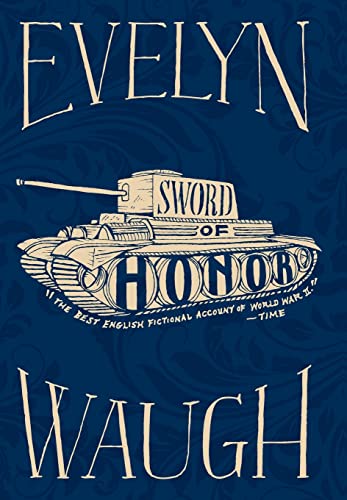
Book Break: Sword of Honor

Last month, I drove to Michigan and back on consecutive weekends. Roadtripping comes easily for me, especially with a good audiobook. During the winter, I saw an article on the Imaginative Conservative website about Evelyn Waugh’s Sword of Honor trilogy, and since I haven’t read anything by Waugh since Brideshead Revisited in 2011, it seemed like a solid choice.

In case you don’t know (I didn’t): Arthur Evelyn St. John Waugh is a British man; an author, journalist, and book reviewer; a World War II veteran; and a twice-married convert to Catholicism. Sword of Honor comprises three separate novels published in chronological order: Men at Arms (1952), Officers and Gentlemen (1955), and Unconditional Surrender (1961).

The books trace the wartime story of Guy Crouchback, the only surviving son of a once well-to-do Catholic family in England, who is floundering after his beautiful but promiscuous wife leaves him for another man (and another, and another) in the early days of World War II. Despite being older than most recruits, he joins the Army to escape his loneliness and reassert himself as a man—God willing, to do something meaningful with his life.

Continue reading
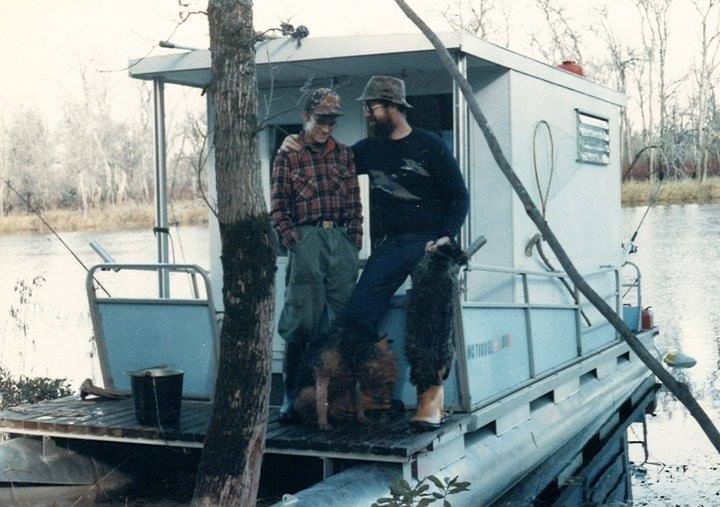

The Dad-Roll and Other Defensive Maneuvers

I am not naturally graceful. As a boy, I cast a shadow like a keyhole—a melon head atop a stick-figure body, careening through the world in whatever direction my topmost orb led me. As a teen, I lived in a narrow trailer house with my folks and spent two miserable weeks after my dad’s foot surgery finding every possible way to pinball into his elevated leg and throbbing big toe.

Today I am much the same: I move effortlessly, like an October acorn pinging from roof to car to driveway. I still drift the way I’m leaning and collide with stationary objects, softly as a poolside preschooler wearing swim-fins.

And yet, somewhere on the outer ends of my Y-chromosome is coded an instinct for self-preservation, which (to date) has kept me physically intact and free of broken bones or stitches.

Continue reading

Grandpa Vibes

Blogger’s Note: Now that I’m writing for a living again, I am trying to find my way back to writing for the heck of it (i.e., for the sheer enjoyment). Wish me luck!

A curious thing happened at the St. Michael Catholic Church Fall Festival last month. The celebration was just getting underway on the church grounds; I was setting up a St. Vincent de Paul display in the gathering space of the church (which also serves as our cry room), and Saturday evening Mass was about to culminate in the reception of Holy Eucharist.

Just then, a young father approached me with his infant daughter in his arms. I am familiar with this young man: We are close friends with his wife’s family and attended his wedding, though I’m not sure I ever spoke to him directly before this moment.

He leaned close and whispered, so as not to disturb the other parents praying nearby: “Would you mind bringing our baby down to her mom? She’s working in the food tent outside. It’s almost time for Communion, and baby needs mom-time!”

I was not expecting this, but the prospect of snuggling this baby, even for a few minutes, was irresistible. “Sure!” I said, extending my arms to receive the precious bundle, “Happy to do it!”

“I knew if I found someone like you or John*, I’d be all set,” the young man said. “Thank you.” Then he knelt and returned to prayer.

As I carefully descended the stairs, I nuzzled the fuzzy head near my chin and a wave of infant sweetness swept over me. Her eyes were open wide, but she seemed content. I stopped at the bottom, closed my eyes, smiled, and sighed, briefly contemplating if it would be a violation of trust to find a quiet corner to enjoy this blessing while she was peaceful and quiet. I shook off the desire and headed out to the festival grounds.

Continue reading

The Final Surrender

As some of you know, my father in Michigan is suffering from both Parkinson’s and dementia. He is still at home, and my mother is still able to care for him. He’s gentle and good-humored, and I’m grateful to be able to visit as often as I can.

But it’s terrible to watch his decline and the toll it has taken on both him and my mom. He was a machinist, a mechanic, and a builder, with a great engineering mind despite no formal education. Parkinson’s took his hands first, but dementia is worse—and as much as I would like all the time I can get with him, it’s hard to see him like this.

I’ve prayed for healing, and I know God could do it in an instant if He wants—but so far that’s not His plan. So what should I pray for?

Continue reading

A Life Well-Remembered

I remember, many years ago, sitting with Dad in a homemade ice-shanty-turned-deer-shack on the Lofgren farm in Michigan, where we used to hunt. It was muzzleloader deer season, snowy and cold, and we had a little porcelain-coated gas heater to keep us warm while we watched and waited. Dad was slicing an apple with his pocketknife and placing the slices on the top of the heater, where they hissed, filling the shack with the smell of the roasting fruit.

We ate them once they were soft and warm, and talked quietly together. My father is not a religious man; that day he told me he didn’t believe in an afterlife, but that heaven and hell are how people remember you. To his way of thinking, if you were a good person and took care of your family and your neighbors, you would be loved, missed, and remembered well. You would live on in the hearts of others, and that would be heaven.

If you didn’t, you would not be missed, and your memory would fade—or worse, you would be despised in retrospect. That would be hell.

I don’t share this view personally. I believe in a real and eternal afterlife, and I trust in our merciful God to see the goodness and beauty my father has brought into this world. But in the meantime, I want to give Dad something he can use here and now: a glimpse of his “heaven” as it stands today.

Most of our family and close friends know by now that my dad has both Parkinson’s Disease and dementia. If you hadn’t heard, please know that we didn’t intend to keep you in the dark. It’s not the easiest subject to broach, especially for our emotional clan. Parkinson’s and the resulting effects on his hands and mobility have been problems for several years now. The dementia diagnosis is a newer thing. Over the past few years, Dad’s short-term memory has declined and sequential thinking has become more challenging. More recently he has begun to imagine things.

Continue reading