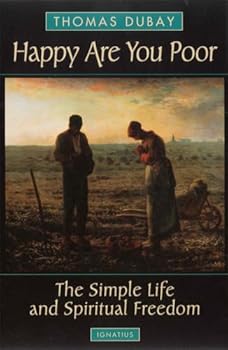
Book Break: Happy Are You Poor

For the past 20+ years, I’ve noticed several strange phenomena nearly every time a conversation turns to what the gospel says about material wealth and spiritual poverty:

  • Friendly conversations turn defensive: “We don’t have that much; so-and-so has X, and vacations every year in Y.”
  • Faithful Catholics attempt to justify themselves: “If you include Catholic school tuition, we give 10 percent like the Bible says—and we serve in other ways too!”
  • Straightforward moralists become subtle and nuanced: “What ‘poor in spirit’ actually means is…’”

And, in some cases, actual spiritual deafness occurs: I was in a conversation once in which I admitted my own struggles in this area and said I felt I needed to do more to actually love my neighbor from my own resources. A friend followed my remarks with, “It’s like Jim says…” and proceeded to relate the exact opposite message.

Father Thomas Dubay’s book Happy Are You Poor was written to combat these phenomena with clear teaching from the Gospels and the rest of sacred Scripture, edification offered by various popes and councils, and the lives of the saints. It was recommended to me by Father Daly in response to the awe I feel as Brother Jude (our second son Gabe) proceeds in his journey as a Franciscan friar and the conviction that I need to live a less self-centered and materialistic life.

Continue reading

Wednesday Witness: The Father’s Heart … In Us

Last Saturday I was blessed to go to the Men’s Lenten Event at St. Michael Catholic Church, with our former associate Father Nathan LaLiberte presenting. Father Nathan celebrated Mass before the event, and his homily left a mark on my heart for ministering to those in need.

The gospel was the familiar Parable of the Prodigal Son (or the Forgiving Father). He opened by noting that this powerful and thought-provoking story only appears in St. Luke’s gospel. Why did a Gentile include this story when the Jewish evangelists did not? Father suggested a Jewish audience, like many rules-based Christians today, would struggle to accept the superabundant mercy of the father in the story.

Continue reading

Wednesday Witness: Borders and Boundaries

A few years ago, I worked for the Church of Saint Andrew in Elk River. The parish had a strong charism of service to those in need and a growing Hispanic community. I was able to get to know a few immigrant families through the Faith Formation and sacrament programs, as well as the parish’s Hispanic liaison. The experience gave my valuable perspective on the conditions that might cause someone to uproot their family and cross our southern border (whether legally or illegally) in search of a better life.

Saint Andrew also had an annual mission trip to Mexico. Invariably, the parishioners who traveled and served in the barrios south of the border came back with one overriding impression: Poverty there is often a deeper, darker thing than poverty here at home.

As a result of these encounters, I often found myself asking: What would I be willing to do to protect and provide for my family?

Continue reading

Wednesday Witness: Digging Deeper the Right Way

Awhile back, Facebook served up to me an ad for sarcastic coffee mugs, including one that read “No One Cares. Work Harder.” I recognized it right away as that strain of humor that laments how soft we have become, how prone we are to excuses and taking the easy way out of tough situations—but it didn’t seem funny. 

See, I tend to think I need to handle whatever comes my way in order to measure up. I don’t want to fail or let anyone down, and I struggle to say no or ask for help. Reading that mug felt like the world’s weight settling on my shoulders: I’ll never be caught up. I’ll never retire. I’ll never rest.

Doing good work well is a virtue, but when our efforts become a relentless slog to do more, something changes. An old friend tells me that BUSY means Burdened Under Satan’s Yoke—because, as you’ll recall, Jesus says to take up His yoke, and we will find rest.

Continue reading

Wednesday Witness: Wanting, Needing, Having

Between Thanksgiving and this coming Monday, when our new refrigerator arrives, my bride and I will have replaced all four major kitchen appliances. These expenditures were practical: Our dishwasher hadn’t worked in a year or more; the electronic oven controls on our gas range worked only if you held your mouth right while pressing the buttons; our microwave struggled to pop popcorn, and the range lights quit working; and our refrigerator/freezer gets hot to the touch.

At the same time, new appliances were not entirely necessary. We had, after all, survived a year without a dishwasher; the oven still worked with a little coaxing; the microwave was still quicker than most other options for a wide range of tasks; and thus far, the fridge is still cold inside, if not outside. And plenty of people live quite comfortably without one or more of these devices.

Over the past couple weeks, as we prepare to tackle some home projects and work on my old truck, I convinced my bride to allow me to upgrade our garage. My work has gone well the past year—I’ve picked up a few extra projects and used the money from one such project to purchase some new hand and power tools and organize them. Now, when I have time to work on projects, I spend far less time looking for tools, purchasing cheap tools for particular tasks, setting up, and cleaning up. I can just get to work.

Continue reading