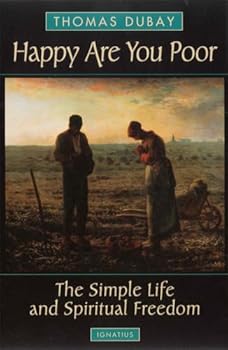
Book Break: Happy Are You Poor

For the past 20+ years, I’ve noticed several strange phenomena nearly every time a conversation turns to what the gospel says about material wealth and spiritual poverty:

  • Friendly conversations turn defensive: “We don’t have that much; so-and-so has X, and vacations every year in Y.”
  • Faithful Catholics attempt to justify themselves: “If you include Catholic school tuition, we give 10 percent like the Bible says—and we serve in other ways too!”
  • Straightforward moralists become subtle and nuanced: “What ‘poor in spirit’ actually means is…’”

And, in some cases, actual spiritual deafness occurs: I was in a conversation once in which I admitted my own struggles in this area and said I felt I needed to do more to actually love my neighbor from my own resources. A friend followed my remarks with, “It’s like Jim says…” and proceeded to relate the exact opposite message.

Father Thomas Dubay’s book Happy Are You Poor was written to combat these phenomena with clear teaching from the Gospels and the rest of sacred Scripture, edification offered by various popes and councils, and the lives of the saints. It was recommended to me by Father Daly in response to the awe I feel as Brother Jude (our second son Gabe) proceeds in his journey as a Franciscan friar and the conviction that I need to live a less self-centered and materialistic life.

Continue reading
Book Break: Small Is Still Beautiful: Economics as if Families Mattered

Providentially, my reading lately has all been cut from similar cloth: our relentless pursuit of better, newer everything and the dangers it poses to our humanity and health (physical, mental, and spiritual). This latest volume, Small Is Still Beautiful: Economics as if Families Mattered by Catholic scholar, biographer, and author Joseph Pearce was a gift from our Bismarck family, and is a reiteration and expansion on E.F. Schumacher’s 1973 classic Small Is Beautiful: Economics as if People Mattered, with a particular focuses on the environment, food supply, and land use.

In my 2017 review of Schumacher’s book, I described a couple non-academic objections and numerous things I loved about the book. I also said it seemed like the sort of book that had been read, admired, and forgotten in the powerful current of worldly progress.

Continue reading

Book Break: Two Volumes by Matthew B. Crawford

One of the great pleasures of these latter years as a father is receiving books and book recommendations from my grown children. The University of Mary in Bismarck, Saint John Vianney Seminary in Saint Paul, and the Franciscan Friars of the Renewal have led each of them on tremendous intellectual and spiritual journeys. Occasionally, I tag along.

This past Christmas, Brendan and Becky presented me two books I may have never encountered had Brendan not taken a surveying (as in, land measurement) course as an undergrad…a surveying course taught by a history professor with a love for useful arts and practical skills.

Both books are by Matthew B. Crawford, who holds a PhD in political philosophy and a prestigious research fellowship at the Institute for Advanced Studies at the University of Virginia. He also runs a motorcycle repair shop. In these two books, he makes a convincing case that we are ceding more and more of our will, abilities, and control to technologies and systems that make life easier by making it less lively, less human, less worth living.

Continue reading

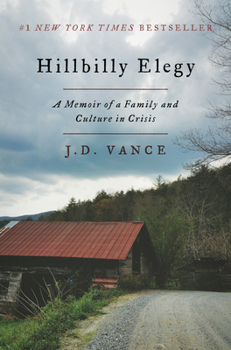
Book Break: Hillbilly Elegy by JD Vance

Last summer, when we were visiting Jodi’s parents, her mom gave me a copy of JD Vance’s memoir Hillybilly Elegy. I think she had picked it up for herself, but we were talking about the upcoming election, and she thought I had a better chance of reading it sometime in the near future. She said I could tell her about it when I did.

Well, Momma Venjohn, here you go.

In case you avoid the news: JD Vance is a young, former US senator for the state of Ohio, now vice president of the United States of America. He is a Marine Corps veteran, a graduate of Ohio State University and Yale Law School, and the author of the afore-mentioned memoir, a book-length reflection on a traumatic childhood, poverty and addiction in Appalachia and the Rust Belt, and the dysfunctional family connections that somehow got him through where so many others flounder.

Continue reading

Wednesday Witness: Digging Deeper the Right Way

Awhile back, Facebook served up to me an ad for sarcastic coffee mugs, including one that read “No One Cares. Work Harder.” I recognized it right away as that strain of humor that laments how soft we have become, how prone we are to excuses and taking the easy way out of tough situations—but it didn’t seem funny. 

See, I tend to think I need to handle whatever comes my way in order to measure up. I don’t want to fail or let anyone down, and I struggle to say no or ask for help. Reading that mug felt like the world’s weight settling on my shoulders: I’ll never be caught up. I’ll never retire. I’ll never rest.

Doing good work well is a virtue, but when our efforts become a relentless slog to do more, something changes. An old friend tells me that BUSY means Burdened Under Satan’s Yoke—because, as you’ll recall, Jesus says to take up His yoke, and we will find rest.

Continue reading