Three Disconnected Thoughts

Every so often on my commute I surf the FM airwaves to hear what “the kids” are listening to. Not my kids, mind you — I brought them up right on The White Stripes and Ella Fitzgerald and Johnny Cash and stuff — but their classmates and friends. I discovered two things: 1) nothing worthwhile is going on above 100 on the dial (unless you get nostalgic for high school; then there’s Jack FM*) and 2) the five most requested songs in the Twin Cities (as compiled by KDWB) are brainless, heartless, soulless, and painfully repetitive. It’s like a free day in junior-high Phys Ed class, as scored by R2D2. Beeps and bleeps. Twits and tweets. A steady bass thud and random screeching. Whining and bravado. Cat-calls and wolf-whistles. Turns out I’d rather listen to death metal. Anyone can wear excess makeup and questionable clothing, jump around on stage, and not sing. But at least the metalheads play instruments and break stuff.

—-

Ever walk down the street and spot someone coming toward you whom you can’t quite place…and as she gets closer, her face breaks into the sweetest smile, and her eyes gleam, and you’re a bit embarrassed because you must have met her, but you just can’t remember…so you smile a little, sheepishly, and now she’s grinning, and gives a little wave, and you start to raise your hand in greeting, almost close enough to speak…and then you realize there’s someone walking about 15 feet directly behind you, and you don’t know this girl at all?

No? Okay, yeah, me neither…

—-

I did a little Easter shopping this evening at St. George Catholic Books and Gifts in Blaine. Wonderful selection of all things Catholic — like many such stores, it used to be in a tiny little space, but it has since expanded significantly. Nevertheless, every time I go in there, they have boxes of new stock on the floor and seem to be reorganizing; every shelf is chock-a-block with books, icons, statues, and keepsakes; the walls are lined with paintings and crucifixes…clearly they have everything, if they could just remember where they put it! I love the store, and always spend more than I intend. It occurred to me today that St. George’s is very like the local hardware: everything is organized just well enough that I feel comfortable browsing myself, and everything is in just enough disarray that by the time I find what I’m looking for, I’ve picked up at least two other items, as well. Savvy storekeepers?

—-

* Ever re-listen to the songs we were singing along to back then? Eesh. I had no idea.

Book Break: Three Little Books

I’m playing catch-up on a few recently completed books, lest you think (aside from The Brothers Karamazov) I haven’t been reading in the past year. All of them are “little” books in one sense or another, but none are insubstantial; in fact, all three have Catholic or spiritual underpinnings and overtones. I shall write about them in the order that I completed them, though the last one I began reading even before Dostoevsky.

Parish Priest: Father Michael McGivney and American Catholicism by Douglas Brinkley & Julie Fenster is a short biography of the founder of the Knights of Columbus and an intriguing glimpse into the struggles of American Catholics in the nineteenth century. Fr. McGivney, like many priests of his day, died young, but nevertheless transformed the communities of which he was a part, and ultimately re-envisioned the role of Catholic men in America. The authors admit he left few personal papers or other items behind, and at times, it felt as though the material on Fr. McGivney was a bit thinner than the book. I was particularly struck by several points, however:

  • Fr. McGivney’s gifts as a parish priest, and his ideas behind the Knights of Columbus, first manifested themselves at St. Mary’s Catholic Church on Hillhouse Avenue in New Haven, Conn. Interestingly (to me, at least), when I was at Yale, this was a church I walked by on a daily basis, and when I met my bride and began (occasionally) to attend mass, it was at St. Mary’s. As a result, the book was full of names and places I knew and could envision from my college days.
  • Catholics in America were subject to discrimination; however, New Haven’s sophisticated liberal leanings made the community quite tolerant of its Catholic immigrants. On the other hand, when I was at Yale, the community’s sophisticated liberal leanings caused the students to look sideways at the priests and parishioners at St. Mary’s.
  • Fr. McGivney’s desire to start the KCs stemmed from the problems he saw in his Irish Catholic community, including poor widows, fatherless children, and men who wanted something more than their workaday lives, but were seeking it in the bottle and secret societies that separated them from their faith and their families. As they say, the more things change…
The book was a quick read, and especially for Yale Catholics and my KC brothers, I recommend it.

Antoine de Saint-Exupery’s The Little Prince is a grown-up fable masquerading as a children’s book. It’s a book I’ve seen often and have often wanted to read based on the whimsical illustrations alone, but until I recently heard an interview about the book on the local Catholic radio station, I’m embarrassed to say I knew almost nothing about the book or the author. I found a like-new, soft-cover, second-hand copy at The Sixth Chamber in St. Paul, brought it home, and did something I certainly haven’t done since Trevvy learned to read for himself: I began to read to the kids after dinner.

It’s neither overtly Catholic nor overtly religious. It is beautiful. I won’t tell you a thing about the story; I knew very little, and I found my voice choking with emotion throughout as I discovered my kids, and especially myself, in the characters in the story.* I will say only that it is worth reading and worth sharing. Everyone, from six-year-old Trevor to Jodi and I, loved the book. Gabe says it may be his new favorite. Our teenager said, “Will you pick another book, Dad? I really like this!”

If you want just a taste, my good friend Fr. Tyler wrote about The Little Prince, as well, on his Prairie Father blog. The excerpt he used is one of my favorites, too. Read this book!

Finally, the other night at Adoration I finished Introduction to a Devout Life, a Catholic spiritual classic written in the early 17th century by St. Francis de Sales. The copy I have is a pocket-sized hardcover; an undated old printing of an old translation, I suspect. The book is available for free in its entirety on several web sites; CatholiCity.com describes it this way:

Introduction to the Devout Life is the most popular Catholic “self-help” book of all time. First published in the early 17th century, it has proven its value as a daily spiritual guide and helpful reference for living an authentic Christian life. Written specifically for laymen, it began as letters from Saint Francis to a married woman who was seeking holiness amidst the distractions of her life of wealth and status. It contains treasures of wisdom for every reader, from eager beginner to lifelong Christian.

I came late to the Church and was confirmed as a young husband and father and an aspiring writer.** I picked St. Francis de Sales as my confirmation saint, primarily because he is the patron saint of writers. I read a bit about him and learned that he had a privileged education and upbringing, and he was looking for signs all the time…so it took him awhile to come to the decision to serve God. (That seemed appropriate.) Once he became a priest, he went into fairly hostile areas to convert people, and often used his writings to do so. These details, plus the fact that Francis is a family name on my father’s side, seemed like good reasons at the time. (I never even considered any of the numerous St. Jameses.)

It wasn’t until years later that I realized St. Francis de Sales was a doctor of the church and decided I should probably read my patron’s writings. I searched for a copy of the book and wound up with two (one in English, and one in French, which I don’t read or speak. I’ve been reading it a bit to a time each Monday night in the Adoration Chapel ever since. The sentences are often intricate, but the saint’s voice and genuine joy in serving God shines through. The book provides step-by-step guidance for increasing devotion and holiness in your life, and the saint’s suggestions, while intimidating taken in their entirety, are individually small, practical, and still relevant today. And every so often something strikes you as so profound that you incorporate it immediately into your prayer life. It is a challenge to anyone living in this world, but I suspect it rewards repeat readings.
—-
* Of course, I am an emotional guy…
** I’m still all of these things except young.
The Second Third, Week 19: A More Visible Faith

Some of you might know that I have a peculiar love for ancient or seemingly outmoded codes of honor. It’s the reason I love Jim Jarmusch’s Ghost Dog, in which Forest Whitaker waxes philosophical as a pigeon-keeping urban assassin who lives atop an abandoned building, listens to hip-hop, works for a mid-level mobster in a dysfunctional crime family on the verge of bankruptcy, and strictly follows the Hagakure: The Book of the Samurai. Two old, impractical (and completely implacable) codes of conduct crash headlong, and the result is a weird, violent, foul-mouthed, and (to me, at least) strangely compelling movie.

Film critic Roger Ebert opened his review of the film with, “It helps to understand that the hero of ‘Ghost Dog: The Way of the Samurai’ is crazy. Well, of course he is.” I, unlike Ebert, am not so sure. Here’s a man who grew up alone on the streets, with nothing to believe in and no one to look up to; who is nearly killed as a boy and is saved by a generally cowardly criminal in a moment of sudden grace; who finds a way (or in this case, a Way) to survive, to rise above his weaknesses, to earn respect, and to pay back the man to whom he, in a very real sense, owes his life. The way of the samurai is not easy, but I don’t see it as irrational. Self-sacrifice is difficult, but it can be beautiful, can’t it? Perhaps his obedience to this ancient Way is what passes for beauty in his broken world.

When I launched my old blog, Yield and Overcome, I was actually reading books like Hagakure and The Art of War. I was doing a fair amount of “kung-fu writing” and adopted the web handle “werdfu” to underscore my freelance avocation. But in the years since, I’ve watched our government and economy go dark, even as my own family and faith have grown bright as a beacon in the black. “Yield and overcome” seems too soft and passive a philosophy for tough times, too gray for this cold twilight. So in my Second Third (as promised), I’m unveiling a new look and name for my blog: Archangel Stomp. Sound like a dance, and it is, in a way: imagine a mosh pit with the Devil lying prostrate at the bottom. Most of the old posts are there, and I’ll still be fighting the Good Fight as best I can. Only this time, I’ll be doing so more intentionally as a Catholic and a believer.

Perhaps obedience to this ancient Way still passes for beauty in this broken world.

Dostoevsky, or Three Things to Love About The Brothers Karamazov

Blogger’s Note: Three long summers (and three even longer winters) ago, I agreed to my friend Jacqui’s challenge to read 15 Classics in 15 Weeks. I have since read 10 of 15, this being my tenth from the list. The last one, Homer’s The Odyssey took 11 months, not because it was overly long or monotonous, but because it required a level of mental engagement I couldn’t always give it. The same is true for this one, which has taken me more than a year…

I literally just finished The Brothers Karamazov and logged into this blog with a tear in my eye. It has not managed to displace Steinbeck’s East of Eden as perhaps my favorite book ever (thus far) — but I imagine it will prove to be a 936-page seed that will germinate, slowly grow, and bear fruit years from now. It will stick with me, I have no doubt. Without further ado, Three Things to Love about The Brothers Karamazov:

  • Absurd As Us. Many, and perhaps most, of the characters seem absurd, even over-the-top. Chances are you’ve never been in a town such as this, with people such as these. You know no one like the Karamazov clan or their diverse friends and lovers — and yet, each rings true, and we recognize ourselves, our friends, and our families in the peculiarities we find here.
  • Fatherhood and Brotherhood. What does it mean to be a father? A brother? A friend? What would you endure for fools who share your surname, whom you can abuse but no one else can touch — what loyalties do we bear to our fathers, sons, and brothers? Though you might guess that this is a theme from the title, these ideas emerge slowly and subtly from the plot, since the Karamazov men’s family ties are, uh, looser than most…
  • Religion and Culture. Dostoevsky does not shy away from religion and philosophy, permitting his characters to speak at length (and in character, so not always clearly) about the existence of God, morality, humanity, science, psychology, justice, the state, and more. I was struck by how a book written circa 1880 could have so much to say about our world in 2011.

You might ask, would I recommend it? I might reply: in general, or to you, specifically? I don’t know how to answer, so for now, I will say that I enjoyed it very much, and that it rewards persistence. It is a great book.

I have another, contemporary novel to knock out before I proceed, but it should be a quicker read. Next on this long-running (and long-overdue) challenge will be a book not on my original list of 15, but one recommended by my good friend Fr. Tyler at Prairie Father: Brideshead Revisited. Fr. Tyler, incidentally, recently wrote this wonderful review of Dostoevsky’s Crime and Punishment.

The Second Third, Week 9: Books Books Books

Blogger’s Note: The whole idea behind these “Second Third” posts can be found here.

I love books. Though I’ve been known to ingest audiobooks on long road trips, I’m not an ebooks guy…there’s no Kindle in my future. I like big, beautiful volumes that look like heirlooms; musty hardcovers with yellowed pages; beater paperbacks with the cracks of years in their spines. I like poetry, fiction, and non-fiction…and even leather-bound French translations of the masterworks of Catholic saints, apparently, despite the fact that I neither read nor speak French. When I see books, I browse. When I see great books, beautiful books, cheap books, or neglected books, I tend to buy them.

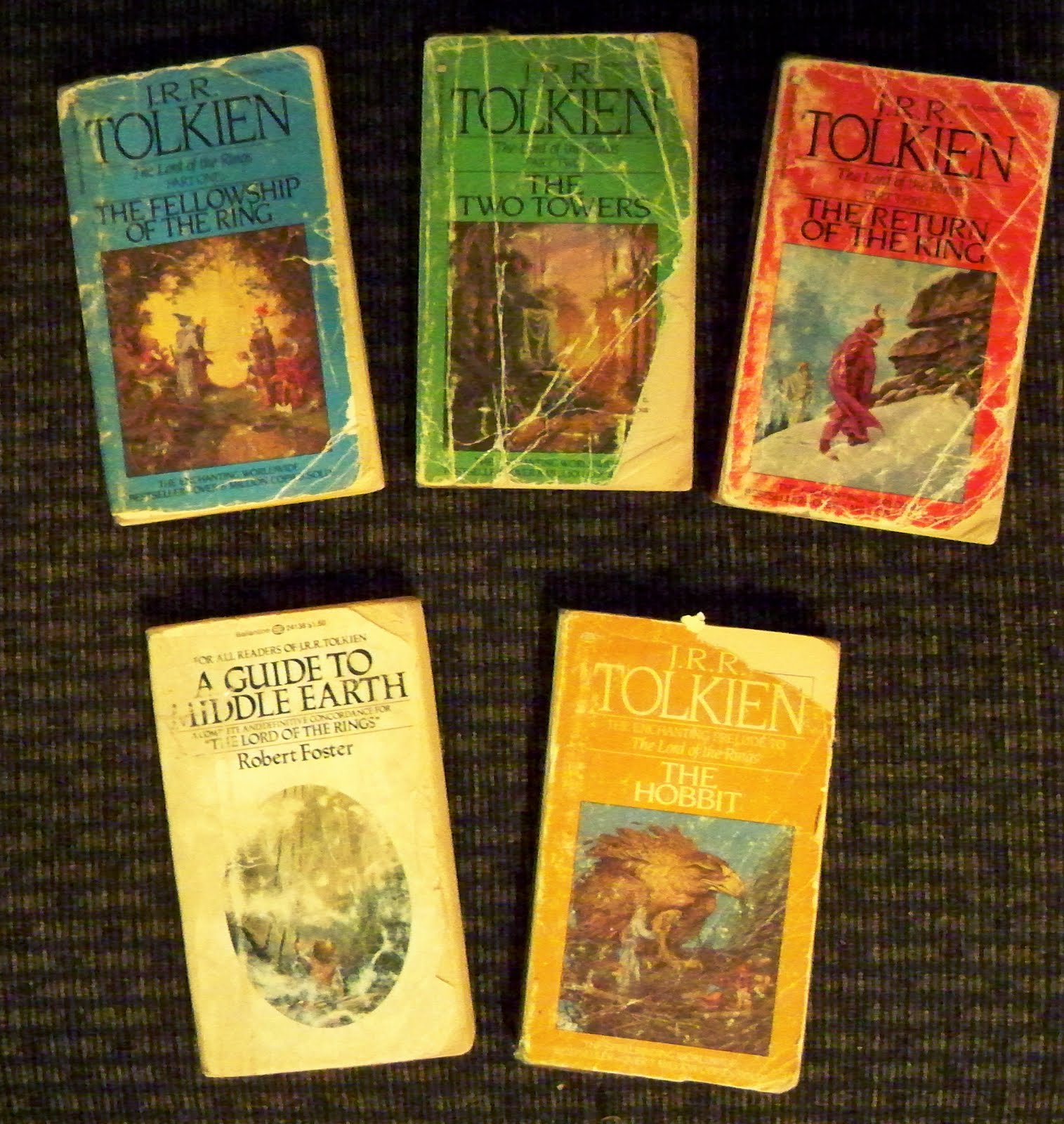
I also tend to re-read favorite books. Again and again. The five books pictured above (my paperback set of the Lord of the Rings trilogy, plus The Hobbit and The Guide to Middle Earth) were my constant companions from roughly sixth through eighth grade, and I’ve taped them back together more than once. And when I love a book, I read it slowly. Re-read parts I like until I’ve absorbed them. Re-read them again until I can share them with others.

As a result, it takes time for me to finish a book and start a new one. My famous friend Jacqui of Jacqui’s Room challenged me and others to read 15 classics and 15 weeks way back in May of 2008. I used it as an excuse to buy books. I’m better than halfway through my list of 15 (in no particular order here…and Blood Meridian may not make the final cut), and I’ve loved them all. East of Eden is still my favorite book ever, and it took nearly 6 months to properly savor. The verse translation of The Odyssey was wonderful, but a journey in itself that seemed unending and took 11 months. And I’ve now entered my 12th month reading The Brothers Karamazov, which is dark, absurd, brilliant, and beautiful. I can’t wait to finish…and yet I will not rush. (I hope to finish this weekend, but don’t hold me to it.)

As a result, I have shelves of unread books. They call to me sometimes, begging to be opened and allowed to speak. In my Second Third, I’m going to have to cut back on books…

Nah. In my Second Third, I’m making more time to read. TV stinks anyway.