From the Notebooks of Theodore Roethke

Finished reading a book of Roethke poetry over lunch, and ran across a few lines from his notebooks that spoke to me:

“Dear God, I want it all: the depths and the heights.”

“Deep in their roots, all flowers keep the light.”

“Live in perpetual great astonishment”

“Those who are willing to be vulnerable move among mysteries”

“Surround yourself with rising waters: the flood will teach you to swim.”

This is the book: Theodore Roethke: Selected Poems. I’ve always loved his early stuff, and the later material was wonderful, too. The stuff in the middle was a bit beyond me, but I read it and was rewarded nonetheless.

Callings

Lots of folks — Catholic and non-Catholic alike — have a hard time imagining the choice a priest makes to remain celibate his entire life. Some are amazed; some view it as impossible; some are simply grateful they weren’t called to such a life. Boy, I couldn’t do it, they say. Better them than me.

A few months back, our associate pastor, Father G, joined a group of us at an event for married couples. He spoke about what a beautiful vocation marriage is, then said, “I’m glad I wasn’t called to it.”

As you might expect, that got quite a laugh from the couples in attendance — like, if it’s so great a calling, why are you so happy not to be married?

I laughed, too. Later, as I talked to a friend, he pointed out that no one thinks twice about a married man saying, “I’m glad I wasn’t called to the priesthood.” The Catholic Church views both vocations as lifelong, life-giving commitments, in one case, to your spouse; in the other case, to the Church. So just as I feel I am meant to be a husband and father, so Father G feels he is meant to be a priest.

You might argue that the reason one’s easier to swallow for most people than the other is that taking a mate and giving birth to children seems somehow more natural. And in a way, that makes sense — in a “taking a mate and giving birth” sort of way. But in terms of a lifelong commitment to marriage and raising a family, come what may, the differences are less apparent. Would I leave Jodi if a tragic accident made it necessary for us to spend the rest of our days celibate? No. Would I stay married and cheat? Of course not. My “I do” a dozen years ago was more than a mere one-time choice — it’s a daily commitment and lifelong vocation. It’s a calling.

I bring this up because for the past couple of years, our middle son, Gabriel, has been talking about becoming a priest. When he first told our priest, Father M began to call Gabe “Father Gabriel” — and it bugged him at first, because he was worried that we might hold him to a lifelong decision made at age seven. “What if I don’t become a priest?” he asked.

But his comfort with the idea seems to be deepening, and he talks to Father M and Father G whenever he gets the chance. When we start poking fun at the kids about girls and boys and who they might marry, Gabe says matter-of-factly, “I’m marrying the church.”

Puberty may tweak his thinking, but for now, he seems to be serious.

When my mom first heard this, she was saddened, despite herself. She’s Catholic, too, and knows we need priests, but she also dreams of seeing countless great-grandchildren from each of her grandkids. Our oldest, Brendan, wants to go the Naval Academy, then become an officer in the Marine Corps. I mentioned this to another friend of mine, who said, “Well, at least you’ve got time to talk him out of that!”

I understand these feelings, but I wouldn’t dream of it — first, because a kid deserves his or her dreams, and second, because I am so deeply proud to have two boys who are willing to entertain lives of service and sacrifice at their young age. Even if they don’t become what they aspire to today, that willingness to serve will be a great asset to our future.

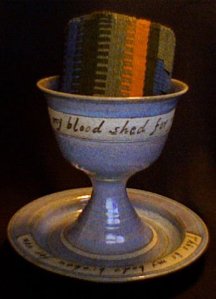
Some of you read about the special gift given to Gabe by Father M a few weeks back — a stole, chalice and paten (pictured above) with which to practice the Mass. Gabe made him a thank-you card and has been looking for an opportunity to give it to him. In the meantime, last Saturday we visited our friend Deacon Tyler (from the Future Priests of the Third Millennium blog) at the St. Paul Seminary. (He will be ordained a priest in Rapid City this June, and yeah, we’ll be there.) He showed us all around: the chapel, the dorms, the lounge, the grounds. He explained that the higher floors of the residence hall have the best view of the Mississippi River below, and that the priests who teach at the seminary get those rooms.

While we were in St. Paul, we stopped by one of my favorite used bookstores, Sixth Chamber, to pick up a copy of Steinbeck’s East of Eden, which Deacon Tyler, Jacqui of Jacqui’s Room, and Matt “HubbaTrask of Hubba’s House turned me onto. I had discussed it briefly with Father M and discovered that he hadn’t read it, so we thought we would get a copy to thank him for his thoughtfulness toward Gabe.

He was not the presiding priest at the Mass we attending on Sunday, but appeared just before the end to make a bombshell announcement: he will leaving our parish this summer — the archbishop has asked him to teach at the seminary.

Through my own tears, I looked at Brendan. He was crying softly; he and Father M had bonded over military history during numerous conversations. Gabe was quiet, unflinching.

After Mass, we made a beeline across the church with Gabe’s card and the book. We hugged Father M and told him it was coincidental, but we had something for him. It was a bittersweet moment — then Gabe piped up that he had been to the seminary the day before, and that Father would live on the upper floors, overlooking the river …

Later, I asked Gabe how he felt to hear that Father was leaving for the seminary. His eyes grew wide and glassy, but he didn’t speak.

I told him that I noticed he didn’t cry like Bren and I did. He told me he was sad, too — but a little excited that he might have Father M for a teacher one day.

He is eight, but this appears to be no distant calling.

Impulse Buy

I’ve been buying a lot of books lately. Mostly used on eBay — great deals on good Catholic books. Got a nice former-library Encyclopedia of the Saints, which the whole family digs (10,000 saints — who knew?) for $2 or so.

Also picked up St. Thomas Aquinas’s simplified Summa Theologica, called My Way of Life, the source of that spectacular quote under This Moment on this blog, along with hardcover copies of Imitation of Christ and Imitation of Mary for something like $7 total, including shipping. Nice.

But what I really wanted was a nice pocket-size copy of Introduction to the Devout Life by St. Francis de Sales (pictured), patron saint of writers and journalists, and my confirmation saint. (Lest you think I knew at an early age what I would become, I should note that I was confirmed as a 25-year-old father of two; when I was a teen I didn’t know I would be a writer or a Catholic!)

There were lots of new paperbacks on eBay, and two hardcover editions from the 1920s. The first was a 1923 second edition in the saint’s native French, bound in brown leather. Beautiful book, but I don’t speak or read French, so it made sense that I’d bid on the late 1920s American edition, the size of a coat’s inside pocket, with the yellowed dust jacket still intact. There was another bidder, but surely it was destined to grace my shelf.

I bought the English edition, but couldn’t keep from watching as no one bid on the French version. Minimum opening bid was $5, plus $3 shipping. No reserve. No bids.

A horrible thought struck me: this book would be regarded as worthless and tossed. It would be burned, or rot amongst coffee grounds and banana peels. I had to save it.

I bid $5. Spent $3 on shipping. The book is beautiful, bizarrely bound (to my eyes, at least): a metal strip runs behind the leather spine, with two wire spring clips the hold the pages in. The pages themselves are not uniformly sized and are variously stitched together.

I was fascinated and promptly showed the family. Jodi smiled and shook her head. The kids were vaguely interested in the book — what caught their collective attention was Brendan’s question to me, in a tone equal parts hopeful and impressed, doubtful and incredulous: “Dad, can you read French?”

Um, no. I simply can’t help myself.

Mere Christianity

I finished C.S. Lewis’s Mere Christianity after supper this evening. It’s a deceptively thin book for its substance — or put another way, much more has been written on the subject of Christian faith, and much less said, many times over. (I’m reading Dinesh D’Souza’s What’s So Great About Christianity right now, as well — much thicker, full of footnotes and sources and extremely interesting factoids … and not nearly as convincing as an apologetic work.)
Lewis’s little book is plain-spoken, well-argued, even-handed, and gentle. It is decidedly pro-Christianity, of course — that’s the point, after all. It gives great insight into why we believe what we believe, bolsters the believer’s faith, and may even send a doubter or two into a tailspin. Will it create new converts? Win fresh hearts and minds? Repel the atheist horde? Perhaps not. But I folded over many a page corner in my battered paperback copy.* I loved it.
* * * * *
* A habit I abandoned years and years ago, and only resurrected for this particular volume.

Faulkner, or Three Things to Love About As I Lay Dying

Last summer, I agreed to my friend Jacqui’s challenge to read 15 Classics in 15 Weeks. I’ve not kept pace, but I have persisted — and today I finished William Faulkner’s As I Lay Dying.

I picked it for two reasons: one, because I was reading Hemingway, and as I recall the two crossed words now and again, and two, because it is told stream-of-consciousness, and I thought it might warm me up for James Joyce’s Ulysses. (As I’m writing this, I realize how poorly read I am: I’m not sure these connections make any sense at all, since I am making them all second- and third-hand.)

At any rate, I enjoyed Faulkner a great deal, although the story and characters aren’t particularly lovely or lovable. That’s part of the genius, I reckon …

And so, Three Things to Love About As I Lay Dying:

  • The Family. The Bundrens are quite the lot. Simple and canny, ugly and magnificent, pitiful and hard-as-nails. You can’t help but pull for them, even though at times they don’t seem to have a lick of sense — like their neighbors, you feel you must help them, even as you shake your head. They muddle along and survive. They persist.
  • The Method. The story unfolds character-by-character, just as it unfolds to their individual minds and senses. Stream-of-consciousness isn’t always easy to follow, but Faulkner makes it fascinating, and each character’s inner workings sing clear and true, if not always in harmony with the others.
  • The Time and The Place. How best to drink from the water bucket. How to get a frightened mule out of a burning barn. How to attempt a river crossing with the bridge out, and how to find woodworking tools lost in the flood. How two drowned mules roll and wash up on a river’s bend. Faulkner describes country life in loving and stark detail.

Next up: Homer’s The Odyssey, then Joyce’s Ulysses.