 Being without work these past few weeks, I’ve had more time than usual to read. Last weekend, I finished Walter M. Miller’s 1959 novel A Canticle for Leibowitz, a book recommended to me by three of the smartest men I know. Set in post-apocalyptic America in the centuries following a nuclear holocaust, it tells the story of the monks of the Albertine Order of Leibowitz, who scratch their livelihood from the rocks and dust of the southwestern deserts and dedicate themselves to their founder’s mission of extracting knowledge from the rubble of the previous civilization and preserving it for the future. Continue reading
books
Book Break: Resisting Happiness
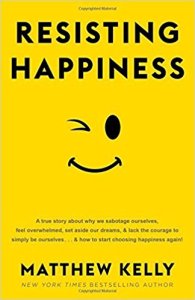 This morning I finished Matthew Kelly‘s 2016 book Resisting Happiness. I opened this book several weeks ago while staying at a friend’s, after reading the cover blurb: “A true story about why we sabotage ourselves, set aside our dreams, and lack the courage to simply be ourselves…and how to start choosing happiness again.”
It seemed relevant.
Although his books are very popular in our local parish and in the Church more broadly, this is my first cover-to-cover reading and mini-review of a Matthew Kelly book. Resisting Happiness was clear and concise, personal and practical, naming and describing dozens of little things we do that keep us comfortably stagnant and offering simple ideas on how to overcome those tendencies and start living intentionally for God. Continue reading
Book Break: Praying with Padre Pio
 Yesterday morning I finished Eileen Dunn Bertanzetti’s little book Praying With Padre Pio—a wonderful, simple introduction to the life and spirituality of one of our great 20th-century saints. As I mentioned in the past week, I’m increasingly drawn (or pointed) to St. Pio as an example and intercessor in my own life. A Capuchin monk, priest, mystic, and stigmatist from southern Italy, St. Pio has been the subject of numerous books and biographies; this one breaks his life and spiritual advice into fifteen meditations on topics of particular interest or importance to his practice of the Catholic Christian faith, such as suffering, the Eucharist, Mary, and joy in the Lord.
The book opens with a brief overview of St. Pio’s life before diving into the meditations. Each meditation opens with a one- or two-sentence summary of the topic at hand and an opening prayer. Next follows a brief biographical account of how this particular topic played out in the saint’s life. The book then presents a single question for the reader to reflect on, comparing and contrasting his or her own experience to that of St. Pio’s.
Next, the book shares Padre Pio’s own words on the topic, gleaned from letters, journals, and biographical accounts, followed by three to five reflections, from which the reader is encouraged to choose one. These exercises range from journaling to meditation to resolving to act in a way that underscores the lesson of the day. Finally, the book shares a few relevant scripture passages to reflect on and offers a closing prayer, often in St. Pio’s own words.
I read one meditation a day for the past fifteen days and found the book informative, enjoyable, challenging, and inspiring. Every day I took something new from St. Pio’s life and spiritual practices that could be adopted to my own—and nearly every day, the topic providentially aligned with the daily scripture readings and other spiritual reading and writing I’m doing these days. This was truly an inspired find; if you are interested, it’s at the parish lending library. (I returned it yesterday, so look in the returns bin!)
Book Break: Christianity and the Crisis of Cultures
 I don’t remember exactly when I picked up Christianity and the Crisis of Cultures — or why — but it was on my nightstand, unread, for many months until Brendan came home from UMary and mentioned it was one of the good books he read in his Catholic Studies classes this year. Essentially a lecture delivered by Cardinal Joseph Ratzinger (now Pope Emeritus Benedict XVI) circa 2005, the book highlights the ways in which Europe’s widespread Christianity served as a foundation for many of the great advances of the Renaissance and Enlightenment, which have paradoxically led to a severing of the Christian roots that made them possible and a grave imbalance between technology and morality, between what we can do and what we should. Yet even as we stand on the brink of cultural collapse, Cardinal Ratzinger proposes an approach that could restore the moral foundations of Western societies and lead people back to God.
It is a short (115 pages of well-spaced text), but heady, read — unflinching yet hopeful in its outlook, recalling that all things are possible through Christ. Two major ideas touched on in the book stand out to me this morning, each of which I will paraphrase and tackle in somewhat of my own way so as not to spoil the lecture itself.
The first is that we live each day by faith, which is never blind but always rooted in authority of those who have firsthand knowledge of the subject at hand. An example a friend of mine shared some months ago: how many of us know our birth mother? How do we know? None of us can possibly recall the moment of our birth, and few if any of us have incontrovertible photographic evidence of that moment, with faces in focus and the umbilical tether uncut. We could have been adopted or inadvertently switched. But we have faith based on authority: the signed documents, the witness of family members and friends, and in most cases the presence and loving care of our mothers themselves.
Most of us aren’t engineers, yet we trust another’s deep understanding of engineering to get us to and from work safely each day and to perform our work functions. Most of us no longer raise the majority of our food, yet we trust that it is safe to eat. In the same way, while many of us do not claim to have firsthand knowledge of God in person, our faith is based on the authority of those who did (or do): signed documents, the witness of family members and friends, and the loving care of the Creator Himself.
Indeed, without this foundation of so-called irrational faith — this fundamental belief and trust in things outside our own personal experience — everything else, including the science and technology we cling to as “rational,” breaks down.
The second idea worth highlighting is that, as Cardinal Ratzinger puts it, “It is an obvious fact that the rational character of the universe cannot be explained rationally on the basis of something irrational!” If the origins of the universe, the world, and humanity are random, how then can we rely on them to unfold in a rational way and be understandable? If our brains are merely chemicals and electrical impulses particularly suited to our survival, what are reason and choice, and why do they matter?
Cardinal Ratzinger puts forth a compelling picture of the modern culture and offers advice for believers and non-believers alike to rebuild the crumbling foundations of Europe and the West. Brendan found this little book worthwhile, and so did I.
Book Break: Old House of Fear
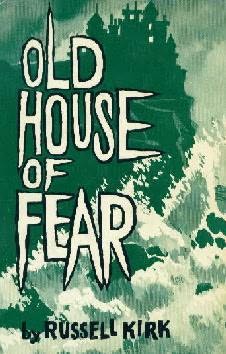
While back home in Michigan over Divine Mercy weekend, I had the pleasure of browsing the Mecosta Book Gallery and coming home with my first Gothic fiction work of local literary hero and celebrated thinker and writer Russell Kirk, an unjacketed, former library edition of Old House of Fear.
Too few people, perhaps, know of Russell Kirk today. Even growing up a few miles from the tall brick house where he dwelt and wrote, and with his four daughters not far from me in age, all I knew growing up was that a eccentric writer supposedly lived in that big house. Such knowledge was wasted on my teenage self; had I known he was one of the foremost conservative political thinkers of the last century and a novelist to boot, I may have postponed Yale for a year and ultimately saved myself the trouble and the expense.
But I didn’t — and now I’m playing catchup.
I would describe Old House of Fear as a Gothic men’s adventure story: equal parts ghostly yarn, murder mystery, and manful romance. Our protagonist is sent by his employer, a Scottish-American industrialist intent on buying his family’s ancestral home on the remote Scottish island of Carnglass. The requisite castle has an ominous name — the House of Fear — though in its ancestral Gaelic it would be spelled fir or fhir and means “man.” What begins as a challenging business transaction with a strange old widow becomes a treacherous tale of intimidation, terrorism, and murder, involving Communists and occultists, as well as more run-of-the-mill ruffians, a beautiful red-headed niece who may also be a witch, and the ever-present shadow of a legend: a grostesque, three-eyed goat-man said to haunt the island from time immemorial.
It is a quick and satisfactory read, if a bit tidier than I expected at the end. I enjoyed it thoroughly and recommend it wholeheartedly…if you can find it! If not, I may be convinced to loan it to you!
 Archangel Stomp