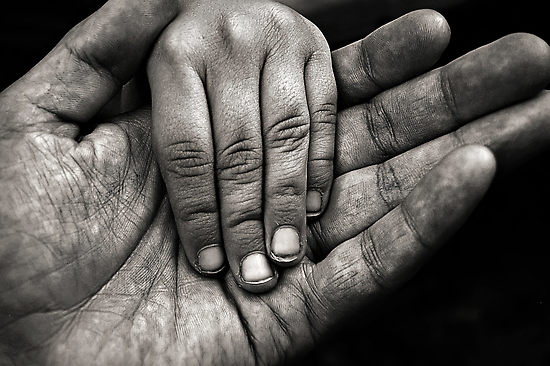
You Did It For Me

It is the first full week of Lent, and already I struggle. I must have chosen well which things to uproot from my life—my family and I are enjoying great sport pointing out my unconscious consumption and countless offhand comments, both of which I’m attempting to quit.

Additionally, each Lent we notice how little we focus specifically, consciously, on the Corporal and Spiritual Works of Mercy.  During our morning prayers, Jodi and I shared today’s Gospel reading,  Matthew 25:31-46, which includes these words of warning:

“‘Lord, when did we see you hungry or thirsty or a stranger or naked or ill or in prison, and not minister to your needs?’  …  ‘Amen, I say to you, what you did not do for one of these least ones, you did not do for me.’ And these will go off to eternal punishment, but the righteous to eternal life.”

It’s sobering each time we hear it: another year flown by, and what did we do for the least of His brothers? Our brothers? Continue reading

Wholly Self-Centered

Blogger’s Note: It’s been awhile. We’ve had an eventful holiday season—I’ll catch you up soon! In the meantime, here’s a short reflection from this weekend.

I have long experience at being self-centered. Those who know me know that I am both self-critical and self-righteous, quick-tempered, easily disillusioned, and a bit of a navel-gazer. I fight against these tendencies, fail frequently, and because I know too well my own selfish tendencies, I see (or imagine) my failings in those I love.

I’m a peach; just ask my family.

Continue reading

He Thinks, Therefore I Am

Do you not know that you are the temple of God, and that the Spirit of God dwells in you? — 1 Corinthians 3:16

Yesterday morning I read St. Matthew’s account of the baptism of the Lord. Two things struck me. The first was that, in the Ignatius (Revised Standard Version) Bible I was reading, the translation is somewhat different from the New American version we hear at Mass (linked to above). The New American translation says, “[H]e saw the Spirit of God descending like a dove [and] coming upon him.” The Revised Standard translation says, “[H]e saw the Spirit of God descending like a dove, and alighting on him.”

The difference is small, but struck me as important, because alighting suggests the Holy Spirit came to rest on Jesus and remained with Him. This is reinforced by the first line of the next chapter, which begins just one verse later: “Then Jesus was led up by the Spirit into the wilderness to be tempted by the devil.”

See that? The Spirit is still with Him, leading Him.

The Holy Spirit doesn’t leave us, either. We talk sometimes about the indelible mark left on our souls by certain of the sacraments, which might leave us with the mistaken notion that God makes an impression on us but doesn’t stick around. But clearly the Spirit did not leave Jesus—in fact, in paragraph 695 of the Catechism, we learn that the Holy Spirit represents the very anointing that signifies Jesus as the Christ, or messiah: the anointed one of God. And He is covered completely by this anointing, as close as oil on skin: “The humanity the Son assumed was entirely anointed by the Holy Spirit” (CCC 695). Continue reading

The Seed Is…Me?

I’ve had a handful of conversations lately about our faith formation programs at St. Michael: what we’ve done differently this year, what’s working and what’s not, and what more I wish we’d done. I am tempted to sudden actions and grand gestures at times, and midway through the faith formation year is no exception: I am tempted to blow up what we’re doing in our parish and start over. So many people need to know that God is real, that Christ is present in the church…and I’m stewing over videos, Powerpoints, and the Catechism.
Then a good friend shares this with me, from something he is reading these days. He knows where my head has been lately, and thinks this might be helpful. He’s right.

“Commenting on the Church’s evangelizing efforts, Pope Benedict XVI warned that Catholics today must resist what he calls ‘the temptation of impatience,’ that is, the temptation to insist on ‘immediately finding great success’ and ‘large numbers.’  He says that immediate, massive growth is not God’s way.  ‘For the Kingdom of  God as well as for evangelization, the instrument and vehicle of the Kingdom of God, the parable of the grain of mustard seed, is always valid.’  He goes on to say the new phase of the Church’s evangelizing mission to the secular world will not be ‘immediately attracting the large masses that have distanced themselves from the Church by using new and more refined methods.’  Rather, it will mean ‘to dare, once again and with the humility of the small grain, to leave up to God the when and how it will grow.’”

The quotes from Pope Benedict are from “The New Evangelization:  Building a Civilization of Love,” his address to catechists and religion teachers, Jubilee of Catechists, December 12, 2000.
We talk often of planting seeds in others, not knowing where, when, or whether they will germinate. But Pope Benedict calls me to the humility of the small grain. 
What does that mean?

A seed perseveres through inclement conditions. It bides its time, then when the time and place are right, it germinates: puts roots down and sends visible growth up.
So far so good, I think.
As conditions are favorable, it continues to grow, and God willing, to put forth fruit. The plant itself has little impact on how much fruit results year to year or what becomes of the fruit once it ripens and drops. But it continues to produce, year after year, as long as it is able. 
The seed is me? That’s a thought I hadn’t thought before…

Our Faith Is Not Genetic

Last month I wrote about the power of family— in particular, parents—in keeping their children Catholic.  It’s sobering, then, to learn that the Catholic Church in the U.S. is losing members faster than it is gaining them, and that, for today’s teens, religious identity is no longer reliably inherited. In other words, Millenials aren’t likely to stay Catholic simply because their parents and grandparents were Catholic.

What does it take to keep our young people in the faith? According to a 2012 Canadian study, young adults who choose to remain Christian have four main characteristics:

  1. They have experienced God’s presence and have witnessed answered prayers.
  2. They can ask and openly discuss their real spiritual questions in their Christian community.
  3. They understand the Gospel at a deep level.
  4. And they have seen communities of faith and older adults living their faith.

Numbers 1 and 4 have to do with experiencing God, both personally and in community. Numbers 2 and 3 involve grappling with spiritual truth. Young people who have the opportunity to know and personally experience God and are encouraged to explore that knowledge and experience are more likely to choose for themselves to remain faithful to Christ and His Church.

Is that the environment we are fostering at St. Michael Catholic Church? In our homes and our schools?

Unfortunately, Catholics have a reputation—earned in many cases—for not spending much time delving into sacred Scripture and for not sharing firsthand experiences of the very real and personal God we hear about in the Bible and the Catechism. And while our Masses may be well attended, a faith that is manifested for an hour on Sunday is not the same faith that made evangelists, world travelers, and martyrs out of a dozen unknown Galileans. Their faith changed lives—their own, first and foremost. If church doesn’t change us, we’re not doing it right!

Eventually everyone makes a choice for or against Christ. So maybe it’s a good thing that we can no longer rely on birth and blood to pass our Catholicism on to the next generation.  If we acknowledge that even cradle Catholics need conversion; if we share our faith not just with those outside the Church, but with each other; if we pray for, and come to expect, God to act in our lives in personal and tangible ways, through answered prayers, spiritual gifts, vocations, and more—we will “become a people living for Christ” in every generation.

Blogger’s Note: This article appears in the Sunday, Nov. 15, parish bulletin.