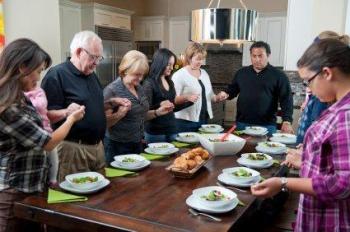
The Power of Family


The family is the community in which, from childhood, one can learn moral values, begin to honor God, and make good use of freedom. Family life is an initiation into life in society. 

– from the Catechism of the Catholic Church, paragraph 2207

As I type, bishops from around the world are gathered in Rome discussing how best to preserve, strengthen, and encourage Christian families. With so many families suffering or broken, such confusion over the nature and purpose of marriage, and the constant cultural tension between anti-child forces (for reasons of overpopulation, so-called social responsibility, or personal choice and comfort) and  “child worship” (treating each child as the center of the world, deserving of the very best of everything), it’s easy to feel underappreciated and overwhelmed. It’s also easy to get caught up in the everyday hustle of school, work, sports, and recreation and lose sight of the true power of the family as a domestic church: an apprenticeship in love of God and neighbor.


The Catholic Church, in her wisdom, teaches that the family is the fundamental unit of society, with certain rights and responsibilities that no higher level social organization can ever claim. Humans are social creatures, made in the image of God, who is Himself a loving, life-giving communion of Persons—the Holy Trinity. The Catechism insists that government has a duty to protect and foster marriage and family and to help families (and not interfere) with raising and educating their children as they see fit, both in the world and in faith.

The Church, in fact, regards the education of children in the faith as a duty of parents—a point that cannot be overstated.  I sometimes hear parents say, “I want my son to make his own choice about his faith,” or “I don’t want to force it—it will mean more my daughter if she comes to God on her own path.” While it is true that, ultimately, we each make our own choice for or against Jesus Christ and His Church, we cannot entrust that choice to the sole discretion of our children—any more than we would allow them to decide whether to drink something we know to be poison. If we truly believe what the Catholic faith teaches, the choice our children face is much more stark than how they will spend their Sunday mornings—it’s about how they will spend eternity.

Next Wednesday we begin a new year of First Confession/First Communion and Confirmation classes—and as always, it is essential that parents take the lead in sharing the good news of Jesus Christ and the eternal truths of the Catholic Church. Your personal example is the most powerful witness to your children—and male role models, in particular, have extraordinary power in keeping kids Catholic. Even simple things, like reading a Bible story, putting on a tie or a dress for Mass, or taking time to pray with and bless your child before bed, make deep and lasting impressions.

Scripture reminds us, “Train the young in the way they should go; even when old, they will not swerve from it” (Proverbs  22:6 ). We are all practicing Catholics, all sinners who are in training to love as God loves. But as parents we are also powerful, and we must not neglect to use that power to bring our kids to Christ, who said, “Whoever receives one child such as this in my name receives me” (Matthew 18:5).

Blogger’s Note: This article appears in the Sunday, Oct. 18, parish bulletin.

Book Break: In the Beginning: A Catholic Understanding of the Story of Creation and the Fall

One of the many things I meant to do in the past year was to explore and review several books on the Catholic view of creation and evolution, in order to help parish parents and grandparents answer their questions on the topic and those of their children. My hope was to find a book or two that might be helpful to inquiring minds of all ages.

As usual, I bit off more than I could possibly chew and have completed only one such book. On a positive note, it was excellent.

‘In the Beginning…’ A Catholic Understanding of the Story of Creation and the Fall is an edited compilation of four Lenten homilies given by Pope Benedict XVI in 1981, when he was still Joseph Ratzinger, archbishop of Munich and Freising. His goal was to develop a catechesis of Creation for adults. The four homilies build, one upon the other, to present a clear case for what the Genesis accounts of Creation and the Fall mean and why they continue to matter:

  • The first homily, “God the Creator,” lays out the so-called conflict between the Creation account(s) and science, and discusses how and why we interpret scripture the way we do: in the context of Jesus, to whom the entirety of scripture, written over the course of centuries, points.
  • The second homily, “The Meaning of the Biblical Creation Accounts,” addresses the Creation story specifically, the reasonableness of belief in Creation, the ways in which science points to Creation, the sabbath structure and rhythm of Creation — and the emergence of the view that humanity is at conflict with nature.
  • In the third homily, “The Creation of the Human Being,” Pope Benedict focuses on the heart of the matter for many modern Catholics: where humans come from. He explains that Genesis has more to do with who we are (imago Dei, or image of God) than how we got here, then tackles evolutionary theory directly — what it can explain about our existence, and what it can’t.
  • In the fourth homily, “Sin and Salvation,” Pope Benedict discusses the Fall of Adam and Eve, and the plan for salvation, with Christ as the new Adam. In perhaps the most profound explanation for me personally, he clearly lays out why, because we are creatures created by God, obedience to God’s law is not a restriction of freedom (like we often perceive it) — we are made for this, and thrive under God’s law because it’s in our nature!
The entire book is exactly 100 pages, including the Appendix, entitled “The Consequences of Faith in Creation, which reads like a fifth homily on how we got to the point that, since the Renaissance, understanding of and belief in Creation theology has diminished to the point that it is rarely spoken of in modern Catholicism, and why our fundamental “creatureliness” is essential to our future. Pope Benedict’s style is straightforward and clear; he is obviously well-read and -researched on this topic, but makes it accessible to (though not always easy for) the patient reader. The book is less specifically about evolution that I imagined, but rewarding and worth the time. It’s fun to imagine these as homilies, sitting in the pews, wishing someone was writing all this down.

What’s Keeping You?

It’s been nearly eight months since I left the University of Minnesota to work full-time for our parish. At some point in each of my previous jobs, I looked around and asked myself, “Jim, what are you doing here?” Thankfully that has yet to happen since I joined the church staff, but I don’t doubt that it could—work is work, after all.

Faith is work, too. It’s hard sometimes to believe in a good God with so much wickedness in the world, including within the Church. It’s hard to do the right thing when so few people agree on what the right thing is, even within the Church. It’s hard to pray or read or learn more about Jesus, to drag ourselves to Confession, or to haul the family to Mass each Sunday when so many Catholics just…don’t.

I’ll bet at least once you’ve sat in church, looked at Father and the people gathered around you, and asked, “What am I doing here?” It’s a worthwhile question to consider. According to data collected by the Pew Research Center, not only do most U.S. Catholics say they attend Mass once a month or less, but many disagree with the Church’s fundamental teachings regarding marriage, contraception, and the sanctity of life. Yet they persist in calling themselves Catholic. What’s keeping them in the Church?

Well, what’s keeping you? Is it habit or family tradition that brings us here week after week? That makes us seek the sacraments for our children? Is it a hope we hold out for the next generation, even though we may have lost it for our own? Is it a hollow ache in our chest that insists there must be something more to this life? Or is it the peace that radiates from altar, the tabernacle, the Eucharist—peace the world cannot provide?

This month the adults in our LIFT classes focused on the Mass and Holy Communion. We heard the deeply personal testimony of one of our youth ministry volunteers on her own struggles with her Catholic faith—and ultimately, on how she could never turn her back on the Real Presence of Christ in the Eucharist. Jesus said, “This is my body…This is the cup of my blood”—and so it is. Jesus is God, and God’s words are the very words of Creation. They bring about exactly what they say.

I’ve said more than once that if we as Catholics truly understood who was present in the tabernacle, nothing could keep us from Him. We would fill the pews to overflowing, bring family and friends to a personal encounter with Jesus. We would gladly sacrifice to spend time at His feet, listening to Him, learning from Him, serving Him.

And yet I don’t do these things. We don’t do these things.

The red lamp above the tabernacle signifies that He’s always there. What’s keeping you?

Blogger’s Note: This article appears in the Sunday, Jan. 25, church bulletin .