Aesthetic Witnesses: Using Beauty to Build the Kingdom

Art must make perceptible, and as far as possible attractive, the world of the spirit, of the invisible, of God.”

The quote above is taken from Pope John Paul II’s “Letter to Artists,” published on Easter Sunday in 1999. I’ve been reflecting on that letter in terms of the saint’s call, beginning in the late 1970s, for a new evangelization, and also in the context of young Karol Wojtyla’s cultural resistance efforts with the Rhapsodic Theater during the period of Nazi control of Poland. The more I reflect, the more convinced I become that the arts—visual, literary, theatrical, and musical—as well as beauty defined more broadly, are ideal tools both of evangelization and of Catholic resistance and encouragement today.

Beauty in evangelization

Beginning with the artist as an image of God the Creator, St. John Paul II makes a strong case for the special vocation of the artist in service to the true, the good, and the beautiful; their ideal role as revealers of the Incarnation and the Good News; and the necessity of art to the Church and vice versa. Continue reading

Able-Bodied

good-friday-2264164_1920Now you are Christ’s body, and individually parts of it. – 1 Corinthians 12:27

Over the past three years I’ve been blessed to serve as faith formation director for our parish and to write a monthly column in our church bulletin. I’ve tried in that time to urge us all to discipleship: to cultivate a personal relationship with Jesus every day, listening and responding to what He asks of us, seeking the lost and leading them to heaven.

It’s a big job, to be sure, but we are not alone. We are one body, with Christ as our head. Through the Apostles, the bishops, our priests, and our baptism, His mission of saving souls has been given to each of us. Individually we are ill-suited to the task of redeeming the world, but together?

Together we are unstoppable. Continue reading

A New Mission

By now it’s pretty well gotten around that I’ll be leaving the role of faith formation director at the end of June. A number of you have said, “I can’t wait to hear what you’ll be doing next,” to which I reply, “Me, too!”  On the other hand, we have taken great leaps forward in the past three years, and I have never felt unappreciated or under-compensated working for the parish. It’s good work—it’s just not my work.

 I’ve made a discovery this past year: I have an evangelist’s heart.

I am competent at many things, and even skilled at some of them. I can be an administrator, a catechist, a communicator, an administrative assistant, and a laborer. I can do all sorts of things when needed. But I have an evangelist’s heart.

And, thanks be to God, I can write. I’ve known this for some time, and every staff or personal retreat I’ve been on for the past decade or more has resulted in me saying to my bride, “Whatever happens from here forward, I need to write.” I’ve been told the same thing countless times, by family and friends, acquaintances and total strangers. I’ve never made a successful go of writing on my own, however—I think primarily because, until now, I’ve tried to do it on my own. I’ve never really asked what God wanted me to write and waited for an answer.

I have always been the least rational and most emotional of all my male friends. I blunder through the world heart-first, find beauty in strange places, share too much, talk too much, and cry more than my bride. It’s embarrassing. I’m not good at casual friendships: most of the time I either go deep, or I can’t link a name to a face.  Any given week I love humanity and hate it, sometimes at the same time.

But when I share from the heart, when I speak or write about things I care about—faith, marriage, family—it moves people. When I talk about my own journey from part-time Catholic kid to an Ivy-educated agnostic with a porn problem to a faithful husband and father, it touches people. And I want to do that.

What’s more: God wants me to do that. (I finally asked.) No more pretending these gifts are weaknesses or wishing He made me differently. I am what He made me, and I’m only as free as I am obedient to His will.

It’s exciting: I feel like an apostle being called by Jesus to follow. And it’s terrifying: I don’t like reaching out to new people, because loving those people involves time, effort, and usually pain. Plus I can’t see my way forward. Peter and Andrew, James, and John dropped their nets and left their boats behind. Matthew left his post, his money, his whole former life. I have a primary vocation as husband and father. I can see no way to do what God is asking of me in my free time, and no simple way to make a living. I can’t see a logical next step.

So for the first time in my life, I find no solution other than utter abandon, to give everything to the Lord and let Him sort it out.

Dive in. Heart-first.

Book Break: Lord of the World

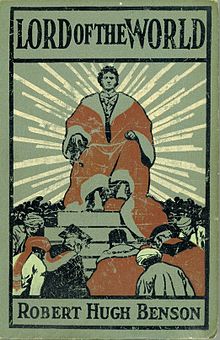
This past spring I ran across an Aleteia blog post relaying that both our current pontiff, Pope Francis, and our Pope Emeritus, Benedict XVI, have recommended the same novel to the Catholic reading public. The book–Robert Hugh Benson’s Lord of the World–is a dystopian novel about the coming of the Antichrist and the end of the world. So I bought a cheap copy for Kindle and have since devoured it. I could not put it down.

Monsignor Benson was the son of the Anglican Archbishop of Canterbury who converted to Catholicism and was ordained a priest. Though he and his work are not as well known today, he was praised in his time by great Catholic writers like Hilaire Belloc, and today by the likes of Joseph Pearce. Pearce has this to say about Lord of the World:

The world depicted in Lord of the World is one where creeping secularism and Godless humanism have triumphed over religion and traditional morality. It is a world where philosophical relativism has triumphed over objectivity; a world where, in the name of tolerance, religious doctrine is not tolerated. It is a world where euthanasia is practiced widely and religion hardly practiced at all. The lord of this nightmare world is a benign-looking politician intent on power in the name of “peace,” and intent on the destruction of religion in the name of “truth.” In such a world, only a small and shrinking Church stands resolutely against the demonic “Lord of the World.”

The novel was written in 1907, but from the world it creates, I would have guessed it had been published after one or both of the World Wars. It does feel prophetic, though I’ve ceased to be surprised by this, given the number of literary classics I’ve read in recent years that seem as though they fit our times. But Benson’s book is short, gripping, dark, terrifying at times–and beautifully represents the challenges of living a Catholic faith in a world with little use for it.

That said, it is a very Catholic book and may not be enjoyed as much by non-Catholics (unless, God willing, they have a heart very much open to learning about the faith). The cheap download for Kindle have numerous typos, but Ave Maria Press has a new edition out for those who prefer print anyway. I recommend it wholeheartedly.

O’Connor, or Three Things to Love About The Violent Bear It Away

Blogger’s Note: Several years ago, I agreed to my friend Jacqui’s challenge to read 15 Classics in 15 Weeks. Though 15 weeks is long past, this, at last, is 15 of 15!

* * * * *
“From the days of John the Baptist until now, the kingdom of heaven suffereth violence, and the violent bear it away.” 
— Matthew 11:12 (Douay-Rheims Bible); epigraph of Flannery O’Connor’s The Violent Bear It Away

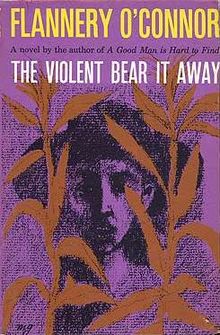
I am somewhat embarrassed to say that this was my first venture into Flannery O’Connor’s fiction, and what an introduction. It is a dark, hard, unflinching work, awful and mesmerizing, like a wreck along the highway–and yet strangely hopeful even as it descends. 

The book tells the story of Francis Marion Tarwater, an orphan boy in the mid-20th century deep South, raised with backwoods, biblical faith by his great uncle who believes himself to be a prophet and the boy to be his successor. When the uncle dies (at the very beginning of the story, so not a spoiler), the boy begins a very real spiritual struggle to discover the truth of this calling and the fate of his soul. The book builds a sense of dread even as the reader clings to threads of hopefulness, and erupts in violence both in present tense and in flashbacks–calling to mind a number of interpretations for the title and scripture verse it references.

I hesitate to say much more, for two reasons: first, this is a novel to be experienced, not spoiled or “set up,” and second, I honestly am not entirely sure what to make of it. I decided to wait a day or so before writing Three Things to Love, in order to reflect on the book–and I purposely didn’t read any commentaries. This morning, however, I read a couple of reflections on it by other people, and it appears I am not alone. O’Connor reportedly agonized over it, and readers for years have struggled with its deeper meanings and implications. On the surface, it is about the persistent pull on our hearts of both God and the world, and each person’s struggle to find freedom: will they take up the Lord’s yoke and find that it is light, or cast off the shackles of belief and live this life, for this world? It can be read (and enjoyed, after a fashion) at this level, but I am convinced there is deeper meaning here and will read it again someday.

So with that preamble, Three Things to Love about The Violent Bear It Away:
  • The Descriptions. Unlike several of the other books I read for this challenge (Tolstoy, Dostoevsky, Melville), this is a short book but still ripe with detail and description. O’Connor uses sparse, poetic language; metaphor; and simile to sculpt with words; the results a real, living people unalterably carved in stone.
  • Unflinching Honesty. O’Connor does not shy away from the darkness in humanity, and shares the thoughts and actions of her characters with relentless, sometimes shocking, honesty. At the same time, she does not succumb to the modern tendency to dwell on violence with pornographic detail–her matter-of-fact simplicity makes the book that much more compelling.
  • Eternal Themes. Faith and reason. Freedom and destiny. The nature of love. The spiritual combat. Here they are again: themes that arise in so much of great literature through the ages appearing again in 1960, set in the south of the United States. 
I feel as though I am sharing very little about this book, so maybe some comparisons would help. It reminds me in ways of two other books I enjoyed: Steinbeck’s East of Eden (one of my all-time favorite novels) and a more recent novel, Tobit’s Dog. If you like, check out those reviews to gauge whether The Violent Bear It Away might work for you.