Greetings from the North Pole, Part X

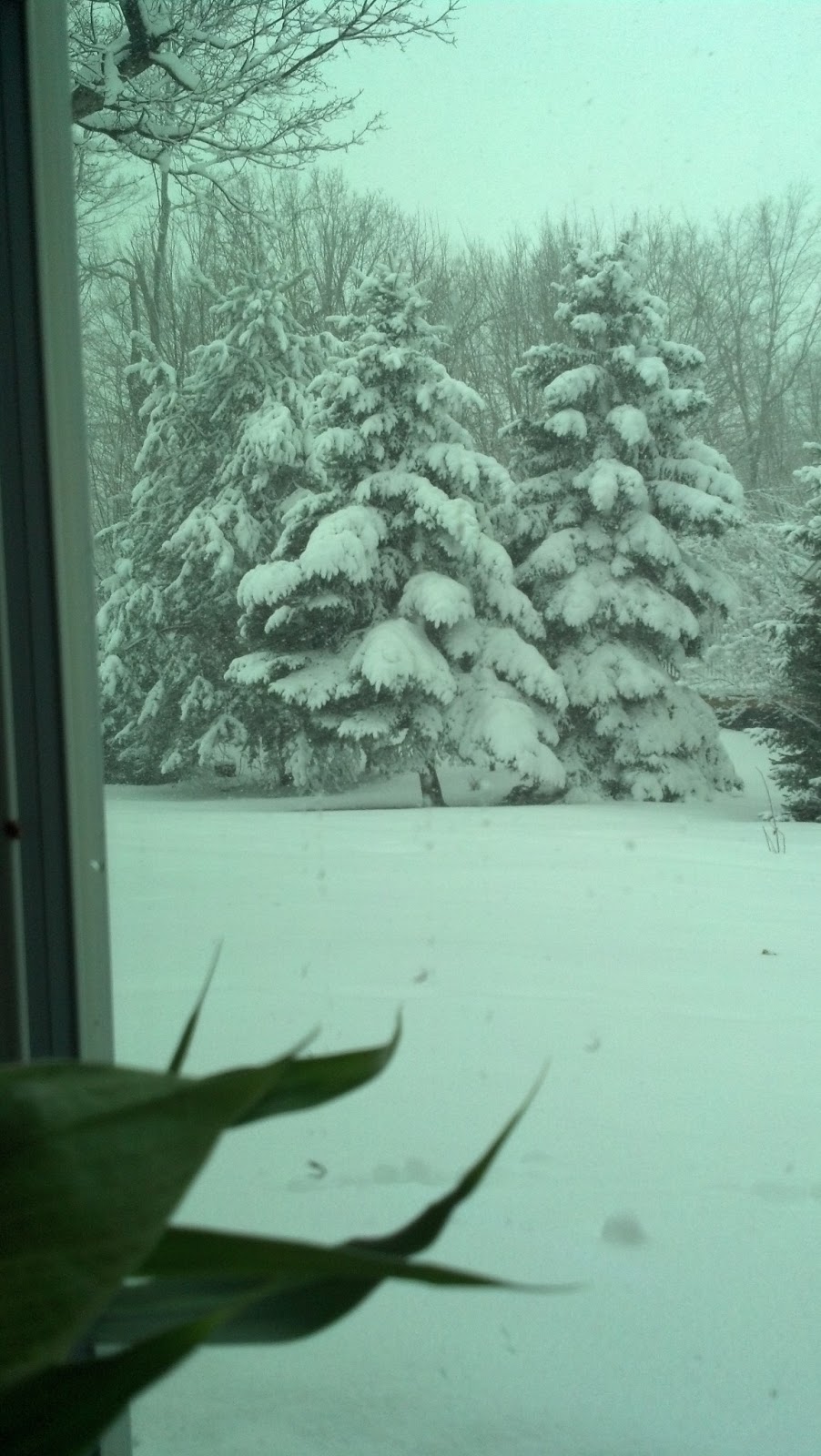
The view out my window, Thursday, April 18, at 6:15 p.m.

It’s beginning to look a lot like Christmas — and since my blog was on hiatus in December, I only shared our latest letter from our elfin correspondent Siberius Quill via Facebook. Since I believe we currently have more snow today that we had then, I thought I share it with you today! Season’s Greetings!

Past letters may be found in the archive.

Serious About Writing…

Back in early December, I announced that I was suspending this blog and taking it off-line. I likened my writing career thus far to standing on my head for show: requiring modest skill; impressive at first, then amusing, before becoming repetitive, uncomfortable, and unnatural. I even went so far as to declare, “ I won’t call myself a writer again until I write something worthwhile, and I don’t know what it will be.”

Those who know me well know I have a tendency to take myself entirely too seriously. I was in a bad spot at the time: way too busy at work, home, and church; unable to make a satisfactory start on the annual Christmas letter; and unhappy in my work. Some several things needed to give — but this blog was not one of them.

As a full-time husband, father, and director of communications, this little corner of the internet is one of the few places I actually do write stuff that people read. The people who matter most to me are here, but they aren’t the only ones — consider that this tiny, rhyming prayer is the most viewed post on my site, in large part due to readers (or skewed search results) from Russia. A favorite web site of mine, The Art of Manliness, posted an article awhile back entitled, “How a Man Handles a Miscarriage.” I read the post and the appreciative comments, before adding a comment of my own and sharing a bit about our little Jude. Men came and read, and though they left no comments, who knows whom it touched?

In fact, if I want to be truly serious about writing, I would not permit myself to be limited by the potential for monetary gain. A few weeks ago I was looking through the Catechism of the Catholic Church to see specifically what the Church teaches about property rights — and learned that while she makes no bones about supporting the right to private property, she is insistent that we steward our property and talents for the greater good:

“In his use of things man should regard the external goods he legitimately owns not merely as exclusive to himself but common to others also, in the sense that they can benefit others as well as himself.” The ownership of any property makes its holder a steward of Providence, with the task of making it fruitful and communicating its benefits to others, first of all his family.

Goods of production — material or immaterial — such as land, factories, practical or artistic skills, oblige their possessors to employ them in ways that will benefit the greatest number. Those who hold goods for use and consumption should use them with moderation, reserving the better part for guests, for the sick and the poor (CCC 2404 and 2405).

I read and re-read it: Goods of production, including practical or artistic skills, “oblige their possessors to employ them in ways that will benefit the greatest number … reserving the better part for guests, for the sick and the poor.”

A “serious” writer , then, should speak the truth, regardless of gain or loss, for the good of those who need to hear or whomever will listen.

It’s good to be back.

Book Break: The Santa of Oz?

A quick review today: as part of my ongoing reading in support of my writing, just before Christmas I checked out L. Frank Baum’s The Life and Adventures of Santa Claus and began to read it to the family. It’s a delightful book with an essentially pagan take on The Old Man’s origins and his status as a saint. It tracks his rescue from a hungry lioness by the nymph Necile when he was an abandoned infant in the Forest of Burzee (the lioness is later made to nurse the child and becomes his friend); it explains the origins of his unusual powers; the “why” behind the reindeer and little people who help him; and what motivated his mission on behalf of children in the first place.

As you might expect from the creative mind behind the Wizard of Oz, Baum’s story is delightful, quirky, and dark at times, but never too dark for children. His writing “voice” is distinctive, and I found it lent itself quite well to reading aloud. This book is a completely unique take (to my knowledge) on the Santa Claus legend, which is why I wanted to read it…but while it is kid-safe, parents may wish to read it first to see how it jives with the experience of Santa Claus in their own homes. It could also be a fun read for older kids who are beginning to question their beliefs; again, however, parents should peruse it first. The edition I read (a Signet Classics paperback, pictured) included an introduction and an afterword (the latter by a Jewish man who, as a boy, was against the very notion of Santa Claus) that make for interesting reading for adults, but might cause greater confusion for youngsters. All in all, our kids enjoyed it well enough, but afterward, Trevor said, “I think it was just a story he made up.”

John Barleycorn

Photo by Trevor

One of the cooler things I received for Christmas, as an aspiring brewer and literary type (also aspiring), was this t-shirt from The Brewing Network, which features Scottish poet Robert Burns’s version of the old folk song, “John Barleycorn” (or “John Barleycorn Must Die”) in the shape of a brewing carboy. The poem tells barley’s story from planting to brewing as a ballad and a tale of heroic sacrifice. The words are below, but to hear a proper reading, check out the YouTube clip at the bottom.

John Barleycorn
by Robert Burns

There was three kings into the east,
Three kings both great and high,
And they hae sworn a solemn oath
John Barleycorn should die.
They took a plough and plough’d him down,
Put clods upon his head,
And they hae sworn a solemn oath
John Barleycorn was dead.
But the cheerful Spring came kindly on,
And show’rs began to fall;
John Barleycorn got up again,
And sore surpris’d them all.
The sultry suns of Summer came,
And he grew thick and strong;
His head weel arm’d wi’ pointed spears,
That no one should him wrong.
The sober Autumn enter’d mild,
When he grew wan and pale;
His bending joints and drooping head
Show’d he began to fail.
His colour sicken’d more and more,
He faded into age;
And then his enemies began
To show their deadly rage.
They’ve taen a weapon, long and sharp,
And cut him by the knee;
Then tied him fast upon a cart,
Like a rogue for forgerie.
They laid him down upon his back,
And cudgell’d him full sore;
They hung him up before the storm,
And turn’d him o’er and o’er.
They filled up a darksome pit
With water to the brim;
They heaved in John Barleycorn,
There let him sink or swim.

They laid him out upon the floor,
To work him further woe;
And still, as signs of life appear’d,
They toss’d him to and fro.
They wasted, o’er a scorching flame,
The marrow of his bones;
But a miller us’d him worst of all,
For he crush’d him between two stones.
And they hae taen his very heart’s blood,
And drank it round and round;
And still the more and more they drank,
Their joy did more abound.
John Barleycorn was a hero bold,
Of noble enterprise;
For if you do but taste his blood,
‘Twill make your courage rise.
‘Twill make a man forget his woe;
‘Twill heighten all his joy;
‘Twill make the widow’s heart to sing,
Tho’ the tear were in her eye.
Then let us toast John Barleycorn,
Each man a glass in hand;
And may his great posterity
Ne’er fail in old Scotland!

I love The Brewing Network’s other shirts and its “hop grenade” logo. I haven’t checked out any of the radio shows or podcasts yet. It must be a small outfit, since the emails Jodi exchanged when ordering this shirt were signed “Linda, Justin’s Mom.”

Anyway, check out the reading below, then check out The Brewing Network.
Homebrew II: Irish Stout

My second batch of homebrew was an Irish Stout kit from Midwest Supplies, fermented with the recommended Wyeast packet in the same glass carboys and set-up used for my first batch. Brewing came off without a hitch, except that I forgot to take an initial hydrometer reading and then broke my hydrometer before taking a reading the afternoon I transferred to the secondary fermenter. (All this means is that I have no real idea regarding alcohol content, though from the feeling in my cheeks and ears, I’d say around 4.5 to 5 percent.)

The kit contained a small packet of gypsum, which (as I understand it) can be used to tweak the pH of your water, but in this context, is used to accentuate the bitterness of the brew and give you a drier stout. The wort tasted stoutish, and the samples at racking and bottling both tasted like flat stout…all good signs in my book.

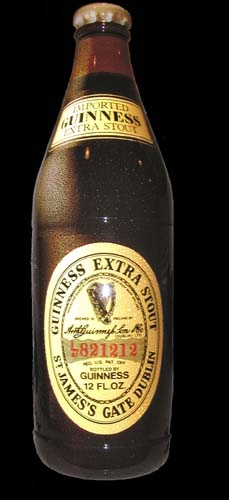
The final result? This is good beer, like the non-draught bottled Guinness I used to buy, only (dare I say?) better. Like strong French roast coffee, hearty bread dark-toasted, with a pleasant prickliness that grabs your tongue on the way down. [Blogger’s Note: I may be biased, since it’s mine, my own, my…prrrrecious!] I’ve had one bottle chilled and several at basement temperature (around 65 degrees F), and all have been delicious, though the warmer ones are decidedly better in my book.

Complaints? I definitely get a better head with these (see the top photo), but it still lingers only a few minutes. Also, I had hoped to make an all-homebrew black and tan with one my few remaining English pale ales, but despite my Dad’s insistence that he has successfully pour a black and tan with non-draught stout, I failed on multiple attempts. The resulting mistakes were consumed, of course, and fortunately tasted like good dark beer.

My next brew awaits bottling. It’s a bit of an experiment using an old stout kit from a decade ago. More on that when the time comes. In the meantime, as Dad and I would say, “Na zdrowie!”*

—–

*Na zdrowie (nah ZDRO-vee-ah) is a Polish toast meaning “to your health.”