Pre-Election Rant-A-Day 7: Most Politics Should Be Local

Blogger’s Note: One more rant after this one, If I can get it together. Feel free to look at the past six, as well, and comment if you like. Or not.

“Excessive intervention by the state can threaten personal freedom and initiative. The teaching of the Church has elaborated the principle of subsidiarity, according to which ‘a community of a higher order should not interfere in the internal life of a community of a lower order, depriving the latter of its functions, but rather should support it in case of need and help to coordinate its activity with the activities of the rest of society, always with a view to the common good.'”

Catechism of the Catholic Church (CCC), 1883

It’s worth looking at the larger context of the quote above before Election Day — it’s food for thought whether you’re Catholic or not. Of particular interest is paragraph 1881 — “Each community is defined by its purpose and consequently obeys specific rules; but ‘the human person . . . is and ought to be the principle, the subject and the end of all social institutions.'” — and paragraph 1885: “The principle of subsidiarity is opposed to all forms of collectivism. It sets limits for state intervention. It aims at harmonizing the relationships between individuals and societies. It tends toward the establishment of true international order.”

Subsidiarity, according to Dictionary.com, means two things, both of which I am personally partial to:

  1. (in the Roman Catholic Church) a principle of social doctrine that all social bodies exist for the sake of the individual so that what individuals are able to do, society should not take over, and what small societies can do, larger societies should not take over
  2. (in political systems) the principle of devolving decisions to the lowest practical level

What we’re talking about, essentially, is local control. Who better than ourselves and our neighbors to solve the problems in our back yards? Who better to rally around the new mother, the unemployed father, the sick child, than friends and family, church and community? Why on earth should we send so much of our resources half a nation eastward to be reallocated when we have plenty to do here at home, and plenty of smart folks with similar goals to do it?

We waste so much time, energy, and money on the national campaigns and the race for governor, and too often can’t name our local reps, school board and city council members, or mayor. We want them to have our backs, but we vote for the state and national policymakers who pass the laws that tie their hands. Those in power take money out of local communities; local communities can either raise property taxes, cut services, or both; and we complain no matter what. Is it any wonder that our local officials who go on to state or national office mold themselves into professional politicians? It’s because that’s what we reward! We expect their service and support for local priorities, and are outraged when they fail or fall…but where are we the rest of the time? How many of us will go to the polls on Tuesday, look at the local races and vote for the two or three people we might know (or whose names we might recognize) and vote “incumbent” or party lines for the rest?

I’m as guilty as most: My big step forward in the last year or so was to cancel our once-a-week subscription to the Sunday edition of the Minneapolis Star-Tribune and reinvest a portion of that money into our local weekly, the North Crow River News. I’m slowly beginning to know who’s who and to get involved in community service at home, instead of at work in the Twin Cities. But I still wouldn’t know our mayor by sight and couldn’t name a single city councilperson.

Former Speaker of House Tip O’Neil is credited with the adage, All politics is local. In truth, politics should be local — but these days, most of politics looks coastal and feels feudal. We need to take personal interest in our local elections and vote to keep as much control as we can here at home. We should take care of our own.
Pre-Election Rant-A-Day 5: Stop Yelling and Say Something!

Blogger’s Note: The Rant-A-Day blitzkrieg continues. Check the past few days to see what’s got me going.

I have a hard time voting. I love the concept. I love the sense of civic duty, the solemnity of the retiree election judges. I love having voted, and watching the returns roll in. But I’m a visceral guy — I trust my gut, and it doesn’t respond well to well-oiled answers and million-dollar smiles. So the voting booth often feels like a trap.

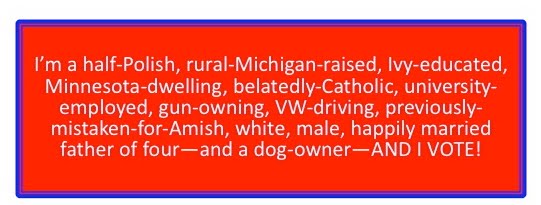
If you’ve been reading these rants, you may be thinking that I lean to the right, politically speaking. That’s true enough — although I voted for candidates from four different political parties in the 2008 election, I’m getting progressively more conservative (see what I did there?). My good friend Jinglebob, whose Dennis Ranch blog is to the right of here (literally and politically), once told me, “If you’re not liberal when you’re young, you’ve got no passion…and if you’re not conservative when you get older, you’ve got no sense.”

Not long after that, another friend described me as an “old soul.” There you have it. Storm’s comin’…feel it in my knees…

So yeah, I lean right. The only thing that keeps me from tipping over completely is that it seems like too many Republicans have forgotten that there is a conservative intellectual tradition* that is deeper than the handful of talking points they’ve memorized, and actually could be employed to change minds and solve problems. (Yes, that’s right: you can be a conservative intellectual; they just don’t give you a talk show.) The folks on the Left like to describe the Democrats as the Party of Ideas and the Republicans as the Party of No. I think they’re half right on both counts — I see the two as the Party of Bad Ideas and the Party of No Ideas. I often disagree with our Democratic candidates’ approach to issues, but the Republicans rarely get specific enough for me to make an informed judgment about their approach.

I guess I’m supposed to trust that we’re like-minded, provided the candidates are minded at all.

And this year in Minnesota, politicians and newspapers of all stripes are endorsing the Independence Party candidate, who, according to the Dems, is a once and future Republican in disguise, and according to the Republicans, is only Right relatively speaking, insofar as he is right of the Left. He seems completely rational, has a balanced approach to every issue, and appears to be personally principled and professionally pragmatic. Perfectly positioned to appeal to the thinking public.

I can’t stand that: Where do you stand, sir? Right here in the middle. What’s your opinion? Well, I can see both sides. We should do this AND that.

Peachy. Except everybody can’t be right and everybody can’t win all the time. Too much compromise is the same as “It’s all good.”

Where are the lines you won’t cross?

I am a conservative, and a Christian, but not a “Christian Conservative” as it is popularly understood. I am a Catholic, but what does that mean, come Election Day? Does it make me a “one-issue” voter? I suppose it would, if I were a one-issue Catholic. What most people — many Catholics, even — don’t understand or have forgotten is that the Catholic Church also has a rich intellectual tradition, rooted in philosophy, and history, and (dare I say?) science — a tradition that, once understood, suggests new ways of thinking, new solutions to problems, and even new responsibilities for believers, both in their public and private lives.** We like to wear our various faiths like badges of honor, and point to those on the outside as the problem — but in truth, our beliefs make demands primarily of us. And the same holds true of the candidates.

My point? It’s easy to spout off. The donkeys bray; the elephants trumpet; and no one moves an inch. I lean right, and further every day, but my vote’s not guaranteed. I do my homework as best I can. I’ll vote third-party to have a clear conscience.

So stop shouting — I can hear you even with my hearing aid turned down. I know what you’re saying. Now tell me what you’re thinking. AR-TIC-U-LATE something. Let me in on the plan. If you need my vote, convince me. And if you don’t need me, stop junking up my mailbox with oversize postcards that say the same thing as last week.

Now get off my lawn.

* As a teen, I lived 5 miles or so from a big old mansion in the tiny village of Mecosta, Michigan. Rumor was that an eccentic old writer lived in that house. When Jodi and I bought our first house in Mecosta after we married, we lived just a few blocks from the mansion, and the old writer’s widow invited us to dinner. Russell Kirk: Father of American conservatism, with a little Gothic fiction on the side. And I left town and went to Yale…

** Kirk was Catholic.

Pre-Election Rant-A-Day 1: Of Course I’m Right! Aren’t You?

Blogger’s Note: I’ve been absent a long time, partly because I’ve been crazy busy this fall, and partly because I’ve had a terribly long and curmudgeonly blog post brewing in my head for months, and no time to write it. So I’ve settled on the “Rant-A-Day” format. My intention is to post a portion of the aforementioned terribly long and curmudgeonly blog post, in rant form, each day until the election, at which point (hopefully) they amount to something.

At Mass on Sunday, Deacon Steele shared the observation that, while saints in heaven are wonderful, saints here on earth can be tough to stomach. You know the type: always polishing their halos and making a point to love the smiles right off their neighbors’ faces.

To a certain extent, in college that was me. Not growing up in the Church, I didn’t consider myself a saint, per se — but my upbringing was quite different from that of most of my college friends and, I thought, clearly superior. Some of this was defensive: I was surrounded by very different expectations and standards of behavior than I was used to, and I watched the beliefs of like-minded classmates crumble around them at the hands of the better-informed and the sharper-tongued. So I bolstered my arguments to support my beliefs — and in the process, polished my halo.

I remember the moment a close friend finally called me on it. We were talking about the death penalty and prison and to what extent a convicted criminal’s environment and upbringing should be taken into account when sentencing. Apparently, I was arguing not very dang much because my friend said, “You think you’re better than them, don’t you?”

I paused for a moment, taken aback by the question (because, let’s be honest, when you hear that question, you’re almost programmed to respond with an indignant, “NO!”). Then I said, “Yeah. Yes, I guess I do. Don’t you?”

“No,” he said. “I think we’re the same. I got lucky to be born into the family I did, and to go to the school I did, and to come here, or I might be in the same situation as they are.”

I didn’t back down at the time, but he gave me food for thought. How much pride could I take in my parents, whom I did not choose, and the solid home and upbringing they provided? How much of me was me, and how much them? I began to listen to myself speak, and I could hear the squeak of the rag on the halo. And I didn’t like it.

Shortly thereafter, I embraced agnosticism — and not just religiously. I started to build a world view on the notion that there was very little we could know for sure about anything, and it’s best to just get along.

Thank God I met Jodi.

See, self-righteousness is ugly. Smugly counting your blessings and crediting yourself for them all won’t win you friends or favor, and clinging blindly to beliefs that keep you safe and comfortable won’t get you to Heaven (or even across the street).

But pretending that nothing is certain — or that you don’t believe in anything for sure — so as not to offend or be caught in error, is as cowardly as it is false. And yet recently — within my 35 years, it seems to me — it has become arrogant to express confidence in or adherence to your personal convictions in public, unless your underlying worldview is neutral. This approach can be summarized by three insidious words: It’s All Good.

“It’s all good.” This is how we summarize freedom and love of neighbor. It’s how we avoid conflict; how we justify ourselves and avoid condemning others; how we let everyone know we’re on their side without taking sides. It is without meaning — and when we live accordingly, so are we.

We cannot and do not live our lives in unbelief. We might keep our beliefs secret, and even act in opposition to them on occasion — but we all have convictions, and we should have the courage of them. We should act, speak, and vote accordingly. We should absolutely vote for like-minded candidates who support our way of life and our values and morals. That’s the only way in which “government of the people, by the people, for the people” can function. If we do anything less — if we decide by our actions, our words, or our ballots that any one candidate, position, or decision is as good as another — we cede our authority to the government, and all priorities and decisions become the state’s.

In this week prior to the elections, the first thing I want to say — the thing I want to shout from the rooftops, really — is this: It is NOT all good. Decidedly not. For God’s sake, and our own, believe in something and make a stand. If it’s all good, as they say, why get out of bed a week from Tuesday? How will you choose, anyway?

It’s all good will be are downfall.

We should come to the polls believing that we’re right — each and every one of us — and if we don’t believe we’re right, we should spend a little time contemplating a new direction before November 2nd. I have a set of beliefs, some of which stem from my upbringing, some of which stem from my experience, and many of which stem from my faith. Not only is it decidedly not arrogant to bring these (faith included, even in America) with me the ballot box, but it is required in order to have a functioning democracy. Our ideas and our ideals must do battle.

So next week, I will vote and do my level best to impose my own belief system on our local, state, and national governments. Why? Because I believe I’m right. Of course I believe I’m right. Don’t you?

Book Break: Walking on Water

Just finished reading Madeleine L’Engle’s book Walking on Water, on being a Christian and an artist. (She doesn’t talk so much about “Christian artists,” because the phrase suggests something about both the art and the artist that may not be true; some overtly Christian works are poor art, and some great “Christian” works have been produced by nominal Christians or non-Christians.)

This book was recommended by a former colleague and friend of mine, Cerdo — he of Squad 19 and Harley-Davidson fame, and true to his word, it’s solid. L’Engle’s not afraid to believe and proclaim the hard parts of more “orthodox” or traditional Christianity — the Annunciation, the Incarnation, Transfiguration, Resurrection … sin and the devil … angels and redemption. She sees the artists role (whether writer, composer, sculptor, painter, or actor) as “incarnational” — much like Mary. Whatever the medium, we are called to be co-creators with God; the artist who is true to his or her vocation says yes to work — the gift — God has given to make Him present in the world. Sometimes the work is hard, and it’s easy to be led astray; to choose not to serve, and use the gift to destructive ends. (The book is 30 years old now, but she speaks frequently and well about the problem of pornography, as though she saw this online epidemic coming.)

L’Engle’s use of the “title story,” of Peter stepping off the boat to walk toward Christ on top of the waves, beautifully to illustrate how a deep and almost childlike faith lies at the root of creative work, of following inspiration where it leads. She describes Peter’s (and our) situation more like we’ve forgotten how. It’s not that Peter was doing the impossible and sank when he lost faith, but instead, that he was doing what we are all meant (and able) to do — walking with God — and sank when he “remembered” that he didn’t know how to walk with God.

Deep down, we all know. I’m realizing that these cement shoes are my own handiwork.

The Creation of Thunder

As originally reported on my Facebook page, I watched Ben-Hur this weekend with Brendan and Gabe. I think Brendan now wants me to go back to The Albertville Creamery antiques shop to pick up the late 19th century edition of the book they have for sale. He knows I am susceptible to such suggestions…

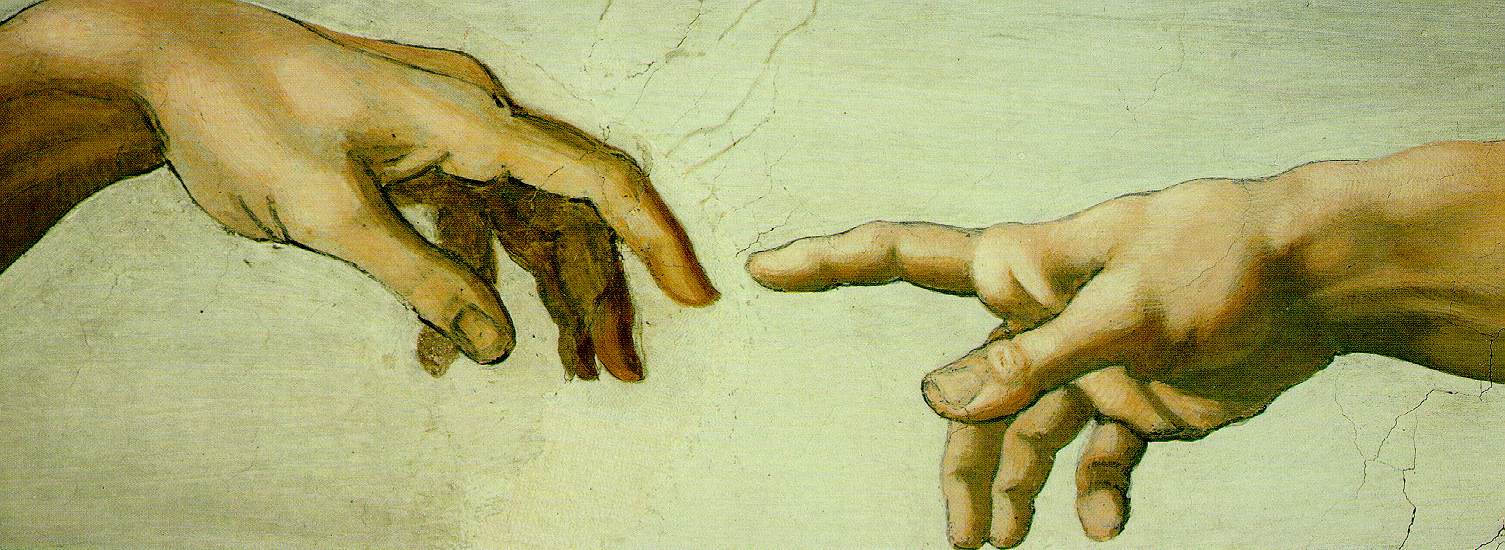
At the outset of the movie, as the Overture played, the DVD displays Michelangelo’s painting, The Creation of Adam, and since I was watching with two tween boys, I referenced the irreverent “pull my finger” caption you sometimes see associated with that painting. It was storming at the time, and Gabe (our aspiring priest) said, “GOD said, ‘Pull my finger,’ and the first thunder was created!”

We laughed and laughed. And it was good.