The Sacraments Keep Us Catholic

“At last the most wonderful day of my life arrived, and I can remember every tiny detail of those heavenly hours … How lovely it was, that first kiss of Jesus in my heart—it was truly a kiss of love.” – St. Therese of Lisieux, describing her first Holy Communion
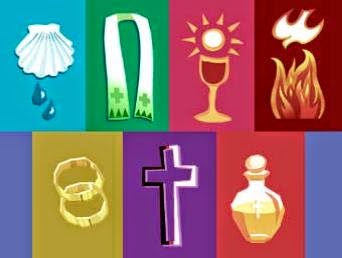
Last month I was blessed to witness nearly 140 young people from our parish and school receiving their first Holy Communion. They were, by and large, reverent and excited—and those I spoke with personally understood at least in concept that they were receiving Jesus’s Body and Blood under the appearance of bread and wine. I hope at least a few of them remember the day with the same deep joy and devotion as St. Therese expresses above.  I’m almost certain, unfortunately, that a few have not been back.

Our approach to preparing children for First Confession and First Communion in recent years has increasingly fallen on their parents. In one sense, this is as it should be: the Catechism of the Catholic Church affirms that, through marriage, “parents receive the responsibility and privilege of evangelizing their children” and “should initiate their children at an early age into the mysteries of the faith.”

On the other hand, many parents do not feel equipped to share those mysteries, being uncertain themselves about the Church’s teachings on Reconciliation and the Eucharist. And while we provide families with workbooks to help them teach their children, these are poor substitutes for the level of love and support young Therese had in the months leading up to the sacraments. Her desire to make a good confession and to receive the gift of the Eucharist consumed her completely, and everyone in her family and community fueled her understanding and love for the Lord in whatever way they could.

As a parish, we can certainly do more. Beginning this fall, First Reconciliation and First Communion students will have an extra class or activity (in addition to LIFT) each month dedicated to sacramental preparation and a deeper understanding of the great gifts of Christ’s love and mercy we find on the altar and in the confessional. But this is no substitute for the evangelizing witness of parents leading a sacramental life in which their Catholic faith is a top family priority.

This is true for two reasons. The first is this: because children naturally observe and imitate their parents’ actions and interests, parents don’t have to have all the right answers, but it helps if you do the right things. Secondly, the sacraments are defined as outward signs instituted by Christ to give us grace—in particular, sacramental grace, which strengthens us to live according to our faith and state in life. The sacrament of Matrimony, for example, confers upon the spouses the graces needed to live in union as husband and wife, come what may.

The same applies to the sacraments of Confession and Communion. They strengthen us to resist temptation and seek communion with God, to forgive and seek forgiveness, to love sacrificially—in short, to be holy men and women of God. Each time we receive them, we are changed for the better. And when our children imitate us, so are they. What better way to ensure our kids remain Catholic?

Blogger’s Note: This article appears in the Sunday, May 24, church bulletin.

Confessions of a Fledgling Catholic: Mass Doesn’t Fulfill Me, Either

When he returned to his disciples he found them asleep. He said to Peter, “So you could not keep watch with me for one hour? Watch and pray that you may not undergo the test. The spirit is willing, but the flesh is weak.”    – Matthew 26:40-41

I’ve had a version of the following conversation countless times, including twice in the last week: I don’t get anything out of Mass. I’ve heard it from parishioners and strangers: I’m not learning anything. I’m just going through the motions. I’ve heard it from family and friends: I don’t any feel joy or peace. I don’t feel fulfilled.

These conversations resonate with me because I’ve heard their echo over the years in the hollow around my own heart: I want to love the Mass, but I’m not like those people. I can’t pray like that.

It is a strange sort of pride that insists that our problems are not like anyone else’s—in this case, that we alone struggle with distraction, temptation, and doubt. We often cling to our weaknesses like a badge of honor, insisting, “For me, it’s different…you don’t understand.” I have come to believe that this is from the Enemy—his subtle deception to help us justify ourselves as the exception to the rule and lead us, degree by degree, away from God.  The Devil is cunning and loves distraction as much as we do, so when our minds wander, he seizes the opportunity to tell us we’re not worthy of our call or that we need something more.

Couple the Devil’s taste for stray minds (a fitting appetizer for an entrée of lost souls) with our own misperceptions of what the Mass is, and we are ripe for falling away from our “Sunday obligation.” If we see Mass simply as an obligation, it becomes dry and stale, just another item on the weekend’s long list of To-Dos. If we see Mass as all about us—as weekly affirmation, intellectual nourishment, a spiritual workout, or wholesome entertainment—we will eventually be left cold when it doesn’t leave us fat, flush, and smiling.

But the Mass is not these things—at least not primarily. The Mass is where we come, once a week at least, to give God his due: our love and praise for literally everything we have in this world. We are asked by His Church to do this each Sunday and a handful of special feast days throughout the year. We are asked to spend about an hour a week to thank God for life, family, friends, the beauty of the created world around us, good food and drink, a warm house on a cold night, the breaking dawn, our next breath…

So we come to His house; we sit, kneel, stand, and struggle to stay in the moment, to pray and praise and give thanks. We fight distraction, and occasionally we win. And then, at about the 45 minute mark, instead of simply receiving our praise as His due, God gives us His very substance, our Lord Jesus Christ, in the Eucharist—as if He hadn’t given us enough already!

This is how it occurs to me now: I struggle to spend an hour a week focused on giving thanks and praise to God for everything I have and will have in this world, and before I’m even finished, He pours His whole self out—again—for me.

If I leave this exchange feeling cheated, my heart is not yet in the right place.

The truth is that our hearts aren’t in the right place. They are fallen, fleshy things, slightly off-kilter and left of center, fluttering over temporary pleasure and not yet conformed to Christ. But that’s okay, because the sacraments, particularly, of Confession and Communion, give us the grace we need to continue to reshape ourselves as we were created, in the image of God. All we need is to persist.

I have said before that if people really understood Who was present on the altar and in the Confessional, in the monstrance or the tabernacle, nothing would keep them from coming to the church. I believe this, and yet I struggle to see Jesus in the Holy Eucharist, or in our holy priests, or in my neighbor. I may look like one of those devout souls who are in communion with the heavenly host, praising God during the liturgy each Sunday, but my thoughts turn to my kids and yours, the whispering teens, the appearance of others, Sunday brunch, the budget, the time.

And then I realize that Father has already said, “This is my body,” and my eyes open upon the elevated host. I hear the words of Jesus when He finds his disciples asleep in Gethsemane: “So you could not keep watch with me for one hour?”  And I feel unworthy of being His disciple—an uncomfortable feeling in the moments before Holy Communion. I gaze at the Eucharist in Father’s hands and pray, “Lord, I believe—help my unbelief.”

Alone in ourselves at the Mass, in the midst of so much quiet and so many distractions, it can be difficult to seek and to find God, even when He is so near at hand. As a friend and fellow parishioner puts it: “If you only knew the drama playing out, not only on the altar, but in your very heart and soul!  This is the moment you need God the most, in this insidious serenity of Mass, with your defenses lowered.”

And in this moment, He is closest at hand. St. John of the Cross writes, “If a person is seeking God, so much more is her Beloved seeking her.” Consider that for a moment. When we turn our gaze toward God, He is there, gazing upon us. When we seek Him, He finds us. And when we return our attention to Christ during the Mass, His response is not anger or jealousy, but the response of a bridegroom to His bride: “At last!”

What more could we ask for from the Mass?

And yet we still sometimes feel unfulfilled. One reason may be that we attend Mass, then think: Is that all there is? Of course it’s not. If we feast on the richest foods, then sit idly week after week, we grow comfortable, complacent, and ultimately, fat and unhealthy. The same is true spiritually: we cannot gorge ourselves on the love of God and then sit idly. We are not Christian only on the day of rest. The other six days we are called to work, to be fruitful. The Mass strengthens us to do God’s work in the world—to “go and make disciples of all nations,” as Jesus commissioned us.

But even when we do this work, we may still feel dissatisfied. St. Augustine says, “You have made us for yourself, O Lord, and our hearts are restless until they rest in you.” We are made for God, and we long to be with Him. He gives us so much, but He promises so much more. May we persevere in faith and be made worthy of that promise!

O Death, Where Is Your Sting?

At long last, we celebrate Easter, and the resurrection of our Savior, Jesus Christ! Perhaps you’ve been steadfast in prayer, heartbroken and sincere in penance, and generous in alms-giving. Or perhaps you feel you’ve done too little, too late, for our Lord — perhaps you’ve slipped in your Lenten commitments or find that Easter has crept up on you almost unawares.
Either way, take comfort in the Easter homily below from St. John Chrysostom. Drawing on the gospel of Matthew, chapter 20, he reminds us that we never come too late to God and always receive full payment!

Easter Homily by St. John Chrysostom

Let all pious men and all lovers of God rejoice in the splendor of this feast; let the wise servants blissfully enter into the joy of their Lord; let those who have borne the burden of Lent now receive their pay, and those who have toiled since the first hour, let them now receive their due reward; let any who came after the third hour be grateful to join in the feast, and those who may have come after the sixth, let them not be afraid of being too late; for the Lord is gracious and He receives the last even as the first. He gives rest to him who comes on the eleventh hour as well as to him who has toiled since the first: yes, He has pity on the last and He serves the first; He rewards the one and praises the effort.

Come you all: enter into the joy of your Lord. You the first and you the last, receive alike your reward; you rich and you poor, dance together; you sober and you weaklings, celebrate the day; you who have kept the fast and you who have not, rejoice today. The table is richly loaded: enjoy its royal banquet. The calf is a fatted one: let no one go away hungry. All of you enjoy the banquet of faith; all of you receive the riches of his goodness. Let no one grieve over his poverty, for the universal kingdom has been revealed; let no one weep over his sins, for pardon has shone from the grave; let no one fear death, for the death of our Saviour has set us free: He has destroyed it by enduring it, He has despoiled Hades by going down into its kingdom, He has angered it by allowing it to taste of his flesh.

When Isaias foresaw all this, he cried out: “O Hades, you have been angered by encountering Him in the nether world.” Hades is angered because frustrated, it is angered because it has been mocked, it is angered because it has been destroyed, it is angered because it has been reduced to naught, it is angered because it is now captive. It seized a body, and, lo! it encountered heaven; it seized the visible, and was overcome by the invisible.

O death, where is your sting? O Hades, where is your victory? Christ is risen and you are abolished. Christ is risen and the demons are cast down. Christ is risen and the angels rejoice. Christ is risen and life is freed. Christ is risen and the tomb is emptied of the dead: for Christ, being risen from the dead, has become the Leader and Reviver of those who had fallen asleep. To Him be glory and power for ever and ever. Amen.

He is risen, indeed — let us feast and rejoice this day like no other! Alleluia!

Book Break: Saint John Paul the Great: His Five Loves

This past Christmas, our church gave to all parish and visiting families a copy of Jason Evert’s book Saint John Paul the Great: His Five Loves. I finished it this past week while recuperating, and it seems only right that on this tenth anniversary of the great man’s passing, I offer a brief review and encourage family and friends to read it.

First, let me encourage you to read the Foreword and Introduction, as both share personal anecdotes that share what sort of man Pope John Paul II was, The first half of the book, then, is a condensed and easy-to-follow biography of Karol Wojytla from his boyhood in Poland to his death at the Vatican at age 85. Some years ago, on a long solo road trip, I had the pleasure of listening to an audiobook version of George Weigel’s JPII biography, Witness to Hope — Evert’s book uses Weigel as one of several sources, and provides a great overview of the events and circumstances that shaped young Karol into Father Wotyla, then bishop, archbishop, pope, and saint. When I hear these stories, I can’t help but be proud to be (half) Polish and Catholic.

The second half of the the book uses additional sources and anecdotes to outlines the “five loves” that inspired and sustained Pope John Paul II in his priestly ministry and personal holiness:

  • Young People: From his earliest priesthood, he was drawn to youth and young adults, recognizing early on that they were the church’s best hope for the future, and that a watered-down morality would not satisfy their idealism and thirst for the challenge of living full and Godly lives.
  • Human Love: He saw, in human love and sexuality, and image of the Holy Trinity’s loving and life-giving communion, and went to extraordinary lengths to explain the unity of love, sex, marriage,and procreation and to elevate these topics to the realm of the sacred.
  • The Blessed Sacrament: His love for the Holy Eucharist and experience of the Real Presence of Jesus was so deep and strong that he spent hours in adoration and conversation with God, and more than once, located the Blessed Sacrament in hidden chapels and unknown places by his love for and sense of the Divine alone. 
  • The Virgin Mary: After the loss of his mother, and ultimately his brother and father as well, he embraced Mary, the Mother of God, as his own and never ceased his devotion to her guidance and intercession — he knew that she always leads us to Christ.
  • The Cross: He saw the dignity in the elderly, the disabled, the sick, and the suffering, and showed it to them, first by articulating the ways in which human suffering can be used to benefit others, and finally, by living his own painful and debilitating struggles in the public eye, serving the Church until his death.
Last I looked, we still had a few copies of this book in the Gathering Space. If you didn’t get one, let me know. It’s a quick and enlightening read that is almost sure to inspire!

Book Break: Story of a Soul

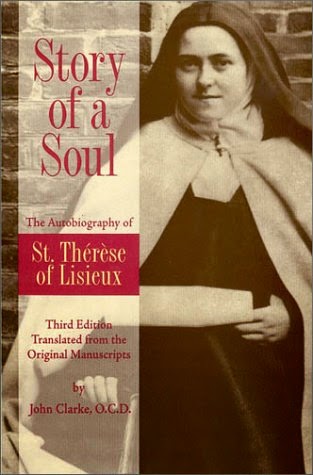
One of the great blessings of surgery has been time to read; as a result, I’ve now finished three books that lay on my nightstand, long overdue. The first was the the autobiography of St. Therese of Lisieux, Story of a Soul. The Little Flower had been much on my mind and had shown up time and again in my prayers and study this past winter, so much so that I decided she must be trying to tell me something. I found her biography in our parish lending library, and finished in late last week.

Autobiographies, especially those that weren’t expressly written for publication, can be challenging to read, and this is no exception. St. Therese is writing out of obedience, fulfilling requests of three different prioresses to record the memories of her life. Her style is emotional, sentimental, somewhat meandering, and acutely self-aware — in fact, she acknowledges throughout the book, with good humor, that she has drifted far from the main point, but that she is writing because she was asked to, and if her work is found lacking and destroyed, it will be of no great loss to her.

It does not take long to realize this is the story of an exceptional soul from an exceptional family. From her earliest days in 19th-century France, the Martin family’s life revolved around their Catholic faith, prayer, and the sacraments. The first thing that struck me (and I believe this was one thing the little saint wished to tell me) was that in her childhood, preparation for receiving Jesus in the Holy Eucharist for the first time was the most important and most exciting thing that could happen. She understood the mystery of the Real Presence early on and longed for the sacrament with her whole being; her entire family — parents, sisters, aunts, uncles, everyone — helped her to prepare, encouraging and instructing her, helping her to make a mature first Confession, even sending this little girl on retreat to prayerfully prepare for her first Communion. We fall far short of this today, and that must change!

From an early age, St. Therese longed for the religious life of a Carmelite sister. The persistence of her vocation also struck me: she prayed long and hard on this beginning in childhood and was so strongly minded that, on a pilgrimage to Rome, she pulled rank on her local priests and bishop and cried to the Pope to let her honor him by entering Carmel at age 15. He told her she would enter if God willed it, and a short time later, the local church authorities relented.

The religious life was not without struggles for St. Therese, and it was there that she perfected her “Little Way,” which has made her so beloved the world over. She wanted to do great things for God, but was confined to a convent, young and of poor health. She could not be a priest, and would not be a missionary or a martyr. She was just a little flower on the forest floor — but the little things she did, she could do with great love. As a result she began to bite her tongue when accused or  provoked, to seek out the sisters who were avoided by others and look for ways to serve them, and to seek the good for others in every situation, regardless of the cost to herself. She began to love as God loves.

St. Therese was extraordinary, but blazed a trail that ordinary Catholics can follow, perhaps, more easily than that of the spiritual powerhouses of the Church. And I think that was another thing she wanted to tell me. This is a beautiful story of a great soul, and while it’s not a traditional page-turner, I highly recommend it.

On a related note: during the same time period as I was reading this book, a colleague gave me a booklet called “40 Days of Preparation for First Communion with St.Therese of the Child Jesus.” It is a booklet of very short daily prayers and exercises for children, based on the prayers and exercises St. Therese undertook as a girl under her family’s guidance. Unbeknownst to me, my colleague Kathy was given the same booklet by one of our priests to consider for use with this year’s First Communicants. It’s a baby step toward what our First Communion preparation ought to be. St. Therese of the Child Jesus and the Holy Face, pray for us!