What’s Keeping You?

It’s been nearly eight months since I left the University of Minnesota to work full-time for our parish. At some point in each of my previous jobs, I looked around and asked myself, “Jim, what are you doing here?” Thankfully that has yet to happen since I joined the church staff, but I don’t doubt that it could—work is work, after all.

Faith is work, too. It’s hard sometimes to believe in a good God with so much wickedness in the world, including within the Church. It’s hard to do the right thing when so few people agree on what the right thing is, even within the Church. It’s hard to pray or read or learn more about Jesus, to drag ourselves to Confession, or to haul the family to Mass each Sunday when so many Catholics just…don’t.

I’ll bet at least once you’ve sat in church, looked at Father and the people gathered around you, and asked, “What am I doing here?” It’s a worthwhile question to consider. According to data collected by the Pew Research Center, not only do most U.S. Catholics say they attend Mass once a month or less, but many disagree with the Church’s fundamental teachings regarding marriage, contraception, and the sanctity of life. Yet they persist in calling themselves Catholic. What’s keeping them in the Church?

Well, what’s keeping you? Is it habit or family tradition that brings us here week after week? That makes us seek the sacraments for our children? Is it a hope we hold out for the next generation, even though we may have lost it for our own? Is it a hollow ache in our chest that insists there must be something more to this life? Or is it the peace that radiates from altar, the tabernacle, the Eucharist—peace the world cannot provide?

This month the adults in our LIFT classes focused on the Mass and Holy Communion. We heard the deeply personal testimony of one of our youth ministry volunteers on her own struggles with her Catholic faith—and ultimately, on how she could never turn her back on the Real Presence of Christ in the Eucharist. Jesus said, “This is my body…This is the cup of my blood”—and so it is. Jesus is God, and God’s words are the very words of Creation. They bring about exactly what they say.

I’ve said more than once that if we as Catholics truly understood who was present in the tabernacle, nothing could keep us from Him. We would fill the pews to overflowing, bring family and friends to a personal encounter with Jesus. We would gladly sacrifice to spend time at His feet, listening to Him, learning from Him, serving Him.

And yet I don’t do these things. We don’t do these things.

The red lamp above the tabernacle signifies that He’s always there. What’s keeping you?

Blogger’s Note: This article appears in the Sunday, Jan. 25, church bulletin .
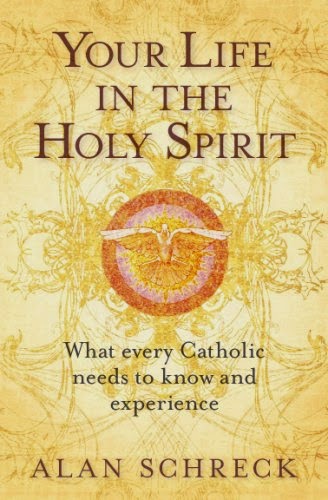
Book Break: Your Life In the Holy Spirit

Blogger’s Note: I reserve the right to re-read this book and revise this review as what I’ve read continues to sink in. I wanted to write about it soon, but honestly, my head is spinning!

If you’re like most Catholics, the concept of the Holy Trinity — three persons; one God — is one of the mysteries of our faith that is most difficult to grasp. The best explanation I’ve heard uses marriage to teach us about the Trinity, and vice versa:

  • God is a loving communion of persons.
  • Just as God the Father loves God the Son, and God the Son reflects that love back to God the Father, so to with husbands and wives: the two are united in love so completely they are inseparable and become one person.
  • Just as that shared love between husband and wife can become so powerful, life-giving, and tangible that it results in a new person and is given a name, the shared love between God the Father and God the Son is so abundant and powerfully life-giving that it takes on a life of its own and becomes a third person, God the Holy Spirit — who, in the Nicene Creed each Sunday, we call “the Lord, the Giver of Life.”

This explanation helps me to conceive of the Three-In-One, but the ability to relate to the Holy Spirit as a person remains elusive to me. I recently found up a copy of Alan Schreck’s Your Life in the Holy Spirit and decided to read it, in hopes that it would relieve this difficulty and help my devotion to the Holy Spirit as a person, rather than some mysterious force that helps me understand the Father and the Son. Schreck is a theology professor at Franciscan University of Steubenville and a contributor to Catholic Answers — so he seems like a good source on the topic.

Continue reading

LIFT Links: Family Faith Formation Through Sacramental Living

If we want to raise Catholic children and keep them that way, it’s important that we aren’t just going through the motions. This week, how about a few links to help us be more intentional Catholic parents who lead our children to Christ by the sacraments and example?

  • Show Your Faith, Even at Work. When I worked for the University of Minnesota, I often felt as though I were behind enemy lines. I found myself anticipating conflict and constantly wondering if I were outspoken enough about my faith. Three separate priests, on three separate occasions, gave me the same advice: It’s not about picking fights with people who feel differently — it’s about being a known, visible, practicing Catholic. If people see you living your faith, they’ll be drawn to it, and if nothing else, they’ll realize that Catholics are all “bad.” For advice and inspiration on this topic, check out “Five Ways to Show Catholic Courage at Work.”
  • Make Up Their Minds For Them. Some parents worry they are somehow hampering their children’s personal development and freedom by raising a them Catholic. The First Things article “Should Children Make Up Their Own Minds About Religion” makes the case that, no matter how you raise your child, you are shaping their reality for them, and rightly so — because they aren’t equipped to do it for themselves. It is important to give them the right framework early, that they may choose wisely when it comes time to choose for themselves.
  • Mass Is Essential! This month’s adult lessons are focused on the Mass and the Eucharist — the “source and summit” of our faith. How serious is it to miss Sunday Mass? Years ago, I went to confession with a long list of sins, including the fact that I has missed Mass while traveling. When I finished my list, the priest ignored everything but that missed Mass. “You know that the Mass and the Eucharist are meant to be an experience of the heavenly banquet here on earth, right?” he asked. I said yes. “And when you choose not to go to heaven, where do you choose to go?” I understood. God asks us to give Him one day a week — a small price to pay for our existence! For more on how to share this reality with your children, read, “Keepin’ It Real: Why Sunday Mass Is Important” on the LifeTeen website.
  • Stop Worrying and Take a Load Off. For a blessing as big as the sacrament of Confession, we sure have a lot of anxiety about it. “Should I go or not? Is my list long enough? Too long? Face-to-face or behind-the-screen? Will Father know me? Judge me?” For a great insider’s perspective on what happens in the confessional, relax and read Fr. Mike Schmitz’s article “Inside the Confessional: What Is It Like For a Priest?
…then pack up the family and head to the church. The sacraments — and the Savior — await!

Called to the Light Through Confession

Not long after Jodi and I were married, I found myself sitting beside her at Mass with more questions than answers about why I was coming every week, but refusing to resume receiving the sacraments. I had been baptized Catholic as an infant, and had made my First Reconciliation and First Communion as a tween, but had not grown up in the faith. I had a few doubts, a dozen objections, and a hundred excuses — but fatherhood changes a guy, and I was struggling with the fact that what I loved about my wife (her strong and solid faith) I was as yet unwilling to commit to myself.

Our priest at St. Michael Catholic Church in Remus, Michigan, changed all that. I asked Fr. Bill if I could meet with him one evening, and we talked for a couple of hours or more. I dumped my doubts, issues, concerns, and questions in the middle of the floor of the rectory living room, and he helped me pick through them awhile.

Finally he said, “Jim, you’ve got a good head on your shoulders. God gave you that brain, and he wants you to use it. But you aren’t going to find the answers to all your questions if you hold your faith away from you and examine it at a distance. You need to embrace it and look at it up close. You should consider going to confession and resume receiving the Eucharist.”

It sounded reasonable, so I thought I would consider it. “Okay,” I said, “Thank you, Father.”

He smiled. “If you like, I can hear your confession right now.”

“I dunno,” I said. “It’s been a long time…I don’t even remember how.”

“Don’t worry,” Fr. Bill said. “I can help you through it.”

After another half-hour or more, I floated home to my bride, a goofy smile on my face. I have not lived my faith perfectly in the days since that second “First” Confession, but I am always amazed at how wonderful it feels to receive God’s mercy through the sacrament of Reconciliation.

A couple weeks ago, a dear friend in Michigan sent me a copy of Faith magazine from the Diocese of Grand Rapids. On the cover was Fr. Bill, older and balding, but with the same kindly smile. The title of the article? “God is Madly in Love with You: Fr. Bill Zink and the Sacrament of Confession.” It’s a great reminder to practicing and fallen-away Catholics that God loves us — and a reassuring pledge that there is nothing to fear from this blessed sacrament.

Read it and share it, if you feel called — and thank you, Father, for calling me back into the Light!

The Feast Before the Feast

Alarm at 6. Hands inside a semi-frozen turkey at 6:05, breaking free the neck and extras. Stuffed and in the oven by 6:20. Sun’s not even up yet. Maybe I should head back to bed — it’s a holiday, after all.

Nah. Coffee and a quick post about the Feast before the feast.

Each year, the church offers a special Thanksgiving Mass on Thanksgiving morning — the perfect start to a day dedicated not so much to fats and football, but to that most precious of human expressions: gratitude. We are blessed people. Blessed to be breathing. Blessed to have a God in heaven who cared enough to create us, to give us an ordered world in which to live, and the freedom to strive, fall, and strive again.

In The Lamb’s Supper: The Mass as Heaven on Earth, Scott Hahn reminds us that the sacrifice of the Mass, the Holy Eucharist, takes its name from the Greek word for thanksgiving: “Man’s primal need to worship God has always expressed itself in sacrifice: worship that is simultaneously an act of praise, self-giving, atonement, and thanksgiving (in Greek, eucharista) (p. 26).”

In the early Church, the Eucharist would have been the most distinctive and outlandish characteristic of “the Way,” and the Church today reaffirms the sacrament as the source and summit of our faith. Our greatest expression of thanksgiving is a re-presentation of the greatest sacrifice ever known: God’s own humiliation and death on a cross.

Thank God it didn’t all end there.

Hahn goes on to write:

Perhaps the most striking liturgical “ancestor” of the Mass is the todah of ancient Israel. The Hebrew word todah, like the Greek Eucharist, means “thank offering” or “thanksgiving.” The word denotes a sacrificial meal shared with friends in order to celebrate one’s gratitude to God. A todah begins by recalling some mortal threat and then celebrates man’s divine deliverance from that threat. It is a powerful expression of confidence in God’s sovereignty and mercy (p. 32).

Our own family feasts of gratitude, then, should also involve a sacrifice, signifying that what we have is not ours by right, but a gift from above. We should give something back. And lest we think we’ve faced no mortal threat from which God has delivered us in this past year, we should remember Christ’s victory over death and Hell — the fundamental threat of our mortality, which none can escape except through God’s grace.

So instead of scarfing the last of the potatoes on our plate to beat our siblings to the last piece of pie, or skipping cleanup to ensure we get the sunniest couch cushion on which to nap, we should give and serve. We should make a point of saying Grace and sharing our blessings. And we should avail ourselves of the Feast before the feast: the precious Body and Blood of Jesus, at our communal table, the altar.

Time now for a shower. If I don’t see you this morning, may you have a blessed Thanksgiving!