
A New Mission

By now it’s pretty well gotten around that I’ll be leaving the role of faith formation director at the end of June. A number of you have said, “I can’t wait to hear what you’ll be doing next,” to which I reply, “Me, too!”  On the other hand, we have taken great leaps forward in the past three years, and I have never felt unappreciated or under-compensated working for the parish. It’s good work—it’s just not my work.

 I’ve made a discovery this past year: I have an evangelist’s heart.

I am competent at many things, and even skilled at some of them. I can be an administrator, a catechist, a communicator, an administrative assistant, and a laborer. I can do all sorts of things when needed. But I have an evangelist’s heart.

And, thanks be to God, I can write. I’ve known this for some time, and every staff or personal retreat I’ve been on for the past decade or more has resulted in me saying to my bride, “Whatever happens from here forward, I need to write.” I’ve been told the same thing countless times, by family and friends, acquaintances and total strangers. I’ve never made a successful go of writing on my own, however—I think primarily because, until now, I’ve tried to do it on my own. I’ve never really asked what God wanted me to write and waited for an answer.

I have always been the least rational and most emotional of all my male friends. I blunder through the world heart-first, find beauty in strange places, share too much, talk too much, and cry more than my bride. It’s embarrassing. I’m not good at casual friendships: most of the time I either go deep, or I can’t link a name to a face.  Any given week I love humanity and hate it, sometimes at the same time.

But when I share from the heart, when I speak or write about things I care about—faith, marriage, family—it moves people. When I talk about my own journey from part-time Catholic kid to an Ivy-educated agnostic with a porn problem to a faithful husband and father, it touches people. And I want to do that.

What’s more: God wants me to do that. (I finally asked.) No more pretending these gifts are weaknesses or wishing He made me differently. I am what He made me, and I’m only as free as I am obedient to His will.

It’s exciting: I feel like an apostle being called by Jesus to follow. And it’s terrifying: I don’t like reaching out to new people, because loving those people involves time, effort, and usually pain. Plus I can’t see my way forward. Peter and Andrew, James, and John dropped their nets and left their boats behind. Matthew left his post, his money, his whole former life. I have a primary vocation as husband and father. I can see no way to do what God is asking of me in my free time, and no simple way to make a living. I can’t see a logical next step.

So for the first time in my life, I find no solution other than utter abandon, to give everything to the Lord and let Him sort it out.

Dive in. Heart-first.
God’s Love Is Mercy

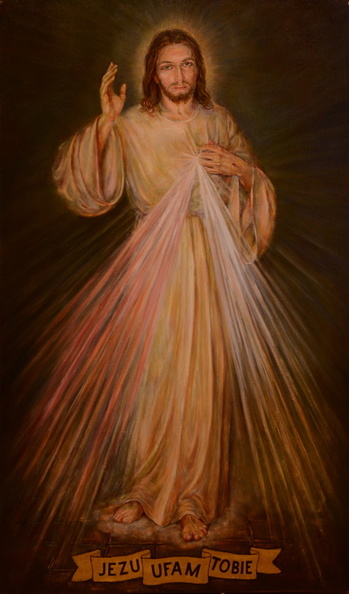
84764-divinemercy“Proclaim that mercy is the greatest attribute of God.” – Jesus to St. Faustina

Devotion to Divine Mercy is not every Catholic’s thing. Some people struggle with the image of Divine Mercy: Jesus, His right hand raised to bless and heal, His left indicating his heart, from which rays of red and white, symbolizing blood and water, pour forth as a fountain of mercy for souls. Every version I’ve seen has been a bit mysterious and unsettling—which seems appropriate, given that it’s a vision of the resurrected Christ.

Some don’t like the chaplet, which is simpler and more repetitious than the rosary. Some consider the visions of a poor Polish nun to be private revelations: fine for her, but not necessary for us (even though she is a saint and was canonized by another saint).

Continue reading

It’s the Little Things

I often worry about what my wife and children, family and friends, and even those of you I don’t know, think of me. Am I doing good work? Setting a good example? Who sees me at the grocery store—and what do they see? Who walks down my street and hears me thundering away at my poor children? Am I letting them down? Am I letting you down?

You know the old song: You’re so vain/you probably think this song is about you/you’re so vain. Yeah. I tend to think the song is about me. Like all of you don’t have better things to do than watch for me to stumble. I used to think, At least I’m not prideful—I’m worried I’m going to let people down!But now I see what twisted pride convinces a guy that everyone is looking at, paying attention to, and judging him.

I bring this up because Lent is on the horizon. In Fr. Mike Schmitz’s video reflection, Preparing for Lent, he cites three common mistakes people make in their approach to Lenten sacrifice:

  • Take on a very easy sacrifice that will have no spiritual impact whatsoever
  • Take on a very hard sacrifice just to see if they can do it
  • Take on a two-fer–use Lent as a reason to fix a broken resolution or to do something you should have been doing all along

I have done made all three of these mistakes over the years: trying to break old habits during Lent, but for myself, not for God, or piling on the sacrifices and prayer practices until I couldn’t help failing, then cutting back and simplifying to the point that I became an unprofitable servant, only giving to God the minimum due. And all the while, I’ve wondered: Who’s watching? Who’s judging

Who cares? The point of prayer, fasting, and almsgiving Lent is to draw nearer to God and to detach from things that keep us bound to our earthly lives. We should ask, What in this world is keeping me from Christ? What can I do to more closely follow Him? —and listen to the answer.

Jodi and I used to tell our youth group in Michigan that if they thought of a sacrifice and had a sinking feeling in their hearts because they didn’t want to give that up, it might be the right thing. It doesn’t have to be earth-shattering. In fact, once I started thinking in terms of the little things, I realized that this is where the real work is. I’m no longer a slave to those big, serious, mortal sins that used to weigh me down, but I have countless little attachments and anxieties that crowd God out of my life.

Do you, too? Pick one, and let it go this Lent. Replace it with a simply prayer practice (maybe genuflecting more slowly and reverently before the tabernacle or monstrance, as though the King of the Universe is present—because He is!) and self-giving (how about a loving compliment to each person we interact with?).

Uh, oh. I’ve got that sinking feeling…

Note: Lent begins on Wednesday, March 1, with Ash Wednesday. Watch Fr. Mike Schmitz “Preparing for Lentand collect bonus points for watching “4 Reasons for Fasting“…

The Still, Small Voice of God

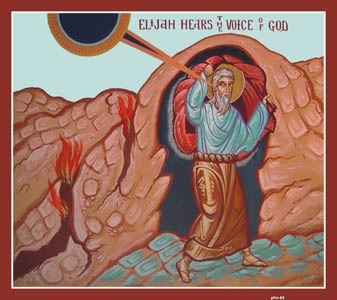
There was a strong and violent wind rending the mountains and crushing rocks before the LORD—but the LORD was not in the wind; after the wind, an earthquake—but the LORD was not in the earthquake; after the earthquake, fire—but the LORD was not in the fire; after the fire, a light silent sound.  When he heard this, Elijah hid his face in his cloak and went out and stood at the entrance of the cave. –1 Kings 19:11-13


It is Tuesday afternoon, and I am writing from home. This column should have been done and in already. It is not, because even a job working for the church is not as important as some things.

Around 9 p.m. last night my youngest son threw up, and my bride informed me she didn’t feel well either.  Between 9 p.m. and 2 a.m. or so, my son was sick probably two dozen times. Jodi did not get as sick, but was as sleepless as Trevor—and I tried to stay clear so that hopefully I could handle little Lily in the morning and keep her from catching whatever this was.

I rose and prayed with Jodi at 5:30. She felt a bit better, and Trevor was sleeping, at last.  At around 6, Emma was sick the first time, and by 8, Lily was complaining that she didn’t feel well either. I was getting ready for work—Day 2 with our new faith formation coordinator, Andrea Zachman—but had the sinking feeling that it was only a matter of time before it hit me, and that my colleagues might rather I stayed home. I was torn—I felt fine, but so had Trevor and Emma before it hit, and I had plenty of work to do. Lily seemed fine, but if she were on the verge, I didn’t want her spreading it to her friends and their families. Jodi was torn, too—she didn’t feel great, but had a mountain of work waiting for her and didn’t feel she could afford to miss a day.

And as fate would have it, we had a blanket of fresh snow on the walk, cars, and roads.

Ultimately we compromised: we both went to work briefly to take care of a few things and bring some additional work home to do around our other duties. We were out of several basic food items in our house, so I fought the blowing snow to stock up on a few things—and now here I sit, writing furiously.

We are all called by God—do you hear Him? I often imagine the God of the prophets speaking to them in a deep, thundering voice, but that’s not what we hear in first Kings, above. Elijah recognizes the Lord in “a light, silent sound”—other translations say “a sound of sheer silence” or “a still, small voice.” God whispers, as it were, drawing us close with his words, into an intimate conversation with Him.

Unfortunately, the noise of the world too often drowns Him out. We hear the voices of our colleagues and bosses ringing in our ears; the ringing of the phone and ping of emails, IMs, and texts…the traffic report…the weather…and nothing of the still, small voice of God.

Excuse me a minute: my other high-schooler, Gabe, just called—he’s sick and can’t drive himself home. Jodi and I need to go get him and the Suburban.

We are all called to a first and universal vocation of holiness. Most of us are called to live out that first vocation in terms of a second vocation to marriage and family life—we sanctify ourselves, our spouses, and our children by imaging God Who is Love. Everything else we do and are come in below that. We are created from Love, and Love is our purpose and end. That’s all. That’s enough.

Because that’s everything.

We Are a Pilgrim People

“I’ll be home for Christmas, if only in my dreams.”
 
We are on the home stretch: a week out from the blessed Feast of the Nativity, Christmas, when we celebrate the birth of our Savior, Jesus Christ. Many of us, however, feel as though Christmas has been upon us for weeks now, an immense burden of gifts, lights, music, and cheer under which we labor to breathe—like a lone elf struggling to load the loot of the world into a glossy red sleigh.
 
The first Christmas was uncomfortable for a different set of reasons. In the days prior, a newly-married couple traveled from Nazareth to Bethlehem with a few essentials and a donkey. They traveled not by choice, but by order of the emperor in Rome. They arrived not to familiar faces, food, and comfort, but to a town crowded with distant kin and strangers, and the crudest of accommodations: a dugout-stable-turned-makeshift-nursery where the woman would give birth to a son.

It turned into celebration of sorts, I suppose, as angels summoned shepherds from the hills to the town to greet the newborn as they were, dirt-poor and smelling of sheep. A star, too, beckoned Magi from the East, strange and majestic, in rich robes and bearing gifts too generous for the circumstances. (I wonder if Joseph might have gripped his staff a little tighter, wondering how he, his wife, and son would make it back across the dangerous country alive while carrying gold, frankincense, and myrrh.)
 
Imagine a Christmas celebration in which only your third and fourth cousins showed up, along with the local indigent population and three fabulously wealthy foreigners—and then you had a baby the basement. Perhaps the stresses of this Christmas are more manageable from this perspective.

Mary and Joseph were displaced—from Nazareth to Bethlehem for the census; from Bethlehem to Jerusalem for the presentation of Jesus at the Temple; and in exile to Egypt, to protect their son from the murderous intent of Herod. Even as a baby, “the Son of Man has nowhere to rest his head” (Matthew 8:20).
 
In LIFT this month, we are completing our study of the Mass. As an introduction to the adult and teen lesson, we are watching a short video from elementsofthecatholicmass.com on the role of parishioners in the Mass. As the video explains, the word parishioner comes from the Greek work paraoikos, meaning pilgrim—it’s the same Greek word that gives us the English word pariah, which means outcast.
 
We don’t belong here. We, like the Holy Family, are a pilgrim people, en route to our true home with God in heaven. The Church is the ship that carries us: the ark which preserves God’s people from the storms and waves that batter and drown the rest of the world.* Let us take refuge here from the maelstrom—the dizzying spin the world has put on Christmas—and draw near, instead, to Mary, Joseph, and the newborn king of kings.
 
* * * * *
*In fact, the area of the church worship space where we sit, which we commonly call the sanctuary, is technically called the nave—which comes from the Latin word for ship.