A New Mission

By now it’s pretty well gotten around that I’ll be leaving the role of faith formation director at the end of June. A number of you have said, “I can’t wait to hear what you’ll be doing next,” to which I reply, “Me, too!”  On the other hand, we have taken great leaps forward in the past three years, and I have never felt unappreciated or under-compensated working for the parish. It’s good work—it’s just not my work.

 I’ve made a discovery this past year: I have an evangelist’s heart.

I am competent at many things, and even skilled at some of them. I can be an administrator, a catechist, a communicator, an administrative assistant, and a laborer. I can do all sorts of things when needed. But I have an evangelist’s heart.

And, thanks be to God, I can write. I’ve known this for some time, and every staff or personal retreat I’ve been on for the past decade or more has resulted in me saying to my bride, “Whatever happens from here forward, I need to write.” I’ve been told the same thing countless times, by family and friends, acquaintances and total strangers. I’ve never made a successful go of writing on my own, however—I think primarily because, until now, I’ve tried to do it on my own. I’ve never really asked what God wanted me to write and waited for an answer.

I have always been the least rational and most emotional of all my male friends. I blunder through the world heart-first, find beauty in strange places, share too much, talk too much, and cry more than my bride. It’s embarrassing. I’m not good at casual friendships: most of the time I either go deep, or I can’t link a name to a face.  Any given week I love humanity and hate it, sometimes at the same time.

But when I share from the heart, when I speak or write about things I care about—faith, marriage, family—it moves people. When I talk about my own journey from part-time Catholic kid to an Ivy-educated agnostic with a porn problem to a faithful husband and father, it touches people. And I want to do that.

What’s more: God wants me to do that. (I finally asked.) No more pretending these gifts are weaknesses or wishing He made me differently. I am what He made me, and I’m only as free as I am obedient to His will.

It’s exciting: I feel like an apostle being called by Jesus to follow. And it’s terrifying: I don’t like reaching out to new people, because loving those people involves time, effort, and usually pain. Plus I can’t see my way forward. Peter and Andrew, James, and John dropped their nets and left their boats behind. Matthew left his post, his money, his whole former life. I have a primary vocation as husband and father. I can see no way to do what God is asking of me in my free time, and no simple way to make a living. I can’t see a logical next step.

So for the first time in my life, I find no solution other than utter abandon, to give everything to the Lord and let Him sort it out.

Dive in. Heart-first.
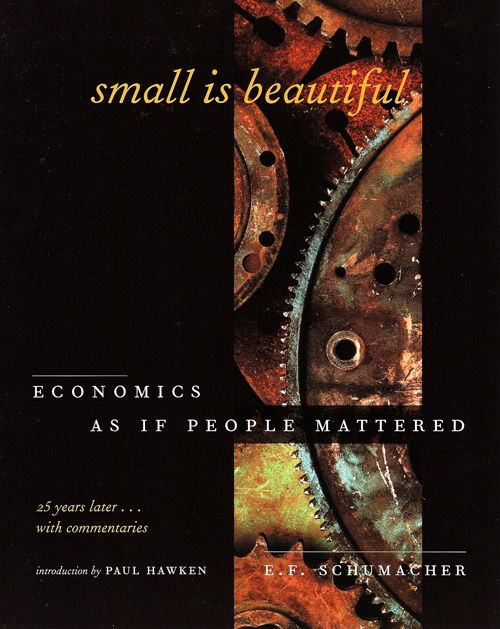
Book Break: Small Is Beautiful: Economic As If People Mattered

One of my regrets from my college days is not taking any courses in economics. I received a relatively unstructured liberal arts education: aside from a few specific prerequisite courses for my undergraduate degree, all class were divided into four groups, and we had to take a certain number from each group. Math and physical sciences were grouped together, so the classes and labs I took in chemistry meant I didn’t have to take math. I heard only complaints from my friends in economics classes, and since I had so many other interesting classes in the social sciences to choose from, I skipped it.

This teenage shortsightedness bothers me still today, since our news and politics revolve around the economy. E. F. Schumacher’s Small Is Beautiful: Economics As If People Mattered recognized this utter domination of economics over all, warned against it, and proposed specific antidotes. Written in 1973—a year before I was born—and recommended to me by a former boss, it strikes me as a book that was likely read, loved, and then neglected by many in the last 40 years as they were swept along by currents too strong to swim against.

With no economic background of my own with which to offer a proper review or critique, I will instead offer a couple of objections and a few ideas I loved from the book.

The most obvious grounds for dismissal of Schumacher’s book for many will be that the alarms he sounded in 1973 were, in retrospect, too shrill—the gloom and doom he predicted, especially in terms of natural resource shortfalls and environmental crises, have not yet come to pass. For some readers, this alone will “prove” that the author obviously didn’t know what he was talking about. Schumacher himself, a Rhodes Scholar and economic advisor with the British Control Commission and the British National Coal Board, warned against trying to predict the future. Common sense told him that finite resources can’t last forever, and exploratory calculations suggested that, at the rates of consumption and growth he was seeing in the 1970s, we were living on borrowed time. He acknowledged it was possible that we would find new sources of fossil fuels and other rapidly consumed resources—his point was, to what end? Unless we change our habits, eventually we will suffer.

The second objection was, for me, the more difficult: at this point in his career, Schumacher had strong opinions about what was wrong in the world and what needed to be done about it, and his blunt negative assessments of markets, economists, and motivations in his day leave little room for compromise or evangelization. I found myself nodding in agreement with three-quarters of his writing, only to run against passages about which I thought, surely not everyone in capitalist society is solely motivated by relentless profit-taking?

On the other hand, Schumacher does an excellent job of drawing our attention to the underlying problems with an economic approach to everything. Early in the book  he quotes his fellow British economist (and an early benefactor of sorts) John Maynard Keynes from 1930: “For at least another hundred years we must pretend to ourselves and to every one that fair is foul and foul is fair; for foul is useful and fair is not. Avarice and usury and precaution must be our gods for a little longer still. For only they can lead us out of the tunnel of economic necessity into daylight.”

Is this not contrary to the Christian ideal and common sense? Can fallen man use sin to achieve virtue? Of course not—but he can use his fellow man to achieve personal prosperity.

Schumacher goes on to write, “This was written forty years ago and since then, of course, things have speeded up considerably. Maybe we do not even have to wait for another sixty years until universal plenty will be attained. In any case, the Keynesian message is clear enough: Beware! Ethical considerations are not merely irrelevant, they are an actual hindrance, ‘for foul is useful and fair is not.’ The time for fairness is not yet. The road to heaven is paved with bad intentions.”

Lest you think of Schumacher as a naïve idealist imagining utopia, consider that two simple, practical ideas he advocated in his writings were the continuation of coal development and reducing energy consumption. He recognized that mankind is notorious for developing new problem-solving technologies that create new problems; that turning one’s back on an entire energy source on the belief that we could replace it entirely with oil or nuclear energy and meet rapidly growing worldwide demand, was foolish, even if it turned out to be true; and that wasting resources we cannot, ourselves, replace never makes sense.

This, to me, is (at least in part) what conservatism ought to be: maintaining the tried and true even as we explore new possibilities and conserving, even when a crisis is not looming, because it’s the sensible and moral thing to do.

Am I good at it? Not very—but getting better.

His biggest idea, however, was the concept of intermediate technologies for developing countries. Schumacher traveled the world and saw that most economic development supported by wealthy nations not only replicated the patterns of economic dysfunction he was in the developed world, but deepened the economic problems in the developing country for all but a fortunate few.

One example he uses (which I will paraphrase and expand on) is that of a large earthwork project that needs to be done in a developing country. You have a range of options you may employ for accomplishing this work, from people using their hands to scrabble and scrape away at the earth to the most modern and powerful earth-moving machinery. The former approach would cost almost nothing and “employ” a lot of people for a long time at menial and nearly impossible work; the latter would employ relatively few people for a relatively short time, unless the expensive equipment broke down and needed repairs—in which case there would be no parts or expertise locally to fix it. In the middle, however, are a range of intermediate technologies, however, that could put people to work, providing income for their families, value for their time, and dignity for themselves. For example, equipping a hundred men with well-built shovels and wheelbarrows would put those men to work—plus many more making and repairing shovels and wheelbarrows using local materials. The money earned by all those people (instead of just a few heavy-equipment operators) could be used to support other local industries—because what good is producing food or consumer goods if no one has any money to buy them?

There is much to love in this book, including Schumacher’s very Catholic views on the dignity of work and the human person. He speaks against an all-pervasive economic approach to efficiency, which quantifies and assigns value to the incalculable and invaluable. When everything is assigned a value, the sacred (such as human life) is diminished and no longer sacred. He speaks against an approach to labor and productivity that reduces work to individually pointless tasks without freedom or creativity and fails to employ large segments of society that, because they see no value in their time and effort, quickly devalue themselves. And he speaks against the underlying assumption that one who works less and consumes more is better off than one who works more and consumes less.
It is a thought-provoking read, and I highly recommend it. 


It’s the Little Things

I often worry about what my wife and children, family and friends, and even those of you I don’t know, think of me. Am I doing good work? Setting a good example? Who sees me at the grocery store—and what do they see? Who walks down my street and hears me thundering away at my poor children? Am I letting them down? Am I letting you down?

You know the old song: You’re so vain/you probably think this song is about you/you’re so vain. Yeah. I tend to think the song is about me. Like all of you don’t have better things to do than watch for me to stumble. I used to think, At least I’m not prideful—I’m worried I’m going to let people down!But now I see what twisted pride convinces a guy that everyone is looking at, paying attention to, and judging him.

I bring this up because Lent is on the horizon. In Fr. Mike Schmitz’s video reflection, Preparing for Lent, he cites three common mistakes people make in their approach to Lenten sacrifice:

  • Take on a very easy sacrifice that will have no spiritual impact whatsoever
  • Take on a very hard sacrifice just to see if they can do it
  • Take on a two-fer–use Lent as a reason to fix a broken resolution or to do something you should have been doing all along

I have done made all three of these mistakes over the years: trying to break old habits during Lent, but for myself, not for God, or piling on the sacrifices and prayer practices until I couldn’t help failing, then cutting back and simplifying to the point that I became an unprofitable servant, only giving to God the minimum due. And all the while, I’ve wondered: Who’s watching? Who’s judging

Who cares? The point of prayer, fasting, and almsgiving Lent is to draw nearer to God and to detach from things that keep us bound to our earthly lives. We should ask, What in this world is keeping me from Christ? What can I do to more closely follow Him? —and listen to the answer.

Jodi and I used to tell our youth group in Michigan that if they thought of a sacrifice and had a sinking feeling in their hearts because they didn’t want to give that up, it might be the right thing. It doesn’t have to be earth-shattering. In fact, once I started thinking in terms of the little things, I realized that this is where the real work is. I’m no longer a slave to those big, serious, mortal sins that used to weigh me down, but I have countless little attachments and anxieties that crowd God out of my life.

Do you, too? Pick one, and let it go this Lent. Replace it with a simply prayer practice (maybe genuflecting more slowly and reverently before the tabernacle or monstrance, as though the King of the Universe is present—because He is!) and self-giving (how about a loving compliment to each person we interact with?).

Uh, oh. I’ve got that sinking feeling…

Note: Lent begins on Wednesday, March 1, with Ash Wednesday. Watch Fr. Mike Schmitz “Preparing for Lentand collect bonus points for watching “4 Reasons for Fasting“…

Your Eternity Begins Now


For the past few years, our family has joined numerous others from our parish and surrounding churches for Life Chain, an hour of silent public prayer for an end to the evil of abortion in our country. We spread out along Highway 19 between the parish school and Middle School West and stand facing the road, holding signs and praying.

On the back of the signs are suggested hymns, prayers, and petitions to guide our personal reflection during that hour. Every year, I am taken aback by the petition that asks me to pray for God’s mercy for all I have failed to do to protect life and work for an end to abortion—because every year, I am convinced I could have done more.

Now we are two weeks out from electing a new president. Most of us have likely made up our minds how we will vote—guided, I hope, by reason and a well-formed conscience.  God willing, no Catholic will cast a vote in support of abortion or its proponents. Beyond that, faithful Catholics can and do disagree on how best to combat the evils in our society by our actions at the ballot box. With that in mind, I would like to share three thoughts about the aftermath of Election Day.

First, remember the words of St. Therese of Lisieux: “The world is thy ship and not thy home.” We are a pilgrim people, and although our country is great and worth fighting for, the kingdom to which we truly belong is not here. We are called to evangelize and make disciples; to deny ourselves, take up our cross, and follow Jesus. The outcome of this election will not change our mission.

Second, we are all called by God—and not one of us is worth less in His eyes because of the votes we’ve cast, the mistakes we’ve made, or the sins we’ve committed. Whatever happens on November 8th, we will continue to suffer for our faith, as Christ foretold, and our nation and world will continue to need our light, our service, our faithful example. Cast your vote on Tuesday and move on, because we must pull together as one body, one spirit, in Christ.

Finally, we have no time to waste. Too often our efforts on behalf of the unborn, marriage, freedom of conscience, or religious liberty hinge on the headlines and reach a fever pitch every four years with the election of a new president. We support particular candidates or policies; we act as though everything is riding on the results of the next election, then shake our heads when nothing changes and go back to minding our own business.

What about the roughly 1,460 days between presidential elections?

As Catholics, our opposition to abortion and the other great evils of our time is not primarily about saving lives, but about saving souls—including our own. Obedience to Christ and His Church is a daily choice. Disobedience is also a choice. So is complacency and non-action.

Every moment, God calls; every moment we respond. Our eternity begins now.
Lord, have mercy on me for all have failed to do here in my own community to draw people to you and build your kingdom. Amen.

Love Does Not Divide

How long, Lord? Will you utterly forget me? How long will you hide your face from me? How long must I carry sorrow in my soul, grief in my heart day after day?  – Psalm 13:2-3

I ended last night with coverage of the shooting of Philando Castile by a police officer in Falcon Heights, Minnesota. I woke to 12 police officers shot by a sniper in Dallas, Texas.

Can you feel it? The tension in the air? A spark has been struck, I fear, that cannot be contained.

And it’s an election year. Everything is spun, hyper-analyzed, re-calculated, and spun again. Everything is us-versus-them.

Can you hear it? The rattle between my lungs of the small stony lump that passes, these days, for a human heart? I can. It has shrunken and solidified more while I slept.

I can feel my heart hardening, each time my “enemies” advance. I can feel the love draining away and the anger rising. I am tempted to turn away from those I once cared about because we don’t agree. I have no time to spend on the lost sheep with my little flock to attend.

How cavalierly we treat the salvation of souls—including our own.

Here’s what I know for certain about these shootings: Someone took a life. Someone lost a life. Both are terrible and permanent things with serious implications in this world and the next. And the proper response for most of us, who are removed from the situation, is earnest prayer for the souls of those involved and for peace.

The Evil One relishes these divisions in humanity, and fans the flames that rage around us. Instantaneous media coverage and commentary stifles reflection and discernment, prudence and justice. Politispeak and emotionalism obscure the truth, without which there can be no love. We paint our enemies with one brush and hue, and lose sight of them as unique images of God—each one a masterpiece.

Yesterday I ran across a quote from C.S. Lewis’s book Mere Christianity:

[The devil] always sends errors into the world in pairs—pairs of opposites. And he always encourages us to spend a lot of time thinking which is the worse. You see why, of course? He relies on your extra dislike of the one error to draw you gradually into the opposite one. But do not let us be fooled. We have to keep our eyes on the goal and go straight between both errors. We have no other concern than that with either of them.

Our way, as Christians, is narrow, between the errors. Our Way is Christ.

Here’s the truth, as simply as I can express it this gray morning. We have good cops and bad cops; racist, noble, and scared cops…and this morning, living and dead cops. We also have young black men who are good men and bad men; racist, noble, and scared men; and yet again, living and dead men. We have well-intentioned activists on both sides who want justice, and rabble-rousers who just want to fight.

The same applies to Muslims and Christians, to immigrants and natural-born citizens, to men and women. How do I know this? Because all of them are human, and so am I. All of these tendencies live in me, and I must choose which to follow.

It is also true that significant differences exist between the wealthy and the poor, Christianity and Islam, rural and urban America, liberals and conservatives—differences that we must acknowledge plainly and address if we hope to find peace in our communities—but none of these differences are discernible in our DNA or our soul. None are who we are.

I am Catholic, so I am at odds with the culture, with many of my friends, and with much of my family. And it’s complicated. I am a Christian, but I am at odds other Christian creeds, not to mention the non-Christian religions of the world. I’m at odds with scientism, but not science. I am at odds with supporters of abortion, same-sex marriage, and many other ideas. Faith and reason set me at odds with all of these things, but none of these persons—at least, not if I’m practicing my faith well.

So we disagree. Big deal; it happens all the time at my house.  And we each think we’re right? Well of course. If we thought we were wrong and persisted, we have more serious problems.

But one of us must be wrong? True enough—and likely both of us. But truth and love go hand-in-hand, so what are we worried about? Being proven wrong? That’s pride talking, the root of sin.

Is it possible to disagree and get along? We do it all the time with people we love. And Jesus said to love our neighbor and our enemies as we love our own selves. We have our work cut out for us.

I will give you a new heart, and a new spirit I will put within you. I will remove the heart of stone from your flesh and give you a heart of flesh. … You will live in the land I gave to your ancestors; you will be my people, and I will be your God. – Ezekiel 36-26, 28

We can bring God’s good work to fruition, but we must keep foremost in our minds our common humanity and the dignity of each person as made in the image of God. We must focus our attention on the infinite value of each soul to the Creator, and the boundless desire God has for each of us. Salvation of souls is our goal; repentance and love is our means. We cannot allow ourselves to be distracted by the concerns of this world—goods, comforts, guns, money—and lose sight of the only things worth loving: God and neighbor.  These other things are not bad in themselves, but can they get us to Heaven? Not likely, but they could drag us to Hell.

Love ought to be our first and last response. And God willing, as we learn to love as He has loved us and align our love completely with His eternal Truth, it can become our only response.