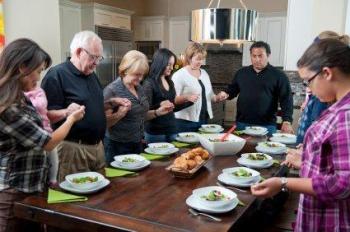
The family is the community in which, from childhood, one can learn moral values, begin to honor God, and make good use of freedom. Family life is an initiation into life in society.
As I type, bishops from around the world are gathered in Rome discussing how best to preserve, strengthen, and encourage Christian families. With so many families suffering or broken, such confusion over the nature and purpose of marriage, and the constant cultural tension between anti-child forces (for reasons of overpopulation, so-called social responsibility, or personal choice and comfort) and “child worship” (treating each child as the center of the world, deserving of the very best of everything), it’s easy to feel underappreciated and overwhelmed. It’s also easy to get caught up in the everyday hustle of school, work, sports, and recreation and lose sight of the true power of the family as a domestic church: an apprenticeship in love of God and neighbor.
The Catholic Church, in her wisdom, teaches that the family is the fundamental unit of society, with certain rights and responsibilities that no higher level social organization can ever claim. Humans are social creatures, made in the image of God, who is Himself a loving, life-giving communion of Persons—the Holy Trinity. The Catechism insists that government has a duty to protect and foster marriage and family and to help families (and not interfere) with raising and educating their children as they see fit, both in the world and in faith.
The Church, in fact, regards the education of children in the faith as a duty of parents—a point that cannot be overstated. I sometimes hear parents say, “I want my son to make his own choice about his faith,” or “I don’t want to force it—it will mean more my daughter if she comes to God on her own path.” While it is true that, ultimately, we each make our own choice for or against Jesus Christ and His Church, we cannot entrust that choice to the sole discretion of our children—any more than we would allow them to decide whether to drink something we know to be poison. If we truly believe what the Catholic faith teaches, the choice our children face is much more stark than how they will spend their Sunday mornings—it’s about how they will spend eternity.
Next Wednesday we begin a new year of First Confession/First Communion and Confirmation classes—and as always, it is essential that parents take the lead in sharing the good news of Jesus Christ and the eternal truths of the Catholic Church. Your personal example is the most powerful witness to your children—and male role models, in particular, have extraordinary power in keeping kids Catholic. Even simple things, like reading a Bible story, putting on a tie or a dress for Mass, or taking time to pray with and bless your child before bed, make deep and lasting impressions.
Scripture reminds us, “Train the young in the way they should go; even when old, they will not swerve from it” (Proverbs 22:6 ). We are all practicing Catholics, all sinners who are in training to love as God loves. But as parents we are also powerful, and we must not neglect to use that power to bring our kids to Christ, who said, “Whoever receives one child such as this in my name receives me” (Matthew 18:5).
Blogger’s Note: This article appears in the Sunday, Oct. 18, parish bulletin.

 Archangel Stomp