All Is Gift

ChestertonThanks

I wanted to tell you yesterday all the things I’m grateful for this year. I rose at 4 a.m. to stretch, pray, and write—but the Bearded Wonder (my eldest son Brendan) is home from college and rose at 4:30. We sat in flickering candlelight and visited for a couple hours, until Jodi got up to start the turkey. Then I left her and her boy alone and greeted the dawn with Bruno. Our walk was unusually peaceful: silent except for the whine of the distant freeway; we saw a total of four cars, a jogger, and a neighbor with the same idea: walking his dog in the quiet of the new day.

The rest of the household was stirring when we returned home, and the rest of the morning was spent going to Mass (the Feast before the feast) and preparing for dinner. We cooked, we ate, we watched the Lions get trounced by the Vikings. (Sorry, fellow Lions fans: to me, the game didn’t feel close.) My folks were supposed to be here, but Mom got sick and they returned home—we arranged for a friend to bring them Thanksgiving dinner, and enjoyed a beautiful, grateful phone call with them in the early afternoon.  We laughed and listened to music; we napped, walked Bruno again, and ate pie.

And yet, when evening fell, I felt unsettled. The one thing I hadn’t done was write. So while the family played games in the dining room, I attempted to journal. Instead I listened to Jodi and the kids joking, arguing, and laughing together. After a while, Brendan stepped away from the games and took up the mandolin, picking and strumming snippets of songs we knew. I closed my journal and vowed to write this morning.

* * * * *

Today Brendan turns twenty. I rose again at four, acutely aware that I have now been a father for two decades—nearly half my life to date!—and unsure about what that means for me. I went downstairs to let Bruno out; stepped into the cold, black morning, and breathed in the clean air. I need to write, I thought.

About what? About all of this.

I brought Bruno back in and shuffled into the bathroom. I stood in front of the mirror to see myself. At 4 a.m., I look lived in: a little worn and disheveled, sagging here and there, but comfortable and still functional. I leaned in closer to peer into my own eyes—windows to the soul, they say—and in an instant, they filled with unexpected tears.

Gifts. All of it—my bride in our bed, our beautiful offspring, the pup downstairs. Our aging suburban split-level. The still unfinished tree house out back. All gifts.

I am working harder these days for less money, and yet I feel better—freer—than I have in years. Gift. We have friends who never get sick of our company, family who love us, and a great God in Heaven who keeps the very rhythm of our hearts in time with His own. All gifts.

The tears brimmed but didn’t fall; my chest swelled but didn’t burst. Sure signs that I have not yet fully grasped the magnitude of my situation: the all-powerful and ever-present Creator of the universe is making room enough in me so He can dwell there. The One who is Love is carving a God-size hole in me, chipping away, flake by flake, at my stony heart.

* * * * *

With all the many gifts I enjoy in this life, perhaps the thing I am most grateful for this year is perspective. I’ve said it before, but I’ll say it again: Look around you. Have you seen this place?

Where were you when I founded the earth? Tell me, if you have understanding. Who determined its size? Surely you know? Who stretched out the measuring line for it? Into what were its pedestals sunk, and who laid its cornerstone, while the morning stars sang together and all the sons of God shouted for joy? — Job 38:4-7

We are so very blessed and have done nothing to deserve it. Sure, we’re good people, as far as that goes. But lots of good people suffer, and a fair number of not-so-good people seem to thrive. I cannot earn these blessings or somehow make them happen—I cannot avoid illness, accident, or tragedy—any more than I can make Brendan’s beard grow. I can only look on with wonder and thanksgiving, and join my song to Mary’s: The Almighty has done great things for me, and holy is His name!
 

Dust Bunnies and Mud Bubbles

“A puddle repeats infinity, and is full of light; nevertheless, if analyzed objectively, a puddle is a piece of dirty water spread very thin on mud.” ― G.K. ChestertonManalive

Scripture tells us that God took a bit of dust from the earth, shaped a man, and breathed life into him. The breath of God—spiritus—brings the unliving to life.*

I have seen what this windy world conjures when its breath stirs the dead earth: dust bunnies and mud bubbles. Continue reading

Gaudium et Tremendum*

“I would maintain that thanks are the highest form of thought, and that gratitude is happiness doubled by wonder.”—G. K. Chesterton

We ended yesterday with a boat and a bonfire. The last of the sun turned the clouds baby blue and perfect pink, touched with fire, a cosmic nursery for the birth of stars; the moon a nursemaid all in white, smiling down. The firepit crackled and popped in greeting on our return to the dock; the sky turned purple, then navy and black; breath of spent oak mingled with pipe smoke and marshmallow; laughter and explosions of sound and color in the skies: blues and greens and purples and whites, red rosettes high above the trees to mark love of freedom and the birth of a nation.

At last the mosquitoes drive us indoors, brave descendants of saints and patriots that we are, fleeing from pinpricks and the whine of tiny wings! Homespun strawberry ice cream, jokes and laughter until at last sleep calls too loudly to ignore despite the din. Continue reading

The Virgin and the Tempest

The Virgin and the Tempest

Blogger’s Note: A close friend’s home was struck hard by the storm last Sunday morning—in all the wreck and ruin, Mary stood untouched, unfazed. Regina pacis, ora pro nobis!

At dawn she stood upon the hill and pondered things unseen;

The lake agleam with silver sun, the grass a rippling green.

A girl, she seemed, of field and fen, of flock and fish and sheaves;

Her crown, the dappled sunlight filtered through the flutt’ring leaves.

Her simple shift immaculate as she, herself unstained,

Enjoyed Creation’s morning-song—but in the west it rained.


Such peaceful virgin beauty could the Tempest not abide:

He spied her from afar and surged, a league to every stride.

He stormed and splashed and shivered homes; his thund’ring voice was heard—

With roar and flash and flood he sought to drown God’s holy Word.

In that unearthly twilight knelt the faithful ’round the stone,

And she, exposed and downcast, stood upon the hill alone.


He strode ashore in bloody rage, devouring as he came,

But naught would slake his appetite except the Virgin’s shame.

He cursed her with his forkéd tongue and lashed her with his tail;

He frothed and foamed and spewed his bile, he struck with tooth and nail.

The trees he snapped like kindling with the fury of his wings;

They came down crashing roundabout—but she began to sing.


Her hands were open to receive, her eyes closed in repose,

And all his filth and flotsam could not even foul her clothes.

She sang a canticle of joy, of gratitude and grace,

And deadfalls burst asunder at the radiance of her face.

A lullaby she sang to soothe the Child within her womb,

And at His Name, the Tempest turned and fled into the gloom.


The wood lays wasted at her feet; the grass, strewn with debris;

A splintered path of ruin marks the path on which he flees.

So stands she still upon the hill, our shelter from the storm—

Our Lady, Queen of Peace, protecting all she loves from harm.

Not David’s solitary stone nor Sparta’s gory stand

Struck such a blow as she, although she never raised a hand!

Book Break: Manalive

“Madness does not come by breaking out, but by giving in; by settling down in some dirty, little, self-repeating circle of ideas; by being tamed.” 

– G.K. Chesterton

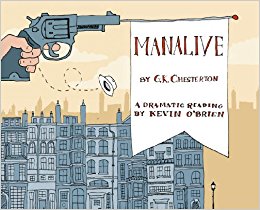
I’ve quit believing in coincidence. When seemingly random events culminate in a meaningful way, providence is my line now. Such was the case when I was searching the Great River Regional Library website for an audiobook to accompany me to and from Michigan over Divine Mercy weekend. I searched for several titles by name, and several topics by keyword, to little avail. Then I stumbled across an audio version of G.K. Chesterton’s Manalive, narrated by athiest-turned-Catholic and Theater of the Word founder and actor Kevin O’Brien.

I didn’t know what the story was about. That it was Chesterton told me it should be good — but as I’ve said before, Chesterton can be too clever by half at times, and I’d never tried his fiction before. I put in a request for this book and for Mark Twain’s biography of St. Joan of Arc, and Manalive arrived first.

I hesitate to say too much. It is the story of an apparent madman or idiot who invades a British boarding house and turns the humdrum lives of the inhabitants upside down. Ultimately, he is accused of insanity, theft, polygamy, and murder  but how can a man as wicked as that make others feel so alive for the first time in years?

On the other hand, why would such a joyful simpleton  a holy fool  carry a revolver among his holiday luggage and playthings? Our protagonist has a mission, which sounds ominous and, indeed, mad: “I am going to hold a pistol to the head of the Modern Man. But I shall not use it to kill him – only to bring him to life.”

Like Myles Connolly’s Mr. Blue, which I reread over Holy Week, the book portrays a man who had dedicated himself to a worldview that the world has little use for and who pursues it at whatever cost. As a result, he makes us think about our own worldview and priorities. Manalive is chock full of great Chesterton quotes and paradoxes and memorable characters made moreso by O’Brien’s theatrical reading, voicing each of the characters as clearly as if he were several people himself.

By way of criticism: The work does wax poetic at times – particularly the introductory chapter – and at all times Chesterton’s presence is felt in the thoughts, wit, and turn of phrase of the characters. I would also be remiss in not pointing out Chesterton’s use of racial and ethnic stereotypes and language, particularly in drawing the character of  Moses Gould. In the context of this story, it was unsettling, but it struck me more as a product of his time than of strong personal animus. As to his actual views of minorities, I need to read more.

By way of endorsement: I listened to it start to finish on the way to Michigan, again on the way home from Michigan, and yet again on the trip back from Florida with Rose and Trev. It has climbed to the upper heights of my list of favorite stories — and if you want a fictitious explanation for why I’m leaving a good job at the church for a nebulous next step involving writing, this is it. I could not have stumbled across a better novel to bolster and encourage me in this time of transition.

That, friends, is providence.