Book Break: The Great Divorce

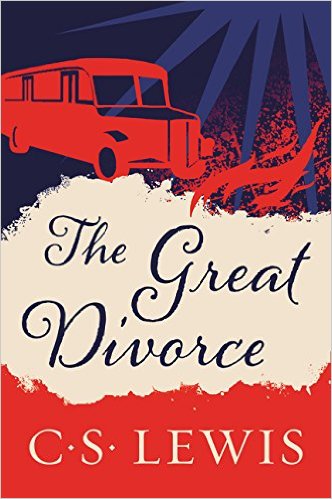
I mentioned in an earlier post that I had a profound Good Friday, but that was only half the story. The other half of the story is that, early that Friday morning, I sought out some spiritual reading for the day, and wound up with a new top-five favorite book: C.S. Lewis’s The Great Divorce.

Of course, when reading spiritually, the Bible is always a good place to start, and I’m also making slow but steady progress through Dante’s Divine Comedy a canto or two a day. But I wanted something fresh, something I could possibly read in a day, and something related to the penitential character of Good Friday and the great saving act of our Lord.

On a hunch, I took C.S, Lewis’s The Great Divorce from the bookshelf. I have great regard for Lewis as a writer and had heard good things about the book, particularly from my good friend Angie at Take Time for Him.

Lewis had me hooked from the preface, which begins by explaining the title of his fantasy:

BLAKE WROTE the Marriage of Heaven and Hell. If I have written of their Divorce, this is not because I think myself a fit antagonist for so great a genius, nor even because I feel at all sure that I know what he meant. But in some sense or other the attempt to make that marriage is perennial. The attempt is based on the belief that reality never presents us with an absolutely unavoidable “either-or”; that, granted skill and patience and (above all) time enough, some way of embracing both alternatives can always be found; that mere development or adjustment or refinement will somehow turn evil into good without our being called on for a final and total rejection of anything we should like to retain.

The book begins with our narrator in line at a bus stop in a grey and gloomy town, surrounded by people he doesn’t know and wouldn’t want to — unsure of where he is or where he’s going. It unfolds like Dante’s Divine Comedy in modern miniature: a pilgrim’s journey from hell to the edge of heaven in just 128 pages. I’m reading Dante now, too, canto by canto, and it is powerful in its way, but this held my attention from the preface to the end, with every word relevant to this sinner and this sinful time. Lewis articulates with poetic beauty and unflinching honesty the glory of God and his angels and saints, the pain of detaching from this world, and the stubbornness, the grasping, the pride and distrust that keep even “good” people from choosing God and reaching Heaven.

The book challenges the reader particularly on the Greatest Commandment: “You must love the Lord your God with all your heart, with all your soul, and with all your mind” (Matthew 22:37). On this point, Dante provides an unintended summary (being some seven centuries older) which, as providence would have it, I read over lunch on Easter Monday. In Purgatorio, Canto IX, Lines 127-132, he writes the words of the angel guarding the gates of Purgatory proper:

“I hold these keys from Peter, who advised
‘Admit to many, rather than too few,
if they but cast themselves before your feet.'” 
Then pushing back the portal’s holy door,
“Enter,” he said to us, “but first be warned;
to look back means to go back out again.”

We sin when we put anything — even the blessings of life on this good Earth — ahead of loving and seeking God. Pilgrim after pilgrim turns his or her back on Heaven because the cost of entry is too high: the cost of admitting that they are mere creatures and of letting go of their earthly pleasures, passions, and prejudices. They want Heaven on their own terms and choose Hell to feel like they have some say in the matter. They cannot stand the humiliation of grace as an unmerited gift.

It is a powerful book: perhaps tied at this moment with Steinbeck’s East of Eden as my favorite of all time (although Tolkein’s The Lord of the Rings (which I still need to review as an adult) and Sigrid Unset’s Kristin Lavransdatter trilogy are right up there, too!) It paints a stark and revealing picture of how far so many of us have to go to be purged of all sin. So I will end this post with Lewis’s words from the Preface, on a hopeful note:

I do not think that all who choose wrong roads perish; but their rescue consists in being put back on the right road. A wrong sum can be put right: but only by going back till you find the error and working it afresh from that point, never by simply going on. Evil can be undone, but it cannot “develop” into good. Time does not heal it. The spell must be unwound, bit by bit, “with backward mutters of dissevering power”– or else not. It is still “either-or.” If we insist on keeping Hell (or even earth) we shall not see Heaven: if we accept Heaven we shall not be able to retain even the smallest and most intimate souvenirs of Hell. I believe, to be sure, that any man who reaches Heaven will find that what he abandoned (even in plucking out his right eye) was precisely nothing: that the kernel of what he was really seeking even in his most depraved wishes will be there, beyond expectation, waiting for him in “the High Countries.”

The Great Divorce. Find it. Read it.
O Death, Where Is Your Sting?

At long last, we celebrate Easter, and the resurrection of our Savior, Jesus Christ! Perhaps you’ve been steadfast in prayer, heartbroken and sincere in penance, and generous in alms-giving. Or perhaps you feel you’ve done too little, too late, for our Lord — perhaps you’ve slipped in your Lenten commitments or find that Easter has crept up on you almost unawares.
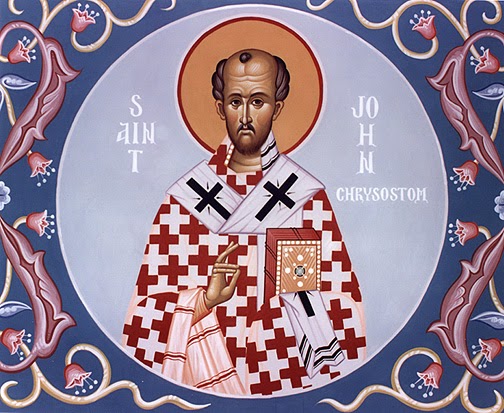
Either way, take comfort in the Easter homily below from St. John Chrysostom. Drawing on the gospel of Matthew, chapter 20, he reminds us that we never come too late to God and always receive full payment!

Easter Homily by St. John Chrysostom

Let all pious men and all lovers of God rejoice in the splendor of this feast; let the wise servants blissfully enter into the joy of their Lord; let those who have borne the burden of Lent now receive their pay, and those who have toiled since the first hour, let them now receive their due reward; let any who came after the third hour be grateful to join in the feast, and those who may have come after the sixth, let them not be afraid of being too late; for the Lord is gracious and He receives the last even as the first. He gives rest to him who comes on the eleventh hour as well as to him who has toiled since the first: yes, He has pity on the last and He serves the first; He rewards the one and praises the effort.

Come you all: enter into the joy of your Lord. You the first and you the last, receive alike your reward; you rich and you poor, dance together; you sober and you weaklings, celebrate the day; you who have kept the fast and you who have not, rejoice today. The table is richly loaded: enjoy its royal banquet. The calf is a fatted one: let no one go away hungry. All of you enjoy the banquet of faith; all of you receive the riches of his goodness. Let no one grieve over his poverty, for the universal kingdom has been revealed; let no one weep over his sins, for pardon has shone from the grave; let no one fear death, for the death of our Saviour has set us free: He has destroyed it by enduring it, He has despoiled Hades by going down into its kingdom, He has angered it by allowing it to taste of his flesh.

When Isaias foresaw all this, he cried out: “O Hades, you have been angered by encountering Him in the nether world.” Hades is angered because frustrated, it is angered because it has been mocked, it is angered because it has been destroyed, it is angered because it has been reduced to naught, it is angered because it is now captive. It seized a body, and, lo! it encountered heaven; it seized the visible, and was overcome by the invisible.

O death, where is your sting? O Hades, where is your victory? Christ is risen and you are abolished. Christ is risen and the demons are cast down. Christ is risen and the angels rejoice. Christ is risen and life is freed. Christ is risen and the tomb is emptied of the dead: for Christ, being risen from the dead, has become the Leader and Reviver of those who had fallen asleep. To Him be glory and power for ever and ever. Amen.

He is risen, indeed — let us feast and rejoice this day like no other! Alleluia!

Farewell to Puck

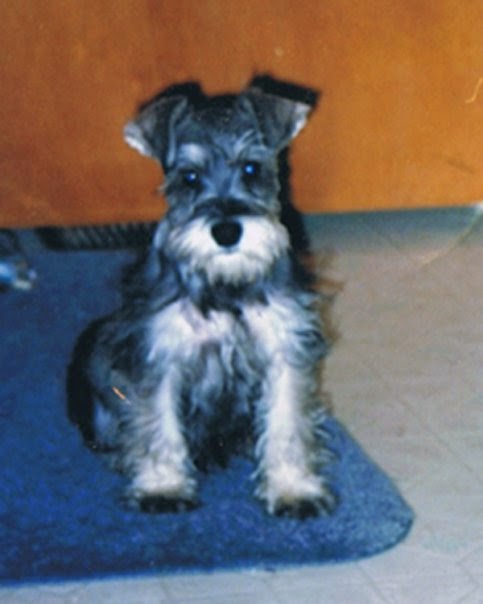
Our new pup, circa 2002

We lost Puck today. At 13 years old, he was certainly not a young for a dog, but definitely not old for a Schnauzer. He had begun, in recent years, to sleep longer and run less, and earlier this fall, he had some teeth removed. At that time, the vet said his blood work was clean and extolled how healthy he seemed for his age, but warned that at this stage in a dog’s life, anything can happen.

And it did. Over a matter of weeks, Puck went from old to frail. He never complained, but slept more, ate less, and stayed closer to the house and us. He was slower on the stairs and slower to respond to our calls and whistles. Then a few days ago, he lost his balance and struggled to stand. Our other dog, Boomer, had done this several times in his old age — he would usually sleep for the better part of a couple of days, then be up and around again. Only Puck didn’t recover.

He was 13, and our kids are age 16 to 2, so he’s been a part of the family for as long as they can remember. We miss him.

Puck, all Christmased out.

We got Puck from a Schnauzer breeder on an old farmstead in rural Michigan. I wanted another dog — a smaller, indoor pet, since Boomer was big, woolly, and hated being inside. Jodi is not a dog person, but gave in to my persistence and the boys’ pestering. (Or was it vice versa?) He was an adorable pup (my Dziadzi — Polish for grandpa — was not overfond of our Airdales, but looked at our Schnauzer and said, “Now that’s a dog!”), and full of curiosity and mischief. I was struggling to come up with a name that reflected both his Germanic roots and his personality, and my choices were getting more and more outlandish. At one point, the name Wolfgang came to mind. I had Mozart on the brain, but was freely associating, and thought of the chef, Wolfgang Puck, then of the Shakespeare character from A Midsummer Night’s Dream.

I looked at our impish pup, and the name fit. (Of course, only later did I discover how a grown man shouting, “Puck!” out the back door sounded to the neighbors, or how many Minnesotans would instantly assume I was a hockey fan.)

Steamy summer roadtrip…

He’s always been an easy keeper and a good traveler. In fact, the only trouble he’s ever been came from a tendency in his younger days to know exactly when we were preoccupied by something else and high-tail it around the neighborhood. During the day, he would turn up in someone’s garage, or walk in through their front door with their kids, and they’d look at his collar and call. At night, he’d run yard to yard, and I’d drive with my head out the window, listening for jingling dog-tags or a neighbor dog in an uproar, trying to catch up to him.

After Boomer passed, Puck no longer wanted us to travel anyplace without him. If he sensed even a hint that we were preparing for something longer than a day trip, he would look for an opening, jump into the van, climb as far back in as he could, and refuse to come out unless I removed him. He would lay in whatever open space he could find in our overstuffed minivan, never bothered the kids when they were eating, and was content to sleep in the vehicle, in garages, in tents, wherever, as long as he could come with us. On cold winter nights, he would curl up under my old Carhartt jacket, head and all, and be there in the morning, ready to greet the frosty dawn.

He loved dog biscuits and pop corn and being scratched above the collar bone, beneath the collar. He used to love chasing tennis balls, but only in the house. He never liked to be picked up or manhandled — I could do what I wanted (he would even roughhouse a bit with me), but he only tolerated Jodi or Brendan lifting him, and nobody else. In recent years, he tended to get out of traffic when little kids were around. He tolerated other known dogs, but strays drove him berserk. Cats made him quiver with nervous energy; he was never quite sure whether he was supposed to chase them or not, and they seemed to relish his uncertainty and rub it in his face.

The old man, a couple weeks ago.

When we told the kids last night that it might be his last, we recalled three other special memories. Jodi remembered how our little ones, especially Lily, bonded with Puck by dropping food from their highchairs, and when they realized he was eating it, making a game of it. I remember him shifting from front foot to front foot and softly ruffing at us when he thought we were paying too much attention to baby Lily and not enough to him.

I also remember how perceptive he could be. He had a habit of sidling up to whomever he thought was most likely to pet or snuggle him — he would sit on your toes, even, or thrust his soft gray head up under your hand. But when we lost little Jude, I remember him insisting that I pet him as I lay on the couch or the bed, quiet and sorrowful. He nudged, prodded, cajoled, as if to say, C’mon…better days are ahead!

And he was right.

Goodbye, old man. Good dog.

Two Views on February

On the Feast of St. Valentine, priest and martyr, I wrote but did not share:

It’s Valentine’s Day—our chocolate-covered, cherry-filled, and rose-scented celebration of what passes for romance in a wonderless age. Named for a priest who was imprisoned and beheaded for secretly marrying second-century Christians, today Valentine’s Day has renounced its sainthood, elevating desire and satisfaction over its patron’s self-denial and sacrifice. Perhaps it is not surprising—we’ve watched the rise of the vampire romance in recent years, and February is a vampirous month, bloodless, pitiless, cold, and pale; short-lived and yet interminable. Ironic that it should be “the month of love,” since no one loves February except by accident, birth, or misunderstanding.


And then a day breaks like this:

Hoarfrost on cherries, St. Michael Catholic Church, St. Michael, Minn.

No matter how deeply we may pine for it, the death of winter is neither pretty nor enjoyablethe season, once virginal and white, is condemned each year to drown in its own juices and filth. So it is that a thick layer of hoarfrost like the one last Sunday morning (and again today) is not the spiteful parting shot of a dying man, but a beautiful reminder that we’ve been blessed to live in this beautiful world, through another wondrous winter. 

Emma Contemplates Death By Brain Overload

We were driving back from town last night — me, Emma, and Trevor — when out of the blue, Emma says, “I’m glad we don’t have to tell our bodies to do everything. Like telling ourselves to breathe, telling our blood to move around our bodies? Because then if you were reading a book and you got really into it, you might forget to tell yourself to breathe and then elkgh!” — and in the rearview I see her pretty head jerk sideways, eyes closed, tongue out, stone dead save a suppressed smile at the corners of her mouth.

It is a good thing we don’t have to worry about telling our hearts to beat and our lungs to breathe, so we don’t accidentally drop dead. However, if everyone looked as happily cute in death as Rose, perhaps we would worry less about it!