The Virgin and the Tempest

The Virgin and the Tempest

Blogger’s Note: A close friend’s home was struck hard by the storm last Sunday morning—in all the wreck and ruin, Mary stood untouched, unfazed. Regina pacis, ora pro nobis!

At dawn she stood upon the hill and pondered things unseen;

The lake agleam with silver sun, the grass a rippling green.

A girl, she seemed, of field and fen, of flock and fish and sheaves;

Her crown, the dappled sunlight filtered through the flutt’ring leaves.

Her simple shift immaculate as she, herself unstained,

Enjoyed Creation’s morning-song—but in the west it rained.


Such peaceful virgin beauty could the Tempest not abide:

He spied her from afar and surged, a league to every stride.

He stormed and splashed and shivered homes; his thund’ring voice was heard—

With roar and flash and flood he sought to drown God’s holy Word.

In that unearthly twilight knelt the faithful ’round the stone,

And she, exposed and downcast, stood upon the hill alone.


He strode ashore in bloody rage, devouring as he came,

But naught would slake his appetite except the Virgin’s shame.

He cursed her with his forkéd tongue and lashed her with his tail;

He frothed and foamed and spewed his bile, he struck with tooth and nail.

The trees he snapped like kindling with the fury of his wings;

They came down crashing roundabout—but she began to sing.


Her hands were open to receive, her eyes closed in repose,

And all his filth and flotsam could not even foul her clothes.

She sang a canticle of joy, of gratitude and grace,

And deadfalls burst asunder at the radiance of her face.

A lullaby she sang to soothe the Child within her womb,

And at His Name, the Tempest turned and fled into the gloom.


The wood lays wasted at her feet; the grass, strewn with debris;

A splintered path of ruin marks the path on which he flees.

So stands she still upon the hill, our shelter from the storm—

Our Lady, Queen of Peace, protecting all she loves from harm.

Not David’s solitary stone nor Sparta’s gory stand

Struck such a blow as she, although she never raised a hand!

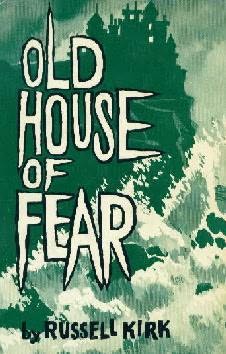
Book Break: Old House of Fear

While back home in Michigan over Divine Mercy weekend, I had the pleasure of browsing the Mecosta Book Gallery and coming home with my first Gothic fiction work of local literary hero and celebrated thinker and writer Russell Kirk, an unjacketed, former library edition of Old House of Fear.

Too few people, perhaps, know of Russell Kirk today. Even growing up a few miles from the tall brick house where he dwelt and wrote, and with his four daughters not far from me in age, all I knew growing up was that a eccentric writer supposedly lived in that big house. Such knowledge was wasted on my teenage self; had I known he was one of the foremost conservative political thinkers of the last century and a novelist to boot, I may have postponed Yale for a year and ultimately saved myself the trouble and the expense.

But I didn’t — and now I’m playing catchup.

I would describe Old House of Fear as a Gothic men’s adventure story: equal parts ghostly yarn, murder mystery, and manful romance. Our protagonist is sent by his employer, a Scottish-American industrialist intent on buying his family’s ancestral home on the remote Scottish island of Carnglass. The requisite castle has an ominous name — the House of Fear — though in its ancestral Gaelic it would be spelled fir or fhir and means “man.” What begins as a challenging business transaction with a strange old widow becomes a treacherous tale of intimidation, terrorism, and murder, involving Communists and occultists, as well as more run-of-the-mill ruffians, a beautiful red-headed niece who may also be a witch, and the ever-present shadow of a legend: a grostesque, three-eyed goat-man said to haunt the island from time immemorial.

It is a quick and satisfactory read, if a bit tidier than I expected at the end. I enjoyed it thoroughly and recommend it wholeheartedly…if you can find it! If not, I may be convinced to loan it to you!

Book Break: The Spiritual Combat

Dom Lorenzo Scupoli’s The Spiritual Combat was recommended to me by a friend many years ago, when I was first looking into my patron saint Francis de Sales’s spiritual classic An Introduction to the Devout Life. First published in 1589, Fr. Scupoli’s book was required reading for those whom St. Francis de Sales advised, and he reportedly carried in his pocket a copy given to him by Fr. Scupoli himself.

Over the past several months, I’ve been reading and reflecting on The Spiritual Combatduring adoration. I will warn you up front: It is not an easy read. The language and structure are archaic and complex at times, and Fr. Scupoli takes sin, Satan, and the possibility of Hell uncomfortably seriously (as we should, too). Take your time; read a section and reflect on it. Re-read if necessary. This is a book the rewards patience and prayer.

I believe it will reward repeated reading, as well. Each “chapter” reads like a short reflection building upon the previous. I have read all of these reflections now, but find that, in my own spiritual life, I’m still focused on the first few reflections. Early in the book, Fr. Scupoli insists that in the battle for souls, we must fight or die—but victory can only come from recognizing our own spiritual weakness and putting no trust in ourselves and our own abilities. We must recognize our overwhelming tendency to fall and put all our confidence in a loving and merciful God, without whom we can do no good, but with whom we cannot fail.

I don’t live like that. Most days I still try to get by on my own steam and get frustrated when I stumble or fail. So in terms of spiritual combat, most days I’m still reminding myself of my weakness and striving to distrust me and trust Him instead. When this becomes habitual, it may be time to read this book again!

My edition ends with a shorter work also attributed to Fr. Scupoli, A Treatise on Peace in the Soul. This is another old fashioned, hard-hitting, and practical work, much shorter than The Spiritual Combat, and for me, much easier to apply as a whole to my day-to-day life. The overarching theme is the importance of maintaining peace in the soul and responding immediately to worries, anxieties, and fears that disturb us, recognizing that these are tools the Enemy uses to separate us from God. I read this part in about two sittings and found myself much refreshed and with much to think about and apply, even as a raw recruit to the spiritual combat.

* * * * *

Blogger’s Note: The cover on my edition is the one pictured. As a former wrestler and father of wrestlers, this image of Jacob wrestling the angel alone is worth the price of the book! Also: toward the end of the post at the following link is my brief reflection on Introduction to the Devout Life, another great spiritual book.

Book Break: The Screwtape Letters by C.S. Lewis

The genius of C.S. Lewis continues to astound me. I read the Narnia series as a child and liked-but-not-loved them (although The Lord of the Rings has taken on new dimensions now that I am a practicing Christian, so perhaps I should revisit the world in the wardrobe, as well). But as an adult, Lewis’s nonfiction — Mere Christianity, The Abolition of Man, and The Weight of Glory — has consistently delivered new spiritual insights and deepened my conversion, and his fictional meditation on the afterlife, The Great Divorce, is one of my favorite books of all time.

Which brings me to The Screwtape Letters. This little book has been on my shelf for quite some time, and my oldest son, Brendan, read it a year or more ago and loved it. The book, ostensibly, is a collection of found letters from the demon Screwtape, an experienced administrator in the bureaucracy of Hell, to his nephew Wormwood, a young tempter striving to lure a budding Christian away from salvation. The letters show the subtlety and patience of the diabolical, the insidious ways in which we are knocked off the straight and narrow path, and the relentlessness with which we are pursued by the “roaring lion looking for someone to devour” (1 Peter 5:8).

I saw myself in nearly every letter, as Screwtape outlines the fledgling Christian’s typical stages of conversion and the best ways in which to turn his progress into regress. The book is darkly funny, which makes the medicine easier to swallow. For example, Screwtape admonishes Wormwood for being naively enthusiastic about the outbreak of war in Europe, saying that while human death and destruction are always to be praised and enjoyed, it is not, in itself, necessarily helpful in the damnation of souls, because A) it affords opportunities for men to exercise saving virtue as well as condemning vice, and B) it can end lives in an instant — snatching souls for the Devil just as easily as from God, and undoing years of patient temptation. He also advises his nephew that tempting humans to great and glorious wickedness can backfire into stunning conversions, and that small temptations that lead them slowly, slowly away from God — all unaware of the danger — is just as good for their Father Below, and besides that, more enjoyable for the skill required.

We never hear directly from Wormwood, but we can hear Screwtape’s displeasure with his dear nephew’s failures and mistakes and begin to sense his affection for the young tempter is only marginally different from his ravenous hunger for condemned souls. My volume (pictured above) included an extra essay, “Screwtape Proposes a Toast,” in which the demon lifts his glass to toast the Tempters Training College and uses the opportunity to explain to the new graduates how Hell is leveraging the public education system on Earth to promote the one thing democracy and virtue cannot survive: forced equality. It is biting and brilliant — and contains one of my favorite passages, about why small, subtle temptations and sins can be better for Hell that bold, passionate wickedness (remember, in this passage from the demon’s perspective, everything is inverted, hence “the Enemy” is God):

I have said that to secure the damnation of these little souls, these creatures that have almost ceased to be individual, is a laborious and tricky work. But if proper pains and skill are expended, you can be fairly confident of the result. The great sinners seem easier to catch. But then they are incalculable. After you have played them for seventy years, the Enemy may snatch them from your claws in the seventy-first. They are capable, you see, of real repentance. They are conscious of real guilt. They are, if things take the wrong turn, as ready to defy the social pressures around them for the Enemy’s sake as they were to defy them for ours. It is in some ways more troublesome to track and swat an evasive wasp than to shoot, at close range, a wild elephant. But the elephant is more troublesome if you miss. — C.S. Lewis, “Screwtape Proposes a Toast”

This is definitely spiritual reading, which you can apply to yourself if you try. A brief example might suffice to illustrate this point: in one letter, Screwtape advises Wormwood on what a huge difference a seemingly small tweak in the language of his “patient” can have on the fate of his soul. He urges his nephew to encourage the man to think of his duty to practice charity as unselfishness. Unselfishness has the advantage, Screwtape says, of turning a positive attribute (charity) into a negative (UN-selfishness), and an external, active habit into something more akin to navel-gazing: inwardly focused, inactive, and a potential source of pride.

He then goes into great detail as to how this commitment to unselfishness can be used to increase resentment and secret pride in marriages and families, as men and women forego the pleasures of this life not out of genuine love and desire of the good for another, but out of a selfish desire to appear unselfish:

“Let’s do what you want to do.”

“No, no, I insist, let’s do what you prefer.”

“Well, I don’t want to anymore.”

“Fine, we’ll do neither.”

She doesn’t even appreciate how unselfish I am!

I don’t need his pity — two can play at this game! 

Like The Great Divorce, The Screwtape Letters led me to think more deeply about the little things that draw me daily away from God, and underscored for me that getting to Heaven is something akin to long-range marksmanship: a tiny deviation at this end can, over the distance of years, result in missing the mark entirely. Yet it never ceases to be hopeful: the demons admit they are at a disadvantage and cannot challenge God directly — and they have no understanding at all of charity, and dismiss it as a lie God has told in service of a secondary goal they have yet to discover. They cannot fathom why He loves us so.