Wednesday Witness: Fasting Well, Feasting Well

On Easter Sunday, we were blessed to talk with Brother Jude. Brother Jude is our second son, Gabe, who is now a novice with the Community of Franciscan Friars of the Renewal (CFRs) in Newark, New Jersey.

From the outside, the novitiate year seems very focused on spiritual growth, detachment, and obedience. Aside from occasional letters, Brother Jude’s contact with his immediate family is strictly limited and with everyone else, non-existent. He spends a great deal of time in prayer and formation, and he does very little without first getting permission from his superiors. This was our first conversation since Christmas and our last until Jodi’s birthday in July.

As you can imagine, it was good to hear his voice. He seems very recollected and peaceful, and I told him so.

“I am, most of the time,” he said. “At least, I try to be.”

We catch each other up on the news and our Easter celebration, then I ask him about his Lent. Our impression last year, when he was a postulant, was that the friars observe a fairly stringent fast during Lent and Advent, which he was not subject to at that time.

Continue reading
Wednesday Witness: How Do I Love Me?

How do I love thee? Let me count the ways…

The 19th-century poet Elizabeth Barrett Browning asked the question above in her Sonnet 43. This morning, I ask a different question: How do I love ME?

I am currently reading the book Happy Are You Poor by Father Thomas Dubay, SM. It is a hard, convicting read about taking seriously the Gospel’s words regarding wealth, poverty, possessions, and sharing with those in need. What has struck me hardest thus far is Father Dubay’s insistence on the actual words of Jesus—currently, “You shall love your neighbor as yourself” (Matthew 22:39, cf. Leviticus 19:18).

How do I love myself? Among other ways:

Continue reading

Wednesday Witness: Take a Minute

In last week’s Wednesday Witness column, I described one of several homeless men and women who frequented Yale’s campus when I attended in the 1990s. I worked for the graduate School of Music all four years, and one of my first and primary duties was walking the entire campus, distributing or hanging concert flyers and posters at various buildings, businesses, and kiosks. I made the rounds at least once a week; as a result, I saw the local homeless frequently, and they saw me.

During my first year, one man, in particular, kept his eyes open for my brown leather ballcap and black poster portfolio. He was an older fellow, creased and grimy from years on the street, with lank and thinning gray hair, well-worn workman’s clothing, and the unmistakable aroma of body odor and booze. Whenever he saw me, his pale eyes would pull into focus, and his mouth would break into a smile that was equal parts crooked yellow teeth and no teeth at all. He would rise (if seated), reach out to shake my hand, and start the same conversation.

Continue reading

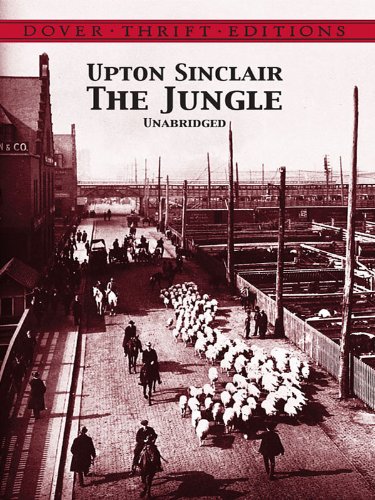
Book Break: The Jungle

A few weeks ago, I attended a day-long training to become a home visitor for our local conference of the Society of St. Vincent de Paul. The most compelling part of the training was the section on what poverty looks like, from the perspective of the person living through it. This segment of the training was led by a man who was born and raised in some of the roughest areas of Chicago and Minneapolis, who was hired by the Society of St. Vincent de Paul as a teen and loved and accompanied for years, through numerous trials and triumphs. Today he is a college-educated husband and father, a successful manager and talented speaker on the state and national level, and a Vincentian for life.

The training was thought-provoking and convicting; it, along with learning more about my own ancestors’ struggles with poverty before I was born, led me to want to dig deeper—which in turn led me to another unread book on my shelf: The Jungle by Upton Sinclair.

Sinclair was an influential muckraking journalist, author, activist, and political candidate at the turn of the 20th century. The Jungle is his fictional but detailed and realistic account of power, corruption, and poverty during this time, particularly in the stockyard district of Chicago. The book follows one immigrant family from Lithuania, who moves to America on the promise of plentiful work for good wages, and finds a corrupt system of capitalists and politicians of every stripe, at every level, keeping prices high and wages low, controlling everything from housing and food supplies in the neighboring slums to law enforcement, inspections, and elections—and driving workers to desperate measures to avoid death by illness, exposure, or starvation.

Continue reading

Last Call: A Christmas Dialogue

This year’s Christmas poem is a conversation and a modest attempt at Shakespearean style. The inspiration popped into my head several weeks ago: an imagined meeting of the World, the Flesh and the Devil, who are sharing a pint of “Christmas cheer” at the end of a seemingly successful year of sowing strife and division. The line that came first to mind was from the Flesh: “The spirit is weak, and the flesh is always willing.”—which survives in a modified form.

For whatever reason, I remain taken with the idea of Satan struggling to accept that he has been defeated by an Infant and His Mother. A few sparks from literature and pop culture also came to mind, for example, C.S. Lewis’s “Screwtape Proposes a Toast,” Scrooge’s promise at the end of Charles Dickens’s A Christmas Carol to discuss Bob Cratchit’s situation “over a Christmas bowl of smoking bishop,” and the exchange between Captain Jack Sparrow and Gibbs in the Tortuga tavern in Pirates of the Caribbean: The Curse of the Black Pearl.

It may be easier to print and read in this format. Apologies to the Bard—I hope a few of you enjoy it. Merry Christmas!

+ + +

Scene: A dark corner of a noisy tavern, lit by melted candle stubs and a large, crackling fire. A table with three chairs and three tankards. Two figures are seated: the World, slight, anxious and in constant motion; the Flesh, immense and languid, with eyes that rove around the room. A third figure, the Devil, well-dressed with a commanding bearing, approaches, and the first two rise.

Continue reading