Book Break: Saint John Paul the Great: His Five Loves

This past Christmas, our church gave to all parish and visiting families a copy of Jason Evert’s book Saint John Paul the Great: His Five Loves. I finished it this past week while recuperating, and it seems only right that on this tenth anniversary of the great man’s passing, I offer a brief review and encourage family and friends to read it.

First, let me encourage you to read the Foreword and Introduction, as both share personal anecdotes that share what sort of man Pope John Paul II was, The first half of the book, then, is a condensed and easy-to-follow biography of Karol Wojytla from his boyhood in Poland to his death at the Vatican at age 85. Some years ago, on a long solo road trip, I had the pleasure of listening to an audiobook version of George Weigel’s JPII biography, Witness to Hope — Evert’s book uses Weigel as one of several sources, and provides a great overview of the events and circumstances that shaped young Karol into Father Wotyla, then bishop, archbishop, pope, and saint. When I hear these stories, I can’t help but be proud to be (half) Polish and Catholic.

The second half of the the book uses additional sources and anecdotes to outlines the “five loves” that inspired and sustained Pope John Paul II in his priestly ministry and personal holiness:

  • Young People: From his earliest priesthood, he was drawn to youth and young adults, recognizing early on that they were the church’s best hope for the future, and that a watered-down morality would not satisfy their idealism and thirst for the challenge of living full and Godly lives.
  • Human Love: He saw, in human love and sexuality, and image of the Holy Trinity’s loving and life-giving communion, and went to extraordinary lengths to explain the unity of love, sex, marriage,and procreation and to elevate these topics to the realm of the sacred.
  • The Blessed Sacrament: His love for the Holy Eucharist and experience of the Real Presence of Jesus was so deep and strong that he spent hours in adoration and conversation with God, and more than once, located the Blessed Sacrament in hidden chapels and unknown places by his love for and sense of the Divine alone. 
  • The Virgin Mary: After the loss of his mother, and ultimately his brother and father as well, he embraced Mary, the Mother of God, as his own and never ceased his devotion to her guidance and intercession — he knew that she always leads us to Christ.
  • The Cross: He saw the dignity in the elderly, the disabled, the sick, and the suffering, and showed it to them, first by articulating the ways in which human suffering can be used to benefit others, and finally, by living his own painful and debilitating struggles in the public eye, serving the Church until his death.
Last I looked, we still had a few copies of this book in the Gathering Space. If you didn’t get one, let me know. It’s a quick and enlightening read that is almost sure to inspire!

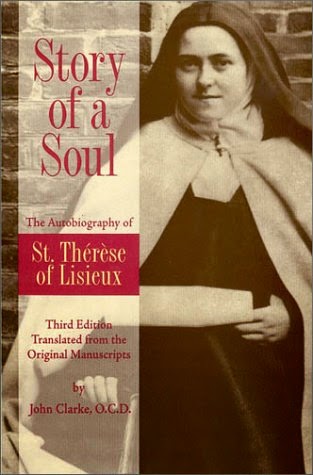
Book Break: Story of a Soul

One of the great blessings of surgery has been time to read; as a result, I’ve now finished three books that lay on my nightstand, long overdue. The first was the the autobiography of St. Therese of Lisieux, Story of a Soul. The Little Flower had been much on my mind and had shown up time and again in my prayers and study this past winter, so much so that I decided she must be trying to tell me something. I found her biography in our parish lending library, and finished in late last week.

Autobiographies, especially those that weren’t expressly written for publication, can be challenging to read, and this is no exception. St. Therese is writing out of obedience, fulfilling requests of three different prioresses to record the memories of her life. Her style is emotional, sentimental, somewhat meandering, and acutely self-aware — in fact, she acknowledges throughout the book, with good humor, that she has drifted far from the main point, but that she is writing because she was asked to, and if her work is found lacking and destroyed, it will be of no great loss to her.

It does not take long to realize this is the story of an exceptional soul from an exceptional family. From her earliest days in 19th-century France, the Martin family’s life revolved around their Catholic faith, prayer, and the sacraments. The first thing that struck me (and I believe this was one thing the little saint wished to tell me) was that in her childhood, preparation for receiving Jesus in the Holy Eucharist for the first time was the most important and most exciting thing that could happen. She understood the mystery of the Real Presence early on and longed for the sacrament with her whole being; her entire family — parents, sisters, aunts, uncles, everyone — helped her to prepare, encouraging and instructing her, helping her to make a mature first Confession, even sending this little girl on retreat to prayerfully prepare for her first Communion. We fall far short of this today, and that must change!

From an early age, St. Therese longed for the religious life of a Carmelite sister. The persistence of her vocation also struck me: she prayed long and hard on this beginning in childhood and was so strongly minded that, on a pilgrimage to Rome, she pulled rank on her local priests and bishop and cried to the Pope to let her honor him by entering Carmel at age 15. He told her she would enter if God willed it, and a short time later, the local church authorities relented.

The religious life was not without struggles for St. Therese, and it was there that she perfected her “Little Way,” which has made her so beloved the world over. She wanted to do great things for God, but was confined to a convent, young and of poor health. She could not be a priest, and would not be a missionary or a martyr. She was just a little flower on the forest floor — but the little things she did, she could do with great love. As a result she began to bite her tongue when accused or  provoked, to seek out the sisters who were avoided by others and look for ways to serve them, and to seek the good for others in every situation, regardless of the cost to herself. She began to love as God loves.

St. Therese was extraordinary, but blazed a trail that ordinary Catholics can follow, perhaps, more easily than that of the spiritual powerhouses of the Church. And I think that was another thing she wanted to tell me. This is a beautiful story of a great soul, and while it’s not a traditional page-turner, I highly recommend it.

On a related note: during the same time period as I was reading this book, a colleague gave me a booklet called “40 Days of Preparation for First Communion with St.Therese of the Child Jesus.” It is a booklet of very short daily prayers and exercises for children, based on the prayers and exercises St. Therese undertook as a girl under her family’s guidance. Unbeknownst to me, my colleague Kathy was given the same booklet by one of our priests to consider for use with this year’s First Communicants. It’s a baby step toward what our First Communion preparation ought to be. St. Therese of the Child Jesus and the Holy Face, pray for us!

Full of Grace

Annunciation by Paolo de Matteis (1712)

Yesterday was a rare treat: a three-sacrament day. I went to work, then to Confession at lunch time, received a pre-surgery Anointing of the Sick late in the afternoon, then went to evening Mass to receive the Eucharist. Never have I felt so full of grace — and today is the Feast of the Annunciation. Providential?

Then I came home — late, because I was tying up loose ends to be out of the office for awhile. The family had already eaten supper, but we still managed to spend some quality time together before bed. They’ve got Dad’s back with prayers today, as do countless other friends and family members, and a few acquaintances I just barely know. I’m a little embarrassed by the support, but I will never refuse prayers. We are blessed to have such love in our home, in our parish, and in our extended families.

Hernia surgery is supposed to be a pretty routine thing, for the surgeons, at least. Less so for me. I’ve never had any sort of surgery, except the removal of my wisdom teeth before I left for college. That involved local anesthesia and laughing gas; I remember begin vaguely fascinated by the industrial crunching and grinding noises emanating from my own mouth. This is different, and I don’t think I’ll care to know what’s going on as it’s happening.

I’m not a great patient, either. Oh, I’m generally alright (perhaps a little talkative) with doctors and nurses…but on the homefront, I’m more of a Man-Cold kind of guy. My bride, who works from home, is so looking forward to the next few days.

But you know what? This is actually a penitential season, in which we strive to enter more fully into Jesus’s suffering for us. This is an opportunity for me to grow in this regard — to be still, to pray, to suck it up a bit in solidarity with the One who took nails for us.

Ask Jodi at Easter if I manage to pull it off. Much love and many blessings to you this Holy Week and Easter!

LIFT Links: Holy Week and Easter Traditions

Icons of Holy Week: Palm Sunday, Holy Thursday, Good Friday, and Easter

I’ve been a little lax on LIFT Links lately (that’s a lot of Ls) — and now, as we’re headed into Holy Week and the Easter Season, I need to make up for lost time.

First, the basics. Until I met and married Jodi, I was vaguely aware that Palm Sunday was the Sunday before Easter, the Good Friday was the Friday before, and Easter was a pretty big deal–right up there with Christmas. At some point early in our relationship, my bride informed me that her family attended Mass at least three (and sometimes four or more) times during Holy Week, the week between Palm Sunday and Easter Sunday. As I’ve said more than once, they went to church on days I didn’t know church was open!

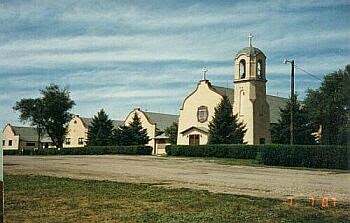
St. Liborius Catholic Church, Polo, SD

Jodi’s family, and many of the other parishioners at St. Liborius Catholic Church in Polo, SD, went to church at every opportunity during the Holy Triduum: Holy Thursday, Good Friday, the Easter Vigil on Holy Saturday, and morning Mass on Easter Sunday. Today, our family goes on Holy Thursday, Good Friday, and either Holy Saturday or Easter Sunday. It’s a beautiful way to enter into that period of uncertainty and darkness, then light and joy, that Jesus’s disciples experienced between the Last Supper and Christ’s Resurrection.

One more thing before I share some links: attending Mass on every Sunday and all Holy Days of Obligation is one of the five Precepts of the Catholic Church — the minimum requirements to be a practicing Catholic. Receiving Holy Communion is not required every Sunday, however, receiving Holy Communion at least once during the Easter season (which is Easter Sunday through Pentecost Sunday) is required. Receiving the sacrament of Reconciliation once a year is also one of the precepts — and since being cleansed of all serious sins is required to receive Our Lord worthily, Lent is a great time of year to get to Confession so you can receive Holy Communion at Easter.

Now, some links:

Have a blessed Holy Week and Easter, friends!

What’s Keeping You?

It’s been nearly eight months since I left the University of Minnesota to work full-time for our parish. At some point in each of my previous jobs, I looked around and asked myself, “Jim, what are you doing here?” Thankfully that has yet to happen since I joined the church staff, but I don’t doubt that it could—work is work, after all.

Faith is work, too. It’s hard sometimes to believe in a good God with so much wickedness in the world, including within the Church. It’s hard to do the right thing when so few people agree on what the right thing is, even within the Church. It’s hard to pray or read or learn more about Jesus, to drag ourselves to Confession, or to haul the family to Mass each Sunday when so many Catholics just…don’t.

I’ll bet at least once you’ve sat in church, looked at Father and the people gathered around you, and asked, “What am I doing here?” It’s a worthwhile question to consider. According to data collected by the Pew Research Center, not only do most U.S. Catholics say they attend Mass once a month or less, but many disagree with the Church’s fundamental teachings regarding marriage, contraception, and the sanctity of life. Yet they persist in calling themselves Catholic. What’s keeping them in the Church?

Well, what’s keeping you? Is it habit or family tradition that brings us here week after week? That makes us seek the sacraments for our children? Is it a hope we hold out for the next generation, even though we may have lost it for our own? Is it a hollow ache in our chest that insists there must be something more to this life? Or is it the peace that radiates from altar, the tabernacle, the Eucharist—peace the world cannot provide?

This month the adults in our LIFT classes focused on the Mass and Holy Communion. We heard the deeply personal testimony of one of our youth ministry volunteers on her own struggles with her Catholic faith—and ultimately, on how she could never turn her back on the Real Presence of Christ in the Eucharist. Jesus said, “This is my body…This is the cup of my blood”—and so it is. Jesus is God, and God’s words are the very words of Creation. They bring about exactly what they say.

I’ve said more than once that if we as Catholics truly understood who was present in the tabernacle, nothing could keep us from Him. We would fill the pews to overflowing, bring family and friends to a personal encounter with Jesus. We would gladly sacrifice to spend time at His feet, listening to Him, learning from Him, serving Him.

And yet I don’t do these things. We don’t do these things.

The red lamp above the tabernacle signifies that He’s always there. What’s keeping you?

Blogger’s Note: This article appears in the Sunday, Jan. 25, church bulletin .