The Choice Is Still Before Us

 
“Why do you call me, ‘Lord, Lord,’ but not do what I command?” – Luke 6:46
Recently I was paid a great compliment: I was called a disciple. My reaction surprised me. I didn’t feel pride or embarrassment, but alarm. My immediate concern was that if people consider me disciple, they might strive to be like me and fall short of true discipleship. The closer I get to God the more clearly I see how far I have to go. I am a tall man, but a low bar.
 

We all have a choice to make, to leave our former life behind and follow Christ to Calvary. As Deacon Ralph Poyo shared in his recent visit, it is an all-or-nothing choice. We are called to love the Lord with all our heart, mind, soul, and strength. The only way to put God first is to place everything else behind Him.

The bad news is that we cannot work hard enough or love well enough to earn heaven without God’s grace—but neither can we cease to work and presume God’s grace will carry us.

The good news is that the choice is still before us, in every interaction, every moment here on earth.

How do we make the right choice in the moment? Jesus gives us clear instructions. For example:

  • Renounce your possessions, pick up your cross, and follow—otherwise you cannot be a disciple (Matthew 16:24-16, Mark 8:34-38, Luke 9:23-26).
  • Love God, love neighbor, love enemies—it is not enough to love those who love you (Matthew 5:43-48, Luke 6:27-36).
  • Provide for the needs of others as you would for Jesus Himself—anything less is damnable (Matthew 25:31-46).

These words are like a punch to the gut for me. I have no trouble at all crying out to the Lord, but I’m terrible at doing what He commands. I go to Mass, pray pretty regularly, and try not to sin. But I enjoy my life, I dislike suffering, and I am comfortable in this community, in my circle of friends and family, in a job that suits my skills and pays the bills.

Surely I get bonus points working for the church? Didn’t the Pharisees?

We have hope, however. God seeks us constantly, loves us endlessly, wants to forgive us and welcome us home. God proves His love by sending His son to sinners, to live, suffer, and die in order to save us from our sins. We can choose today to accept this love or not. We can choose to love God back or not. We can choose to follow Jesus or not. We can make this choice right now.

But we can’t do it alone. If you are ready to change your life and follow Christ today, talk to someone today. Ask someone you regard as a disciple what to do next. They might be a little flustered at first, because discipleship is a big responsibility. If they are uncomfortable, it may mean they need someone to walk with, too. Ask them to partner with you. And if you don’t know who to talk to or want help from the parish to get started, send an email to smallgroups@stmcatholicchurch.org or call me at the parish office. 

Don’t wait. The way is narrow, but not so narrow that we can’t walk it together!

Rise and Walk: Looking Ahead to Next Year’s Program

This past week we completed our family faith formation sessions for the year, and this weekend our LIFT first communicants will receive the Blessed Sacrament for the first time. The past year has flown by, and I suspect the summer planning season will pass even faster. We have lots of great for next year, but one of more significant changes has to do with the age of Confirmation. After extensive discussion in recent years, including our priests, committee members, catechists, and staff members at St. Michael and St. Albert parishes, we have decided to gradually shift the age of Confirmation to 8th grade for all our students.

This decision was made for several reasons, but for me, the two most compelling are these:
  • Middle-schoolers are more open to evangelization and catechesis. They are more likely to follow the lead of their parents and parish volunteers, more excited about activities and retreats, and significantly less busy. High-schoolers have other priorities, including sports, exams, driver’s ed, jobs, and social lives—and unless their faith is already a top personal priority, it is difficult to make them care.
  • We already have great success in reaching and converting middle-schoolers. We have tremendous youth ministry programs that change kids’ lives (as almost anyone who has sent their kids to Extreme Faith Camp can attest). We don’t capture the heart of every middle-schooler, but of the high-schoolers we have who stay committed to their faith through graduation and beyond, nearly all of them were hooked in middle school. Each year we have a large “bubble” of students who show up for Confirmation classes—why not move the bubble to the age at which we have proven success in reaching kids and helping to keep them Catholic

What does this mean for you? If your children attend the parish school, they will continue to be confirmed in 8th grade. If your children attend LIFT and our parish Confirmation program, the plan looks like this:

  • Next year: Tenth-grade students will see no change; they will complete the second year of the Chosen program and be confirmed in Spring 2017 as planned. Ninth-grade students will complete a more intensive, one-year Chosen program and will also be confirmed in Spring 2017.
  • 2017-18:Ninth-grade students will complete a more intensive, one-year Chosen program and will be confirmed in Spring 2018. Eighth-grade students will complete either a one-year program (either based on Chosen or the YDisciple model) and will also be confirmed in Spring 2018.
  • 2018-19:Eighth-grade students will complete a one-year program using the YDisciple model from this point forward.

The YDisciple model involves forming small groups of around eight students each, beginning in middle school, with a trained adult leader who walks with those students from middle-school until they graduate. In each discipleship group (or D-group), students continue to learn about their Catholic faith, grow in prayer and discipleship, support each other, and hold each other accountable.


This is a volunteer-intensive effort. We will need people who feel called to work with teens and share their faith, who are willing to be trained and to commit to a group of young people, and who are able to share their own lives as examples of faithful discipleship. It is a daunting task to find and train so many volunteers, but we believe this is where God is calling us, and He will make our efforts fruitful.

In fact, our need for dedicated disciples who are ready to work in the vineyard is not limited to Confirmation. We have such great needs in this parish, and so few workers. It is time for those of us who have been asleep to rise and walk, with our spouses and children, our friends and neighbors, and all those in our lives who need Christ—in short, with everyone!

Eucharist Pep Talk for Parents


[Blogger’s Note: This is roughly the “pep talk”I gave to First Communion parents at the Wednesday, March 16, class — I am posting it here to share it with those who missed.]

The next day, the crowd that remained across the sea saw that there had been only one boat there, and that Jesus had not gone along with his disciples in the boat, but only his disciples had left. Other boats came from Tiberias near the place where they had eaten the bread when the Lord gave thanks. When the crowd saw that neither Jesus nor his disciples were there, they themselves got into boats and came to Capernaum looking for Jesus. And when they found him across the sea they said to him, “Rabbi, when did you get here?” Jesus answered them and said, “Amen, amen, I say to you, you are looking for me not because you saw signs but because you ate the loaves and were filled. Do not work for food that perishes but for the food that endures for eternal life, which the Son of Man will give you. For on him the Father, God, has set his seal.” So they said to him, “What can we do to accomplish the works of God?” Jesus answered and said to them, “This is the work of God, that you believe in the one he sent.” So they said to him, “What sign can you do, that we may see and believe in you? What can you do? Our ancestors ate manna in the desert, as it is written: ‘He gave them bread from heaven to eat.’” So Jesus said to them, “Amen, amen, I say to you, it was not Moses who gave the bread from heaven; my Father gives you the true bread from heaven. For the bread of God is that which comes down from heaven and gives life to the world.” So they said to him, “Sir, give us this bread always.” Jesus said to them, “I am the bread of life; whoever comes to me will never hunger, and whoever believes in me will never thirst. But I told you that although you have seen [me], you do not believe. Everything that the Father gives me will come to me, and I will not reject anyone who comes to me, because I came down from heaven not to do my own will but the will of the one who sent me. And this is the will of the one who sent me, that I should not lose anything of what he gave me, but that I should raise it [on] the last day. For this is the will of my Father, that everyone who sees the Son and believes in him may have eternal life, and I shall raise him [on] the last day.” — John 6:22-40

One of the striking things about this passage is that this conversation happens right after Jesus feeds 5,000 people with five loaves of bread and two fish — and already the people are asking Him for another sign, so that they can believe in Him: “What can you do?” Time and again, Jesus does incredible things, and time and again, the people doubt and ask for another sign.

This passage continues in with the famous Bread of Life discourse, in which Jesus tells the people, “I am the bread of life. Your ancestors ate the manna in the desert, but they died; this is the bread that comes down from heaven so that one may eat it and not die. I am the living bread that came down from heaven; whoever eats this bread will live forever; and the bread that I will give is my flesh for the life of the world” (John 6: 48-51)”

The people, and even his own disciples, struggle with this — it doesn’t makes sense and it offends many of them, so they begin to murmur about it. But Jesus doesn’t back down. He doesn’t say, “Oh, I met this as a metaphor.” He strengthens His language and insists that the people need to eat his flesh and drink his blood. And for many people, this is too much — they stop following Him.

Many Catholics struggle with the mystery of the Real Presence of Jesus in the Holy Eucharist, because it is a mystery. I have struggled with it, too, over the years, and so I pray with the man who asked Jesus to cure his son of a demon: “I do believe, help my unbelief!” (Mark 9:24).

As parents, we have to make a conscious effort of the will to believe this teaching and understand it as best we can. Why? Because as a Church, this is what we believe, and as a parish, this is what we are teaching your children: that Jesus is truly present, body, blood, soul, and divinity, in the Holy Eucharist. We make a big deal out of First Communion, and that’s wonderful. but if we tell our children that Jesus is truly present in the Eucharist, and the next weekend we don’t return to Mass, at some level they will know that we don’t really believe it, because if we did, nothing would keep us away!

As I said, I’ve struggled with this great mystery of our faith, as well — so I want to share a few things that helped me along the way. 
  • The first is something I’ve shared with you all before during First Communion classes. Scripture tells us that, “The word of God is living and effective” (Hebrews 4:12). What God says, is. For example, when God says, “Let there be light,” or let there be plants, animals, or people, it happens. And since Jesus is God, and since God is all good and all Truth, when Jesus says, “This is my body; take and eat,” we can trust that it is, in some mysterious way, truly his Body.
  • The second is something I noticed as I returned to the church and the sacraments: that what appeared to be a bit of bread and a sip of wine affected me in a way that no other bread and wine outside of the Mass ever did. I eat bread and occasionally drink wine outside of Mass, but never do I experience such a sense of peace and love as I do in the Eucharist.
  • The third is something that I began to do self-consciously, as an act of the will: I began to correct my thoughts and words. When I talked or thought about the Eucharist, I began to move myself from referring to the bread and wine, to the consecrated host or the consecrated wine, to the Body and Blood and Jesus. Over time, I began referring to the Eucharist as a person, Jesus, rather than a thing. This made more and more sense to me as I reflected on the fact that we often teach our children not to judge people by their appearances; it’s what’s underneath — what we can’t see — that counts. If the Eucharist is Jesus, it makes sense that the same logic applies: we should not judge the Real Presence by appearance (we see bread and wine) but what is inside and underneath (Jesus’ promise that this is His Body and Blood).
I remember, several years ago, my predecessor Carol asked me if I would lead the closing prayer for our LIFT classes. We had a brief period of Adoration at the end, and I was contemplating what I should say before the closing prayer and wondering how I got in this position. I fell to thinking about who was the most important person in the room. Certainly not me, even though I was leading prayer. Carol was the director of faith formation, but Father was there, too — so he was the most important, the leader…

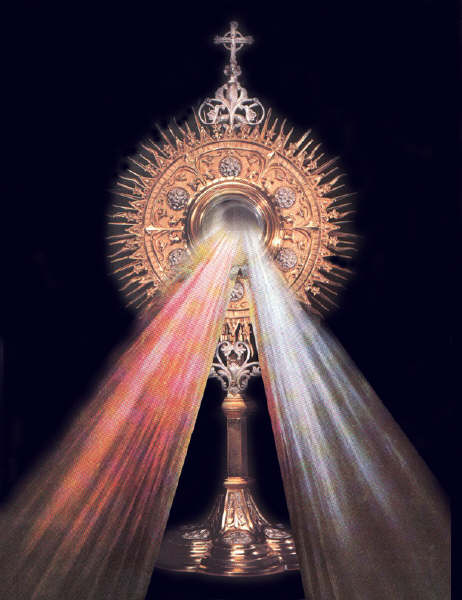
Then I looked at the monstrance and realized the truth that was staring me in the face: the most important person in the room was Jesus Christ, truly present in the Eucharist.

As parents, we must make every effort to believe this and act on it. There is no better witness, no better way to pass on the Catholic faith, than you making the Mass and Holy Eucharist the top priority in your life.

A Baby Catholic’s First Steps

be26f-cover_october_2014_web

Fr. Bill, from an article on Confession
in the Diocese of Grand Rapids magazine Faith.

I have mercy on the brain this month. At LIFT we talked about the sacrament of Confession, and several parishioners shared powerful stories of how God’s mercy had strengthened their faith. Then, in recognition of the Pope’s Year of Mercy, our parish retreat focused on God’s message of Divine Mercy. Fr. Alar’s presentations were both consoling and challenging—showing me clearly the great ocean of mercy that stretches before us and how slow we are to tap into it for ourselves, much less for others.

I made my first Communion around age 10, during a brief period in which my mom returned to the church with my sister and me. As a young husband, I attended Mass with Jodi, out of respect for tradition and curiosity more than anything else. When I became a father, I began to open up to the possibility of becoming a practicing Catholic, but I had many questions and was deeply enmeshed in many of the typical sins of young men. I hid those sins under a thick blanket of pride, convinced that I knew better about right and wrong—but Jodi’s solid, peaceful faith played on my curiosity. So one evening, I sat down in the rectory to talk with our priest.

I told Fr. Bill I wasn’t sure it was possible to know if God exists. I told him I disagreed with the Church’s teaching on birth control. I told him I didn’t understand the Church’s teachings on the real presence of Jesus in the consecrated bread and wine at Mass. I told him I couldn’t believe that a merciful God could condemn good men to Hell for not believing in Him.

Fr. Bill addressed my issues calmly and thoughtfully. He told me I had a good head on my shoulders, and God gave it to me to use. He told me not to be afraid of my doubts or questions—that even priests struggle with the same and need faith to follow God.

“But you’re not going to find the answers to these questions by holding your faith at arm’s length,” he said. “My advice is to go to Confession and begin receiving Communion again, and ask your questions from inside the Church.”

I thanked him, and he said, “I could hear your confession now, if you want.” I protested that it had been many years and I didn’t remember how, and he said, “Don’t worry—I will help you.”

So right there, in the living room of the rectory, I made the first Confession of the rest of my life—my first face-to-face Confession—with the priest who first showed me the depths of God’s mercy. I began receiving Holy Communion again the following Sunday, was Confirmed in the Church a few years later, and began a lifelong march to Calvary and Christ, because Fr. Bill saw my dignity as a son of God under layers of pride and years of sin.

Here’s the kicker: I know now that my Confession that evening wasn’t technically valid. The sins I was struggling with come in buckets; I confessed most of them that night, but not all, because some I didn’t agree were sins and had no intention of changing. But I made the best Confession I could in my ignorance and was sincerely contrite—as sorry as I could be in that moment of faltering pride and budding faith. Fr. Bill started me on a road I may not have taken otherwise. Had I waited a week, that spark may have gone out, and had he said, “Good effort…but come back when you’re ready to confess everything else I suspect you’re doing,” I may never have come back.

I need to remember that my first steps on the path to an adult faith were baby steps, small and unsteady, and that Fr. Bill saw enough in me to invite me back to communion with God. We need to see each other as he saw me—as Jesus sees every sinner—and encourage those first faltering steps.

The Seed Is…Me?

I’ve had a handful of conversations lately about our faith formation programs at St. Michael: what we’ve done differently this year, what’s working and what’s not, and what more I wish we’d done. I am tempted to sudden actions and grand gestures at times, and midway through the faith formation year is no exception: I am tempted to blow up what we’re doing in our parish and start over. So many people need to know that God is real, that Christ is present in the church…and I’m stewing over videos, Powerpoints, and the Catechism.
Then a good friend shares this with me, from something he is reading these days. He knows where my head has been lately, and thinks this might be helpful. He’s right.

“Commenting on the Church’s evangelizing efforts, Pope Benedict XVI warned that Catholics today must resist what he calls ‘the temptation of impatience,’ that is, the temptation to insist on ‘immediately finding great success’ and ‘large numbers.’  He says that immediate, massive growth is not God’s way.  ‘For the Kingdom of  God as well as for evangelization, the instrument and vehicle of the Kingdom of God, the parable of the grain of mustard seed, is always valid.’  He goes on to say the new phase of the Church’s evangelizing mission to the secular world will not be ‘immediately attracting the large masses that have distanced themselves from the Church by using new and more refined methods.’  Rather, it will mean ‘to dare, once again and with the humility of the small grain, to leave up to God the when and how it will grow.’”

The quotes from Pope Benedict are from “The New Evangelization:  Building a Civilization of Love,” his address to catechists and religion teachers, Jubilee of Catechists, December 12, 2000.
We talk often of planting seeds in others, not knowing where, when, or whether they will germinate. But Pope Benedict calls me to the humility of the small grain. 
What does that mean?

A seed perseveres through inclement conditions. It bides its time, then when the time and place are right, it germinates: puts roots down and sends visible growth up.
So far so good, I think.
As conditions are favorable, it continues to grow, and God willing, to put forth fruit. The plant itself has little impact on how much fruit results year to year or what becomes of the fruit once it ripens and drops. But it continues to produce, year after year, as long as it is able. 
The seed is me? That’s a thought I hadn’t thought before…