The Superbowl was this past Sunday. Midway through the evening, social media exploded with critiques of the halftime show, which apparently featured two high-profile female performers in various states of undress dancing provocatively while sharing a medley of their musical hits.
I am not sorry we missed it.
I won’t rehash what I’ve read on the subject. The reason we did not watch was because a year or two ago, after repeatedly venting about the content of the halftime show and even some of the commercials, we agreed as a family to stop watching. When Superbowl Sunday rolls around, we prepare the usual snacks and treats, gather around the TV…and watch a movie.* We are not big football fans, and it occurred to us that it was a waste of time and energy to watch a game we didn’t particularly care about in order to see questionable commercial content and to be subjected to yet another pop-culture skin flick. It wasn’t easy to take that first step “out of the loop,” but honestly, we haven’t regretted it.
This is not to say you can’t enjoy football or the Superbowl. But I was struck by the volume of social media posts, articles and commentary that began with some variation of, “Thanks for exposing my child to X, Y and Z during the halftime show. They shouldn’t have to see that.”
They don’t have to see it—and as consumers and parents, we have the power and the responsibility to ensure they don’t.
Providentially, the next morning, the daily gospel was Mark 5:1-20. Bishop Robert Barron’s scripture reflection focused on the age-old practice of scapegoating: projecting our anxieties and anger onto a particular person or group of persons in order to preserve unity in our community. Bishop Barron suggested that we could interpret the numerous demons possessing the man living among the tombs as all the fears and frustrations of the people in that territory. They may not have liked the demoniac, but they knew him. They had a scapegoat. When Jesus sets him free and casts the demons into a great herd of swine, the people do not rejoice that their neighbor has been restored to his right mind. Instead, they are afraid and beg Jesus to leave.
How often are we uncomfortable with seeing and claiming our part in the evils of the world? How comforting it is to see someone else as the villain—to gawk, point and howl at wickedness instead of changing something in our own lives to prevent its spread!
How many years in a row did I shake my head at the garbage on our television but resist cutting the cable?
In last Sunday’s bulletin, I referenced Thomas Merton’s autobiography, The Seven Storey Mountain. This morning I read his account of learning that war was again breaking out in Europe:
There was something else in my own mind—the recognition: “I am responsible for this. My sins have done this. Hitler is not the only one who has started this war: I have my share in it too…” It was a very sobering thought, and yet its deep and probing light by its very truth eased my mind a little. I made up my mind to go to confession and Communion on the First Friday of September.
…
I knelt at the altar rail and on this first day of the Second World War received from the hand of the priest, Christ in the host, the same Christ Who was being nailed again to the cross by the effect of my sins, and the sins of the whole selfish, stupid, idiotic world of men.
I have to admit I was caught off guard when I read this—the vehemence with which Merton incriminates himself, and at the same time, the sense of relief he feels in coming to terms that he is in company with all of mankind, all to blame and all loved and redeemed by Christ.
There is an image often shared with children: When you point at someone else, the rest of your fingers point back at you. My wish for myself and all of you is that, as often us possible, we point to Jesus.
——-
* This year, appropriately enough, it was an annual favorite: Groundhog Day. I understand a Jeep ad based on the movie was one of the highlights of Sunday evening.
* * * * *
Blogger’s Note: This post first appeared as part of the Wednesday Witness blog series on the St. Michael Catholic Church website.
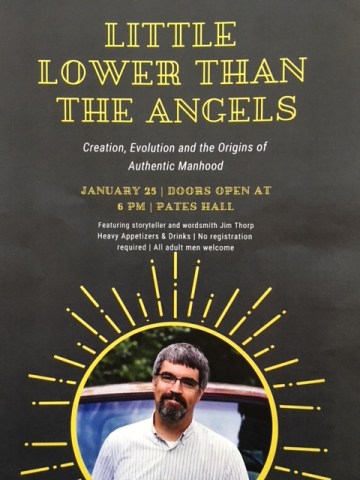 Late last month I was invited to speak to the Men’s Club at
 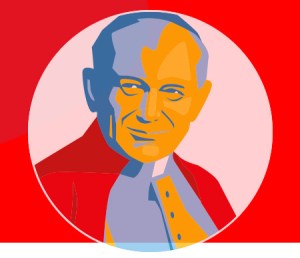 Born Karol Wojtyła in Wadowice, Poland, in 1920. Suffered the loss of his family, freedom, and country by the time he was 21 years old; risked his life under the Nazi regime to promote Polish cultural resistance and study for the priesthood. Recognized as a gifted theologian, pastor, and bishop; elected pope in 1978 and brought the Good News to 129 countries. Instrumental in the fall of dictatorships and Communism; wounded critically in an assassination attempt in 1981; credited Our Lady for preserving his life and met with and forgave the assassin. Served as pope until his death in 2005, despite declining health due to Parkinson’s and old age. One of the most recognized figures of the 20th century.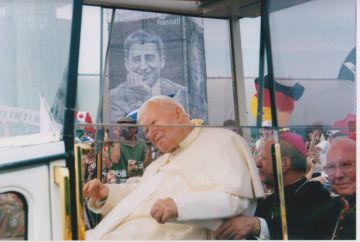
 Archangel Stomp