Call and Response: Embracing the Already of Christ’s Saving Act

Blogger’s Note: This was my final paper for the fourth semester of the Catechetical Institute, “Prayer: The Blessing Given and Received.” In this reflection, we were not only to discuss the final pillar of the Catechism, but the book and Institute as a whole. After two years of study, the Class of St. Padre Pio graduated this evening, following Mass with Bishop Kettler presiding. 

The fourth pillar of the Catechism of the Catholic Church (CCC) calls us to deeper relationship with our heavenly Father who loves us and redeems us by the sacrifice of His Son, Jesus, and the actions of the Holy Spirit in the world today. This relationship is cultivated through the gift of prayer, “a vital and personal relationship with the living and true God” (CCC 2558), approached “‘out of the depths’ of a humble and contrite heart” (CCC 2559). We are creatures, completely dependent on God’s love and mercy, not only for salvation, but for our basic needs, our next breath, our very existence. Even our desire to pray is prompted by the One who desires us, seeks us, spies us from afar and runs to greet us with great joy and love.

As with the previous pillars, I was struck by how much of the “work” of prayer is in God’s hands, not ours. We bear it like a burden at times, but it is He who beckons and inspires, who teaches us what to pray for and in what order (CCC 2763), who knows our needs before we express them and even when we can’t express them. It is He who changes us in prayer, not the other way around. I was also drawn again to His proximity: We sometimes cry out to Him as though He dwells a long way off in Heaven, but that Catechism reassures us that the heaven in which God dwells—“Our Father who art in Heaven”—is less elsewhere and more elseway:

This biblical expression does not mean a place (“space”), but a way of being; it does not mean that God is distant, but majestic. Our Father is not “elsewhere”: he transcends everything we can conceive of his holiness. It is precisely because he is thrice holy that he is so close to the humble and contrite heart.

“Our Father who art in heaven” is rightly understood to mean that God is in the hearts of the just, as in his holy temple. At the same time, it means that those who pray should desire the one they invoke to dwell in them (CCC 2794).

So we are not only immersed in God, but He in us—the Holy Spirit is not only as close as oil on skin, but so thoroughly fills us that, in truth, our only escape from Him is an act of the will in which we reject His love and refuse to turn back to Him. He who has the power to save us desires my salvation more than I do myself! Continue reading
‘I Can’t Love You Enough’

A while back I was counting my blessings in prayer, reflecting on my life and my family. I was struck by how differently things have turned out than I would have predicted, and how much better than I ever could have orchestrated myself. I remember choking up a bit (which happens more than I like to admit), smiling to myself and God, and saying to Him, “I can’t love you enough!”

When I said it, I meant, “I love you so much for all the great things you’ve done in my life, and even that isn’t adequate!”

But as soon as I heard my words, it struck me another way: I cannot love You enough. I am unable to love You, Lord, in the way that I should. You have given me everything; You lived and died for me…and I can barely find time to say thank you, let alone seek to do Your will.

I am unable to love You as I should, Lord.

That thought struck me again late last week, as we prepared to head to Bismarck for our oldest son Brendan’s graduation. As I reflected on it, I saw two paths I could take from there.

The first is well-worn and dusty; I have traveled it many times. It’s the path by which I try to pray harder, do more, use better words, cram more in. I try to earn my way into heaven through my own effort…and time and again, I fall, because I can’t love Him enough.

The other path is so little traveled that flowers grow, so that you almost dare not take a step. It’s the path by which I acknowledge the truth about myself: that nothing I can ever do can repay my debt to God for loving me into being and dying to save my soul. I learn to humble myself and submit to His plan, in which He saves me because I can’t love Him enough.

The first path leads to exhaustion, failure, frustration and despair. The second leads to freedom and peace. Which one, do you suppose, leads to Him?

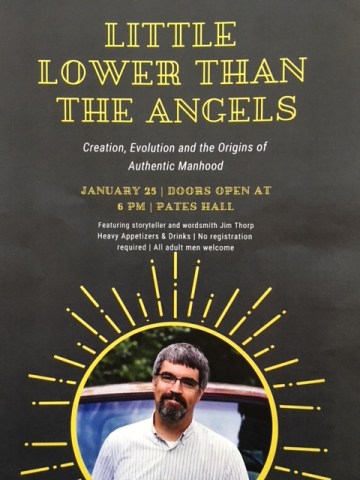
Men’s Club Speaking Gig: ‘Little Lower Than the Angels’

IMG_0716Late last month I was invited to speak to the Men’s Club at Our Lady of Peace Catholic Church in South Minneapolis, where our former associate pastor at St. Michael, Fr. Joah Ellis, is now pastor.

The event was an annual lecture they have called Decuria Schola; the talk was titled “Little Lower Than the Angels: Creation, Evolution, and the Origins of Authentic Manhood.”

If you have time, the video is below—it’s not much to watch, but take a listen and let me know your thoughts.


Mass Hospitality: Welcoming Strangers to Worship

Not long ago, our pastor implemented the practice of having parishioners stand and greet those around them just before Mass begins. Predictably, the reaction was split: Some people like it as a small gesture of warmth, welcome and connection, while others think it’s unnecessary, corny or even disruptive to their preparations to worship God in the Divine Liturgy.

What struck me most among the reactions, however, was something I saw on social media: That standing and saying good morning to each other before Mass is fake in some sense and doesn’t make us more welcoming. This observation bothered me enough that I set out to determine why. Here’s what I discovered in my own heart.

* * * * *

For several years now, Fr. Richards has challenged us to intentionally seek out and introduce ourselves to people we don’t know in the parish, especially people who appear to be new to the community or otherwise disconnected. I have never taken this challenge seriously. Instead, I have a list of rationalizations, excuses and cop-outs that will show up rather poorly when I have to explain them to Jesus. These are just a few: Continue reading

Second Coming?

Sometimes at the end of a long day, or after hearing a particularly depressing news story, I catch myself shaking my head and wishing Jesus would just come back already. Of course, I recognize that I am not the saint I am called to be—but I continue to turn and turn and turn again back to God, to beg for His pardon and His strength to do better day by day, and I have great hope in His mercy and His desire for me. So in these moments of sorrow over our tilted world and broken hearts, I find myself longing for His return.

Then last night, at a meeting of the Stewardship Council, we watched a short video from Bishop Robert Barron on our mission as disciples and evangelists. I encourage you to take a few minutes to open your hearts to what God may want to tell you, then watch it yourselves.

About two-thirds of the way through the video, a strange thought struck me: What if we are the Second Coming? Think about it: As the Church, we are the Body of Christ in the world—the only hands and feet, the only eyes and ears, the only heart He has in this world. What if, while I am watching the world and waiting for Jesus to return, He is watching and waiting for me?

This morning’s gospel reading contained these words of Jesus:

“Who, then, is the faithful and prudent steward whom the master will put in charge of his servants to distribute the food allowance at the proper time? Blessed is that servant whom his master on arrival finds doing so.” – Luke 12:42-43

We are called to act on the master’s behalf, to bring Christ—to be Christ—to a waiting world. When I wonder, “What’s keeping Him?”—might He not ask the same of me?