Given Name

To the victor I shall give some of the hidden manna; I shall also give a white amulet upon which is inscribed a new name, which no one knows except the one who receives it.

Revelation 2:17

On Monday evening, something unusual happened—something unique in my experience, though the tradition extends back to the Book of Genesis: My son received a new name.

Our second son, whom we named Gabriel Venjohn Thorp, is discerning religious life with the Community of Franciscan Friars of the Renewal (CFRs). After spending the past year as postulants at St. Joseph’s Friary in Harlem, he and five other young men entered the novitiate Monday at Most Blessed Sacrament Friary in Newark, New Jersey. As novices, they received their habits—the gray hooded robe and cincture of the friars—and their new names. Our son is now Brother Jude Apostoli, of St. Michael.

In my line of work, you might call this a brand refresh: new name, new packaging, same great mission—serving as a living witness and example of the love of Christ.

Continue reading

Book Backlog: Three Diverse Reads

For a host of reasons, I’ve not been doing as much personal writing in recent years. I won’t promise that’s going to change yet, but I’m going to make a start, at least, with short “reviews” of three very different books I’ve read in the last year: a chance spiritual read called Beautiful Outlaw by John Eldridge; Cannery Row, a great short novel by John Steinbeck; and Shantyboat, a non-fiction account of a married couple’s journey from Ohio to New Orleans in a homemade driftboat in the 1940s, by artist and writer Harlan Hubbard.

Continue reading

So What’s Your Plan?

In April, Jodi, Lily, and I spent a few days at St. Joseph Friary in Harlem with our second son Gabriel and the Franciscan Friars of the Renewal (CFRs). Gabe is discerning religious life, and the visit was meant to help us better understand the life of the friars, his formation during the past year, and the novitiate—a period of more intensive prayer, spiritual growth, and detachment—in the year ahead.

One of the unexpected joys of the long weekend was a visit from Father Columba Jordan, who was passing through New York on his way home to Ireland. Some of you may know Father Columba from his YouTube channel, Called to More: lean and gray-haired, close-clipped and bushy-bearded, an animated preacher who often delivers two homilies at once, providing a running comedic commentary on his profound reflections as they unfold. When he vested for Mass, I was excited. When he stepped forward to preach, I was thrilled.

Continue reading

Book Break: Hind’s Feet on High Places

Our second son, Gabriel, is discerning religious life with the Franciscan Friars of the Renewal (CFRs) in New York City. Not long after he left for the friary, we were talking with him on the phone and asked what we could send that would be useful and received. The friars take their vow of poverty seriously, own very little, and share what they have with others and their Harlem neighbors, so sending a care package can be a challenge.

At the time, one of his brother postulants was looking for a particular spiritual book I didn’t know, called Hind’s Feet on High Places, by Hannah Hurnard. Since we have the luxury of the internet, I found it quickly on eBay and had it shipped to our home, intending to include it in our next package. By the time it arrived, however, we spoke with Gabe again and learned they had already obtained a copy. So I slipped it into our bedroom bookshelf, amongst other books I hoped to read soon.

I opened it late in my Lenten journey this spring and began the book with some trepidation. It is very much an allegory: The main character is named Much-Afraid, who lives with her relatives, the Fearings, in the Valley of Humiliation. She is lame and deformed and regards herself as unloved and even unlovable. She is betrothed to her cousin Craven Fear, a vicious bully—and the only bright spot in her life is that she works for the Shepherd, who is loved by all who follow him and feared and avoided by all who don’t. The shepherd promises Much-Afraid that, even in her lame state, he can give her hind’s (deer’s) feet and bring her to the high places where her relatives have no power over her. But the path seems impossible and contradictory at times.

See what I mean? Very much an allegory.

In the early pages, it felt like it would be too simple and childlike to hold my attention, but instead I found it to be a carefully observed account of the path to faith, conversion, surrender, and charity. I’ve not walked that path in its entirety, mind you—but the early stages of the journey were spot on. After only a couple of chapters, I found myself shuffling along in Much-Afraid’s shoes, then watching as she proceeded further that I have ever gone, and praying to God to bring me along, too.

Continue reading

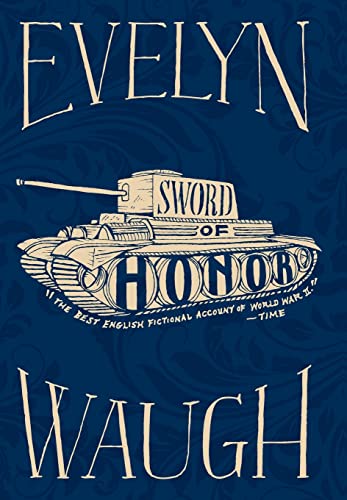
Book Break: Sword of Honor

Last month, I drove to Michigan and back on consecutive weekends. Roadtripping comes easily for me, especially with a good audiobook. During the winter, I saw an article on the Imaginative Conservative website about Evelyn Waugh’s Sword of Honor trilogy, and since I haven’t read anything by Waugh since Brideshead Revisited in 2011, it seemed like a solid choice.

In case you don’t know (I didn’t): Arthur Evelyn St. John Waugh is a British man; an author, journalist, and book reviewer; a World War II veteran; and a twice-married convert to Catholicism. Sword of Honor comprises three separate novels published in chronological order: Men at Arms (1952), Officers and Gentlemen (1955), and Unconditional Surrender (1961).

The books trace the wartime story of Guy Crouchback, the only surviving son of a once well-to-do Catholic family in England, who is floundering after his beautiful but promiscuous wife leaves him for another man (and another, and another) in the early days of World War II. Despite being older than most recruits, he joins the Army to escape his loneliness and reassert himself as a man—God willing, to do something meaningful with his life.

Continue reading