We Are a Pilgrim People

“I’ll be home for Christmas, if only in my dreams.”
 
We are on the home stretch: a week out from the blessed Feast of the Nativity, Christmas, when we celebrate the birth of our Savior, Jesus Christ. Many of us, however, feel as though Christmas has been upon us for weeks now, an immense burden of gifts, lights, music, and cheer under which we labor to breathe—like a lone elf struggling to load the loot of the world into a glossy red sleigh.
 
The first Christmas was uncomfortable for a different set of reasons. In the days prior, a newly-married couple traveled from Nazareth to Bethlehem with a few essentials and a donkey. They traveled not by choice, but by order of the emperor in Rome. They arrived not to familiar faces, food, and comfort, but to a town crowded with distant kin and strangers, and the crudest of accommodations: a dugout-stable-turned-makeshift-nursery where the woman would give birth to a son.

It turned into celebration of sorts, I suppose, as angels summoned shepherds from the hills to the town to greet the newborn as they were, dirt-poor and smelling of sheep. A star, too, beckoned Magi from the East, strange and majestic, in rich robes and bearing gifts too generous for the circumstances. (I wonder if Joseph might have gripped his staff a little tighter, wondering how he, his wife, and son would make it back across the dangerous country alive while carrying gold, frankincense, and myrrh.)
 
Imagine a Christmas celebration in which only your third and fourth cousins showed up, along with the local indigent population and three fabulously wealthy foreigners—and then you had a baby the basement. Perhaps the stresses of this Christmas are more manageable from this perspective.

Mary and Joseph were displaced—from Nazareth to Bethlehem for the census; from Bethlehem to Jerusalem for the presentation of Jesus at the Temple; and in exile to Egypt, to protect their son from the murderous intent of Herod. Even as a baby, “the Son of Man has nowhere to rest his head” (Matthew 8:20).
 
In LIFT this month, we are completing our study of the Mass. As an introduction to the adult and teen lesson, we are watching a short video from elementsofthecatholicmass.com on the role of parishioners in the Mass. As the video explains, the word parishioner comes from the Greek work paraoikos, meaning pilgrim—it’s the same Greek word that gives us the English word pariah, which means outcast.
 
We don’t belong here. We, like the Holy Family, are a pilgrim people, en route to our true home with God in heaven. The Church is the ship that carries us: the ark which preserves God’s people from the storms and waves that batter and drown the rest of the world.* Let us take refuge here from the maelstrom—the dizzying spin the world has put on Christmas—and draw near, instead, to Mary, Joseph, and the newborn king of kings.
 
* * * * *
*In fact, the area of the church worship space where we sit, which we commonly call the sanctuary, is technically called the nave—which comes from the Latin word for ship.

Who Reigns In Your Heart?

Put no trust in princes, in children of Adam powerless to save. 
Who breathing his last, returns to the earth; that day all his planning comes to nothing. – Psalms 146:3-4

This Sunday is the Feast of Christ the King, celebrating the authority and lordship of Jesus over all of creation and marking the end of the liturgical year. Falling just before the all-consuming holiday season and the secular New Year, this feast provides us with an opportunity to reflect on what holds mastery over our hearts before the avalanche of turkey and tinsel. And since it specifically celebrates Chris’s kingship, it takes on special relevance in the aftermath of a contentious election.

Who is this Jesus who rules over all? We are blessed to have an immense icon of Christ the King in the dome of our church. This image, called Pantocrator or “ruler of all,” depicts our glorified Lord looking down from heaven, holding the Book of Life by which we are judged (God’s justice) but with His right hand raised in blessing (God’s mercy). The three-rayed halo behind His head and Greek letters in the image identify Him simultaneously as Jesus Christ (IC XC) and as “I Am Who Am” (WON), or God Himself.

This God-man is the same Jesus who was born in a stable; who grew up a carpenter’s son; who ate with sinners and challenged authorities; who said to His followers, “This is my Body; take and eat;” who suffered humiliation and torture to die on a cross; who rose from the dead and ascended to heaven; and who sent the Holy Spirit to guide the Church in these latter years. This is the same Jesus about whom Nathanael asked, “Can anything good come from Nazareth?” (John 1:46) and Thomas said, “My Lord and My God!” (John 20:28).

We have a second icon of Christ behind the altar and tabernacle, depicted in the womb of the Blessed Virgin. Though within His mother, He does not appear as an infant or as any child we have likely ever seen. His high forehead and discerning eyes convey wisdom and judgment beyond His years. This is the same Jesus that St. Augustine calls, “ever ancient, ever new” and that dwells in the tabernacle, in the Eucharist. He is the very Word of God referenced in John’s Gospel:

In the beginning was the Word, and the Word was with God, and the Word was God. He was in the beginning with God. All things came to be through him, and without him nothing came to be. What came to be through him was life, and this life was the light of the human race; the light shines in the darkness, and the darkness has not overcome it. – John 1:1-5
What joy, what hope, what light we have when He who is the very source of all blessing sits upon the throne of our hearts—and what sorrow, what despair, what darkness we experience when we yield His seat to idols: to fallen persons or passing things that will not—cannot—sustain us.

Advent begins next weekend: four weeks of penance and preparation Christmas. As the Church year ends and we prepare to welcome the newborn King of Kings, let us ask ourselves in whom we have placed our hope and trust. What or whom have we set upon the throne of our hearts? The time is now to elevate Christ to His proper place, that all else may fall into place and peace may prevail.

And the Heavens Respond

We have no love at all except that which comes from God. All love in this world is, as Dante writes, “the Love that moves the sun and other stars.” For as St. John the Evangelist tells us, God is love; and as Moses learned, God Is Who Is—He is Being itself, in whom we live and move and have our (own) being.  From this perspective, Love is the substance of being, its essence, its purpose, its end.

What does this Love look like? It looks like us, roughly—we are made in His image. But we are, most of us, broken and sinful, so the image is distorted. Let us look to Mary, then, as the created image, and to Jesus Christ as the begotten one. Let us look at these two and ask again: What does this Love look like?

It is pure, intense, obedient. It is courageous, honest, and merciful. It is boundless, bloody, and self-sacrificing. It accomplishes the Father’s will at whatever cost to itself. It never fails.

This is the universe in which we live. This is what we are made of, and what we are made for. The very dust of this world cries out in love, for love. And the heavens respond.

Dante, or Three Things to Love About the Divine Comedy

Blogger’s Note: Several years ago, I agreed to my friend Jacqui’s challenge to read 15 Classics in 15 Weeks. I continue to press forward, this being number 13 of 15, and at this point 15 Classics in 15 Years seems quite doable…

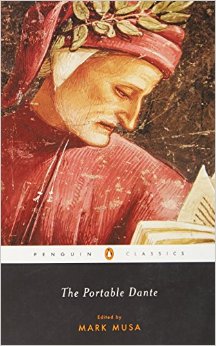
Late last week I finished reading Dante Alighieri’s Divine Comedy in its entirety for the first time. I had read excerpts for different classes over the years, and have read a little about the great work. The book itself was something of a pilgrimage through hell, purgatory, and heaven. This is my least favorite of the thirteen classics I’ve read so far as part of this challenge, and was tough sledding at times. Nevertheless, I do agree that this is a great literary work and worth the effort to complete at least once.

Without further ado, Three Things to Love about Dante’s Divine Comedy:

  • The Ambition. Dante the poet takes us on a journey through the Inferno (Hell), Purgatorio (Purgatory), and Paradisio (Heaven) with Dante the Pilgrim in order that the fictional Dante may change his ways and be saved. Each of these three journeys are told in verse, thirty-three cantos each, with each canto approximately 140 to 150 lines long. Along the way he meets ancient and more recent historical figures, who comment and prophesy on the political and religious turmoil of Dante’s time and place, along with sharing their own experience in the world and in the afterlife. The running commentary on the political machinations and rivalries in Dante’s home was the least interesting aspect of the book for me, but it is nonetheless impressive how much he weaves into this ambitious work.
  • The Creativity. The denizens of Hell and Purgatory, in particular, suffer in hundreds of ways peculiar to their specific sins and attachments. Dante’s Hell is hellish, disgusting and terrifying at times, culminating in an immense figure of Satan, not surrounded by flame, but eternally frozen in ice, suffering for his own sins. The journey through Purgatory is hopeful, but not easy, as imperfect souls labor to let go of those earthly things that weigh them down. Heaven, to me, was actually the least interesting of the three, in part due to the poet’s continued insistence that the beauty of the place was beyond his words and ability — but persevering to the end, to full union with God in the beatific vision, has its rewards. The last few cantos are lovely.
  • The Deep Belief. This, to me, is the greatest aspect of Dante’s masterpiece: the depth of theology, of faith, of true belief. Dante believes in the reality of Hell, and he puts people he loved in this world in that place of torment because of their sins. He peoples his poems with friends, contemporaries, nobles, and popes, explaining how and why each fell or rose, and when Dante the Pilgrim is asked to testify to his own faith, the lines resonate as the poet’s own sincere profession. Who knows how accurate a portrayal of the afterlife these poems are, but Dante gives us much to contemplate as we navigate this world.

I have begun number fourteen of fifteen classics, Tolstoy’s Anna Karenina, with that great opening line: “All happy families are alike; each unhappy family is unhappy in its own way.” It is a long book, but engaging— I hope to be done within the month!

Summer School

Lord, teach me to be generous. Teach me to serve you as you deserve; to give and not to count the cost, to fight and not to heed the wounds, to toil and not to seek for rest,to labor and not to ask for reward, save that of knowing that I do your will. 
– St. Ignatius of Loyola

This has been the shortest summer of my life.

I realize that speaking about summer in the past tense is part of my problem. But this summer, in particular, has emphasized how brief our time in this world actually is.

It has been a summer of firsts and lasts. Our first child graduated high school, so after his last wrestling banquet, prom, and awards night (and his first trip to the doctor for stitches), we attended our first graduation and registered for classes at the University of Mary for the first time. My own age doesn’t bother me much, but Brendan’s does—I can’t figure out how he could be leaving for college when I’m only just out of college myself.

June and July were relentless, planning and preparing for events at church and on the home front. On July 23, Gabe and I left for Poland with a group from three area parishes to join 2.2 million other pilgrims in Kraków for World Youth Day. It was a beautiful, faith-filled, overcrowded, and exhausting trip, packed with numerous graces and more than a few trials. We returned on Wednesday, August 3, to a house full of guests getting ready for Brendan’s grad party/college send-off on Saturday. On Sunday Jodi and I had our marriage blessed with a number of friends unknown to us when we got hitched 20 years ago, then went home to clean up from the party before Vacation Bible School, which started Monday.

Finally, on Thursday of VBS week, I left with Brendan for the Jesuit Retreat House in Demontreville. After the noise and chaos of the previous few weeks, three days of silence and reflection alongside my soon-to-be college-bound son seemed just what I needed.

On Thursday night, one of the priests advised us to pray specifically for whatever grace we hoped to gain from the retreat. Here I made a mistake: I had been anticipating rest and recuperation, but in that moment, my soul blurted out, “Intimacy with you, Jesus—I want to be close to you!”

I went to bed Thursday night expecting to sleep soundly and long for the first time in weeks. Instead I tossed and turned and woke multiple times, stiff and store and thirsty. In the wee hours of the morning, as the sky began to pale, a single verse from the Gospel of Matthew took root in my head: “Foxes have dens and birds of the sky have nests, but the Son of Man has nowhere to rest his head” (Matthew 8:20).

My eyes opened. I had prayed for intimacy with Christ and had been given the smallest taste: I was lying awake, exhausted, aching, and alone, with no one to talk with but my God. I prayed. I gave thanks for this new perspective. I slept peacefully, if briefly, until the sun rose.

This lesson—that intimacy with Jesus brings both suffering and peace—is not particularly profound, but it is important. Like a child, I had desired the benefits of heaven and God’s love without considering deeply what might be required of me. I think we do this often. Heaven sounds great if admission is free.

The retreat master offered another lesson, throughout the weekend. He told us to remember that the Holy Spirit is the Consoler: God does not motivate through discouragement, but encouragement. He wants us to take heart, not lose heart—and if He gives us a rock, it’s to build, not to bloody ourselves. Whether we seek intimacy with Jesus or not, things will change, people will come and go, time will fly, death will come. But with Christ, we can take heart: He has walked this road before, and it leads home.

O Jesus, our life here is short, and we cannot save time, but only spend it. Help me not to hoard the blessings I’ve been given, but to share them, and to pour myself out completely in union with you. Amen.