Unbroken

Blogger’s Note: There are both book and movie spoilers below. You have been warned.

We finally saw Unbroken last week. The book version of the story — Laura Hillenbrand’s 2010 biography of Olympic athlete and WWII veteran Louis Zamperini — is a spell-binding, white-knuckled page-turner. It’s well researched, lovingly crafted, and unflinching in its portrayal of the danger and brutality endured by Zamperini and his comrades during 47 days adrift in a life raft after their plane crashes into the Pacific and two and a half years in Japanese prison camps.

I know many people now, men and women alike, who have read this book, and every single one has loved it. When I finished it, I told Jodi this man had four or five movies worth of material happen to him in his lifetime, and I blogged that “the fact that all of them really happened to one man is almost too much to be believed.

Zamperini died just this past summer at age 97. When I heard the news on the radio, I choked up. What an amazing man.


Perhaps it was too much to expect a single film could carry the weight of Zamperini’s story alone. I liked it well enough, I suppose, primarily because it reminded me of the book — but unlike the book, it had no lasting impact for me. I’ve heard both critics and friends offer two reasons for this (Note: Spoiler alert!):

  • Some have said that it’s overly sanitized — that a PG-13 version of an R-rated book simply can’t convey the horrors experienced by Japan’s POWs. Some have suggested that it’s a “Golden Age of Hollywood” sort of movie, well done but too beautiful, without the real grit we’ve come to expect in newer war movies.
  • Others blame director Angelina Jolie for leaving out the book’s final act, which showed both the dreadful toll Zamperini’s years in captivity took on his mental and emotional health, and the path to forgiveness and healing he found in Jesus Christ.
Although I remain disappointed with the pat ending, which relegates Zamperini’s conversion story and personal forgiveness of his captors to an end note, I’m closer in opinion to the “overly sanitized” argument. Don’t get me wrong: I’m glad that teens may get the chance to see this movie and learn about the man — and the violence is plenty real. What’s missing, from my perspective, is the moment-to-moment tension and suspense of the book: the arbitrary, madness-inducing, constant fear of violence and death that make Zamperini’s survival and redemption so incredible and uplifting. 

For example, in the film, when Louie and his two companions are adrift on the Pacific, they are hungry, thirsty, sunburnt, circled and attacked by sharks, and strafed by Japanese warplanes, just like in the book…except that in the book, these dangers weighed on the men constantly. While the movie plays up a single shark attack for a scare moment, the book portrays the sharks as an ever-present fear, constantly testing the integrity of the raft and the resolve of the men. In the book, the rubber life raft is shot full of holes more than once, and pumping and patching to stay afloat and alive is steady work. In the book, faced with malnutrition, disease, parasites, and torture, the POWs are constantly struggling to stay healthy enough to endure daily hard labor — and the “victories” that Louie wins over his antagonizer, the Bird, are moral victories only, and fleeting. He wakes the next morning with new injuries and new challenges, still malnourished and still under the Bird’s oppressive thumb.
Of course, great books are rarely matched by the films based on them — but if a magical, whimsical book like The Hobbit can be expanded into three dark and swarming action movies of three hours a piece, perhaps we could have given a little more time to Zamperini. The TV miniseries (think Roots or Lonesome Dove) seems to be a fading form — perhaps that would have been a better choice for Unbroken?
What’s Keeping You?

It’s been nearly eight months since I left the University of Minnesota to work full-time for our parish. At some point in each of my previous jobs, I looked around and asked myself, “Jim, what are you doing here?” Thankfully that has yet to happen since I joined the church staff, but I don’t doubt that it could—work is work, after all.

Faith is work, too. It’s hard sometimes to believe in a good God with so much wickedness in the world, including within the Church. It’s hard to do the right thing when so few people agree on what the right thing is, even within the Church. It’s hard to pray or read or learn more about Jesus, to drag ourselves to Confession, or to haul the family to Mass each Sunday when so many Catholics just…don’t.

I’ll bet at least once you’ve sat in church, looked at Father and the people gathered around you, and asked, “What am I doing here?” It’s a worthwhile question to consider. According to data collected by the Pew Research Center, not only do most U.S. Catholics say they attend Mass once a month or less, but many disagree with the Church’s fundamental teachings regarding marriage, contraception, and the sanctity of life. Yet they persist in calling themselves Catholic. What’s keeping them in the Church?

Well, what’s keeping you? Is it habit or family tradition that brings us here week after week? That makes us seek the sacraments for our children? Is it a hope we hold out for the next generation, even though we may have lost it for our own? Is it a hollow ache in our chest that insists there must be something more to this life? Or is it the peace that radiates from altar, the tabernacle, the Eucharist—peace the world cannot provide?

This month the adults in our LIFT classes focused on the Mass and Holy Communion. We heard the deeply personal testimony of one of our youth ministry volunteers on her own struggles with her Catholic faith—and ultimately, on how she could never turn her back on the Real Presence of Christ in the Eucharist. Jesus said, “This is my body…This is the cup of my blood”—and so it is. Jesus is God, and God’s words are the very words of Creation. They bring about exactly what they say.

I’ve said more than once that if we as Catholics truly understood who was present in the tabernacle, nothing could keep us from Him. We would fill the pews to overflowing, bring family and friends to a personal encounter with Jesus. We would gladly sacrifice to spend time at His feet, listening to Him, learning from Him, serving Him.

And yet I don’t do these things. We don’t do these things.

The red lamp above the tabernacle signifies that He’s always there. What’s keeping you?

Blogger’s Note: This article appears in the Sunday, Jan. 25, church bulletin .

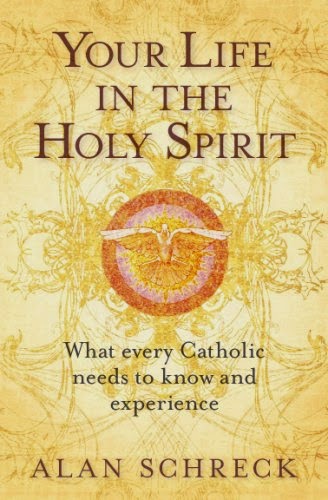
Book Break: Your Life In the Holy Spirit

Blogger’s Note: I reserve the right to re-read this book and revise this review as what I’ve read continues to sink in. I wanted to write about it soon, but honestly, my head is spinning!

If you’re like most Catholics, the concept of the Holy Trinity — three persons; one God — is one of the mysteries of our faith that is most difficult to grasp. The best explanation I’ve heard uses marriage to teach us about the Trinity, and vice versa:

  • God is a loving communion of persons.
  • Just as God the Father loves God the Son, and God the Son reflects that love back to God the Father, so to with husbands and wives: the two are united in love so completely they are inseparable and become one person.
  • Just as that shared love between husband and wife can become so powerful, life-giving, and tangible that it results in a new person and is given a name, the shared love between God the Father and God the Son is so abundant and powerfully life-giving that it takes on a life of its own and becomes a third person, God the Holy Spirit — who, in the Nicene Creed each Sunday, we call “the Lord, the Giver of Life.”

This explanation helps me to conceive of the Three-In-One, but the ability to relate to the Holy Spirit as a person remains elusive to me. I recently found up a copy of Alan Schreck’s Your Life in the Holy Spirit and decided to read it, in hopes that it would relieve this difficulty and help my devotion to the Holy Spirit as a person, rather than some mysterious force that helps me understand the Father and the Son. Schreck is a theology professor at Franciscan University of Steubenville and a contributor to Catholic Answers — so he seems like a good source on the topic.

Continue reading

LIFT Links: Family Faith Formation Through Sacramental Living

If we want to raise Catholic children and keep them that way, it’s important that we aren’t just going through the motions. This week, how about a few links to help us be more intentional Catholic parents who lead our children to Christ by the sacraments and example?

  • Show Your Faith, Even at Work. When I worked for the University of Minnesota, I often felt as though I were behind enemy lines. I found myself anticipating conflict and constantly wondering if I were outspoken enough about my faith. Three separate priests, on three separate occasions, gave me the same advice: It’s not about picking fights with people who feel differently — it’s about being a known, visible, practicing Catholic. If people see you living your faith, they’ll be drawn to it, and if nothing else, they’ll realize that Catholics are all “bad.” For advice and inspiration on this topic, check out “Five Ways to Show Catholic Courage at Work.”
  • Make Up Their Minds For Them. Some parents worry they are somehow hampering their children’s personal development and freedom by raising a them Catholic. The First Things article “Should Children Make Up Their Own Minds About Religion” makes the case that, no matter how you raise your child, you are shaping their reality for them, and rightly so — because they aren’t equipped to do it for themselves. It is important to give them the right framework early, that they may choose wisely when it comes time to choose for themselves.
  • Mass Is Essential! This month’s adult lessons are focused on the Mass and the Eucharist — the “source and summit” of our faith. How serious is it to miss Sunday Mass? Years ago, I went to confession with a long list of sins, including the fact that I has missed Mass while traveling. When I finished my list, the priest ignored everything but that missed Mass. “You know that the Mass and the Eucharist are meant to be an experience of the heavenly banquet here on earth, right?” he asked. I said yes. “And when you choose not to go to heaven, where do you choose to go?” I understood. God asks us to give Him one day a week — a small price to pay for our existence! For more on how to share this reality with your children, read, “Keepin’ It Real: Why Sunday Mass Is Important” on the LifeTeen website.
  • Stop Worrying and Take a Load Off. For a blessing as big as the sacrament of Confession, we sure have a lot of anxiety about it. “Should I go or not? Is my list long enough? Too long? Face-to-face or behind-the-screen? Will Father know me? Judge me?” For a great insider’s perspective on what happens in the confessional, relax and read Fr. Mike Schmitz’s article “Inside the Confessional: What Is It Like For a Priest?
…then pack up the family and head to the church. The sacraments — and the Savior — await!