Inspiration and Aspiration: Our Blessed Mother and the Apostles

inspiration – n. – the action or power of moving the intellect or emotions
aspiration – n. – a strong desire to achieve something high or great

Last month, our adult faith formation groups talked about Our Blessed Mother. The discussions were good, and the Q&A with our priests each night centered primarily around the Immaculate Conception and the fact that Mary remained sinless throughout her life.

I find Mary to be a tremendous inspiration. By saying yes to God plan and saying no to sin, she received her heavenly reward, body and soul, immediately upon leaving this world. And that simple, resolute yes changed the history of the world! Would that all of us could do the same: resolve to do God’s will, whatever the cost, and refuse to yield to temptation, however strong.

Of course, we are not immaculately conceived and full of grace — so while it can be inspiring to meditate on Mary, the crown of creation, it can be difficult (and perhaps moreso for a man) to imagine putting ourselves in her shoes and following in her footsteps.

This month, the adult groups will be talking about Saints Peter and Paul. I recently had the chance to show an Orthodox priest and iconographer the great Eastern-style icons in our sanctuary, and I asked why Paul was portrayed in the dome with the other 11 original apostles. He replied that in the Eastern tradition, Peter and Paul always go together: the weak one who denied Christ and became the Rock, and the proud one who persecuted the church and became the great evangelist to the Gentiles. Both men prove that it doesn’t matter who or where we are, what we do, or how much we stray — when at last we are ready to turn to God, He is right there beside us.

The apostles are great examples of the wondrous creations God can make with broken pieces like you and me. With all their imperfections, St. Peter and St. Paul call us to holiness and to persevere in faith — and because they stumbled along the way, they make the path to heaven seem navigable.

LIFT Links: Resources for “Practicing” Catholics

We are all practicing”Catholics – learning how to live our baptism, our vocation, and a sacramental life here on earth. In an effort to help friends find great Catholic content that supports them in their practice, periodically I’ll be sharing articles, websites, books, and other resources that may be of interest.

As the first installment of this series of posts, I want to share two resources – one for Catholic parents, and two specifically for Catholic men, who are arguably the linchpin in sustaining strong Catholic families. (Moms do so much, but it’s hard to do it alone!)

For Catholic parents:

  • Quick Read: Five Ways Parents Can Engage Children in the Faith. A parishioner and friend shared this great, brief article from Fr. Ed Broom on CatholicExchange.com, highlighting several easy things we can do as parents to lead our children to heaven. The tips on how to acknowledge the Real Presence of Christ in the Mass and the Eucharist are particularly important: remember, our kids can tell if we’re just going through the motions.

For Catholic men:

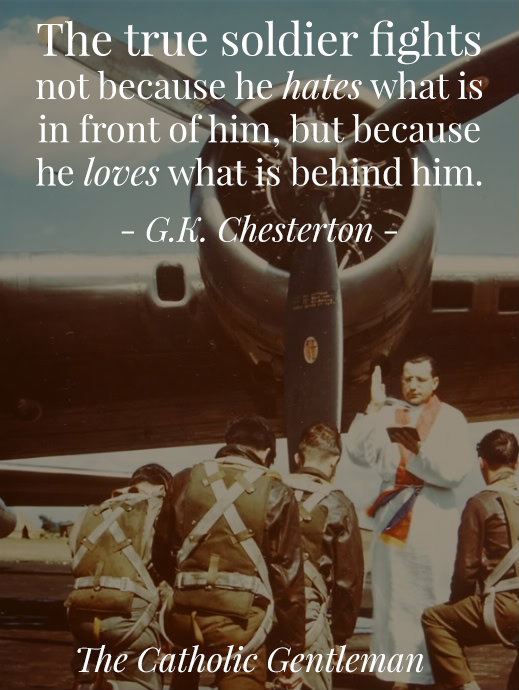
  • Manly Inspiration: The Catholic Gentleman. With solid articles, great photos, and timely topics like “The Thrill of the Chase: Prayers and a Patron for a Virtuous Hunt,” the website The Catholic Gentleman is a great place to go for a regular dose of manly inspiration for teens on up. If you are on Facebook, “like” The Catholic Gentleman for daily encouragement like the image at the right.
  • Strength In Numbers: Catholic Man Night. Catholic Man Night got its start right here in our neck of the woods in 2010, providing men with opportunities to come together to pray, eat, and get to know Jesus Christ. The website alone is full of great information, links, and resources, but the real opportunity for growth here is to attend an upcoming Catholic Man Night in person. We regularly host these events at St. Michael, so keep your eyes peeled for the next one and join us!

Same Blog; New Purpose: Learning From Life In “The Bubble”

Blogger’s Note: The article below will appear in the Sunday, Oct. 26, church bulletin .

Last Sunday, my wife Jodi and I once again experienced the deep faith, honest fellowship, and resounding joy that attracted us to this parish when we moved here in 2003. We began the day with 8:30 Mass and breakfast with our family, then met three other couples for lunch and a book study/discussion about raising Catholic kids. We returned home in mid-afternoon, then loaded the family in the minivan to visit another family here in the community. A lasagna dinner, great conversation, and family games rounded out the evening. We were on the go from the time the alarm sounded, but ended the day rejuvenated.

That’s why life in “The Bubble” of St. Michael’s and St. Albert’s parishes is so appealing to us. Here, we are surrounded by families who can related to our struggles and our goals, culminating (we hope) in eternity in heaven. We feel at home here, secure, and at least somewhat sheltered from the storms of the outside world. 

It is right and good that we should feel this way. Church is meant to be community. This is why, in our first month of LIFT classes this year, we tried to emphasize the importance of getting comfortable with the people around you, with praying and sharing together. It’s why our sacramental programs involve parent meetings, peer discussions, and group activities, and why, in general, we try to draw families in to our programs rather than simply letting folks “go it alone.”

We aren’t meant to be alone. We are adopted sons and daughters of our Heavenly Father, and we are called to be family. 

To that end, I hope to share more of myself and my family with all of you, as well as ideas and resources for sharing our Catholic faith among your own friends and family, on the Faith Formation page of the parish website and through my blog at archangelstomp.blogspot.com. I’ve been writing on this site on and off for years now, but with Father’s blessing, I’m refocusing my efforts around this new role in the parish, as well as the challenges of being a good Catholic husband and father.

It is important to note that life in The Bubble can also lure us to stagnation. We can become so comfortable with our lives here, so secure in the like-mindedness of our friends and community, that we can be tempted to circle the wagons and watch the world burn. We sometimes forget our mission to win souls for Christ and become inwardly focused, seeking to preserve what is dear to us here on earth rather than spend ourselves and all we have for God. It can seem like an appealing thought – but anyone who has ever blown soap bubbles as a child knows what happens when a bubble in motion comes to rest. It glistens briefly, shudders, and POP!…it vanishes.

We are many parts, but one body in Christ—and when all the parts pull together, the body is strong, and can do the work it’s called to do. Blessed Mother, pray that your children learn to share with each other, care for each other, and work well together for the Kingdom of God. Amen.

Past posts on The Bubble:

Are We Scapegoating the Most Vulnerable Among Us?

This past month, the adults in our parish faith formation program discussed Lesson 4 from Fr. Barron’s Catholicism DVD series, “Our Tainted Nature’s Solitary Boast: Mary, the Mother of God.” One of the consistent bits of feedback we heard when we started this video series last year is that sometimes Fr. Barron gets a little academic for the average lay audience — and as a result, the material and discussion questions sometimes miss the mark when it comes to generating discussion. In the case of the lesson on Mary, even the title warranted translation.

I watched most of the Mary video at least six times over the course of the past few weeks, and one part, in particular, stuck out to me as academic and not very applicable to the lives of most Catholics — until I thought about it in a new light.

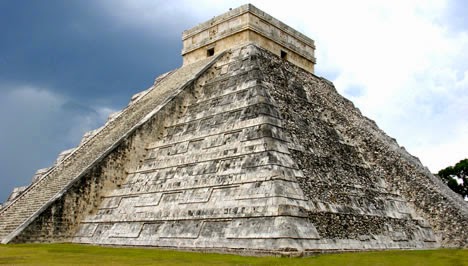
When Fr. Barron discusses Our Lady of Guadalupe and the impact her appearance to St. Juan Diego made on Mexico, he references a two key facts:

  • The fact is that within 10 years, almost the entire nation converted to Christianity — nine million souls, or roughly 3,000 people a day, every day, for decade turned to Christ.
  • With that conversion, the culture changed fundamentally, and the practice of human sacrifice to appease the gods was eliminated completely.
Then Fr. Barron goes on a brief tangent, discussing philosopher Rene Girard’s cultural theory of the scapegoat mechanism. Briefly, Girard suggests that a dynamic underlies our cultural, social, and personal relationships that serves to restore order during periods of violence or social upheaval by assigning responsibility to a particular victim or victims. The victim is punished, cast out, or killed — and in doing this the society will find itself renewed and unified in common understanding and common purpose.


We see this idea in literature, like the gut-wrenching short story “The Lottery;” in our modern history of wars and genocides; and of course, laid bare in Christ’s crucifixion and in Caiaphas, “who counseled the Jews that it was better that one man should die rather than the people (John 18:14).” Even so, I struggled to relate this theory to our lives today, until I asked myself specifically, “Who do we sacrifice today, and what underlying tension are we trying to resolve?”

It seems to me that we today sacrifice the most vulnerable among us: the unborn, the disabled, the ill, and the dying. If that’s true, to what end do we sacrifice them? 

First, let me say that most people never decide to abort a child or to assist someone in ending their lives — nor would I suggest that those who do aren’t at the end of their ropes and genuinely desperate (though, from a Catholic standpoint, they are sadly misguided). But many of us — even many who consider themselves to be good Catholics — are willing to permit the sacrifice of the vulnerable, at least in some cases. 

Why? I would argue it’s so that we won’t have to suffer with with them.

Let’s face it: most Americans (myself included) have no concept of the way much of the rest of the world lives. Most of us have no stomach for suffering, poverty, or pain. So our society allows human sacrifice and calls it mercy. We do it for the “health of the mother,” or of society, or of the planet. We tell ourselves that we have limited resources, and it’s irresponsible to lavish them on one person, one family, or one nation (never mind that many larger families get by on less, not more, than their small-family peers). Like Caiaphas, we advocate a definite “smaller” evil to avoid an indefinite “bigger” evil. We end their suffering and ours, not by giving of ourselves or sacrificing our present to make a better shared future, but by sacrificing their future — their very lives — so that we may enjoy our present.

This really hit home for me during the recent Life Chain event. Scores of people stood along Hwy 19 between St. Michael and Albertville, holding signs and praying silently for an end to abortion — and for the courage and will to do what is necessary to bring about that peaceful end. It is an uncomfortable experience to stand, exposed and silent, for an hour, confronting one’s neighbors with the evil we permit to occur so that we may live comfortably — but even moreso, perhaps, for the passersby. One young man slowed his car in the lane nearest me, looked hard into my eyes, and pumped his thick middle finger at me — watching me over his shoulder as he passed, for emphasis. I prayed him over the hill and out of sight.

Why so much anger? Because the natural fruit of evil is guilt, suffering, and death. It’s easy to allow death in the abstract, but to be confronted with it, not in anger but in charity, hurts.

Blessed Mother, pray for us, that by your example we will say yes to God, whatever the cost, and that we may suffer well ourselves so that the vulnerable may be spared. Amen.
Book Break, Feast of the Archangels Edition: Tobit’s Dog

For those of you who recall our wedding (or those who have heard Jodi and me speak at the engaged couples retreats around these parts), you may remember that the only detail I was specific about in the ceremony was the Old Testament reading, from the Book of Tobit, Chapter 8, verses 4-8. The back story, about the faithful but afflicted Tobit, his son Tobiah, a long-lost kinsman, and a cursed young bride, is retold in the novel Tobit’s Dog by Michael N. Richard.

Richard re-sets this ancient story as a mystery of sorts, set in the rural South during the Depression, and opens with a vignette of the titular canine visiting a local dump with his master, who is looking for discarded furniture to repair and sell. The dog is torn between the lure of his senses and the love of his master, but ultimately, chooses to follow and obey and is rewarded for it. It’s a compelling analogy to our relationship with God — but I was nervous: if the entire book were written in this way, it could be heavy-handed.

Thankfully, it isn’t. Instead, the opening scene sets the theme for the rest of the book, in which all of the major characters are conflicted in some way and are either moving toward their Master or further away.

Though the story is told in an easy and often humorous style, the subject matter is dark — the apparent mutilation and lynching of a teenage boy, rape and racism, and a tragic family cycle of alcoholism and abuse all figure into the tale, as does spiritual warfare as conducted by the old man’s unusual dog and a talented and world-wise traveling musician who may be Tobit’s cousin but doesn’t seem to be from “around here.”

It is a Catholic book, featuring Catholic characters living their Catholic faith, but you don’t have to be Catholic, or even Christian, to follow the tale or enjoy it — and in fact, nearly all of the characters find themselves questioning their faith and why bad things happen to good folks. As a bonus, for those who know the Book of Tobit or the three archangels named in Scripture and celebrated today, there is a strong connection between the book and today’s feast — but that’s probably more fun to uncover after the fact. As for the novel, I recommend it highly!