Do Whatever He Tells You

Above: A Wedding in Cana: my sister Jill and her husband Rusty, married in the Wedding Church at Cana of Galilee, Tuesday, October 18, 2011. Photo courtesy of Stephen Ray, their pilgrimage guide, online at Catholic-Convert.com.

On the third day there was a wedding in Cana in Galilee, and the mother of Jesus was there. Jesus and his disciples were also invited to the wedding. When the wine ran short, the mother of Jesus said to him, “They have no wine.” And Jesus said to her, “Woman, how does your concern affect me? My hour has not yet come.” His mother said to the servers, “Do whatever he tells you.” Now there were six stone water jars there for Jewish ceremonial washings, each holding twenty to thirty gallons. Jesus told them, “Fill the jars with water.” So they filled them to the brim. Then he told them, “Draw some out now and take it to the headwaiter.” So they took it. And when the headwaiter tasted the water that had become wine, without knowing where it came from (although the servers who had drawn the water knew), the headwaiter called the bridegroom and said to him, “Everyone serves good wine first, and then when people have drunk freely, an inferior one; but you have kept the good wine until now.” Jesus did this as the beginning of his signs in Cana in Galilee and so revealed his glory, and his disciples began to believe in him. 

— John 2:1-11

My sister was married yesterday. I was there in spirit. I woke in the dark wee hours of Tuesday morning — 4:18 a.m. — to discover a text from Jill on my phone, sent a couple hours earlier, while I slept: “We are going to Cana right now! Won’t be long!!”
4:18 was what time? 11:18 in Jerusalem. And they were leaving Cana for lunch, according to the itinerary, so they may be there right now.
Jodi slept peacefully beside me. I lay on my back, eyes wide, and began to pray.
I learned later, via text, that at 11:18 local time, Jill and Rusty were likely walking up the aisle in the Wedding Church in Cana. For the half hour I lay awake, praying, they were promising their lives to each other. Those moments are captured in video below, courtesy of their pilgrimage guide Steve Ray at Catholic-Convert.com and FootprintsOfGodPilgrimages.com.

I wore a tux in Jill’s first wedding, a lovely outdoor ceremony on a little island in the Chippewa River in Michigan where her high-school sweetheart had grown up. We were fallen-away Catholics then — my mom, Jill, and I — and her first husband’s family was of no particular faith that I knew, so they were married by a the pastor of the Wheatland Church of Christ, who was a neighbor of my folks, in a short ecumenical service. It was a day of great joy, the start of something wonderful — though we had no idea in what way. 
Today she has two wonderful children, Kayla and Kyle, and an ex-husband who is remarried, and who by all accounts is a supportive dad and a good friend to her again. In the months that followed the breakup, she found herself seeking God, and, with Jodi’s conversion of me and Gabe’s youthful interest in the priesthood as inspiration, ultimately came back to the Catholic church. As fate (or faith) would have it, I was there in Michigan with her when she met with her priest to discuss returning to the Church and the sacraments, and having her teen and her tween baptized. I was there when, after going to Reconciliation for the first time in decades, she received the Eucharist for the first time. And when her priest told her when the baptism of the kids would be, Jill and I were amazed to realize that Jodi and I were already planning to be back in Michigan that weekend — since she had just told us that she wanted us to be their godparents. 
We were also in Michigan this past Easter when my niece and nephew made their First Communion, and Jill and Kayla were confirmed. This was my first opportunity to meet the man my sister had begun seeing during the previous year — a man with whom she was unabashedly smitten. After all she had been through, it had been strange to listen from afar as she met and fell in love with somebody new. I’ve watched a handful of female friends go through divorce, then quickly and repeatedly fall for the wrong guys, and I had to swallow hard. I don’t want to see her hurt again.

My parents, on the other hand, had met Rusty and seemed to like what they saw. That helped, especially because Dad has a knack for gauging people. Still, it was difficult to show up at Easter as the only close family member who hadn’t meant this man — and as the person (quite frankly) who was most inclined to not like him. I had my guard and filters up, but he came through clean: a genuinely nice guy who likes good music, a Catholic convert who enjoys talking about his faith, a veteran of the Navy and other life battles who loves his young son and his aging parents, and a good man who did not hesitate to say that he would gladly spend his life working hard to treat my sister right and to get her to Heaven.

They told us that weekend that they were planning to marry, although they weren’t yet engaged. Then they told us they planned to do it at the church in Cana, in the Holy Land, on a pilgrimage to learn more about their faith. We were amazed. How much more different could this possibly be from her first wedding? How far had my sister journeyed, in such a short time?

“Do whatever he tells you” — these words from Our Blessed Mother from the Gospel account of the miraculous wedding at Cana were a statement of faith in her son, that, although He insisted it was not yet his time, He would not allow a need to go unmet for God’s faithful — that  from misfortune he would work wonders in order to manifest God’s love in our lives. He did it again and again during his ministry, and again in the most profound way on the cross on Calvary.

And again yesterday, at another wedding in Cana.

Before she left, Jill told me she was thinking of ways she could have her closest family and friends with her on her wedding day: a family rosary, a lucky coin, that sort of thing. From Jodi and me and our family, she asked that I write a prayer for them to meditate upon.

I was overwhelmed. I had planned to write a letter, but the idea that I could add something substantive to this sacrament when the very location was a homily and blessing seemed like more than I could possibly deliver. I wrote a letter that said as much, then asked that, the night before their wedding or the morning of, they consider doing the following:

  • First, ask the priest to hear your confessions, that your hearts may be pure and open to God’s graces.
  • Second, read the only scripture that ever mattered to me at the time of our marriage (and the only detail of our wedding I insisted upon): Tobit 8:4-9.
  • Finally (not that the prayer of Tobiah and Sarah needs any improvement or addition), please share the following as our prayer for you both:

Father in Heaven, in your wisdom and love, You said:
“It is not good for the man to be alone.”
You made man and woman both in Your holy image,
unique in all of creation, as both spiritual and physical beings,
made for each other, as complements and co-creators, living and life-giving.

Then, in the fullness of time, you called Our Blessed Mother to bear your Son,
and St. Joseph, her husband, to raise and protect Him,
giving to our Lord and to Your people two shining stars to guide us
in holiness, obedience, fidelity, chastity, and courage
in marriage and family life.

We love you, O Lord, and we thank You for Your many blessings:
For life and love, for mercy and grace,
for Your living example of selflessness and devotion shown by Your Son, Our Lord, Jesus Christ.
We ask Your forgiveness for the times we have failed to love as You love,
and for the strength each day to forgive and to try again

O Lord, please bless my beloved and me,
that we may make a true and generous gift of self to each other and to You;
that we may be a light for each other on the pathway to heaven;
that we may be a living sign of Your love and fidelity;
and that we may be a beacon to draw others nearer to You.

This we pray with confidence in the name of Jesus Christ and through the power of the Holy Spirit. Amen.

Another friend of ours tells a story related to the biblical account of the wedding at Cana, in which we imagine ourselves as the servants, who, on the word of a wedding guest — a poor but faithful mother from Nazareth — and the orders of her son, also a guest in the house, lug six massive crocks to the city well, carrying back, on foot, more than a hundred gallons of water for who knows what purpose. As a result, they got to see Christ’s first miracle…

When I texted Jill later in the day yesterday and told her how I was with her in prayer, she agreed, and closed her reply with, “Thank you, Jim and Jodi, for leading the way…”

Sister, we were just carrying the water.
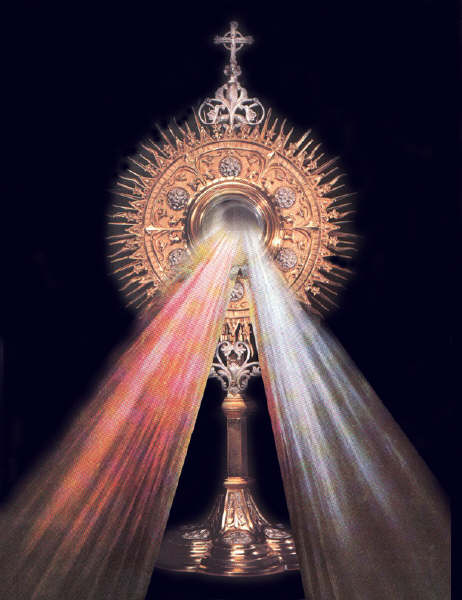
How Great Thou Art

Blogger’s Note: This popped more or less fully formed into my head after I received Communion this morning. Perhaps it’s a new prayer for our children?

Lord, make of me a monstrance,
The Eucharist as my heart,
That all may see your light in me
And know how great Thou art.

Amen.

Book Break: The Abolition of Man

I have said more than once that too often we seek to explain the hell out of everything and explain the heaven out of it in the process. This observation seems tightly intertwined with the arguments set forth in C.S. Lewis’s thin little book, The Abolition of Man. Do not judge this book by its size — the content is dense and provocative, demanding close attention. I’m sure I’ll need to read it again (and again).

The book starts innocently enough, with a critique of an English textbook of the day (the late 1930s) — then expands into a defense of objective reality and value, and the increasingly maligned notion of true right and true wrong. Lewis doesn’t suggest that we won’t continue to debate the finer points of how to live according to this universal Way (he uses The Tao as his term in the book, though he makes it clear that this is for convenience; that the Way transcends world views, creeds, and cultures); his goal is not peacemaking, but to lend credence to the idea that some things are simply worth fighting for and to illustrate the dangers of “debunking” objective values in favor of a more scientific approach to the world — an approach which, ultimately, (he said way back in 1939) would force us to sacrifice our humanity.

This relates to an idea I began to form last week, thinking about the story of the Fall in the book of Genesis: When we seek to become like gods, we become something less. Why? Because the only thing of value we have to trade for godhood is the thing that already makes us as close to God as we can ever be — our humanity. Lewis’s book, to me, was sobering and prescient.

Unfortunately, my head is still spinning, and I know I’m not doing the book justice by a mile. Perhaps a few favorite passages, then…

“As the king governs by his executive, so Reason in man must rule the mere appetites by means of the ‘spirited element’. The head rules the belly through the chest … It may even be said that it is by this middle element that man is man: for by his intellect he is mere spirit and by his appetite mere animal. … The operation of The Green Book and its kind is to produce what may be called Men without Chests. It is an outrage that they should be commonly spoken of as Intellectuals. This gives them the chance to say that he who attacks them attacks Intelligence. It is not so. They are not distinguished from other men by any unusual skill in finding truth nor any virginal ardour to pursue her. … It is not excess of thought but defect of fertile and generous emotion that marks them out. Their heads are no bigger than the ordinary: it is the atrophy of the chest beneath that makes them seem so.”

“The final stage is come when Man by eugenics, by pre-natal conditioning, and by an education and propaganda based on a perfect applied psychology, has obtained full control over himself. Human nature will be the last part of Nature to surrender to Man. … Man’s conquest of Nature turns out, in the moment of its consummation, to be Nature’s conquest of Man. Every victory we seemed to win has led us, step by step, to this conclusion. All Nature’s apparent reverses have been but tactical withdrawals. We thought we were beating her back when she was luring us on. What looked to us like hands held up in surrender was really the opening of arms to enfold us for ever. If the fully planned and conditioned world (with its Tao a mere product of the planning) comes into existence, Nature will be troubled no more by the restive species that rose in revolt against her so many millions of years ago, will be vexed no longer by its chatter of truth and mercy and beauty and happiness. Ferum victorem cepit: and if the eugenics are efficient enough there will be no second revolt, but all snug beneath the Conditioners, and the Conditioners beneath her, till the moon falls or the sun grows cold.”*

“[Y]ou cannot go on ‘explaining away’ for ever: you will find that you have explained explanation itself away. You cannot go on ‘seeing through’ things for ever. The whole point of seeing through something is to see something through it. It is good that the window should be transparent, because the street or garden beyond it is opaque. How if you saw through the garden too? It is no use trying to ‘see through’ first principles. If you see through everything, then everything is transparent. But a wholly transparent world is an invisible world. To ‘see through’ all things is the same as not to see.”

I wholeheartedly recommend this book, although it is essentially philosophy and so will vex some readers. I read the Chronicles of Narnia as a boy, enjoying them somewhat less than the Lord of the Rings trilogy, which appealed to my love of history and myth and language in a different way entirely. But I renewed my love of Lewis as my own children began to read (and watch) Narnia, and even moreso when I finally acquainted myself with Mere Christianity. Abolition came on the recommendation of a good friend and deep thinker, and it is again clear to me that I must read more by C.S. Lewis.

*Ferum victorem cepit essentially means “the conqueror is conquered,” I think.

Waugh, or Three Things to Love About Brideshead Revisited

Blogger’s Note: Four summers ago, I agreed to my friend Jacqui’s challenge to read 15 Classics in 15 Weeks. I continue to press forward, this being number 11 of 15, and at this point 15 Classics in 15 Years seems quite doable…

Evelyn Waugh’s Brideshead Revisited was the wildcard in my list of 15 classics, replacing Cormac McCarthy’s Blood Meridian on the original list. I was trying to buy all 15 books used, and couldn’t find McCarthy; one previous spring I picked up Walt Whitman’s Leaves of Grass and thought, “What the heck; I’ll read that instead.” — then my friend Fr. Tyler recommended Brideshead. He has proven to be a reliable recommender of books (especially East of Eden), so I added it to the mix.

This is not a book I would’ve chosen without recommendation. An impenetrable title by an author with whom I was not familiar (a man, as it turns out), which, as I flipped through it, skimming pages, seemed another novel about shallow, wealthy people indulging in food, wine, and art and mocking the less sophisticated and the pious. If not for Father Tyler, I might have set it aside, guessing it similar to The Picture of Dorian Gray — which it is not so much. And so…Three Things to Love About Brideshead Revisited:

  • People Change: As in Dorian Gray and The Brothers Karamazov, most of the characters in Brideshead begin as superficial, hedonistic, and not particularly likable, however, through chance and tragedy, as these characters collide and intermingle again and again, they grow deeper and more complex. This is not a story in which the weakness of characters lead them to an inescapable end. These people struggle. They learn from their mistakes (however slowly). They change over time, and emerge different people at the end.
  • The Whole is Greater Than the Sum of Its Parts: One recurring theme in the book is that of a tiny part of a man, pretending to be whole. These upper-crust Brits lead lives of leisure — they have time on their hands and passions and vices they indulge, ignoring transcendental truths, scoffing at faith and virtue and love, and pretending to live. They become artists, politicians, alcoholics, trophy wives, adulterers and mistresses, but can’t figure out to be whole or happy. How many people have we seen like that?
  • All Roads Lead Home: The deeper theme of the book, it seems to me, is that all roads lead to Truth and God — you are never so far away that you cannot get back, and although we may choose to resist, when we do not, He draws us inexorably to Him, with grace and mercy we do not merit. It is, in the end, a very hopeful book.
A side note: I have said numerous time in this journey through 15 classics that it is remarkable how timeless these books are — how the characters are relatable and the themes common to our time. I finished this book yesterday, even as I started a new book for work called Pinched: How the Great Recession Has Narrowed Out Futures & What We Can Do About It. (Sounds like a page-turner, doesn’t it?) 

Brideshead was published in 1944 and is set between the World Wars; Pinched opens with a 1914 quote from writer and journalist Walter Lippmann: “We are unsettled to the very roots of our being. There isn’t a human relation, whether of parent and child, husband and wife, worker and employer, that doesn’t move in a strange situation….There are no precedents to guide us, no wisdom that wasn’t made for a simpler age. We have changes our environment more quickly that we know how to change ourselves.”
Sound familiar? It is ironic to me that a book published just this year should open with a quote from 1914, claiming there are no precedents to guide us. We’ve been down the path of “unprecedented change” repeatedly* — apparently in 1914, for example. Waugh’s great novel, to me, insists that the wisdom “made for a simpler age” is unchanging, still relevant, and even necessary. We are simply slow to learn.

—–

*If change wasn’t unprecedented, it wouldn’t really be change, would it?

Amazing Grace of Motherhood

“I’m constantly amazed at the sheer power that women hold within their bodies. The power to create, to nurture, to grow. It’s such a mind-blowing thing. And not just once, but over and over again.” —a young female friend currently living in Central America

Something amazing happened last weekend: at long last, I felt our baby move. It’s been a long time coming; apparently, the position of the placenta is such that, even for Jodi, our little one’s movements were nearly imperceptible for most of the last several months. But even in recent days, when Jodi would say, “Jim! The baby’s moving!” her exclamation or the touch of my hand was enough to still whatever stirring had been underway.

I’ve said many times that this is my chief jealousy with regard to the opposite sex — that I’ll never feel the movement of my own child growing within me. Even with four children already born into this world, it’s still a thrill to experience this, even from the outside.

Something else amazing happened this weekend. At the St. Michael Catholic Church Fall Festival, Jodi received abundant congratulations—such is the genuine joy that this community finds in each and every baby, no matter how commonplace a miracle it seems in our little Catholic bubble—and at least twice, two grandfathers asked if they could hug her. One said he feels in awe of pregnant women, and the other, with his thumb and forefinger an inch apart, said, “I always feel about this tall around mothers.”

Their tremendous respect for women and motherhood resounds in my own heart—and calls to mind one of the traits that attracted me to my bride from the beginning: the fact that she was the first woman I had met since I started college who did not hesitate to say she wanted to be a wife and mother. Sexuality and fertility, procreation and co-creation, married love and family life are tremendous blessings, which, too often, we devalue or seek to avoid. Thank you, Jodi, for allowing God to work this miracle through you, as my young friend said, “not just once, but over and over again.” You are beautiful, strong, resilient — and we love you.

Related poems and postings: