The Adjustment Bureau

A young, popular New York City politician suffers an unexpected electoral defeat. Suddenly he finds himself face-to-face with the girl of his dreams – a strange woman he’s never met before – in an unlikely place. Their time is short, the attraction is palpable enough for a sudden, passionate kiss, interrupted by campaign staff. She exits quickly. He has only her first name and these few moments. He delivers the speech of a lifetime, and from the jaws of defeat, snatches superstardom and frontrunner status for the next open Senate seat in New York state.

In a city as vast as this, he could never find this beautiful stranger using only her first name – but chance throws them together on a city bus, and it’s clear this is something special. Too special, in fact. He was not supposed to see her again. A group of grim, dark-suited G-men snatch him from his workplace to inform him: they are with the Adjustment Bureau, and this love affair not in The Plan. Whose plan? The Chairman’s – but you know him by many names.

What follows is a fast-paced, but coherent sci-fi romance that turned out to be the perfect mix for my bride and I – with Matt Damon doing a low-key Bourne, trying to outsmart and outpace adversaries who are nearly (but not quite!) omnipotent and omnipresent, and who are bent on keeping him from what he feels sure is true love. More than once he is ripped abruptly from Emily Blunt’s life, re-finds her, and works to regain her trust, unable to tell her what’s really going on.

It’s a solid, entertaining movie, with some language and sexuality (including two instances of a word neither Jodi or I thought was permitted in PG-13 films). And it’s thought-provoking after the fact: at one point, Damon’s character asks a more sympathetic “adjuster” if they are angels. This is not an idle observation, since the underlying problem in the movie is the problem of free will versus predestination. The film proposes a world in which beings who are less limited and more powerful than humans direct the world according to a grand scheme they themselves do not entirely comprehend. From what little I’ve read, this is in close keeping with Catholic traditions and teachings about angels – except that in the film, the adjusters suggest that they function to override human free will, which, unfettered, produced the Dark Ages and the World Wars, but with their guidance (i.e., free will only with regard to small, day-to-day choices), yields peace, happiness, and productivity. (Hmm…that sounds familiar.)

I don’t believe angels, according to Catholic teachings and belief, have the option of taking free will from us. They operate more subtly and keep the world operating according to plan…but we still choose. We make our beds, and we lie in them.

In the film, the very aggressiveness and implacability of the adjusters seem to increase our hero’s resolve and drive him to his climactic decision and the film’s resolution. It’s almost as if the adjusters themselves are off-plan…and as if that, in fact, is part of the plan.
(Pro) Life, Without Religion, Part 1: It’s My Body!

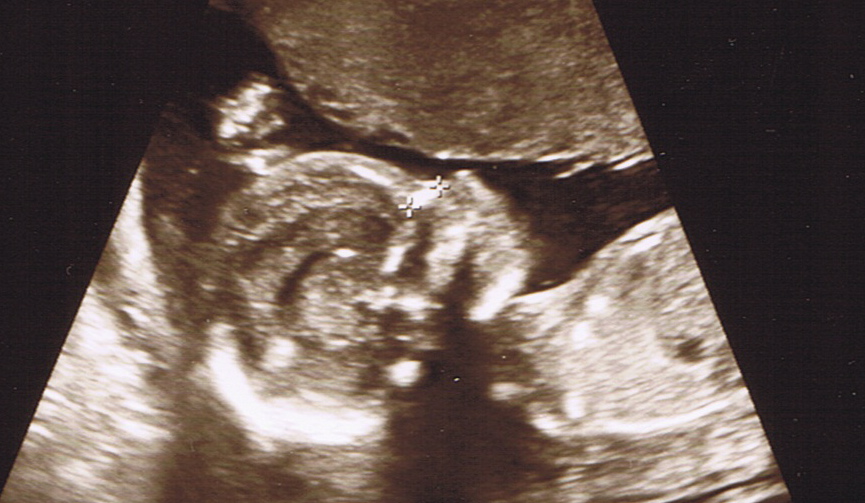
This morning Jodi and I saw the face of an angel — our angel, a tiny new Thorplet, just 11 ounces now at 18 weeks of development. Our baby pulled away from the attempts to examine his or her feet, just like all of our children, but otherwise kept uncooperatively still, making it difficult to get a good look at the tiny, chugging heart. When the sonographer was finally finished her thorough examination, she took the photo above: a tired wee child, hand above head, resting peacefully.

I’ve always loved ultrasounds. In part, it’s the geeky wannabe scientist in me, but mostly, it’s the wonder and sweet jealousy of seeing our tiny baby alive and safe inside the love of my life, and knowing that yeah, I can pee standing up, but I’ll never feel life moving within me. This was a level-2 ultrasound: given my bride’s so-called “advanced maternal age” (I wouldn’t begrudge her a right cross next time someone says that…not this time, but next time…) they offer it as a way of taking a closer look at how both the baby and the mother are progressing. We turned down all the other tests and genetic screening, but taking a closer look at our little one and Jodi, especially given the size of our babies, seemed like a good idea.

The photo above was the highlight of the hour or more we spent in a dimly lit room with the sonographer. It was worth the wait, but to be honest, I was more excited about these two images:

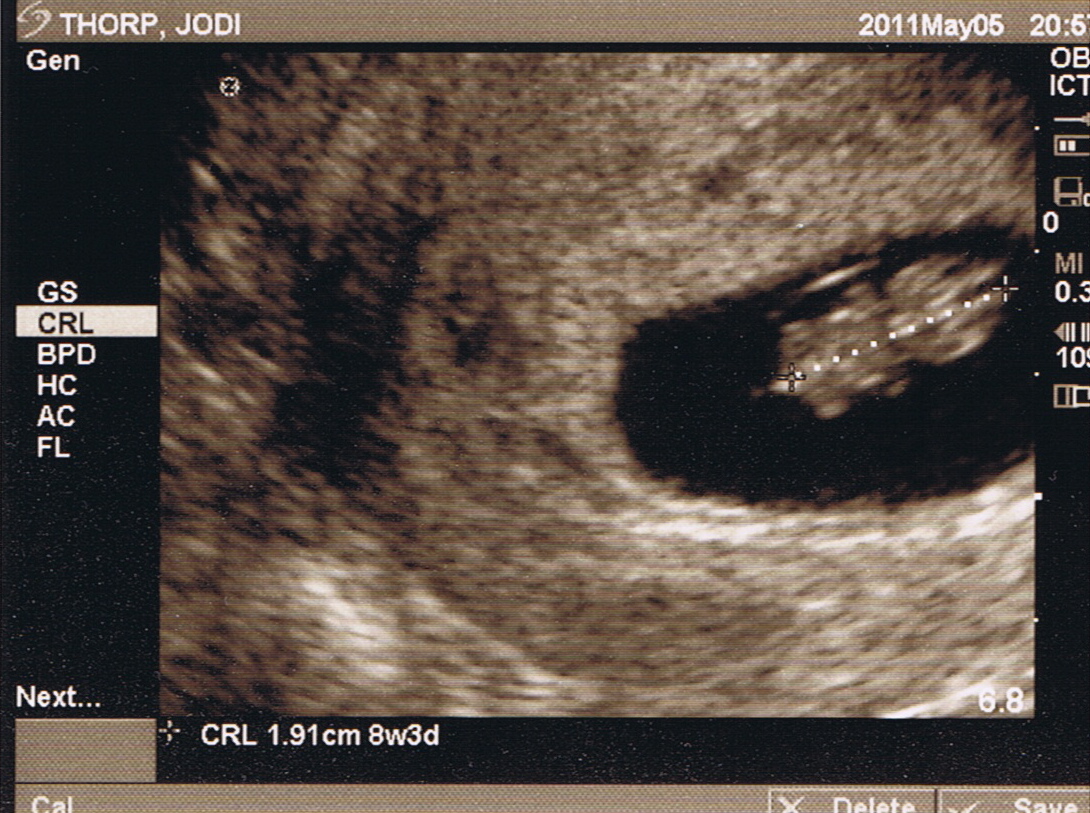
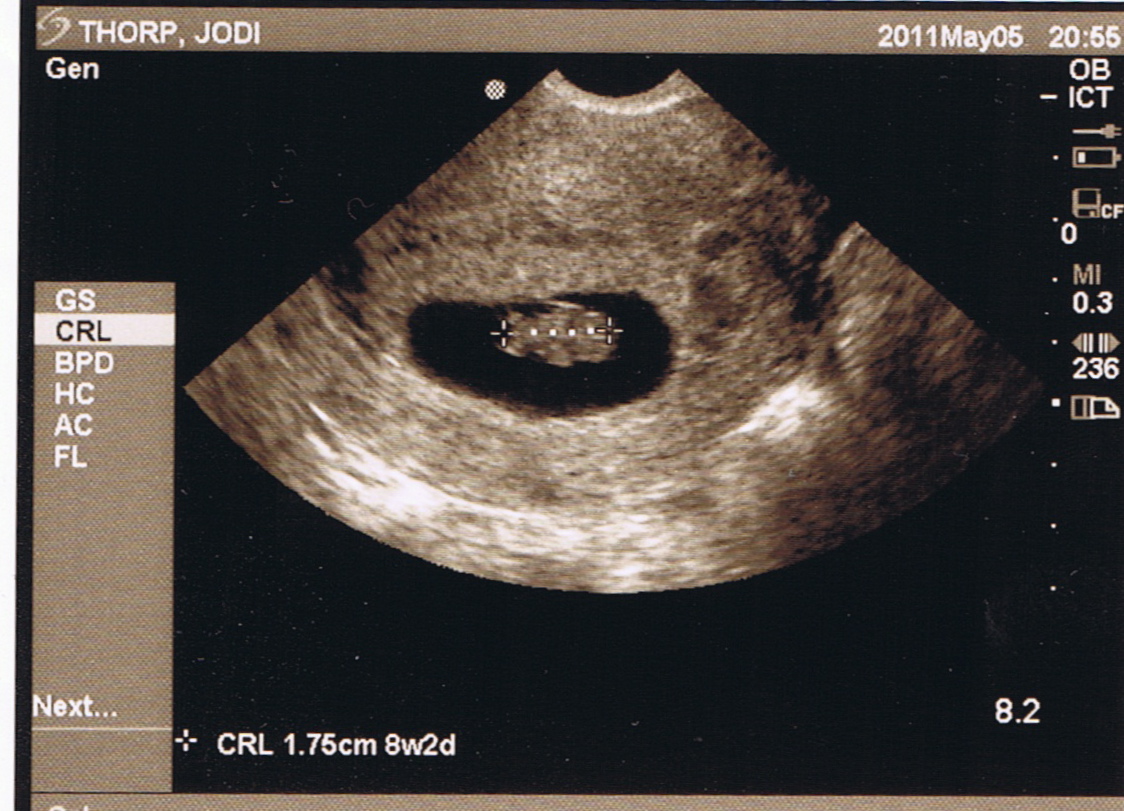
These show our baby at just eight weeks of development. We’re looking down on him or her from above, with an absolutely Thorpian head to the right, and a torso with four tiny limbs extending to the left and down in the lower image. This was a thrill, not only because we lost a little one last fall and were hoping for an “all systems go!” from our doctor, but because there on the screen was a tiny person, less than two centimeters long, with a beating heart and legs and arms that moved independently of any thought or command from Jodi or me. A child the size of my fingertip who, just before Christmas, we will be blessed to welcome and trusted to raise.

Some people say miracles are impossible; others believe they happen, but only rarely. I believe miracles happen daily, all across the world. I’ve got photographic proof.

As we drove home from the earlier ultrasound, I was reminded of an extended argument I had once, on a political blog in South Dakota, with a staunch and pseudonymed liberal who dismissed me and two of my friends as Bible-thumpers for being against abortion. I explained to him that, on the contrary, I studied physical anthropology and human evolution in college and was anti-abortion well before I became a practicing Catholic. I articulated to him a set of arguments against abortion, completely independent of religious belief or church doctrine, and asked, then begged, then dared and taunted, him to engage me on them. He would not.

What came back to me as we drove home was the first argument I offered to him. As I recall, he insisted, on behalf of women everywhere, that “It’s their body; it should be their choice.”

“Which part of their body is it?” I asked.

An abortion removes something from a woman’s body, without a doubt. If what is removed is her, or some part of her, then it should share both her gender and her genes, and she should be somehow physically diminished, something less than the whole and functional woman she was before the procedure. If she had her gallbladder removed, for instance, or a toe, a mortician or coroner might note such a thing upon her death.

A woman who has a “successful” abortion, however, emerges physically intact, but no longer pregnant. What is removed, though taken from within her, and attached to and dependent on her, is not her — not genetically, and not logically. (In my online arguments, I moved from what a fetus isn’t, step by step, to what it is, over several exchanges. In time, I think I’ll do the same here.)

This was made clear again to me when I saw our tiny infant, wriggling in amniotic bliss, at eight weeks of development. Jodi had no say in the flailing of those tiny arms and legs, and that tiny heart beat in part because of, but not for, her. No choice on her part, short of violence, could have stopped it.

And of course, it was made clear yet again today when we saw that beautiful profile at the top of this post. There’s a reason that the Knights of Columbus and other Catholic and pro-life organizations are investing in ultrasound machines for clinics and teaming with expecting mothers to show live ultrasounds of their babies to middle- and high-school students. There’s no better way to recognize the humanity of others than to see them face to face.

Strength In Weakness

A few years ago, I briefly joined the kids in studying Chen-style taijiquan — the original “tai chi,” an ancient Chinese grappling art rarely taught in the West. During a “push hands” class, I was partnered with a diminutive older woman. We stood toe-to-toe, our right hands extended and connected, back-of-wrist to back-of-wrist; I would shift my weight forward (toward her) and rotate my hand to push her hand toward her; when she could shift no further backward, she would redirect my push in a circular fashion, rotate her own wrist, and push back into me in the same fashion. We did this continuously, until our quads were burning and droplets of sweat ran down our forearms, and the longer we went on, the faster her redirect, until it felt (to me) barely controlled. I shrugged inwardly — she was a more experienced student than I — and tried to maintain a slow and steady pace.

Our instructor, Jose, approached and watched us a moment, then gently reminded her to move in a more deliberate and controlled manner. “I’m trying,” she replied, “but he’s pushing like hell!”

Jose shifted his knowing gaze to me and smiled. “I paired you with someone of a different size on purpose,” he explained. “One of the most difficult parts of taiji for men — especially large men — is learning to sense the other person and knowing their own strength, learning to be gentle. Anyone can be hard, but it’s often difficult for men to be soft.”

Jodi had told me for years that that I didn’t know my own strength and that I should be more careful when “handling” her or the kids — but this lesson drove it home. We resumed the exercise, and I tried to empty myself. I could barely feel that we were connected, which made it difficult to respond to my parter’s movements. I found I needed to be infinitely more attentive to my partner. Jose was right: It was hard to be soft.

A week or so later, I was partnered with a man closer to my own size and build, in a similar exercise, except this time the circular hand motions were more vertical in orientation, and the one whose hands were beneath the other’s was supposed to bear the weight of the other’s arms. This requires the other person to empty himself and let his weight (or at least, the weight of his arms) be carried — another act that does not come naturally to men. Both of us tested the other by periodically stopped our circles and watching the “empty” person continue to circle on their own, a sure sign that he was not truly “empty.” This time we were forced to be more attentive to ourselves.

It is easy to find the power in our strengths — to rely on our size or our natural aptitudes and bulldoze our way through the problems that confront us. This past Sunday, Fr. Mark of Our Lady of the Black Hills Catholic Church preached on the topic of meekness, in part using the definition “strength under control,” and indeed, the New Testament of the Bible is rife with the apparent paradox that we are strong in our weakness.

I’ve struggled with this concept myself and, in the past, have made my peace with it in the sense of Clint Eastwood’s line (above): “A man’s got to know his limiations.” But a few weeks back, our associate pastor at St. Michael Catholic Church, Fr. Meyers, helped my understanding in a profound new way. In a three-minute homily at a Saturday morning Mass, he said that each of us has a tendency toward one of the seven deadly sins — I believe he referred to this as our primary fault — which can also be the means of our salvation. (I’m certain I’m oversimplifying and not doing this topic justice.)

This resonated with me. I know that I struggled, early in my marriage, with lustfulness and learning to better love my bride, and I know that coming to terms with the Church’s teachings on married sexuality has transformed my marriage, my faith and family, my entire life. Despite a number of strengths as a husband, father, and man, I had a basic weakness and misunderstanding that kept me from being all I could be in all three of these areas. Not only did I come to understand my limitations, but my weakness was turned to strength.

St. Paul, in his second letter to the Corinthians (Chapter 12, verses 7-12), says:

Therefore, that I might not become too elated, 3 a thorn in the flesh was given to me, an angel of Satan, to beat me, to keep me from being too elated. Three times I begged the Lord about this, that it might leave me, but he said to me, 6 “My grace is sufficient for you, for power is made perfect in weakness.” I will rather boast most gladly of my weaknesses, in order that the power of Christ may dwell with me. Therefore, I am content with weaknesses, insults, hardships, persecutions, and constraints, for the sake of Christ; for when I am weak, then I am strong.

May we all be blessed with such a thorn, and find the strength in our weaknesses.

The Second Third, Week 34: Blessed Are the Meek

Yesterday morning, Jodi and I sat around her mother’s kitchen table with Grandma Pam, her sister, and her brother-in-law, and discussed politics, religion, and parenting. I have heard over the years that these topics are taboo to discuss in mixed company, especially with one’s in-laws, and Jodi’s brother-in-law (by his own admission) likes to stir the pot now and again. But all’s well that ends well, and when they left for home mid-morning, there were still hugs all around.

Part of the reason that it went so well may be the words of Fr. Mark’s homily on Sunday. Fr. Mark is the pastor at Our Lady of the Black Hills Catholic Church in Piedmont, S.D. He is not a big man, but his enthusiasm for his vocation, his joy in the Mass, and his genuine love of the Eucharist erupt in a loud voice that resonates to the wooden rafters of the sanctuary. He tends to gain, and keep, your attention.

On Sunday, he preached on the gospel of Matthew, chapter 11, 25-30:

At that time Jesus said in reply, “I give praise to you, Father, Lord of heaven and earth, for although you have hidden these things from the wise and the learned you have revealed them to the childlike. Yes, Father, such has been your gracious will. All things have been handed over to me by my Father. No one knows the Son except the Father, and no one knows the Father except the Son and anyone to whom the Son wishes to reveal him. Come to me, all you who labor and are burdened, and I will give you rest. Take my yoke upon you and learn from me, for I am meek and humble of heart; and you will find rest for your selves. For my yoke is easy, and my burden light.”

“Meek and humble of heart” — this from a man who would be put to death for proclaiming that he is God’s only son and the messiah, who toppled tables in the temple and drove the traders from “his father’s house” with an improvised whip of cords, who stood before the authorities unafraid and walked willingly to his doom. This is not the image of a meek man by today’s definition of the word, and in fact, the definition of meekness was the root of our discussion yesterday. Fr. Mark gave two: “not easily provoked” and “strength under control.” Afterward, Jodi’s brother-in-law said that those seemed to be reasonable definitions that worked well for the homily, but were not necessarily in keeping with the commonly accepted definition of weak, cowardly, or passive.

I’ll discuss “strength under control” in a separate post; for the purpose of this post (and the discussions at Grandma’s house), “not easily provoked” is the key. Webster’s online dictionary gives three definitions, and the first and third line up well with Father’s explanation and with Christ:

  1. Enduring injury with patience and without resentment : MILD
  2. Deficient in spirit and courage : SUBMISSIVE
  3. Not violent or strong : MODERATE

Many people do not wish to be seen as activists or evangelists, and it can be difficult to discuss one’s faith and convictions with people who have different viewpoints. It takes a deep inner strength to endeavor quietly to do right and to endure wrongs patiently, without physical or verbal violence, out of loyalty to a higher calling or greater good. The person who can do this possesses a deep inner strength and is decidedly not deficient in spirit or courage.

It is in this respect that I have re-titled and re-focused my blog this year, and that I hope, in my Second Third, to cultivate meekness in my own life, in order to facilitate civil discussions about the things that really matter with people different than myself.

The Good Life

Jodi and I were talking the other day about making peace with what we have. She’s wanted a bigger house in a nicer neighborhood with more children the age of ours; I would like a bigger vehicle (like a Suburban) and think an Airstream like my sister’s would be great fun. Instead, this winter we’ll shoehorn a fifth child into a three-bedroom, mid-80s split-level and well-used Chrysler minivan…and when we want to camp, we’ll break out the tent.

Have we settled? In some sense, I suppose – but this new baby was a mutual decision and something the entire family wants more than a new house or car. Materially, we are fine with what we have.

Some folks want the best of everything, and in a free country, they are free to pursue it. As for me personally: I want to be left alone, to pursue my own version of happiness. I want a close, loving family; a good community; the freedom to worship God in the way we see fit. I want to hunt and fish when I can, to brew beer and to bake sourdough and to accidentally blow up my garage or make myself sick in the process. And I don’t need anyone to guarantee my medical care. I don’t need state-of-the-art treatment or extraordinary measures – I need a doctor I can trust and the ability to say “when.”

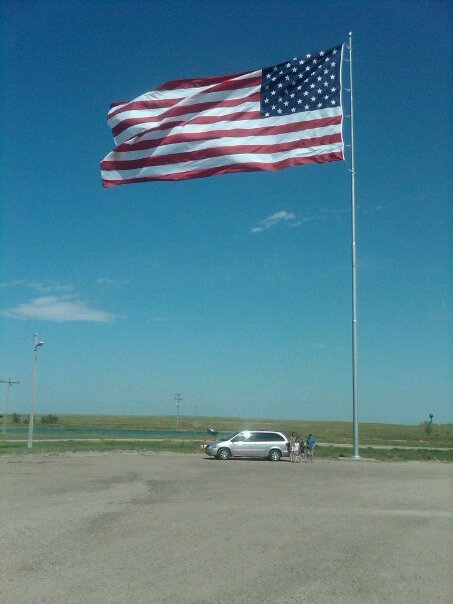
On this Independence Day, it occurs to me how blessed we are. It’s a wonderful thing to live in a country where all of these things are still possible: where Jodi and I can raise a Catholic family; choose a fifth child and not care about the gender; and do what we want with our money, our free time, and our health. It seems as though these things are at risk; that, like General Motors and AIG, our government has become both dysfunctional and “too big to fail” – and that regular folks are rapidly becoming, not the end, but the means. So today, let’s thank God that we live where we do, but recommit ourselves to the safeguarding the freedoms we celebrate – not state-run stability (which seems laughable during the current budget stalemate) but the risk and reward of happiness defined, pursued, and attained by we the people, as we see fit.