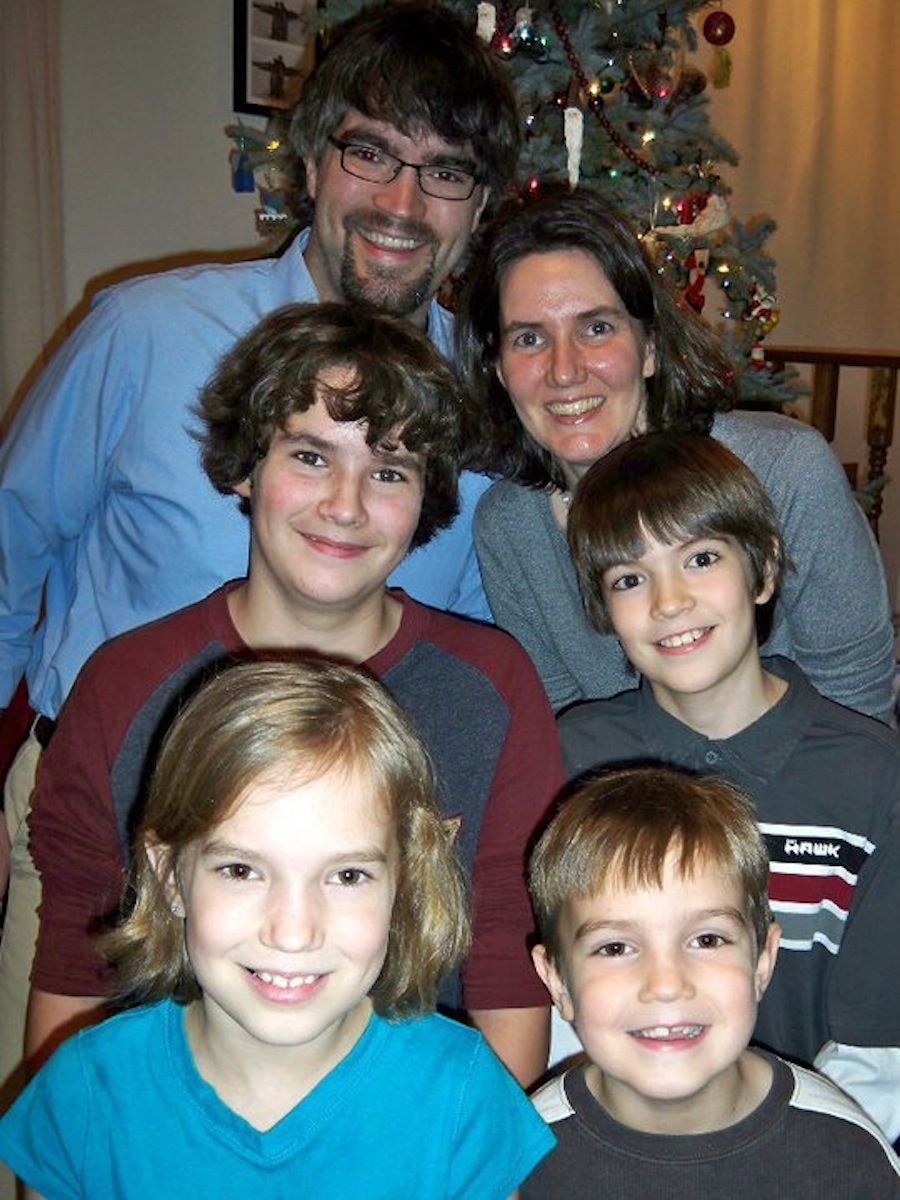
There is a paragraph from this year’s Holiday Letter that has returned to me again and again in the past few months:
“Ever wonder how God can know everything that will happen, even though we have free will and make our own decisions? St. Augustine talks about God as existing outside of time: He existed before time in any meaningful sense, so He can see all of time—past, present, and future—in an instant. But I think of life as a high sledding hill with God at the top, giving us a push. It’s left to us to steer, but like any good father, He knows our tendencies to close our eyes or overcorrect better than we do, and so He can see every curve we’ll negotiate, every bump that will bounce us airborne, every tree we’ll hit. He sees the trajectories of other sledders and knows their tendencies, as well—knows whose paths we’ll cross, for good or for ill, and when we’ll be blindsided by love. He alone has the long view, the Big Picture. We must persist with less—a glimpse of heaven through the treetops as we slip away, faster, faster…”
This seems particularly appropriate this Ash Wednesday, when we dwell a moment or two on the ephemeral nature of this life and this world: We are dust, and unto dust we shall return. In these Second Third posts, I’ve already written about being grateful for what we have and finding the sense to know when enough is enough. But today, the focus is on something a little different: In my Second Third, I hope to detach even from the “stuff” we choose to keep. I hope to turn my eyes toward heaven instead of where I am now, staring at the ground, watching my step. I hope to quit worrying about who’s in control of the sled, and enjoy the sting of snow on my cheeks, the gleam of stars passing overhead, the laughter of those I love weaving through the trees beside me, the white moon and the lonely miles. I hope to live, not hastily or extravagantly, but thoroughly — so that when I reach my third Third I have nothing left but joy to spend on anyone. Including you.
Blogger’s Note: Yes, yes…most of you know, but occasionally I get a new visitor. So in case you’re that guy or gal, the whole idea behind these “Second Third” posts can be found here.
My father’s machinist-mentor Chuck used to have a slogan hanging on the wall of his shop, and to this day, Dad continues to quote it: Old age and treachery will overcome youth and skill. As you might guess, not being particularly skillful, I spent most of my youth thoroughly overcome by the treacherous old fellow.
Dad genuinely has different abilities and interests than me — that’s part of it — not to mention vastly more experience. But as I’ve become a father myself and watched my own children gaze in wide wonder at my courage, skill, knowledge, and strength, I find things that used to be a struggle come easier to me. In this respect, life in my Second Third is vastly more enjoyable that the previous 35 years — and I believe I know why.
See, when I was a kid, I was worried about million different things: screwing up, failing, disappointing myself, letting others down, looking stupid, getting hurt, hurting someone else, you name it. As the young samurai says in The Last Samurai, “Too many mind.” I was so wound up about about everything, so lacking in self-confidence, that I couldn’t accomplish anything without a messing up. My worries were often self-fulfilling prophecies.
My friend Father Tyler made a similar observation when he turned 30 last month: “[T]he pride which so hobbled my willingness to try then has been tempered. At thirty (especially as a professed celibate) it is much easier to not give a damn about how foolish one appears.”
I am not a professed celibate, but I can relate. I’m still not graceful, not mechanically inclined, etc. — but I can do many things I never used to simply because I’m no longer so tightly wound about them. Because I’m more secure in myself than I used to be, I can work within my limitations, ask questions, and be more patient — and it pays off more often than not.* In my Second Third, many** of the things that used to stress me and hold me back simply don’t concern me anymore. And as Fr. Tyler so aptly concluded, “To not give a damn, I am coming to understand, is one of the richest graces of full-fledged adulthood.” ________
*Of course, being 6’3″ and about 240 helps, too, at least in terms of striking fear in children, and intimidation, like treachery, goes a long way in overcoming youthful prowess. And if I force it — and I do from time to time — I still fall flat.
Blogger’s Note: My Second Third post for this week is delayed tonight in favor of a movie post that is long overdue. WARNING: This could be chock full of spoilers!
In February 1993, when the movie Groundhog Day was released, February 2 was an obscure observance, and Punxsutawney Phil was an obscure rodent attraction of which I, myself, had never heard. At that time Roger Ebert gave the film credit as a somewhat thoughtful comedy, and gave it a fairly favorable rating (3 out of 4 stars on his current web site). Twelve years later, Ebert wrote a new review of the film, adding it to his growing list of Great Movies. In the 2005 review, he says, “Certainly I underrated it in my original review; I enjoyed it so easily that I was seduced into cheerful moderation. But there are a few films, and this is one of them, that burrow into our memories and become reference points. When you find yourself needing the phrase This is like “Groundhog Day” to explain how you feel, a movie has accomplished something.”
My own experience with the film was similar. The first time I saw it, I liked it well enough: I laughed throughout and remembered the premise and specific scenes particularly well. Now, for me, there aren’t a lot of comedies I’ll go back to watch again and again (unless I’m channel-surfing and happen to catch one)…but for whatever reason, Groundhog Day struck me as worth a repeat viewing. In the years since, I’ve seen it multiple times and have grown to love the movie. For a long time, I couldn’t figure out why.
Ebert’s second review catches a glimpse of the movie’s greatness. He cites an article in a British newspaper claiming that Groundhog Day is one of the most spiritual movies of all time.
A bit much? Think about it: We have a man in Bill Murray who is completely self-absorbed and cares about no one except insofar as they serve his interests. One morning he wakes up to find himself stuck: same alarm, same room, same routine, same job. One day, same as the next.
The premise is that he is literally stuck in time and space: He wakes up in the same place on same minute of the same day of the same month of the same year. But re-read the previous paragraph. Who hasn’t gone through a similar stretch in life?
He goes through stages: shock, anger, denial. Then he comes to the conclusion that he might as well make the most of it. He eats what he wants, acts how he wants, behaves outrageously. He gathers information “one day” and uses it the “next,” to seduce an attractive women, to rob an armored car. The rules don’t apply to him. He sees himself as godlike, free to do whatever he wants.
I’ve heard multiple priests and theology buffs insist that true freedom isn’t doing whatever you want. True freedom has at least some boundaries, which protect us and enable us be secure in ourselves and so to act for the good of others. True freedom is the ability to choose to do right, as best we can.
Groundhog Day hits this nail on the head. Murray’s character is not made happy by his power, his gluttony and greed, or his conquests. He is lonely, bitter, unloved, still stuck in the same rut, and increasingly desperate. Finally he tries to kill himself…only to find himself waking up in the same spot again and again. Suicide is, literally, not the answer. He slowly discovers he wants to be loved.
The movie could have wrapped itself up with a nice moralizing bow right there, but it doesn’t. He begins to try to live each “new” day rightly. He fails, and tries again. He uses what he learns about the people he encounters to help them instead of use them. At one point, he even seems to have set the bar too high, trying to live the perfect day, to do everything right, to help everyone and eliminate any trace of suffering in the little town. In this case he fails simply because that’s not how the world works. Even when he’s doing Good Work, he’s still not God.
He gets closer and closer to love, messes up, loses it, and gets up in the morning to make another run. He tries to make each tomorrow a little better than today.
Re-read the previous paragraph. Don’t know about you, but that sounds familiar to me, too.
Finally, the 2010 Thorp Family Christmas Letter is finished! It is long, yes; footnoted, of course; also bittersweet, overtly religious in places, and probably too much information. You’ve been warned; proceed accordingly…and Merry Christmas!
jude
if life is a larger, later thing, what left this perfect
child-size hole? what nameless wonder wrought
such joy, such sorrow in so short a time, unseen?
tiny saint — a soul unstained by flesh and blood,
a heart too big for a bone cage — we feel your
flutter, little one, and rejoice to know a piece
of this love has found heaven.