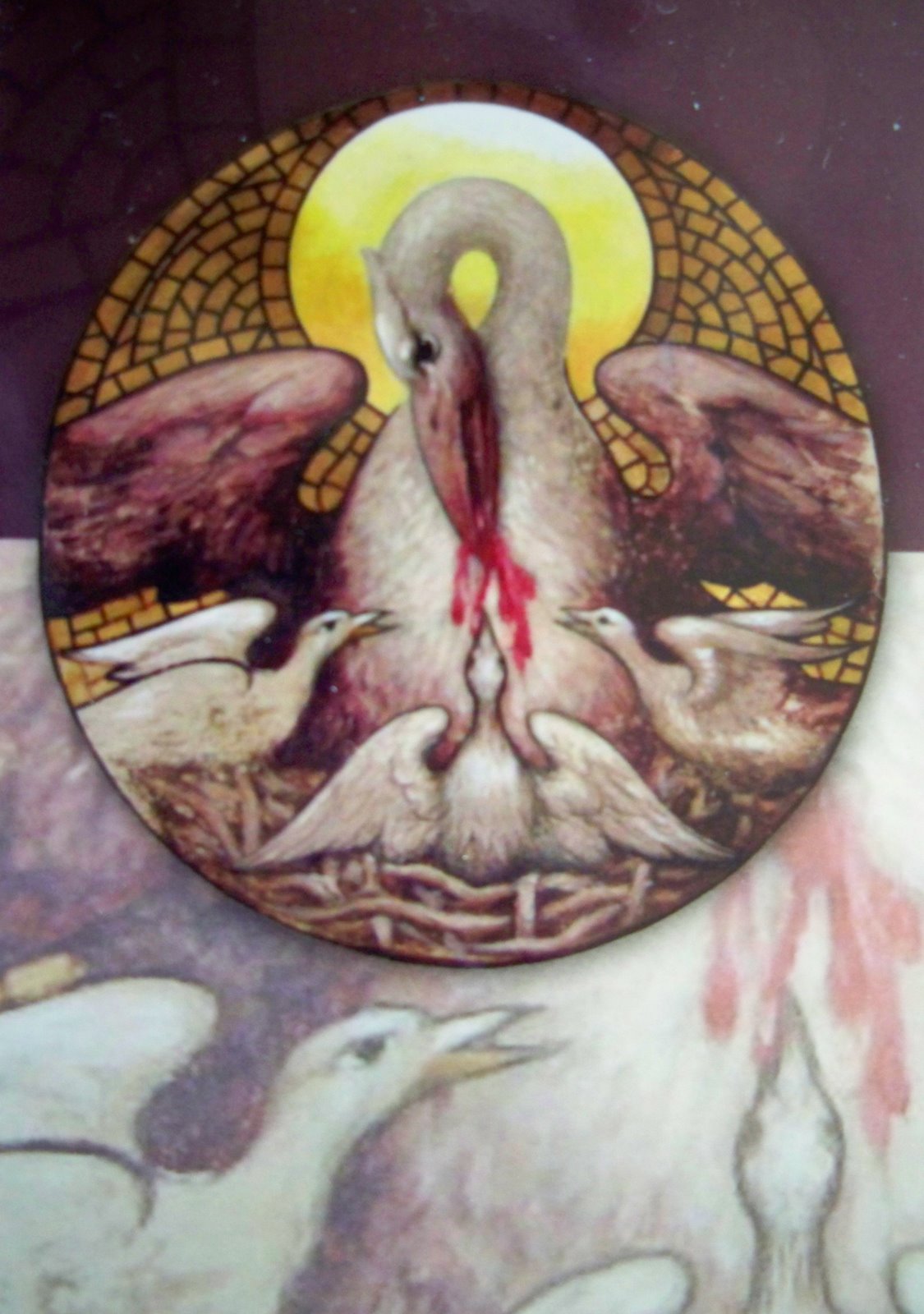
"Feed My Sheep"

When therefore they had dined, Jesus saith to Simon Peter: Simon, son of John, lovest thou me more than these? He saith to him: Yea, Lord, thou knowest that I love thee. He saith to him: Feed my lambs. He saith to him again: Simon, son of John, lovest thou me? He saith to him: yea, Lord, thou knowest that I love thee. He saith to him: Feed my lambs. He said to him the third time: Simon, son of John, lovest thou me? Peter was grieved because he had said to him the third time: Lovest thou me? And he said to him: Lord, thou knowest all things: thou knowest that I love thee. He said to him: Feed my sheep.
— John 21:15-17
* * * * *
The Thorp gang is in western South Dakota this week, where it has been a tremendous honor and blessing to see a dear friend of ours, Tyler Dennis, be ordained a Catholic priest last Friday, June 26, 2009. It is tradition that newly ordained priests give out prayer cards marking their ordination. The front of Father Tyler’s features the image above. The back bears this prayer and explanation:

Take, O Lord, and receive my entire liberty, my memory, my understanding and my whole will. All that I am and all that I possess You have given me: I surrender it all to You to be disposed of according to Your will. Give me only Your love and Your grace; with these I will be rich enough, and will desire nothing more.

— St. Ignatius of Loyola
The pelican is an ancient symbol of Christ. It is said that when no other food is available, the pelican will feed its young with the flesh of its own breast, just as Christ feeds his people with his body and blood in the Eucharist.

The significance of the pelican is not unlike the Gospel reading above, which was the Gospel reading from the Ordination. The theme was repeated numerous times: Feed my lambs. Feed my sheep.

It’s been an incredibly moving last few days. I thought I’d share a little of the experience, from our perspective.

* * * * *
Many of you know that Jodi and I met while working summer jobs at the world-famous Wall Drug Store, she in hats and western wear; I in boots and moccasins. Jodi worked with Cindy Dennis, whose husband, Robert, works his family’s ranch near Red Owl, more than an hour north and west of Wall. Cindy had a little place in town and as I recall, their oldest son, Tyler, was a cerebral and musical teenager working in the dish room at the Wall Drug Cafe. His younger brothers, Tate and Chance, stayed on the ranch with Robert that first summer, I believe (Tate worked at the drug store as a high-schooler) — and somehow they all stayed close.

Robert would come into town now and again, dressed every bit the cowboy of my boyhood visions: colorful boots pulled up over his jeans, western shirts and vests and silk scarves, big mustache and bigger hat. Sometimes he’d come by the house I lived in, guitar in hand, to share cowboy songs and country humor — but the night he played “The Wreck of the Edmund Fitzgerald” and allowed me to help with the lyrics, a friendship was sealed.

* * * * *
We’ve had more than a few adventures with “Cowboy Bob” (as Robert became known in my newspaper columns), Cindy, and the boys. We’ve been snowed in at their place with no power. We discussed all manners of philosophy, swapped jokes, drank beer and tequila and whiskey, traveled together and fished, shared poetry, you name it. It’s been a great friendship over the years, and since Jodi and I sit just about perfectly in age between Robert and Cindy on one hand, and their boys on the other, we’ve enjoyed being friends with the whole gang.

I’ve written about ol’ Jinglebob any number of times over the years, but probably the best picture of the Dennis family I can offer is this essay I wrote after accompanying my dad and our oldest son, Brendan, to the ranch for a branding.

At that time, Father Tyler was completing his undergraduate work at St. Mary’s in Winona, and I offered this assessment:

Bob’s oldest boy, Tyler, is leaning against Sorley, a stripped down Suzuki Samurai with a homemade plywood roof and four-wheel drive—the name comes from the little rig’s sorrel color. He’s only recently back from Winona, where he’s studying for the priesthood; he’s dressed in a plain t-shirt and sweats, untied duck boots and an old fedora. His little brother’s riding with the men below.

Tyler stands in front of the little 4×4, watching the cowboys work. He’s not like these others—he’s a big kid and prone to discussing philosophy, praying aloud in Latin or singing in Spanish—but he looks at home here and I snap a picture of him, God’s country in his eyes.

* * * * *
The little church in Red Owl, St. Anthony Catholic Church, is unlike any other I’ve ever been to. It’s tiny by Twin Cities standards (though not the tiniest West River Catholic church in South Dakota, I’m told): several short pews and a humble sanctuary, with no place to hide or “go through the motions” during the Mass.

During the ordination, Bishop Cupich remarked that a man raised in one of the smallest parishes in the Rapid City Diocese would now being serving in the Cathedral of Our Lady of Perpetual Help, underscoring the unity of the church across all peoples and communities. Small town boy makes good, some may say, but I would suggest Fr. Tyler was good all along, and perhaps better for his rural ranch upbringing. Indeed, Monsignor O’Connell, the homilist during Father Tyler’s First Thanksgiving Mass on Saturday morning, suggested the diocese’s newest priest thank his father for teaching him how to work hard, his mother for showing him how to care about others (a virtue that seems pervasive in ranch country), and his brothers … for teaching him patience.

* * * * *
The weekend before we left for South Dakota, I told a fellow parishioner from our St. Michael Catholic Church that we were attending Fr. Tyler’s ordination, and he insisted there is no more beautiful liturgy in the Church’s traditions. We arrived at Our Lady of Perpetual Help with great anticipation. Deacon Tyler was greeting family, friends and future parishioners at the foot of the front steps to the cathedral, a broad smile on his face. Such joy, I thought. Robert hailed us from the top of the steps, wearing a dark suit, red tie, and his best boots, a grandson on his arm. Cindy descended the steps quickly to greet us, and she seemed joyful and nervous and warm, like a mother at a wedding — and so she was.

We sat midway back on the right. At the opening hymn, the priests processed in pairs, old and young, black and white, tall and short, stout and wiry, dozens of them from across the diocese and from the seminary, with deacons and the bishop, and Tyler, of course, singing with and above the others, the same broad smile in his cheeks as he sang. I grinned the first of several goofy grins that would crease my face all weekend.

The proceedings open with great formality, with Tyler called forth and the bishop asking for verification from his soon-to-be brother priests whether he is known to be worthy. I had been told to expect countless moving moments: the vow of obedience to the bishop and the Church; the laying on of hands upon Tyler’s by each prayerful priest in turn; the kiss of peace, in which each priest in turn greets their new brother with a welcoming embrace. The moment I was most anticipating I was unable to see from the middle of the pew: as those assembled prayer the Litany of the Saints, Tyler lay prostrate on the cold stone floor at the base of the steps before the altar, in the ultimate gesture of humility and submission. Gabe, Emma and Brendan* stretched into the aisle and stared at Tyler’s motionless form; I imagined how he must look lying there, and marveled. (Later I asked the three kids to demonstrate how Tyler was lying, with three very different interpretations. I asked Father Tyler at the Dennis ranch on Sunday, and he explained that he lay flat on his chest with his hands overlapping, palms down, beneath his forehead.)

But the most moving moment in the entire liturgy came at the end, and was entirely unexpected. As the Mass ended, Bishop Cupich announced he would ask Fr. Tyler’s blessing before the bishop himself offered his closing blessing for the congregation. We watched transfixed as the bishop knelt before our friend and humbly bowed his head. My breath caught as Fr. Tyler placed his hands on the bishop’s head and red cap and prayed over him. Incredible.

During the reception that followed, the five of us waited in line to receive our own blessing from Fr. Tyler. We knelt as a family, with Trevor close at heart, and our friend called upon the intercession of the Holy Family and blessing in the Name of the Father, and of the Son, and of the Holy Spirit.

* * * * *
On Saturday morning, all six of us made our way to St. Paul Catholic Church in Belle Fourche for Fr. Tyler’s First Mass of Thanksgiving, a Votive Mass for the Immaculate Heart of Mary. Robert and Cindy invited us to the front pew (“You’re family, y’know …”), and I again spent the hour with a goofy grin and a tear at the ready.

Tyler was no longer the dishwashing teen or the seminarian or the deacon. He had walked nearly a decade on the path to priesthood, from Red Owl to Rome to Rapid City, and he looked at home in the sanctuary. When he spoke the Words of Consecration in particular, our friend and our world changed. We believed, and said “Amen.”

* * * * *
Of course, I’m not the only one blogging about Father Tyler these days:
* * * * *
Finally, this weekend has me thinking about the nature of marriage and other lifelong commitments. Priests undertake years of education, preparation, formation, discernment. The call to the priestly vocation is often compared to the call to marriage as way of understanding the complete, lifelong commitment of the less common vocation.

Two observations come to mind: not for the first time, but with great clarity today. The first is that, while few people would agree to several years of preparation and discernment prior to marriage, perhaps this would drive home the magnitude of the commitment couples undertake when they say, “I do.”

The second is that the “marriage” a priest undertakes is far from loveless. I’ve posted before on my middle son’s own priestly aspirations, and these postings have generated lots of conversation, both online and offline. One friend, in particular, voiced the opinion that a marriage to God would be particularly hard and one-sided work, since your spouse has largely been silent for centuries.

The better metaphor is that a priest (like Jesus, the Bridegroom) doesn’t marry God, but the Church (the Bride) — and as we witnessed all this weekend, the Church consists of real people, is full of love for her priests, and is quite expressive. In addition, Fr. Tyler pointed out the sacramentality of his commitment. I took his comments to mean (in much simplified layman’s terms) the real belief in a real commitment between a real person and a real God doing real good in a real world. From this perspective, his relationship with God is hardly one-sided. (Or if it is, the effort is all on the Other Side …)

God bless you, Father Tyler — and all our priests.

*Trevor stayed with Grandma and Grandpa Venjohn for the ordination; it was scheduled for the evening, and his lungs don’t always agree with incense.

Callings, Revisited

Blogger’s Note: That last post garnered some interesting comments, both on- and off-line. Hope this one does, too.

It occurred to me on my commute this morning that there is one aspect of the priestly vocation versus the married vocation that I failed to explore: The possibility of answering one calling, only to hear another years or even decades later.

I know of at least two former Catholic priests who have chosen to leave the priesthood and get married. To the best of my knowledge, one left the Catholic Church and may now be a Protestant minister; the other is the head of one of the most Catholic families I know back home in Michigan.

I know of precisely zero married men who have chosen to leave their marriage to become priests. In neither case do I know what the “rules” are — how one “undoes” one sacramental vow and undertakes a new one, or even if it’s possible, within the Catholic Church. I suppose one might do it regardless and seek forgiveness in some way, perhaps.

What is of more interest to me is that it is easier for people to imagine a celibate priest discerning a call to marriage later in life than to imagine a married man discerning a call to the celibate life of a priest. The romantic-triangle buddy comedy Keeping the Faith includes a great scene between a young priest, played by Edward Norton, who is contemplating turning his back on his vows over a girl, and an old priest who declares that falling in love every so often is part of the gig — and just like in marriage, you make a choice to stay faithful to your vows. The scene seems funny, wise, and true.

But why not the other way? I can imagine the possibility of years or even decades of celibacy were I to outlive my wife. (Perhaps even celibacy by my own choice …) But another calling now? While I’m here, with this other half of me? It’s unfathomable.

The question becomes, why is it unfathomable for me to imagine falling so in love with the Church that I would want to leave my married vocation, but it’s not unfathomable for me to imagine a priest falling so in love with a woman that he would want to leave the Church? If you knew a man in former situation, would you not think it strange, or even outrageous? But in the latter situation? I suspect most people might be sympathetic.

I wonder if it’s not the case that have we been so immersed in popular understandings of sexuality — especially male sexuality — that continence seems unnatural and celibacy, next to impossible. In such a world, it’s difficult to imagine anyone who had experienced marital intimacy ever choosing celibacy.

But the discussion returns to a question posed in the last post: Would you leave your spouse if a tragic accident made it necessary for you to spend the rest of your days celibate? Would you stay married and cheat?

If you can imagine one, you can imagine the other. And if you can’t imagine a love for God deep enough to forsake all others, perhaps you simply aren’t called.

Callings

Lots of folks — Catholic and non-Catholic alike — have a hard time imagining the choice a priest makes to remain celibate his entire life. Some are amazed; some view it as impossible; some are simply grateful they weren’t called to such a life. Boy, I couldn’t do it, they say. Better them than me.

A few months back, our associate pastor, Father G, joined a group of us at an event for married couples. He spoke about what a beautiful vocation marriage is, then said, “I’m glad I wasn’t called to it.”

As you might expect, that got quite a laugh from the couples in attendance — like, if it’s so great a calling, why are you so happy not to be married?

I laughed, too. Later, as I talked to a friend, he pointed out that no one thinks twice about a married man saying, “I’m glad I wasn’t called to the priesthood.” The Catholic Church views both vocations as lifelong, life-giving commitments, in one case, to your spouse; in the other case, to the Church. So just as I feel I am meant to be a husband and father, so Father G feels he is meant to be a priest.

You might argue that the reason one’s easier to swallow for most people than the other is that taking a mate and giving birth to children seems somehow more natural. And in a way, that makes sense — in a “taking a mate and giving birth” sort of way. But in terms of a lifelong commitment to marriage and raising a family, come what may, the differences are less apparent. Would I leave Jodi if a tragic accident made it necessary for us to spend the rest of our days celibate? No. Would I stay married and cheat? Of course not. My “I do” a dozen years ago was more than a mere one-time choice — it’s a daily commitment and lifelong vocation. It’s a calling.

I bring this up because for the past couple of years, our middle son, Gabriel, has been talking about becoming a priest. When he first told our priest, Father M began to call Gabe “Father Gabriel” — and it bugged him at first, because he was worried that we might hold him to a lifelong decision made at age seven. “What if I don’t become a priest?” he asked.

But his comfort with the idea seems to be deepening, and he talks to Father M and Father G whenever he gets the chance. When we start poking fun at the kids about girls and boys and who they might marry, Gabe says matter-of-factly, “I’m marrying the church.”

Puberty may tweak his thinking, but for now, he seems to be serious.

When my mom first heard this, she was saddened, despite herself. She’s Catholic, too, and knows we need priests, but she also dreams of seeing countless great-grandchildren from each of her grandkids. Our oldest, Brendan, wants to go the Naval Academy, then become an officer in the Marine Corps. I mentioned this to another friend of mine, who said, “Well, at least you’ve got time to talk him out of that!”

I understand these feelings, but I wouldn’t dream of it — first, because a kid deserves his or her dreams, and second, because I am so deeply proud to have two boys who are willing to entertain lives of service and sacrifice at their young age. Even if they don’t become what they aspire to today, that willingness to serve will be a great asset to our future.

Some of you read about the special gift given to Gabe by Father M a few weeks back — a stole, chalice and paten (pictured above) with which to practice the Mass. Gabe made him a thank-you card and has been looking for an opportunity to give it to him. In the meantime, last Saturday we visited our friend Deacon Tyler (from the Future Priests of the Third Millennium blog) at the St. Paul Seminary. (He will be ordained a priest in Rapid City this June, and yeah, we’ll be there.) He showed us all around: the chapel, the dorms, the lounge, the grounds. He explained that the higher floors of the residence hall have the best view of the Mississippi River below, and that the priests who teach at the seminary get those rooms.

While we were in St. Paul, we stopped by one of my favorite used bookstores, Sixth Chamber, to pick up a copy of Steinbeck’s East of Eden, which Deacon Tyler, Jacqui of Jacqui’s Room, and Matt “HubbaTrask of Hubba’s House turned me onto. I had discussed it briefly with Father M and discovered that he hadn’t read it, so we thought we would get a copy to thank him for his thoughtfulness toward Gabe.

He was not the presiding priest at the Mass we attending on Sunday, but appeared just before the end to make a bombshell announcement: he will leaving our parish this summer — the archbishop has asked him to teach at the seminary.

Through my own tears, I looked at Brendan. He was crying softly; he and Father M had bonded over military history during numerous conversations. Gabe was quiet, unflinching.

After Mass, we made a beeline across the church with Gabe’s card and the book. We hugged Father M and told him it was coincidental, but we had something for him. It was a bittersweet moment — then Gabe piped up that he had been to the seminary the day before, and that Father would live on the upper floors, overlooking the river …

Later, I asked Gabe how he felt to hear that Father was leaving for the seminary. His eyes grew wide and glassy, but he didn’t speak.

I told him that I noticed he didn’t cry like Bren and I did. He told me he was sad, too — but a little excited that he might have Father M for a teacher one day.

He is eight, but this appears to be no distant calling.

Fear of Death

Blogger’s Note: Have you ever, in the urgency and heat of a conversation, been pushed to consolidate and analyze a pattern of thinking you’ve been victim to for some time and share your findings before you’re certain they are fully baked? Well, I had that experience today. A dear friend was alarmed, in the midst of great blessings, to be suddenly afraid of death. As an emotional, navel-gazing kind of guy, I’ve been down this path more than once, so I worked to put my own cycle into words. And now it seems a part of a larger conversation, involving this post of mine and this post from our friend Deacon Tyler. Forgive the rambling and lofty sentence structures; I’ve been listening to St. Augustine during my commute these past few days. Now, onto the limb — here’s what I replied …

Yes, I do know somewhat of what you speak, I think. And sometimes these feelings are worse in moments of clarity and great joy, when you can see so vividly all you’ve been given (however unworthily!) and all you have to lose. At least, that’s been my case …

For me, the fear oscillates between that of an early death (before I’ve managed to complete what I view in that moment as my earthly duties) and the sudden loss of all that I have (namely, my wife and children) while I yet live. Both fears are more vivid in times of abundant blessing — a dark temptation to take no joy in joy: in one case, out of a natural but short-sighted tendency to cling to what we have without reference to (or reverence for) greater goods to come, and in the other case, to a natural but ill-conceived effort to steel ourselves against possible tragedy (however improbable) which, if taken too far, may lead us to view our blessings as curses (i.e., “Why am I burdened with such wonderful things I can only hope to lose?”).

When fearing an early death, I often want to abandon my livelihood and take my family to a mountaintop (as you’ve heard me say before!) where I can spend all my time eking out an existence, loving my wife, and teaching my children exactly what they need to survive and live uprightly — never mind the fact that Jodi would not regard such a retreat as an act of love, and I scarcely know how to survive and live uprightly myself, let alone how to teach such things. By living we learn — not by retiring.

When fearing the untimely loss of my family, I begin to imagine how I would react. It’s invariably heroic in its first draft — I soldier on, sorrowful and stoic — but with even a second’s worth of consideration, the smallest pinch of realism, I see my emotionally charged self falling utterly apart, at least for a time. How long? Who can tell? — I quickly conclude (true or not) that I’ve never been tested by want or direct and personal tragedy, and may well curl up in a ball and die myself. How unmanly! And I see my wife: so strong in faith, rock-solid, unyielding, and quickly conclude (true or not) that, were the tables turned, she would, in fact, soldier on, sorrowful and stoic. Why, if I were to die suddenly …

… and thus we return to the fear of an early death.

Life and death, that great unknown, is a deep, deep rabbit hole, into which some descend and never emerge. Better, perhaps, to stand at the edge and drop pebbles down, as we did as children, listening to see if and when they struck bottom, than to dig too deeply and collapse the whole thing upon us. A favorite (and to my knowledge, an original) saying on these subjects: We seek to explain the hell out of everything and explain the heaven out of it in the process. Or something like that.

Faith and doubt can both be gifts in moments like these — faith that, independent of what we do (or don’t do), the world and those we love move toward their proper end and all is (or will be) right in the world; and doubt that the proper end can ever be reached without our hand at the till or the oar, which may make us rethink our priorities and love each other more and better.

But the fear never leaves me entirely — and I feel everyday that I can never accomplish what I want, or what I should, or (some days) even what I must. I can only accomplish what I can, and thus far, it’s been just enough.

Summer Vacation, Day 29: An Unexpected Blessing

Unbeknownst to me, downtown Rapid City is hosting a deeply moving and inspiring exhibit, A Blessing to One Another: Pope John Paul II and the Jewish People. The exhibit includes photos, videos and artifacts from Karol Wojtyla’s childhood through his papacy and death, tracing his strong ties to, and profound affection for, the Jewish people in his native Poland and throughout the world.

Jodi and I took Brendan and Gabe to see it today. It cost $5 for the family, and the tickets are good for duration of the display (through August 13). It’s very content-rich – you probably should visit it more than once to take it all in, especially the videos. Some of the video interview material from the Holocaust is a bit much for children, but it’s easily avoided. Reading aloud to the boys, my voice broke often – it’s hard to imagine such cruelty and compassion among neighbors and neighboring countries.

But the lasting message is one of peace, understanding, and common humanity that transcends race or religion. Well worth $5, my friends. The exhibit has been there since May 2, and attendance has been low. If you have the chance, go.